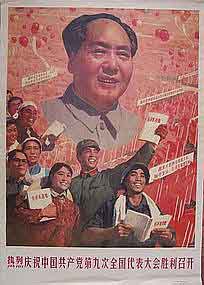
Marxist Maoism Died in 76

June 29, 2010

Walter Russell Mead writes about changes taking place in China, and his long piece was quoted at Beliefnet.com. Read the quote or go to “Walter Russell Mead” for the “longer” piece.

What bothered me was the ignorance of the comments below the shorter Beliefnet piece. “We know what happened when the Velvet Revolution tactics that worked in Eastern Europe were tried in Tiananmen Square—the protesters were crushed to death under tank tracks.… We and they are almost in a prisoner’s dilemma here—doing the morally right thing is hugely dangerous but alone can deliver those 1.2 billion from a form of slavery”.

Have you heard of the 2/28 Massacre in Taiwan? Almost 30 thousand protesters were slaughtered by Chiang Kai-shek’s troops, while only few hundred were killed in Tiananmen Square.

Not counting sexual slavery, which is a global problem and illegal in China, there are no slaves in China. Those factory workers are free to go home to the rural village any time they want. Also, there is an expanding middle class with lifestyles equal to Europe and America.

Most people in the West have no concept of the effort it has taken to lift China from where it was in the 1950s, when Chiang Kai-shek, protected by US military might, fled with most of his troops and all of China’s wealth.

Prior to the Western nations and Japan invading China in the 19th century, China had the world’s largest economy and it wasn’t built on manufacturing or exports. China’s leaders are aware that China cannot rely on this type of economy for long and must return to an economy that supports itself from within. China is not a Maoist Communist country. It’s a blended capitalist, socialist system and is evolving with a Chinese twist.

And by definition, China is not a dictatorship.

_________________________

Lloyd Lofthouse,
Award winning author of Hart’s concubine saga, My Splendid Concubine & Our Hart. When you love a Chinese woman, you marry her family and culture too. 

Sign up for an RSS Feed for iLook China 


Mao’s War Against Illegal Drugs

June 25, 2010

From The Opium Monopoly by Ellen N. La Motte, we learn how opium addiction became an epidemic in China. Although The Chinese knew about opium for more than a thousand years, it wasn’t until the Portuguese arrived in the 18th century that  the Chinese used it as a drug by smoking it. Merchants from Britain, France, Portugal, America and other nations became the drug cartels that plagued China into the 20th century.

In 1729, the emperor issued the first anti-opium edict, but the supply of opium flooding China went from 220 chests in 1729 to 70,000 in 1858.

It is estimated that before 1950, as many as 20 million Chinese were addicts. Then Mao had the Red Army execut the drug dealers and forced millions of addicts into compulsory treatment.

Opium growers, who did not want to comply, fled into the Golden Triangle Region of Southeast Asia where many of Chiang Kai-shek’s nationalist troops had gone to escape defeat. Those generals also did business with the CIA, and American soldiers in Vietnam became the new customers. It is estimated that at least 20% of the almost nine million American troops that served in Vietnam became addicted.

China remained free of drugs until Deng Xiaoping declared, “Getting Rich is Glorious” and opened China to world trade. In 2003, it was estimated that China had four million regular drug users even with China’s strict laws concerning illegal drug use.

Sources: Opium and Illegal Drugs in China and How Maoist Revolution Wiped Out Drugs in China

To learn more about Mao’s China, see China’s Great Leap Forward

______________

Lloyd Lofthouse is the award-winning author of the concubine saga, My Splendid Concubine & Our Hart. When you love a Chinese woman, you marry her family and culture too.

If you want to subscribe to iLook China, there is a “Subscribe” button at the top of the screen in the menu bar.


Mao’s Motives

June 24, 2010

Why did Mao cause so much suffering with his failed Great Leap Forward and The Cultural Revolution? Yes, the power Mao held was a corrupting factor in the decisions he made, but  fear of repeating history was also a factor.

Mao's Little Red Book of Quotations

How many millions of Chinese were addicted to Western opium forced on China by Great Britain and France during two Opium Wars?

Historians say that 20 to 30 million were killed due to the Taiping Rebellion. If Christian missionaries had not been forced on China because of the Opium Wars, would that rebellion have taken place?

Another 115,000 Chinese were killed during the Boxer Rebellion, which was a popular peasant uprising against Christian missionaries, foreign meddling and exploitation.

After 1911 when the Qing Dynasty collapsed, chaos and anarchy ruled China, while foreigners—Americans included— lived in luxury in the treaty ports protected by modern foreign military forces. A Century of Madness chronicles this time.

Mao survived Chiang Kai-shek‘s crack down on the labor movement led by the Communist Party. During World War II, Mao’s army not only fought Chiang Kai-shek’s troops but also the Japanese, who killed between 10 to 20 million Chinese in their attempt to conquer China. The peasants trusted Mao’s troops but did not trust Chiang Kai-shek’s army. Why?

Mao believed that socialism would create a better life for the Chinese. His failures were attempts to make China strong enough to defend the country against foreign meddling and invasions. He failed, but Deng Xiaoping didn’t. What happened in Tiananmen Square in 1989—where a few hundred demonstrators were killed—was nothing compared to what China suffered starting with the First Opium War.

______________

Lloyd Lofthouse is the award-winning author of the concubine saga, My Splendid Concubine & Our Hart. When you love a Chinese woman, you marry her family and culture too.

To subscribe to “iLook China”, look for the “Subscribe” button at the top of the screen in the menu bar, click on it then follow directions.


China’s Great Leap Forward (1958 to 1961) – Part 4 of 6

June 23, 2010

Steel production had to double in one year.  Instead of producing steel from industry, Mao wanted the peasants to build small furnaces. Again, there was competition between teams of peasants.  Forests were cut down to fuel the crude peasant furnaces.

All over China, people were neglecting their other jobs to produce steel because the people had to obey Mao. All metal was melted—including cooking woks. The steel produced was useless.

While the peasants were producing steel, the crops rotted in the fields. In 1960, there was a drought and food production fell more than 25%. Twenty million or more died from the resulting famine.

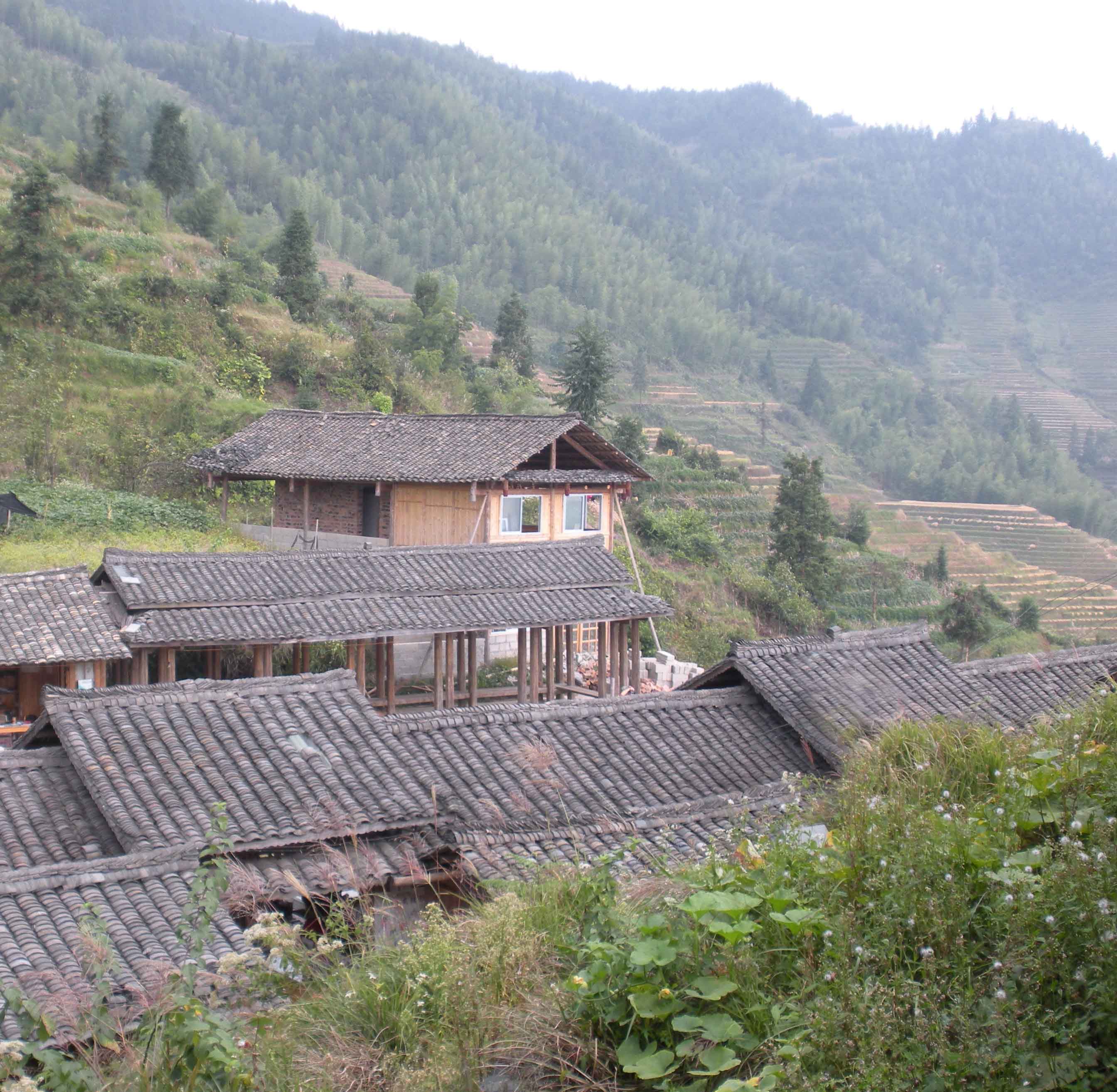
Village in Southeast China

Having failed, Mao stepped aside to let someone else run the nation. The large communes were abandoned. The peasants returned to their villages and were given land again.

Fearing the return of capitalism, Mao’s supporters printed a book with his slogans. Mao wanted to break the thinking and attitudes of old China. Using film, a propaganda campaign was launched so Mao could regain power. Then in 1966, he launched the Cultural Revolution.

Return to Part 3, China’s Great Leap Forward or go to Part 5

______________

Lloyd Lofthouse is the award-winning author of the concubine saga, My Splendid Concubine & Our Hart. When you love a Chinese woman, you marry her family and culture too.

If you want to subscribe to iLook China, there is a “Subscribe” button at the top of the screen in the menu bar.


China’s Great Leap Forward (1958 to 1961) – Part 2 of 6

June 22, 2010

Mao has more power than anyone since the emperors, and he wants China to be a purer, fairer more progressive state than the Soviet Union, so the peasants were the first to benefit.

As promised during the revolution, there were land reforms. Luo Shifa, a party official in Sichuan, tells his story about what happened in 1950.  Rural landlords were judged enemies of the people and hundreds of thousands were executed.

Changes in urban areas were not as violent. The owners and managers of factories were needed to keep things running but all property was signed over to the state.  Factory and business owners  who resisted were executed.

Women were given new rights at work and in marriage and foot binding was abolished. Literacy was also important. Before 1949, illiteracy in Mainland China was 80% and life expectancy was 35.  When May died, only 7% were illiterate and the average life expectancy had increased to 55—today it is 76.

To deal with disease, the Communists launched programs to improve health care that had never existed before. Millions were inoculated against the most common diseases.

Return to Part 1, China’s Great Leap Forward or go to Part 3

______________

Lloyd Lofthouse is the award-winning author of the concubine saga, My Splendid Concubine & Our Hart. When you love a Chinese woman, you marry her family and culture too.

If you want to subscribe to iLook China, there is a “Subscribe” button at the top of the screen in the menu bar.