Influenced by the Mandate of Heaven

October 13, 2010

Although I wrote on the Mandate of Heaven in April, I didn’t see how deeply that belief was influencing China’s Communist Party.

The epiphany took place soon after reading page 235 in Living With Evolution.

At the same time, I realized that America’s judgment of China’s Communist Party was in part due to half a century of entitlement programs for minorities and the disadvantaged in the U.S. — often rewarding those who were less qualified and punishing those who were successful through merit by holding him or her back.

However, in China after Mao was gone and Deng Xiaoping opened the country to world trade, meritocracy was back with a vengeance.

Meritocracy is a system in which the talented succeed and move ahead based on his or her achievement.

The Chinese for almost four thousand years believed that humans were responsible for how events unfolded on earth with human actions subject to the approval or disapproval of heaven.

Successful actions were held to be those that heaven approved of and unsuccessful actions were held to be those heaven did not approve of.

What this means is that anyone, regardless of his or her social status could challenge the elite and rise to the top on the claim that it was legitimate according to the Mandate of Heaven — a concept that was also quintessentially meritocratic.

This explains why China’s central government treats political and/or religious activists, who challenge the status quo, so harshly. 

If the Communist Party allows the Falun Gong, Tibetan and Islamic separatists or Western style human rights activists to have the kind of freedom of expression that is allowed in the West, most Chinese, including the Communist Party, may see this as a sign of weakness.

In fact, the Dalai Lama’s popularity in the West is seen as a challenge to the Party’s mandate to rule. The same could be said about the rival government in Taiwan.

To have a better understanding of what this mean, you may want to start reading the Living With Evolution Blog

______________

Lloyd Lofthouse is the award-winning author of the concubine saga, My Splendid Concubine & Our Hart. When you love a Chinese woman, you marry her family and culture too. 

If you want to subscribe to iLook China, there is a “Subscribe” button at the top of the screen in the menu bar.


The White Lotus Mutation

April 24, 2010

Persecution of the White Lotus Society started during the Yuan Dynasty (Mongols 1271 – 1368). Due to this, the White Lotus Society changed from one of peace and tranquility and organized protests against the Mongol rulers, the first non-Han to rule China.

Since Yuan Imperial authorities distrusted the White Lotus Society, the Dynasty banned them, and the White Lotus went underground.  The White Lotus also started to predict that a messianic (Christ like) figure would come and save them from persecution.

White Lotus Rebellion

A White Lotus led revolution started in 1352 around Guangzhou. A Buddhist monk, Zhu Yuanzhang, joined the rebellion. Soon, he became the leader by forbidding his soldiers to pillage, in observance of White Lotus religious beliefs.

By 1355, the rebellion had spread through much of China. In 1356, Zhu Yuanzhang captured Nanjing and made it his capital. Then Confucian scholars issued pronouncements supporting Zhu’s claim of the Mandate of Heaven, the first step toward establishing a new dynasty.

Zhu Yuanzhang liberated China from the Mongols and became the founding Emperor of the Ming Dynasty (1368 – 1643).  

At this point, you may see the danger of allowing a religious cult like the White Lotus to have any power.

Sign up for an RSS Feed for  iLook China


Building Virtue

April 16, 2010

Regardless of the fact that the West calls the rulers of China Communists, it is clear that to the Chinese mind, the Mandate of Heaven shifted from Mao to Hua Guofeng and Deng Xiaoping and their predecessors. It will be up to China’s future rulers not to lose that mandate.

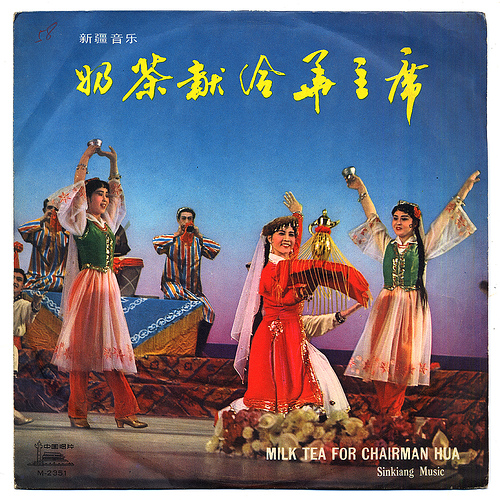
Milk and Tea for Chairman Hua

It doesn’t matter if the words ‘The Mandate of Heaven’ are invoked or not. It is obvious that the ‘Five Great Relationships’, as taught by Confucius, and the ‘Mandate of Heaven’ are infused in the Chinese thought process. Most born in China do not take a class to learn what this means, as students have to do in America to learn what the Declaration of Independence and the Bill of Rights mean. In China, one is raised with these philosophies in mind.

Piety, face, The Five Great Relationships, and the Mandate of Heaven are the foundation guide the behavior of the majority of Chinese.

The Western media and the political rulers of Western nations infer that Communism is evil because it is one party, (so-called) socialist political system, but most Chinese don’t see it that way.

To most Chinese, if the current rulers of China do their job and rule with the blessings of Heaven. The Western democratic political process is foreign to Chinese. To them, “Why change something that works? Leave it to Heaven.”

See The Mandate of Heaven http://wp.me/pN4pY-nc

 Sign up for an RSS Feed for  iLook China


Change Mandated by Heaven

April 15, 2010

To many Chinese, the Taiping and Boxer rebellions failed because they were not blessed by Heaven. After World War II, when Mao’s Communists defeated the Nationalists, who— protected by America—fled to Taiwan, a case could be made that it was the Mandate of Heaven that brought about this change since World War II caused many in China to lose their lives demonstrating the Kuomintang’s inability to protect the Chinese people.

Chang Kai Shek - Leader of the Kuomintang

When Mao died, the new chairman of China’s Communist Party, Hua Guofeng, ordered the arrest of the Gang of Four. Almost everyone connected to the Gang of Four, which included Mao’s wife, Jian Qing, became non-persons. Some went to prison and died like Mao’s wife. Others were pushed aside and ignored. Since millions died due to the Cultural Revolution, they had lost the Mandate to rule.

Deng Xiaoping repudiated the Cultural Revolution and in 1977 launched the ‘Beijing Spring’, leading to a market economy and China’s prosperity today. The suffering that occurred during much of Mao’s twenty-seven year rule was criticized openly making if official that Mao had lost the Mandate of Heaven. After all, more than thirty-million Chinese died horrible deaths due to the Great Leap Forward and the Cultural Revolution.

See Deng Xiaoping’s 20/20 Vision http://wp.me/pN4pY-2o

Sign up for an RSS Feed for  iLook China


Heaven Grants the Right to Rule

April 15, 2010

The Mandate of Heaven is based on four principles:

1. The right to rule is granted by Heaven
2. There is only one Heaven therefore, there can be only one ruler.
3. The right to rule is based on the ‘virtue’ of the ruler.
4. The right to rule is not limited to one dynasty

When the Ch’ing Dynasty fell in 1912, and the Nationalists stepped in, a claim could be made that this change occurred because The Mandate of Heaven made it so. After all, history tells us that the Manchu of the Ch’ing Dynasty were brutal rulers. In addition, during the nineteenth century, China suffered through droughts, famines and rebellions that cost millions their lives.

The principals from the Mandate of Heaven and Confucius’s Five Great Relationships must be on the minds of the members for China’s central government. That’s why, after Mao, China’s government revised the constitution and built-in term limits (two five-year terms) unlike the United States and other Western democracies. There is also an age limit in China set at sixty-seven. In China, we will not see deaf men nearing ninety falling asleep in their senate seats.

See Power Corrupts http://wp.me/pN4pY-40

Sign up for an RSS Feed for  iLook China