Pain, Pollution and People

February 14, 2010

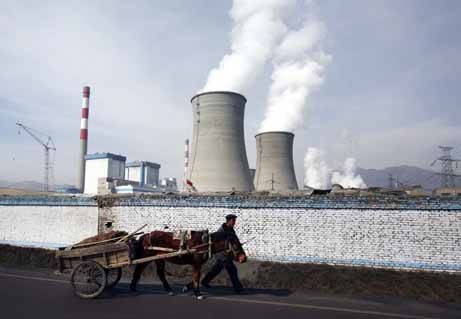
It’s difficult to write when I’m gasping for air and blowing my top. When I was still teaching, walking into a classroom in the morning made me sick—and no, I wasn’t allergic to my students, but I should have been.

Then I retired and for five years, I have been free of wheezy lungs and sinus infections that always arrived with the start of each school year when I worked in those old buildings at the high school where I taught. Have you heard of sick building syndrome? I lived it. The last time I was sick from air pollution was in Shanghai.

This new, peaceful world changed several weeks ago. Workers came with power tools and mud-caked boots. I should have fled, but I stayed at my computer as a stupid, stubborn, former United States Marine would.
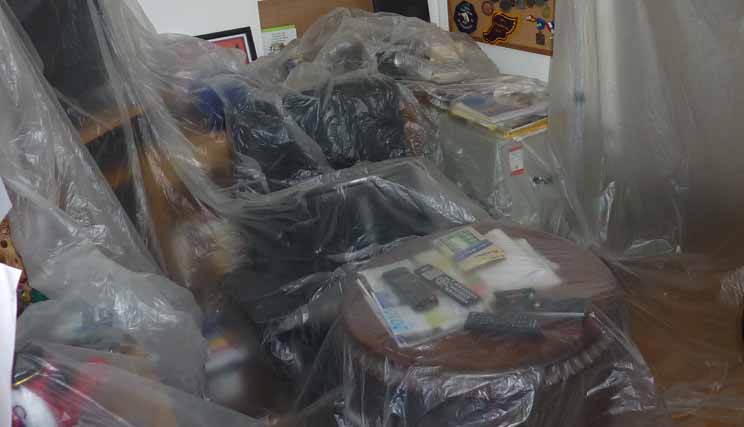
covered office furniture

My office has three doors. One that leads toward the other rooms and one that opens to the outside. Then there is the door that opens to the space under the second story and the foundation. That crew drilled, pounded, cut and tracked dirt from room to room—always in my office. I had trouble concentrating. I suffered from memory loss. Plastic tarps covered most of the furniture, and I couldn’t find things. When I left the office to find a moment of peace, I covered the computer and printers with a bed sheet. The noise reminded me of combat but worse, because I was nineteen and then twenty when I was in Vietnam—noise did not bother me as it does now.

Concrete dust floated through the air and my sinuses and lungs rebelled, so I put on a 3M mask with two pink HEPA filters attached. The last time I wore a mask like this was when I was teaching. I searched the garage and found the noise suppresser to help mute the pounding and drilling.  I looked like an explorer to Mars or a survivor of trench warfare struggling to write while the frigid air froze my fingers.
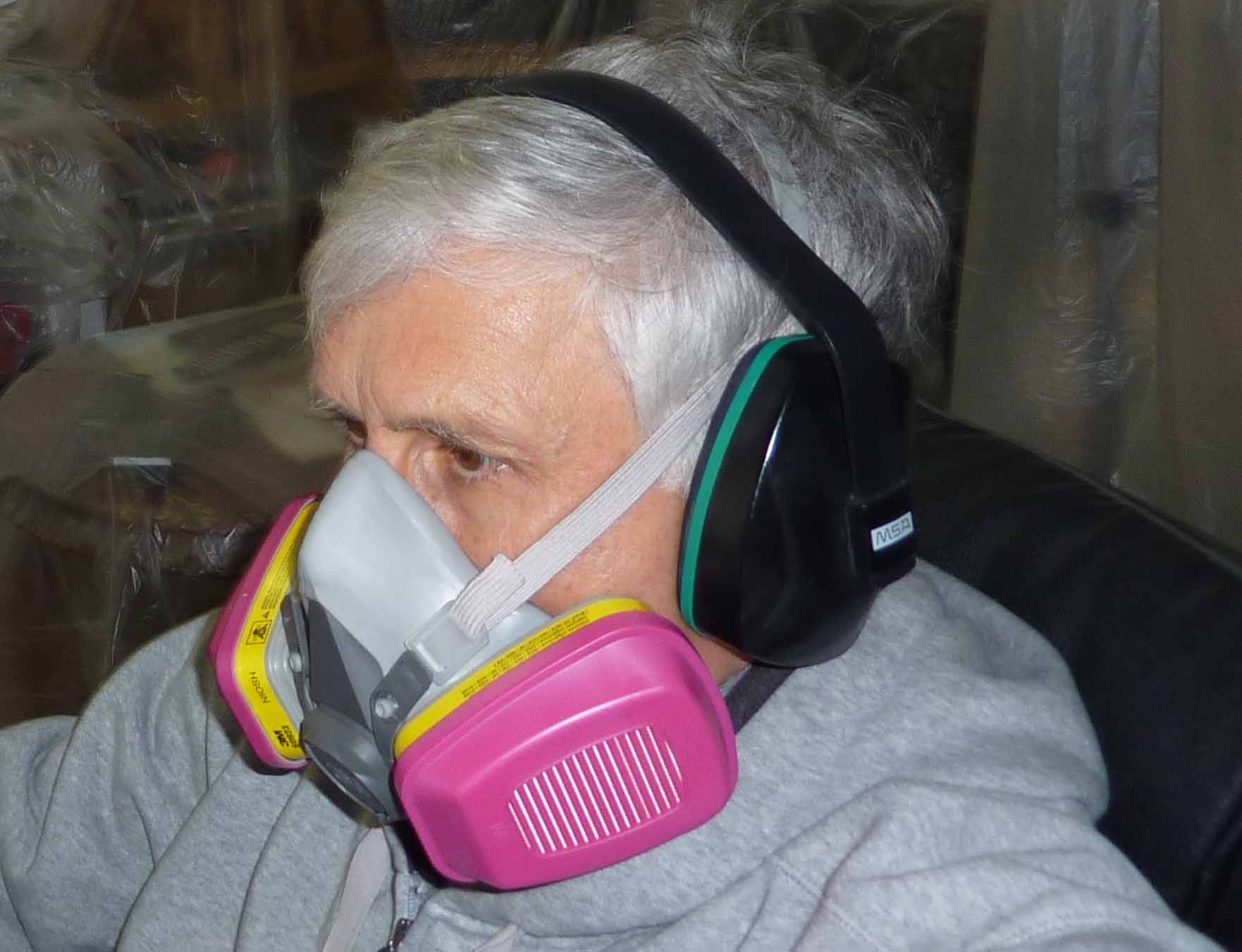
The crew had arrived to bolster the foundation against future earthquakes that might never arrive. Even if a hard tumbler did visit, I doubt that all that work would hold our sixty-year old hillside house together. It still might slide down the hill into the middle of the street blocking traffic.

I could have moved, but I didn’t want to disconnect all the cables and cart the equipment to another room for a few days to escape the dust and noise—something (I soon discovered) that would have been impossible without checking into a hotel.

Even with a noise suppresser covering my ears, muted sounds intruded and the last place I wanted to be was in this chair writing about China, the Vietnam War or being a teacher in the tortured American public schools. I stuck with it for days as my suppressed anger fueled by PTSD started to simmer and fume.

It was a relief when the workers finished. I thought I was going to have the tranquility back where the only noise would be the click of the keys as my warmed hands flew across the keyboard meeting my Blogging goals.

But the workers left something behind.

I started sneezing. My sinuses ran hundred mile marathons. I went to the doctor and he prescribed medications that didn’t work. The sneezing went volcanic—like Mt. Saint Helena blowing its top.  One time, I sneezed so bad, I blew the 3M mask off my face—so much for a mask that’s supposed to protect you from every gas and plague Islamic terrorists can brew. Upstairs or outside, I was fine. But in my office, I was a goner. “Blam, blam, balm,” my nose exploded like rapid shots from a fifty-caliber submachine gun.

I could have opened windows, but it’s been raining for weeks.  The sky has been overcast.  The air breezy and cold.  Then today, the sun came out and I finally let the outside in and the sneezing stopped—I’m crossing my fingers and knocking on wood. I’m afraid to close the windows, but night will come and with it lower temperatures. I fear that whatever industrial poison is haunting my once tranquil office space might return.


When in Rome, Do as the Romans Do

February 14, 2010

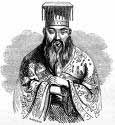
 U.S., EU decry upholding of China dissident sentence. Since when do Americans or Europeans decide what isn’t proper in China? The fact that China doesn’t have an American Bill of Rights has nothing to do with Communism. China’s foundation was built on Confucianism, and Confucius taught five rules for relationships. 

Conficius

  • Father to Son – There should be kindness in the father, and filial piety in the son.
  • Elder Brother to Younger Brother – There should be gentility (politeness) in the elder brother, and humility in the younger.
  • Husband to Wife – There should be righteous behavior in the husband and obedience in the wife.
  • Elder to Junior – There should be consideration among the elders and deference among the juniors.
  • Ruler to Subject – There should be benevolence among the rulers and loyalty among the subjects.

 Look at the last rule. When a Chinese citizen publicly protests the way the Chinese government runs the country, that is seen as an act of disloyalty. You may not agree with what China does, but China has the right to do as it sees fit even if the act is considered inhuman by Western standards.

______________

Lloyd Lofthouse is the award-winning author of the concubine saga, My Splendid Concubine & Our Hart. When you love a Chinese woman, you marry her family and culture too. 

If you want to subscribe to iLook China, there is a “Subscribe” button at the top of the screen in the menu bar. 


Foreign Devils and Barbarians

February 14, 2010

While reading A World Too New by Edmund S. Morgan (Smithsonian Magazine, October 2009), an explanation was provided to explain the conquests and slaughters that were to take place for centuries between 1492 and modern times (and I’m not sure the crusades are over yet).

Morgan wrote that Columbus believed “Christ saved those who believed in him, and it was the duty of Christians to spread his gospel and thus rescue the heathens from the fate that would otherwise await them.” (pg 84)

“Slavery was an ancient instrument of civilization, and in the 15th century it had been revived as a way to deal with barbarians who refused to accept Christianity and the rule of civilized government.” (pg 86).

Although China was exposed to the world’s major religions centuries earlier than Columbus, none had a major influence in China by the 19th century. Even today, the majority of Chinese claim to have no religion.

Yet, the Chinese have a morality (honor and piety) that is equal (if not better) to Christianity and Islam without the need to convince others through wars to adopt the same behaviors and beliefs. There is no history that China went to war to change the beliefs of foreign devils and barbarians, as they saw the rest of the world for thousands of years well before Columbus.

Lloyd Lofthouse is the author of the award winning novels My Splendid Concubine and Our Hart.


The Urban-Rural Divide

February 13, 2010

Photo courtesy of Bob Grant

This morning Bob Grant posted Contradiction of Times at Speak Without Interruption, an international online magazine. He shows visually and through words the discrepancy in lifestyles that he has witnessed between China’s cities and countryside. There is a reason for this discrepancy. After Mao died and China started down the road toward Social Capitalism, the central government decided to focus growth and modernization in the cities.

However, when Hu Jintao became president in 2002, he responded to the rising social tensions and China’s wealth gap by advocating a drive to build a “harmonious society”. He promised greater spending on health and education in rural areas where eight-hundred million Chinese live. Prior to that, most of China’s efforts at growth and modernization took place in the cities.  What we see in China’s cities today took place over a period of more than thirty years. It may take longer to improve the living standards of rural Chinese, but if the current government is going to survive, they have no choice.

Photo courtesy of Bob Grant

To learn more, I suggest you read this BBC piece about China’s Country Profile. Hu Jintao was reelected in 2008 for another five-year term. China has a two five-year term limit for public office.

Discover China’s Stick People

______________

Lloyd Lofthouse is the award-winning author of the concubine saga, My Splendid Concubine & Our Hart. When you love a Chinese woman, you marry her family and culture too.

If you want to subscribe to iLook China, there is a “Subscribe” button at the top of the screen in the menu bar.


Foreign Devil Heroes

February 13, 2010

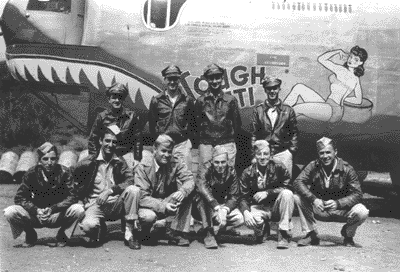
One morning recently, I had an instant message chat with Ian Carter, an Australian living in Southeast China, and learned that in 1944 an American B-24 Liberator bomber vanished without a trace. Then fifty-two years later, in 1996, farmers discovered the bomber’s wreck and the remains of the ten-man crew.

Tough Titi - B-24 bomber crew

These Americans are considered heroes (more about this story here) to the Chinese, and the remains of the crew were returned to the United States for burial. 

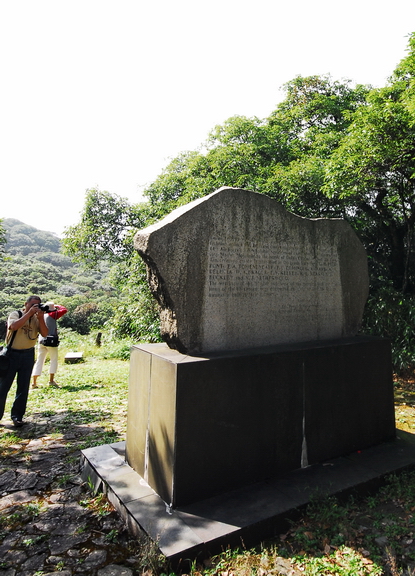
Heroes' Memorial on Mao'er Shan Mountain courtesy of Ian Carter

There’s a memorial stone near the crash site and Chinese tourists pay honor to these Americans by leaving flowers and other gifts.  To honor these heroes further, the Chinese recovered some of the bomber’s parts that were used as a centrepiece for a museum in Xing’an, about four hours from the crash site.

Photo of Little Cat Mountain courtesy of Ian Carter

You can read more about Ian Carter’s discovery on Mao’er Shan (Little Cat Mountain), Southern China’s highest peak, at his Blog.

Lloyd Lofthouse is the author of the award winning novels My Splendid Concubine and Our Hart.