Comparing India and China’s Economic Engines

October 13, 2010

The cover for The Economist of October 2 – 8, 2010, is betting on a race that cannot be won by India.
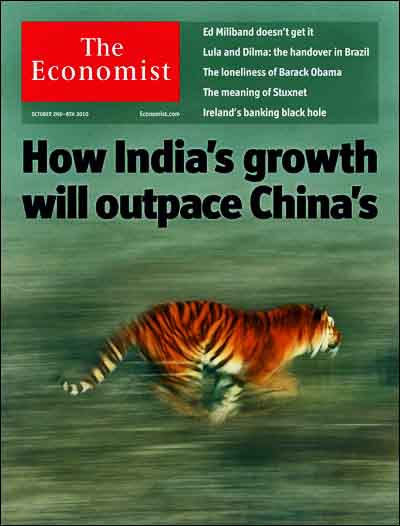

I opened the magazine and read the two pieces that the cover was about.  One is about India’s surprising economic miracle and the second piece was A bumpier but freer road.

On page 11, I read, “many observers think China has done a better job than India of curbing corruption…”

On page 77, a Western banker was quoted saying, “It’s much easier to deal with the well-understood ‘org chart’ of China Inc than the freewheeling chaos of India.”

After reading both pieces comparing China with India, it was obvious that India would never beat China economically.

The Economist wants India to win this race, because it is called a democracy as is the U.S., but what isn’t mentioned is that China is becoming a republic with a Chinese twist, which is what Dr. Sun Yat-sen wanted.

The reason The Economist is wrong about India is because America’s Founding Fathers hated democracy and they had a good reason.

The Live Journal goes into detail on this topic.  To quote the Live Journal, “It would be an understatement to say that the (U.S.) Founding Fathers hated democracy. They warned against it vehemently and relentlessly. They equated it – properly – with mob rule.

“in a democracy, two wolves and a sheep take a majority vote on what’s for supper, while in a constitutional republic (which China is becoming), the wolves are forbidden on voting on what’s for supper and the sheep are well armed.…

“The Founders, who hated democracy, gave us a free country (a republic). Our (meaning many Americans) ignorance of history, which has lead to a love of democracy, is causing us to surrender our freedoms at an alarming rate.”

Dr. Sun Yat-sen (1866 – 1925), known as the father of modern China, said he wanted to model China’s government after America but by combining Western thought with Chinese tradition.

When he said this, it was 1910, and America, by definition, was still a republic. Once you read the two pieces in The Economist, you may understand why India’s democracy cannot beat China’s evolving republic.

This topic is continued (with more details and facts) at India Falling Short

_______________

Lloyd Lofthouse is the award-winning author of My Splendid Concubine [3rd edition]. When you love a Chinese woman, you marry her family and culture too. This is the love story Sir Robert Hart did not want the world to discover.

Subscribe to “iLook China”!
Sign up for an E-mail Subscription at the top of this page, or click on the “Following” tab in the WordPress toolbar at the top of the screen.

About iLook China


India-China Border Dispute in 2009 – Part 4/4

October 12, 2010

Since the 1962 war, China and India have continued to argue about the disputed area that was created by British Explorer McMahon in the 19th century.

Parts of the frontier are still in dispute, including a portion of Kashmir and the eastern Indian state of Arunachal Pradesh.

The area in dispute now is Ladakh. For centuries, Ladakh was an independent kingdom but is now part of India. There are obvious cultural links with China.

In this area, no one knows where India ends and China begins.  China and India still share the biggest stretch of disputed border in the world divided by Nepal and Bhutan from Arunachal Pradesh in the south to Kashmir in the north.


Al Jazerra English – Renewed Tension Over India-China Border

P. Chidambaram, India’s Interior Minister says that it is a disputed border area.  He says that violations have taken place and are resolved by talking to each other (China with India).

India says the border violations were probably a mistake, but China says they never happened.

Diplomatic letters that Al Jazeera managed to get hold of show that both India and China are not telling the truth.  Indian nomads wondered into Chinese occupied territory and were warned to leave or face the consequences.

The diplomatic letters also show that China does not accept that the area is disputed.  Instead, China says it is their territory.

The Indian army had a heavy military presence on India’s side of the border. The Al Jazeera reporters could not visit the Chinese side.

Return to Part 3 of China and India at War in 1962 or start with Part 1

______________

Lloyd Lofthouse is the award-winning author of the concubine saga, My Splendid Concubine & Our Hart. When you love a Chinese woman, you marry her family and culture too. 

To subscribe to “iLook China”, there is a “Subscribe” window at the top of the screen in the menu bar.


China and India at War ­in 1962 – Part 3/4

October 11, 2010

The Chinese moved their Eleventh and Fifty-fifth divisions to the front.

The Indian army had four brigades set up defensive positions along the only mountain road leading south through the harsh terrain.

At the same time, India was planning to attack the Chinese army.

In a risky flanking maneuver, the Chinese sent 1,500 troops along a dangerous mountain trail to attack India’s Army in the rear and cut them in half.

The Chinese troops succeeded, and the Chinese army launched an attack from the north along the road.

India’s Sixty-second Brigade collapsed the first day. Soon after, India’s Sixty-fifth Brigade abandoned their positions without a fight.

News of the Indian army’s defeat reached New Delhi.  The Indian people panicked. Large numbers of refugees started to flow south.

Chinese army troops had advanced into India past the disputed territory. China declared a unilateral cease fire.

There were abandoned Indian weapons everywhere and the Chinese troops gathered the weapons, which were returned to India. Then the Indian troops that were prisoners of war were released.

China’s army withdraw to the 1959 border keeping the disputed territory. The war ended without a treaty to resolve the border dispute.

India’s Casualties

Killed = 4,885
POW = 3,968
Wounded = 1,697

China’s casualties
Killed 722
Wounded 1,696

Go to China and India at War – Part 4 or return to Part 2 of China and India at War in 1962

______________

Lloyd Lofthouse is the award-winning author of the concubine saga, My Splendid Concubine & Our Hart. When you love a Chinese woman, you marry her family and culture too. 

If you want to subscribe to iLook China, there is a “Subscribe” button at the top of the screen in the menu bar.


China and India at War in 1962 – Part 2/4

October 10, 2010

In the embedded video are actual battle scenes from the China-Indian conflict of 1962. Since the Chinese shot this footage, it is obvious that the dialogue has been propagandized.

India’s Nehru government repeatedly rejected China’s requests to negotiate the border dispute over the McMahon Line, which British Explorer McMahon drew on a map during the 19th century.

Instead, the Indian army built bases and outposts in the disputed area.

Chinese troops then strengthened their defenses in the disputed area.

India sent patrols into territory occupied by Chinese troops and the Indian troops were captured.

On June 4, 1962, Indian troops set up outposts deep in the disputed territory.

On September 8, 1962, Chinese troops surrounded the Indian troops to stop further advances.

In the middle of September, Chinese intelligence reported that the Indian army would soon attack.

India’s Seventh Brigade was deployed to the area to launch Operation Leghorn.

On October 9, 1962, he Indian troops crossed the river that divided the two armies and attacked Chinese positions.

The resulting battle caused the Indian Seventh Brigade to collapse and a large number of Indian troops surrendered.

Chinese troops crossed the river and pushed south, but the Indian troops retreated faster.

Heavy Chinese artillery bombed Indian troop positions. Within days, there were many dead and wounded Indian troops.

Go to China and India at War – Part 3 or return to Part 1 of China and India at War in 1962

______________

Lloyd Lofthouse is the award-winning author of the concubine saga, My Splendid Concubine & Our Hart. When you love a Chinese woman, you marry her family and culture too. 

If you want to subscribe to iLook China, there is a “Subscribe” button at the top of the screen in the menu bar.


China and India at War ­in 1962 – Part 1/4

October 10, 2010

In this series, I’ve stitched together three different videos in four parts to show the 1962 border war between India and China.

America is not the first country to attempt nation building (Iraq).  The British Empire did it first and left behind a mess in India, the Middle East and Africa.

In the 19th century, with the reckless stoke of a pen or pencil, British Explorer McMahon drew borders on maps creating India.

Due to his arrogance, India has had border disputes and with China, Nepal and Pakistan. Source: Boundaries

In fact, before the British Empire established the Raj, India wasn’t a country and no Chinese government ever agreed to the changes McMahon made along the borders between Tibet and India. Source: Victorian Web

In 1947, soon after the end of World War II, India gained its independence from Britain, and the Indian government refused to negotiate over land that was once was part of Tibet.

After 1949, Mao’s government told India the land behind the McMahon line was part of China and wanted it back.

For the next thirteen years, China and India had many diplomatic conversations about this boundary issue.  Zhou Enlai, the first prime minister of the PRC, attempted to convince Jawaharlal Nehru to resolve the boundary issue peacefully.

With the failure of peaceful negotiations, Chinese troops were sent to the McMahon Line.

Go to China and India at War – Part 2 or discover The Sino-Vietnam War of 1979

______________

Lloyd Lofthouse is the award-winning author of the concubine saga, My Splendid Concubine & Our Hart. When you love a Chinese woman, you marry her family and culture too. 

If you want to subscribe to iLook China, there is a “Subscribe” button at the top of the screen in the menu bar.