Building Virtue

April 16, 2010

Regardless of the fact that the West calls the rulers of China Communists, it is clear that to the Chinese mind, the Mandate of Heaven shifted from Mao to Hua Guofeng and Deng Xiaoping and their predecessors. It will be up to China’s future rulers not to lose that mandate.

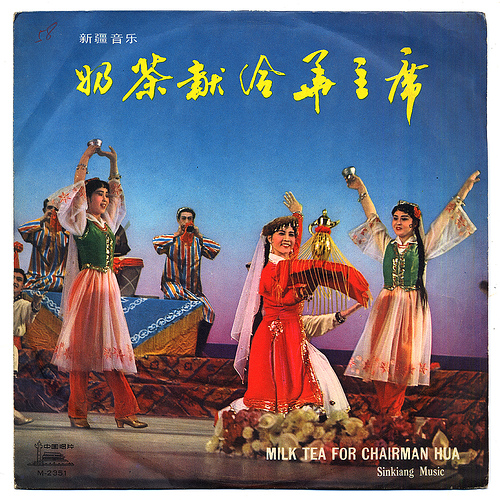
Milk and Tea for Chairman Hua

It doesn’t matter if the words ‘The Mandate of Heaven’ are invoked or not. It is obvious that the ‘Five Great Relationships’, as taught by Confucius, and the ‘Mandate of Heaven’ are infused in the Chinese thought process. Most born in China do not take a class to learn what this means, as students have to do in America to learn what the Declaration of Independence and the Bill of Rights mean. In China, one is raised with these philosophies in mind.

Piety, face, The Five Great Relationships, and the Mandate of Heaven are the foundation guide the behavior of the majority of Chinese.

The Western media and the political rulers of Western nations infer that Communism is evil because it is one party, (so-called) socialist political system, but most Chinese don’t see it that way.

To most Chinese, if the current rulers of China do their job and rule with the blessings of Heaven. The Western democratic political process is foreign to Chinese. To them, “Why change something that works? Leave it to Heaven.”

See The Mandate of Heaven http://wp.me/pN4pY-nc

 Sign up for an RSS Feed for  iLook China


Walking Barefoot on a Double Edged Blade

March 27, 2010

From what I’ve learned, when Mao died, many Chinese were tired of the Communists because of  the Cultural Revolution. If Deng Xiaoping hadn’t introduced a market economy resulting in decades of growth and prosperity, China may have fallen into chaos to emerge with a dictator similar to what they had with the Kuomintang.

Nichols Kristof

Nicholas Kristof wrote, China & Google (New York Times, March 24, 2010), an opinion piece that gets closer to the truth about China. Kristof seems to know what he is talking about when he said, “They (ordinary Chinese) don’t gripe  a lot about the regime imprisoning dissidents, who mostly have a negligible following around the country.”

It’s probably true that many in China want to have free access to the Internet, but I doubt it is serious enough to cause concern. The biggest concern is raising the standard of living for the 800 million rural Chinese who have not cashed in on the prosperity.

When there are accusations from Washington that China isn’t playing fair with currency control, China has a choice. Give in and wait for hundreds of millions of unhappy Chinese to rebel or stand firm and continue to grow the economy.

As far as Google is concerned, China has Baidu (with more than 60% of the market) and shedding Google probably feels like passing gas in public.


More than Money

March 16, 2010

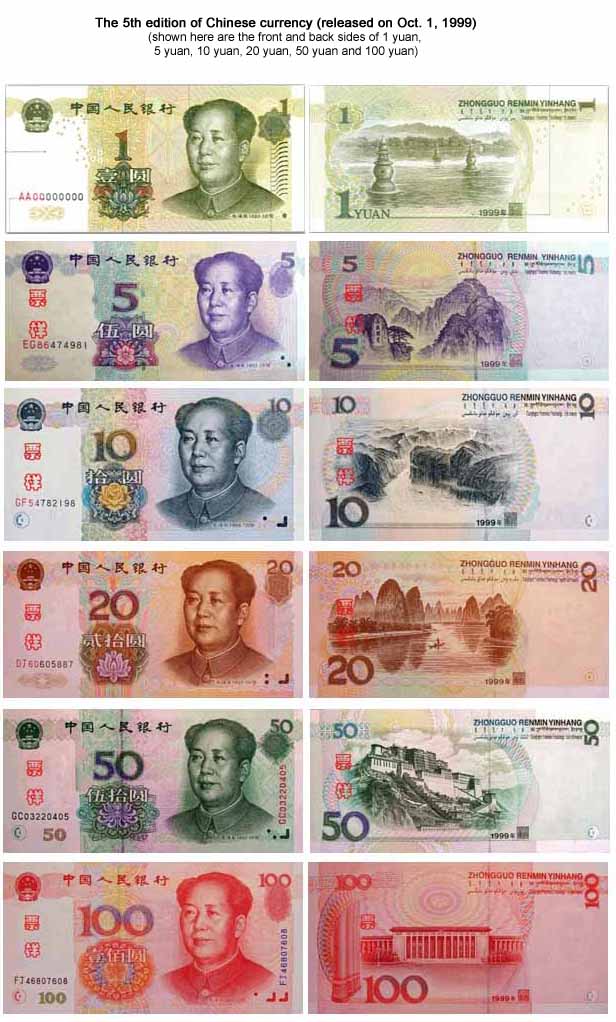
The S’ung dynasty cautiously issued true-paper money in 1023, in small amounts in a limited area good for a specific time period. The notes would be redeemed after three years, to be replaced by new notes for a 3% service charge. source

Chinese money – Yuan

With the United States wanting (source) China to devalue their currency, China finds itself between a rock (1.3 billion Chinese) and a hard place (America). If China caves in and does as America wants, products manufactured in China would cost more. If that happened, demand for Chinese products from other countries would decline and Chinese people would lose jobs.

Labor unrest in China is already increasing. source People want jobs and higher pay so they can join the growing middle class and buy more things like Americans do. To get ready, China’s police  are undergoing special training to deal with expected social unrest over factory closings that have left millions of migrant workers out of jobs.

What’s happening in China today is similar to what happened in America during the 1860s and ’80s. source

It’s the same old story—the rich want to keep the money while workers want to earn more.

Discover Deng Xiaoping’s 20-20 Vision

_______________

Lloyd Lofthouse is the award-winning author of My Splendid Concubine [3rd edition]. When you love a Chinese woman, you marry her family and culture too. This is the love story Sir Robert Hart did not want the world to discover.

His third book is Crazy is Normal, a classroom exposé, a memoir. “Lofthouse presents us with grungy classrooms, kids who don’t want to be in school, and the consequences of growing up in a hardscrabble world. While some parents support his efforts, many sabotage them—and isolated administrators make the work of Lofthouse and his peers even more difficult.” – Bruce Reeves.

lloydlofthouse_crazyisnormal_web2_5

Subscribe to “iLook China”!
Sign up for an E-mail Subscription at the top of this page, or click on the “Following” tab in the WordPress toolbar at the top of the screen.

About iLook China

China’s Holistic Historical Timeline


No Political Machine

March 5, 2010

This post is a response to a politically conservative American, who also sounds like a Christian fundamentalist. He made an ignorant comment about China in an on-line discussion at LinkedIn.  He said that China’s government was a corrupt, political machine.

My response follows.

You do not know what you are talking about when it comes to China. Prove that the central government in China is a corrupt, political machine. Throwing out blanket statements that stereotype serves no purpose but to rile ignorant people (and America has plenty of those) who are too lazy to learn.
China's central government in debate

The government in China has seventy million voting members in one political party, and it is far from a machine.  Take all of America’s political factions and shove them in one political party and you do not have a machine—what you have are different points of view that often do not agree. Chinese cities and provinces are controlled by different political factions just like the blue and red political map that we see on TV/Internet during national elections in the United States. If the Maoists return to power, God help the capitalists in China like GM, Ford, McDonalds, Pizza Hut, Wal-Mart, etc.

Corruption exists in China just as it does in America, but there are also honest, hard working, moral people in China’s government. But the market economy coupled with good old-fashioned capitalist greed is difficult to control. Does America’s government control greed in America?

Contrary to popular, public “opinion” in America, the Chinese central government does not control every aspect of life in China. The Chinese people are very independent and when the government isn’t watching, most people do what they want to do in their personal lives and in business even if what they are doing is against the law.

Most of the power in China is decentralized as it has been for millennia.  The provinces and major cities do what they want even when the central government in Beijing wants something different.

If you want to understand the role of China’s government start by reading this piece:  China shifts gears with smaller defense increase. And remember, anything published in the Western media may not get the story right but there is something to learn here. China’s central government must respond to the needs of most people—not to individuals but to families and communities. If unrest spreads, the government could fall.

There’s an old Western saying, “The grass is not always greener on the other side of the fence.” 

If a national-political machine exists, it is the American Republican Party. Where is my evidence for making such a bold claim?  Since President Obama moved into the White House, the Republican Party has voted as if they were one person directed by one brain.

It may also help to read Deng Xiaoping’s 20/20 Vision  to understand what happened after Mao died.

______________

Lloyd Lofthouse is the award-winning author of the concubine saga, My Splendid Concubine & Our Hart. When you love a Chinese woman, you marry her family and culture too.

If you want to subscribe to iLook China, there is a “Subscribe” button at the top of the screen in the menu bar.

First China Quiz (there is one prize)

March 3, 2010

China Quiz—the answers are in the first hundred posts at iLook China. The first person to answer all the questions correctly will win a free copy of either “My Splendid Concubine” or “Our Hart”.  If the winner lives outside the United States, I will provide a free e-book copy for them to download. There is no deadline. This quiz and the prize will be kept open until the first person answers all the questions correctly. The answers may be found in the first one-hundred posts.  If you find an answer from another source, provide the source but it must match or be similar to the answer found in iLook China. Write your answers in a comment to this post. Make sure there is a way for me to contact you.

1. Why did I write American Hypocrisy, my first post at iLook China?
2. What Chinese city would you find next to the Westlake?
3. What is the name of Zhang Zimou’s night spectacular on the Li River?
4. What is the first of all virtues to most Chinese and what does it mean?
5. Why was the Reuter’s employee roughed up outside Foxconn’s walled city-like facility in Guanlan?
6. During what Dynasty did the Chinese invent paper money and add credit type loans to the banking system?
7. Bob Grant said, “In all honesty, over the years, I have ___ ___ __ ___________ __ ________ flight anywhere inside China.” (fill in the blanks for the six words that are missing)
8. After Mao died in 1976, what did Deng Xiaoping introduce to China for a brief period-of-time, and what was the public allowed to do?
9. What American president’s administration seems to have been the role model for the changes in China’s health care system and what kind of health care system was this?
10. Before the Communists won China in 1949, what was the life expectancy for the Chinese people?
11. What was the name of the health care program that Mao started and how did this system work?
12. (Fill in the blank) Chinese Internet users are _____ times as likely to have blogs as Americans.
13. How far did Tom Carter walk while taking pictures for China: Portrait of a People?
14.  Where will a Disneyland be built in China?
15. On February 28, 60 Minutes ran a segment about a Taiwanese man spying on the United States for mainland China. What was this man trying to discover and why would China care?
16. Who moved China’s first Capital and what was the name of that first capital?
17. Construction of the Longi Rice Terraces was started during what Dynasty?
18. What do the Chinese think about the crew of the Tough Titi, an American B-24 Liberator bomber?
19. What did Confucius say about the importance of gaining an education?
20. What happened in 1421?