Keeping Mao Alive in the West – Part 3/4

July 1, 2011

When Mao Zedong‘s Great Leap Forward failed and millions died of famine (1959-1961 — no one knows exactly how many died), most estimates by mainstream Western sources are usually high. Henry Kissinger in his latest book, On China, says over 20 million. Other Western sources claim as high as 60 million while some say 10.

This tragedy was not caused by a Nazi or Stalinist purge where people were executed or sent to concentration camps to die in gas chambers by the millions. It was a famine caused by flawed agricultural policies leading to crop failures. Most of these deaths were caused by starvation.

In fact, a few experts argue that the famine was not all caused by those flawed policies but severe weather played a role in the crop failures too and there is evidence that this may have been a fact since China has a history of famines. Records show that between 108 BC and 1911 AD there were no fewer than 1,828 major famines in China, or one nearly every year in one or another province. For example, there were four famines in China in 1810, 1811, 1846 and 1849 that caused 45 million deaths. Source: List of Famines

However, during this time of famine, China’s population increased from 563 million in 1950 when Mao first ruled China to more than a billion by 1980. Mao encouraged families to have many children.


Raymond Lotta says Mao’s Great Leap Forward was not the cause of 30 million deaths.

Even with those deaths from starvation during The Great Leap Forward, we discover from this chart, that China’s population has never stopped growing.

As for the Cultural Revolution, which is credited for another two or three million deaths (mostly from suicide due to depression), Mao Zedong put his wife in charge.  At her trial, when she had a chance to speak in her defense, she said, “I was Mao’s dog. When Mao told me to bite, I bit.”

Mao Zedong was 73 when the Cultural Revolution was launched, and he spent little time outside of the Forbidden City where he lived mostly in isolation with limited contact with others, which could also be seen as another sign of someone suffering from PTSD.

His wife, Jiang Qing (twenty-one years younger than Mao) was the architect of the Cultural Revolution since her husband put her in charge, and she was planning to take over and rule China after Mao’s death.  In fact, during his last few years, he was not that healthy.

Continued on July 2, 2011 in Keeping Mao Alive in the West – Part 4 or return to Part 2

______________

Lloyd Lofthouse is the award-winning author of the concubine saga, My Splendid Concubine & Our Hart. When you love a Chinese woman, you marry her family and culture too.

To subscribe to “iLook China”, look for the “Subscribe” button at the top of the screen in the menu bar, click on it then follow directions.


Keeping Mao Alive in the West – Part 2/4

June 30, 2011

Another fact that The Economist left out of Boundlessly loyal to the great monster was that Mao was not in charge of The Cultural Revolution. He started the movement to retain power then put his wife in charge. While she was busy dismantling the nation, Mao was hanging out inside the walls of The Forbidden City.

His wife put students in charge of the schools and made teachers victims.

Before that, Mao turned butchers and peasants into doctors without any medical education to guide them in the healing arts. These untrained doctors were known as bare-foot doctors with little to no training, which I wrote about at China’s Health Care During Mao’s Time.

However, as crazy as it may sound, the bare-foot doctors worked.  Life expectancy was about 35 when Mao launched this program and by the time Mao died, life expectancy had increased by twenty years.

The people that Mao liberated from feudalism know that Mao Zedong was also a poet long before he ruled China. The years of Civil War from the early 1920 to 1949, assassination attempts and broken promises by Chiang Kai-shek , and fighting the brutal Japanese during World War II must have changed Mao. For sure, The Long March was a bloody influence that possibly led to a bad case of Post Traumatic Stress Disorder (PTSD), which tends to make one paranoid.

After all, fighting a Civil War for almost 25 years and living in caves had to have an impact on Mao.  If US soldiers come home with PTSD after one tour of combat, imagine more than two decades living a life of combat.

The Maoists that The Economist mentions mostly want to have the power back but not necessarily the purges and/or denunciations of The Cultural Revolution.

With nostalgia, this minority of Maoists remembers a different time from a different perspective since they may have been the peasant leaders of the adolescent Red Guard.

Many in the West probably do not know that the Red Guard and the People’s Liberation Army (PLA) were two different forces and the PLA for the most part was not involved in The Cultural Revolution.  In fact, several times the PLA stopped the rampaging Red Guard from some of its destruction of all things old in China.

Continued on July 1, 2011 in Keeping Mao Alive in the West – Part 3 or return to Part 1

______________

Lloyd Lofthouse is the award-winning author of the concubine saga, My Splendid Concubine & Our Hart. When you love a Chinese woman, you marry her family and culture too.

To subscribe to “iLook China”, look for the “Subscribe” button at the top of the screen in the menu bar, click on it then follow directions.


The “Vanishing” Street Art of Chinese Calligraphy

June 19, 2011

Chinese calligraphy is not vanishing. What I’m talking about is demonstrated in the videos included with this post. In China, many artists use sidewalks as a canvas and a brush with water to paint the beauty of calligraphy. As the water evaporates, the art vanishes.

In fact, calligraphy is more popular than ever. After the Cultural Revolution, many people turned to calligraphy in the hope of finding solace in the calm repetition of its exercises. Then, in 1981, the authorities took the lead in setting up a Chinese Calligraphers’ Association, the first such nationwide body ever to be established in the country. Source: Fathom.com, The British Museum

Both a language and an art, Chinese calligraphy has been traced back more than 4,000 years to the crude form called “Jia Gu Wen” found on turtle shells from the Shang Dynasty.

Calligraphy first bloomed as an art during the Han Dynasty but by the time of the Tang Dynasty, it had declined as an art. Source: Chinese Calligraphy History

It would be difficult to talk about Chinese art without understanding Chinese calligraphy and its artistic inspiration. A painting has to convey an object, but a well-written character conveys only its beauty through line and structure.

In Shanghai on sidewalks, or Beijing at The Summer Palace, I’ve watched men with long handled brushes, as seen in the first video, using water for ink and concrete for paper. With grace, they exhibit the skills of a Rembrandt breathing life into the characters.

America’s so called street artists should copy the Chinese that practice calligraphy and trade in their cans of spray paint for brushes and water, which would save US taxpayers much money.

Lin Yutang writes in My Country and My People that Western art is more sensual, more passionate, fuller of the artist’s ego, while the Chinese artist and art-lover contemplates a dragonfly, a frog, a grasshopper or a piece of jagged rock—more in harmony with nature.

Owing to the use of writing calligraphy with a brush, which is more subtle and more responsive than the pen, calligraphy as art is equal to Chinese painting.

Through calligraphy, the scholar is trained to appreciate, as regards line, qualities like force, suppleness, reserved strength, exquisite tenderness, swiftness, neatness, massiveness, ruggedness, and restraint or freedom.

Maybe this helps explain why the Chinese are not as warlike as Christian and Islamic cultures.

This revised and edited post first appeared on July 3, 2010 as Caressing Nature with Chinese Calligraphy

______________

Lloyd Lofthouse is the award-winning author of the concubine saga, My Splendid Concubine & Our Hart. When you love a Chinese woman, you marry her family and culture too.

To subscribe to “iLook China”, look for the “Subscribe” button at the top of the screen in the menu bar, click on it then follow directions.


China’s Sexual Revolution (viewed as single page)

April 27, 2011

The world’s biggest country is going through the world’s largest sexual revolution. From the Internet to corner sex shops, China is changing. However, lost in the mix, millions of single men cannot find a date much less a mate.

Changes are talking place as China goes through the West’s 60s rebellion. Mao’s Little Red Book has been replaced with a black book filled with phone numbers and date info.

Mao’s taboos against capitalism and sex are gone. With these changes comes the dark side—drugs, prostitution, HIV and STDs. Under Mao, sexuality was almost done away with. Everyone wore the same baggy colored clothes. Everyone had the same haircut. Couples that fell in love and were caught were punished. Today, cosmetics, perfume and stylish clothes have replaced Mao’s uniforms.

Millions are learning about romance and love. However, millions of others have been left with sexual, psychological problems and are very ignorant about sex. They were victims of Mao’s Cultural Revolution‘s sexual repression.

According to a 2004 survey, only twenty percent of Chinese men know where to find the clitoris, while fifty percent of Chinese women haven’t had an orgasm. Sexual ignorance and dysfunction is common. Mao’s Cultural Revolution left invisible scars.

China also has a new, popular holiday,Valentine’s Day. On February 14, cupid and roses have become fashionable. Nightclubs hold Valentine’s festivals where couples meet, drug use is common and kissing leads to sex.

Private businesses that cater to romance and sex are flourishing in China. Some shops are a cross between a sexual education center that also sells adult sex toys. In Beijing, there are an estimated five thousand sex shops and business is booming. This industry is worth billions.

When the first graphic sex Blog came online, the server crashed and was down for days. When the government censors shut down a sex Blog, more replace it.

In China today, teen girls are living lives their parents never imagined and do not understand. The teens are very open about what turns them on in a guy. Many do not care what their parents think. They only want to have fun.

Listening to the conversation between this group of Chinese girls sounds like listening to spoiled kids in the US talking.

The teens often go out clubbing and the nightclubs are equal to or better than the best in the West. The nightclub featured in the video has life-sized wall paintings from Cultural Revolution posters while teens dressed in sexy clothes dance and grind to loud music. These changes started in the late 1990s.

Even in China’s rural villages, the sexual revolution has been felt as millions of young women leave the villages to the big cities and experience what the urban Chinese are doing. The first stop is the hair salon.

The media is even climbing on board this sexual revolution. Glitzy magazines, like the Chinese edition of Cosmopolitan, feature the stylish, hot and sexy.

China’s one-child policy, created to control the growth of the population, is complicating the sexual revolution.

By ending the pressure on Chinese women to have many children, this has liberated them to do other things. Now Chinese women have the freedom to get an education and find a paying job.

The one-child policy also created another problem. Since Chinese families have always favored having boys, many women get abortions when the fetus is identified as a female. This has led to a growing imbalance between the number of men and women.

Now, millions of poor men cannot find a mate. With so many poor men unable to find women, gangs and crime have become a problem.

China now has the fastest growing sex industry in the world. A decade ago, there was little prostitution. Today, there are many brothels masquerading as massage parlors. Some are modeled after the brothels in Thailand.

Capitalism has arrived in all its guises, and the same problems the US has with sex slavery and drugs is now a problem for China too.

Most prostitutes are village girls and have no idea about safe sex. This is causing an increase in HIV. Many of the men refuse to wear condoms. Sometimes, when the girl says no, the paying customer will rape her.

The sexual revolution in China is a fragile one. While the new China supports it, the old China is afraid of these changes. Adultery and divorce are on the rise. Kids are leaving home. There is a growing generation gap.

One older Chinese man says that China is not used to this. Under pressure from the older generation, the police must crack down, raid bordellos and arrest prostitutes.

However, now that China’s sexual revolution is in the open, it will be hard to stop. At first, the government tried to stop what was going on but soon backed off. In addition, many parents, who grew up in Mao’s puritanical era, don’t want their children to experience the same repression.

These changes are talking place while women are gaining power and many families now value having female children. Few want to return to the way things were.

_______________

Lloyd Lofthouse is the award-winning author of My Splendid Concubine [3rd edition]. When you love a Chinese woman, you marry her family and culture too. This is the love story Sir Robert Hart did not want the world to discover.

Low-Res_E-book_cover_MSC_July_24_2013

Subscribe to “iLook China”!
Sign up for an E-mail Subscription at the top of this page, or click on the “Following” tab in the WordPress toolbar at the top of the screen.

About iLook China

China’s Holistic Historical Timeline


The Fear of Mao Buying the World

November 22, 2010

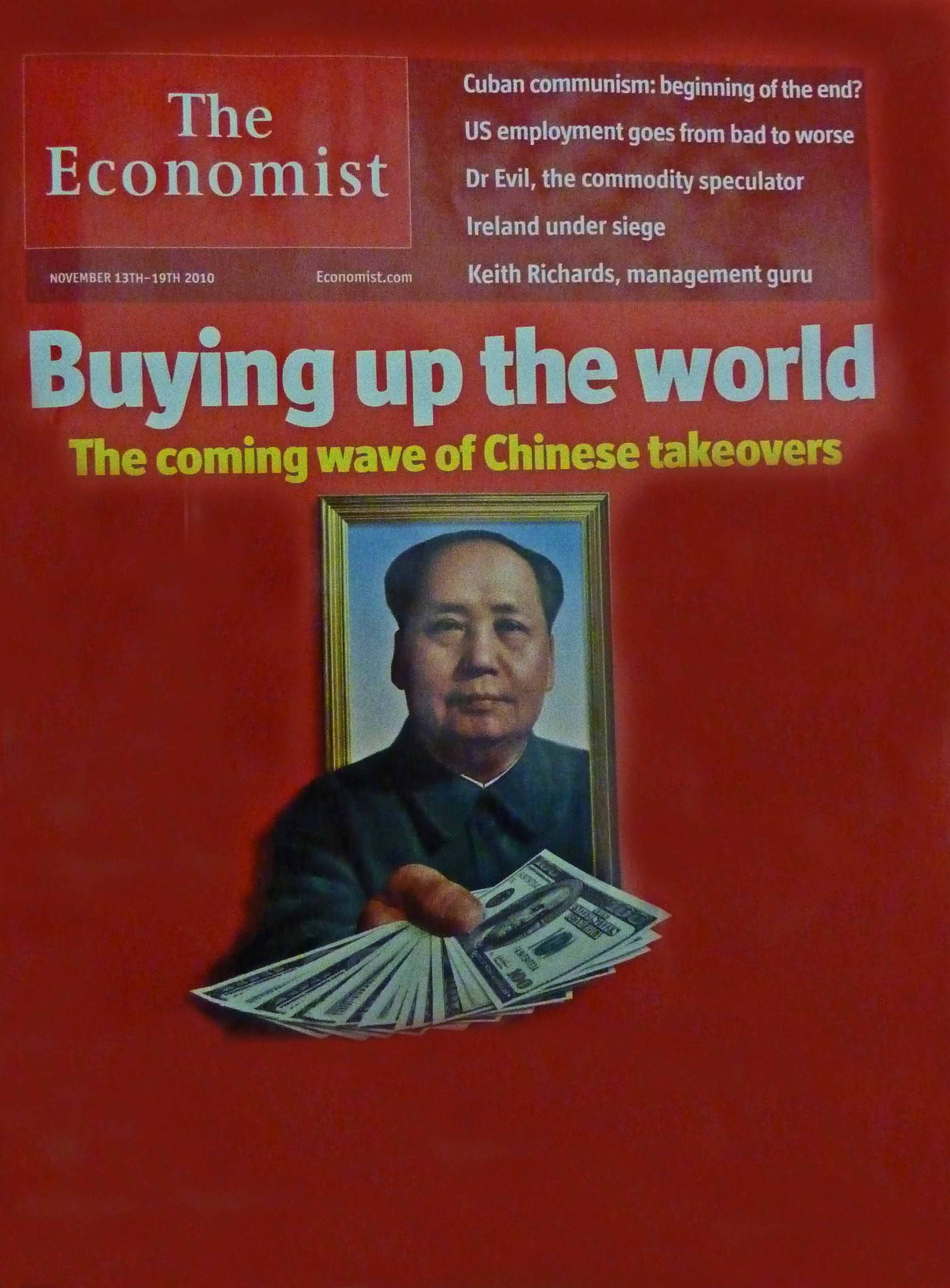
The cover of The Economist’s November 13 issue plays on fear to sell magazines.

I haven’t read Buying up the world, The coming wave of Chinese takeovers yet, which is the feature piece. I’ll probably write another post about that once I do.

Instead, I’m writing about the magazine’s cover, which is taking advantage of the West’s PTCSD (Post Traumatic Chinese Stress Disorder) that has roots in the “history” of a fear of the word “Communist”, the Korean Conflict and the Cultural Revolution.

I’m sure most Sinophobes that see this cover will have flashbacks of the People’s Liberation Army (PLA) and the rest of China dressed in drab Mao jackets marching across the world to take possession of everything China buys.

However, Mao isn’t the proper man to adorn The Economist’s cover.

Deng Xiaoping or one of China’s recent presidents (there have been four since the 1982 Constitution) would have been more appropriate.

Why? Because after Mao died in 1976, Deng Xiaoping and his allies rejected Maoist Revolutionary thought and embraced CAPITALISM in a very big way.

In fact, surviving Maoists consider the Party that rules China today to be traitors to Mao and the revolution.

Do you remember the 1980s, when wealthy Japanese spent billions buying property in America then a real estate bubble burst, Japan lost a lot of money, and its economy has been limping since?

If anyone should be afraid, it should be the Chinese fearing spending habits in the US, Canada and Europe where debt and plastic rule.

______________

Lloyd Lofthouse is the award-winning author of the concubine saga, My Splendid Concubine & Our Hart. When you love a Chinese woman, you marry her family and culture too.

To subscribe to iLook China, look for the “Subscribe” button at the top of the screen in the menu bar, click on it then follow directions