The Ugly Face of Intolerance – Part 2/3

July 4, 2011

I first ran into this particular wall of intolerance on the Amazon Forum where Amy Chua’s critics left reviews and comments about her parenting methods in a hate fest that had mostly nothing to do with the memoir.

What these critics write are attacks on Chua accusing her of being a child molester, a sociopath, or a narcissist, etc.  Often, these critics do not know what they are talking about and the biased ignorance runs deep.

One claim I have been struggling to disprove was the one that said, “Amy Chua does not represent the average mainland Chinese parent and had no right to claim that her parenting methods were Chinese.”

After more than four months, the evidence I have been looking for appeared in China when the China Daily published Tiger Moms’ Popular in China on April 14, 2011.

The China Daily said, “The strict parenting style advocated by Amy Chua, the Yale law professor, in her latest book, Battle Hymn of the Tiger Mother, is still popular in the country today, according to a recent survey.”
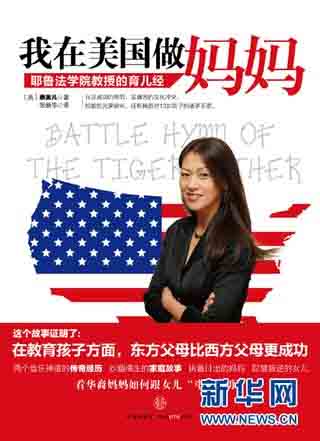
“Among 1,795 people polled online by China Youth Daily‘s social research center, 94.9 percent said they know women who are strict mothers, and 55.1 percent said they see merit in Chua’s parenting.…”

“A Beijing high school teacher, surnamed Liu, was quoted as saying that his wife had enrolled their daughter in violin and ballet classes at an early age and had resorted to scolding and spanking when the girl refused to go.

“Strict parenting is also a tradition in other Asian countries, such as Japan and South Korea,” Liu said. “It has merits in raising smarter children and preparing them better for harsh competition in the future.”

In addition, a critic of Chua’s on the Amazon Forum referred to an opinion piece posted on the Psychology Today Blog where Peter Gray, a research professor of psychology at Boston College claimed that 42 one-star reviews from anonymous people that identified themselves as Chinese was enough to conclude that the majority of Chinese (there are more than 1.3 billion Chinese and almost four million are in the US) were critical of Amy Chua’s parenting methods.

When we compare Peter Gray’s opinion in the Psychology Today Blog with information from almost 2,000 people polled online in China, which source do you think is more credible?

Continued on July 5, 2011 in The Ugly Face of Intolerance – Part 3 or return to Part 1

______________

Lloyd Lofthouse is the award-winning author of the concubine saga, My Splendid Concubine & Our Hart. When you love a Chinese woman, you marry her family and culture too.

To subscribe to “iLook China”, look for the “Subscribe” button at the top of the screen in the menu bar, click on it then follow directions.


Taoism – Part 2/2

December 5, 2010

The video’s narrator, Jean Delumeau (born 1923) is a professor of history at the College of France in Paris and is widely regarded as one of the leading historians of Christianity. Sin and Fear, one of his books, is a monument of flawless scholarship, says Wendy Doniger for the New York Times

Delumeau says that Taoism was a philosophy and a religion, which offered salvation for the individual and responded to the need for the immortality of its followers.

Confucianism, however, was somewhat abstract and didn’t offer a reward of immortality since ancient China did not have a concept of a spiritual soul that survives a physical death.

Taoism believed that the physical body only contains the personality. There were rules for food, hygiene, breathing techniques and different forms of gymnastics, which were designed to suppress the causes of death and allow each follower to create an immortal body to replace the mortal one.

After the mortal body died, the immortal body went elsewhere to live.

In ancient China, the pathway of sanctity preached by Taoism evolved in Chinese Yoga and was recognized some 500 years before Christ.

In the second century AD, Taoism became a true church venerating immortals as saints.

About 200 AD, a Taoist scholar taught that virtue, avoidance of sin, confessions of sins and good works were the most important aspects and took precedence over diet and hygiene.

The difference from religions in the West was that Taoism did not have leaders on a national scale and was more like a federation of linked communities.

In 110 BC, Emperor Wu of the Han Dynasty made Confucianism the state religion to strengthen and centralize his power.

Nevertheless, Taoism continued to be practiced as a parallel popular religion.

Religious Tolerance.org says there are about 225 million followers but the exact number is impossible to estimate since many Taoists also identify with other regions such as Buddhism and Confucianism.

Return to Taoism – Part 1

______________

Lloyd Lofthouse is the award-winning author of the concubine saga, My Splendid Concubine & Our Hart. When you love a Chinese woman, you marry her family and culture too.

If you want to subscribe to iLook China, there is a “Subscribe” button at the top of the screen in the menu bar.


The Origins and Meaning of Taoism – Part 1/2

December 5, 2010

Jean Delumeau, that narrator of the video, is an honorary professor of the College de France. He says by the time Buddhism arrived in China in the first century AD, Confucianism and Taoism had been widespread for several centuries.

Taoism was the popular religion of China while Confucianism was the official state religion of the Han Dynasty. In fact, the bureaucracy practiced Confucianism at work and turned to Taoist spiritual practices after work.

Even though Taoism and Buddhism have fundamental differences, Taoism helped spread Buddhism. While Taoism seeks the salvation of the individual, Buddhism seeks an escape from the cycle of personal existence.

However, certain practices of Taoism and Buddhism are similar, which are meditation, fasting, and breathing techniques.

The word “Tao” means both the order and totality of the universe and the pathway or road that allows the individual to enter into the rhythm of the world through a negation of self.

Two opposing but complementary forces of reality are fused in the Tao — Yin, which is passive, cold and feminine and Yang, which is active, hot and masculine.

The moon and the sun are the manifestations of Yin and Yang and all change is a result of these two dynamic forces such as day and night, the seasons, and life and death.

These two principals alternate in the five phases of a cycle, which are represented by water, fire, wood, metal and earth, which serve to define the five cardinal points, which are north, south, east, west and the center.

A contemporary of Confucius, Lao Tzu’s teachings were compiled in the fifth century BC into a collection called the Tao Te Ching or Dao De Jing, which have had a great influence on Chinese thought and medicine.

One example says, “The wise man does not seek to be known as a wise man but of his own free will remains in obscurity. Those who seek much knowledge enrich themselves daily. Those who seek Tao become poorer each day. Eventually, they become so poor they are incapable of action. Without action, nothing can be achieved.”

Learn more of Yin Yang

______________

Lloyd Lofthouse is the award-winning author of the concubine saga, My Splendid Concubine & Our Hart. When you love a Chinese woman, you marry her family and culture too.

If you want to subscribe to iLook China, there is a “Subscribe” button at the top of the screen in the menu bar.


Cultural Differences and China’s Changing Laws

September 27, 2010

A colleague and friend sent me a link to a post about a Chinese blind activist lawyer released from prison. Isolda Morillo, for the Associated Press, wrote the post that appeared on CBS.com.

Chen Guangcheng was the blind lawyer. In 2006, he was sent to jail after documenting forced late-term abortions and sterilizations and other abuses in his rural east China community.

Morillo wrote that Guangcheng was an “inspirational figure to others in China”.

According to the AP reporter, Guangcheng is under house arrest and, along with his family, is watched closely.  The piece points out how horrible he was treated by Chinese authorities.

One fact stood out, “He expanded his activism after hearing complaints from people living in nearby villages that family planning officials were forcing women to have late-term abortions and sterilizations to enforce the government’s one-child policy.”

I’m sure there will be people who will see me supporting China’s government when I do not condemn China for how Guangcheng was treated.

With more than 1.3 billion people and only 16% of the land capable of growing food crops and a looming shortage of fresh water, China is facing a possible melt down in a few decades that could dismantle all the progress made since the 1982 Constitution.

To understand China better, it would help to learn that China’s legal system is reinventing itself.

Up until 1911 when the Qing Dynasty collapsed, Chinese law leaned heavily toward Legalism influenced by Confucianism.

Near the end of the Qing Dynasty, efforts were made to reform the law by mainly importing German codes with slight modifications.

After 1911, the Nationalists continued this effort. When Mao and the Communists came to power in 1949, the ranks of intellectuals and legal professionals was devastated during the purges. A Soviet-style legal system was then adopted but that system suffered due to political turmoil that ended with the Cultural Revolution.

It wouldn’t be until 1982, that the idea of individual rights would reemerge as a signify influence on Chinese Law. Even then, business law developed much faster than civil law, which is the laws of a state or nation that deals with the rights of private citizens.

http://www.youtube.com/watch?v=zEkWrW9Po58

In an interview with James Zimmerman, about China’s Changing Legal System, Megan Rhodes wrote, “China is transforming its legal system at an amazing rate.” 

When Rhodes asked Zimmerman if foreign law has influenced Chinese law, he answered “Yes, absolutely.”

At the end of the interview, Zimmerman says, “China is going through remarkable times, and should be proud of its ongoing judicial and legislative reforms. It has developed—and continues to develop—a legal system from scratch in just over 30 years.”

American law also evolved and reading Law and History: The Evolution of the American Legal System might give you a better understanding of what is going on in China. 

In 1783, America signed a peace treaty with the British Empire and the U.S. officially became a nation state. However, slavery wouldn’t be abolished for eighty-two years in 1865, after the bloody American Civil War.

In addition, women in America even after the Civil War, were still second-class citizens. Source: Women’s history in America

Forms of child labor, including indentured servitude and child slavery, have existed throughout American History. In fact, it wasn’t until 1938 that the US had, for the first time, Federal regulations for minimum ages of employment and hours of work for children. Source: Child Labor in U.S. History

Then Congress passed the Civil Rights Act in 1964 and the Voting Rights Act in 1965.

China has had about thirty years to change since 1982 while America took 182 years to cover the same ground. However, there may be another reason why the American media and so many Americans condemn China so often, and that can be explained by the history of Discrimination Against the Chinese in America. Maybe that discrimination is not dead yet.

______________

Lloyd Lofthouse is the award-winning author of the concubine saga, My Splendid Concubine & Our Hart. When you love a Chinese woman, you marry her family and culture too. 

If you want to subscribe to iLook China, there is a “Subscribe” button at the top of the screen in the menu bar.


The Tang Dynasty (618 – 906 AD) – Part 2/4

September 24, 2010

During the Sui (589-617) and Tang Dynasties, China went through a period of cultural and spiritual development.

The country’s ethnic groups along with Confucianism, Buddhism and Taoism coexisted peacefully with foreign religions such as Islam.

Literature and the arts developed more than before.

The Han Dynasty (206 BC to 219 AD) opened the Silk Road for trade, and the civilizations of Rome, Ancient Egypt, of the Euphrates and Tigris Rivers and India continued trade with the Tang Dynasty.

http://www.youtube.com/watch?v=acjINcNNOPI

According to Tang Dynasty records contact was maintained with more than 300 countries and regions across the known world, so the Silk Road was also known as the Envoy Road.

People from countries such as Japan, Korea, and India as well as Tehran came to China.

Many foreigners had positions in the central government of the Tang Dynasty, and they served both as civil officials and military officers.

The Tang Dynasty demonstrated respect for all foreign religions.  During this time, Christianity was introduced to China.

The Imperial family of the Tang Dynasty had been a military family in Northwest China for generations and they made Taoism the national religion.

Laozi, the founder of Taoism, advocated harmony between people and nature, which was reflected in the beliefs of the first rulers of the Tang Dynasty.

Continue with Tang Dynasty – Part 3 or return to The Tang Dynasty (618 – 906 AD) – Part 1

______________

Lloyd Lofthouse is the award-winning author of the concubine saga, My Splendid Concubine & Our Hart. When you love a Chinese woman, you marry her family and culture too. 

To subscribe to “iLook China”, look for the “Subscribe” button at the top of the screen in the menu bar, click on it then follow directions.