Sinophobia and the Nation With the Soul of a Church

July 1, 2010

An old friend of mine once wrote in an e-mail that Communism was evil and if China didn’t do what America wanted, the US would spank them. That and his endless born-again preaching bruised about five decades of friendship. Now, we don’t communicate much.

The definition for Sinophobia is one who fears or dislikes China, its people or its culture—in other words, an ignorant, brainwashed bigot (my opinion).

http://www.youtube.com/watch?v=RnoHCk6yMKY

This morning, I finished reading  An Exceptional Obsession by John Lee, which was published in The American Interest. On page 42, Lee wrote, “Above all, Chinese leaders are anxious about having to deal with a society so different from their own, and by different we don’t mean a superficial contrast between communism and capitalism.  China’s is a communal culture; America’s is individualist. China is rooted in its land longer and more deeply than any society on earth. America is an immigrant society and an unprecedentedly mobile one at that. China has never institutionalized the rule of law; America is fundamentally based on it. China has never experienced deistic religions; America, as Chesterton once said is “a nation with the soul of a church.”

Lee’s comparison reminded me of the few shallow Communist haters and Sinophobic people I’ve run into on the Internet, who live in this nation with the soul of a church. Occasionally, one crawls out of the woodpile on a thousand legs.

Discover Power Corrupts

______________

Lloyd Lofthouse is the award-winning author of The Concubine Saga. When you love a Chinese woman, you marry her family and culture too. This is the love story Sir Robert Hart did not want the world to discover.

To subscribe to “iLook China”, look for the “Subscribe” button at the top of the screen in the menu bar, click on it then follow directions.


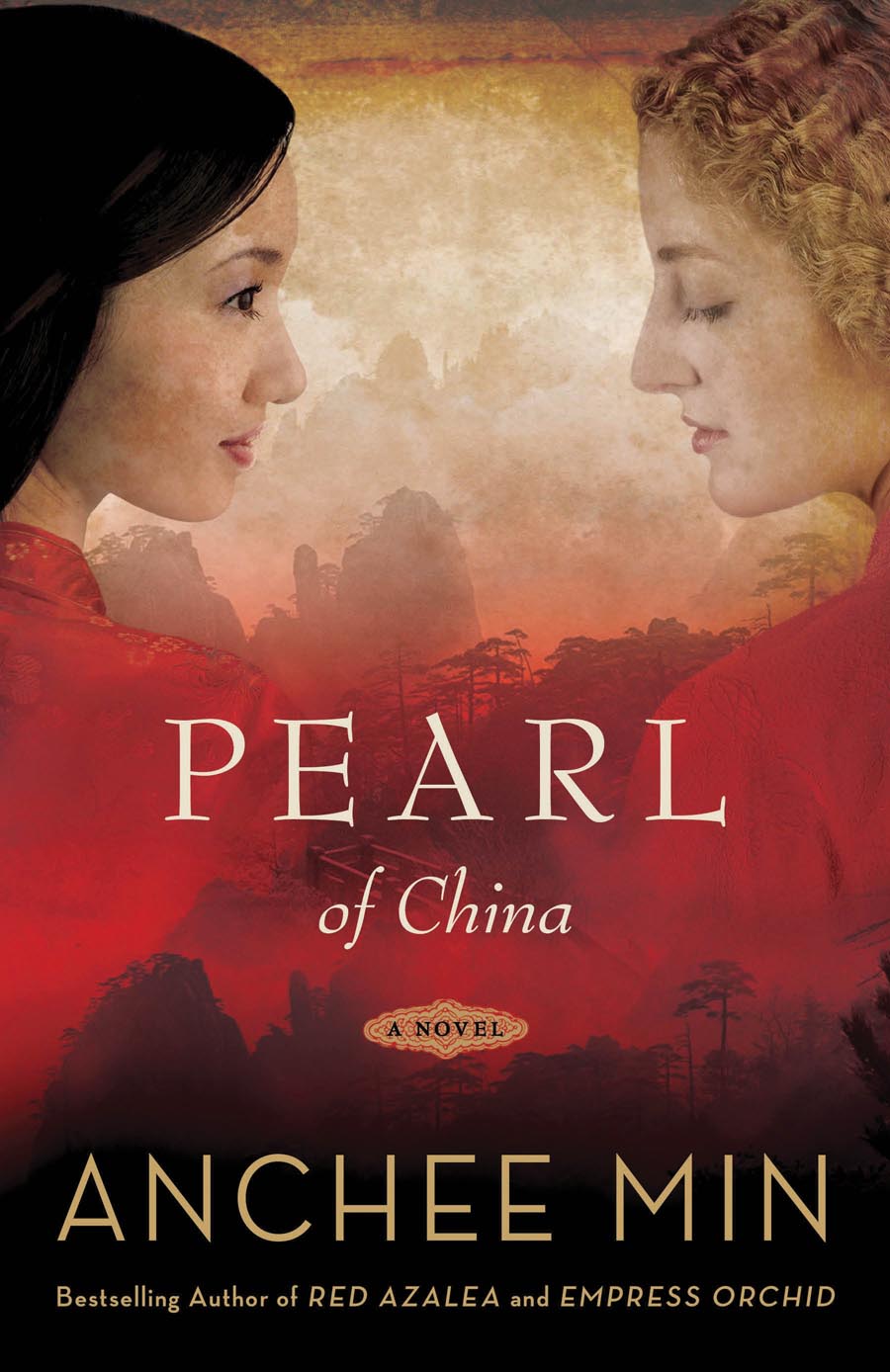
Pearl of China

March 12, 2010

“From the bestselling author of Red Azalea and Empress Orchid comes the powerful story of the friendship of a lifetime, based on the life of Pearl S. Buck.”

“In this ambitious new novel (Pearl of China), Anchee Min brings to life a courageous and passionate woman who is now hailed in China as a modern heroine. Like nothing before it, Pearl of China tells the story of one of the twentieth century’s greatest writers, from the perspective of the people she loved and of the land she called home.” Source Bookbrowse

At Bookbrowse, thirty-five early, reader reviews rated Pearl of China an average 4.5/5 stars.

In the southern town of Chin-kiang, in the last days of the nineteenth century, two girls bump heads and become thick as thieves. Willow is the only child of a destitute local family. Pearl, the headstrong daughter of zealous Christian missionaries, will become Pearl S. Buck, Nobel Prize-winning writer and activist. Their friendship will be tested during decades of great tumult, by imprisonment and exile, bloody civil war and Mao’s repressive Communist regime.

Pearl S. Buck won the Pulitzer Prize in 1932, the Howells Medal in 1935, and the Nobel Prize for literature in 1938.

Read International Women’s Day where Anchee Min was a guest speaker http://wp.me/pN4pY-ft


China’s Modern Women

March 6, 2010

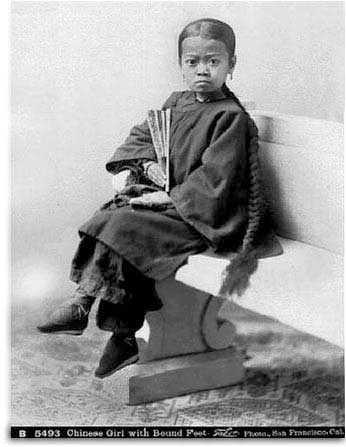
The changing role of Chinese women has been dramatic since Mao won China in 1949. Prior to that time, China was ruled by the Kuomintang—a dictatorship. There were never national elections held in China. There wasn’t much that changed under the Kuomintang leadership regarding the role of women. When my wife was born in the late 1950s, her grandmother had bound feet.

Chinese girl with bound feet

Before Mao, women were grass to be stepped on. Their role was to serve men.

The changes ushered in by Mao set the stage for his wife to become China’s leader after her husband’s death. The only reason she did not assume the leadership was because she was arrested as a member of the Gang of Four and sent to prison for crimes committed during the Cultural Revolution.

Modern Chinese woman

Since Mao, the changes have been even more dramatic.  Woman own businesses, hold political posts in the government, have jobs, and cannot be sold to become a wife or bought to serve as a concubine. They are not property. They are equals to men in many ways.

Learn about Marriage and Money in China.

______________

Lloyd Lofthouse is the award-winning author of The Concubine Saga. When you love a Chinese woman, you marry her family and culture too. This is the love story Sir Robert Hart did not want the world to discover.

To subscribe to “iLook China”, look for the “Subscribe” button at the top of the screen in the menu bar, click on it then follow directions.


I Never Met a Communist in China

February 17, 2010

Originally published at Speak Without Interruption on February 6, 2010
By Bob Grant — publisher/editor for Speak Without Interruption

I have been traveling to China since 1998.  I would not consider myself a seasoned traveler to that country—making around twenty-five visits total.  When I traveled there, I usually stayed between one and two weeks. Never during any of my visits did I ever see or meet a “Red” Chinese person.  I saw no one wearing an “I am a Communist” sweatshirt, ball cap, t-shirt, sunglasses, button or anything else physically labeling them a Communist.  I saw no street banners, bumper stickers, storefront displays, mass gatherings or any other public notice that I was among Communists.  What I was among were just people—regular people.

All of my visits were for business purposes.  I met with business people only and traveled to see their factories or offices.  I did not take much time to “sightsee” which was a mistake in retrospect. 

With my business, I tended to visit locations where I was the “only” non-Chinese person within miles.  I never felt threatened or out of place.  No one ever stared at me or pointed—“Look at that non-Communist person.” 

I found “most” of the people with whom I came in contact during both business meetings and other activities to be very pleasant, warm, humble, honorable, respectful and charming.  I will have to admit that I did have some dealings with business people who were other than honest; however, China does not hold a monopoly on those types of business people.  As a rule, I found the Chinese people with whom I had my dealings to be extremely hard working, dedicated and honest.

I had no fear going out on my own in any part of China that I visited day or night.  I was never threatened or accosted in any manner. 

One day I was walking around a city on a Sunday afternoon—alone.  I felt a tug on my shirtsleeve and turned to find two young girls at my side.  One asked me if they could speak with me—in good English.  I did not suspect their reasons for talking with me to be anything other than honorable, so I said “sure.” 

The girls were students at the university and their English professor had given them an assignment to stop, interview and take a photo with any “Westerner”.  They said they had been looking for hours and I was the only “Westerner” they had seen.  I was happy to answer their questions—one of the girls took my photo with the other girl. They thanked me, and went on their way.  These were just two young students with an assignment, and I felt honored that I was able to help them complete it.

Perhaps I am being a bit naive—I was obviously around Communists during my visits to China, but I never felt that I had really “met” one.  I had been fortunate enough to meet people from another country and culture, and they had accepted me at face value.  I enjoyed each one of my visits to China and care a great deal for China and its people. 

I truly believe if people could meet and work with other people around the world that many of the world’s problems would be solved.  Perhaps this is a bit Pollyanna of me but this is how I see things from my myopic point of view and experiences, with China and its people, and I will stand by them.

If you would like to read other guest posts by Bob Grant, start with They All Look Alike.


The First of all Virtues – Part 8/9

February 1, 2010

I am married to a Chinese woman who was born in Shanghia, China. She suffered with the rest of China during Mao’s Cultural Revolution.

She moved to the United States in the 1980s and is now a U.S. citizen. If you marry a Chinese woman, you marry her family. I know first-hand that filial piety is alive and well in China.

Contrary to popular Western opinions spread by the media, the Communists did not get rid of it. When I travel to China, my white hair is a ticket to respect that was earned over a long period.

In China, I don’t hear, “Hey, old man.”

If you are interested to see how Mao’s Cultural Revolution influenced people, this short video is a good example.

Go to The First of All Virtues Part 9 or return to Part 7

______________

Lloyd Lofthouse is the award-winning author of the concubine saga, My Splendid Concubine & Our Hart. When you love a Chinese woman, you marry her family and culture too. 

Subscribe to “iLook China”
Sign up for an E-mail Subscription at the top of this page.

About iLook China