Growing Cautiously Into a Modern Republic – Part 1/7

October 23, 2010

The China Law Blog challenged an opinion I wrote about China becoming a republic with more freedom for the people.

I wrote, “The Economist wants India to win this race, because it is called a democracy as is the U.S., but what isn’t mentioned is that China is becoming a republic with a Chinese twist, which is what Dr. Sun Yat-sen wanted.… Once you read the two pieces in The Economist, you may understand why India’s democracy cannot beat China’s evolving republic.” Source: Comparing India and China’s Economic Engines

The China Law Blog criticized this post saying, “In other words, iLook takes what he sees as China’s aspirations and assumes (without a shred of factual support or even argument) that China will very shortly fully achieve those aspirations.”

I don’t recall writing “very shortly“.

In fact, the freedoms the world’s democracies are urging China’s government to implement ASAP may not materialize for decades and some freedoms found in the West may never appear.

To understand why China may be moving toward more freedom slowly, the best place to start is with Dr. Sun Yat-sen (1866 – 1925)

Sun is known as the father of China’s Republic.

To achieve this dream, Sun started by unifying the Communists and Nationalists into a two-party republic in southern China in the early 20th century. Both parties respected Sun, and he made it work.

Unfortunately, Sun died in 1924 at a time when China was in ruins and torn by anarchy and violence between competing warlords.

Then, Chiang Kai-shek, who was a member of the ruling class and a man who hated the Communists, went on a rampage slaughtering Communists and igniting a civil war that would rage even after Japan invaded during World War II. 

Chiang’s first move against the Communists was in the south. His next was in Shanghai to break the labor unions the Communists had been organizing to improve the lives of sweatshop labor working in foreign owned factories. 

Chiang Kai-shek’s goal was to exterminate the labor unions and the Communists, and he had support from the foreign factory owners.

The Communists that survived had no choice but to defend themselves. Surrender wasn’t an option.

Decades later, in 1949, the Communist Party won the revolution under Mao’s leadership and with the support of China’s peasants.

Chiang Kai-shek would flee to Taiwan and protected by the US, he would rule that island under martial law as a brutal dictator for twenty-six years. Taiwan would not become a democracy until years after Chiang and Mao’s deaths.

______________

Lloyd Lofthouse is the award-winning author of the concubine saga, My Splendid Concubine & Our Hart. When you love a Chinese woman, you marry her family and culture too. 

If you want to subscribe to iLook China, there is a “Subscribe” button at the top of the screen in the menu bar.


Building the Rest of China’s Republic

October 15, 2010

I’m looking at a site, American President, An Online Reference Resource, and this site has divided the history of the U.S. into eight eras and lists the presidents of each era.

The Early Republic (1789 – 1829)
The Jacksonian Democracy (1829 – 1854)
Sectional Conflict (1853 – 1881)
Gilded Age (1881 – 1897)
Progressive Era (1897 – 1921)
Depression & World Conflict (1921 – 1961)
Social Change & Soviet Relations (1961 – 1989)
Globalization (1989 – )

In Democracy, Deceit and Mob Rule, the embedded YouTube video mentioned that Woodrow Wilson was the first president to refer to the U.S. as a democracy.

By the time President Johnson left office in 1969, America was no longer a Republic. The transition was complete and the democratic mob ruled leading to Political Correctness, Rush Limbaugh and the Self-esteem Generations.

To avoid becoming a democracy, China should consider adding a lower house of Congress as in the U.S.

All eligible voters, who do not belong to the Communist Party, would elect the representatives in the lower house and the upper house would be the National People’s Congress, which would be elected from within the Communist Party as it is today.

Since legislation in the U.S. must be approved by both houses of Congress and signed into law by the president, this would allow the Communist Party in the upper hosue to kill unpopular or destructive legislation from the lower house and the other way around.

That way, the mob rule of a democracy would be avoided.

Since in a Republic, no mature citizen has to vote as in a democracy, it would be wise if China defined who the eligible voters outside the Party would be.

I suggest people only be allowed to vote if they have a high comprehension level that helps understand the issues.

As has been seen in the U.S., with its falling literacy rate, many in the population cannot understand the political issues and don’t vote or use misleading information from politically biased people like Rush Limbaugh to decide for them.

Of course, a democracy ruled by the mob would cry foul, but a republic is ruled by the elected officials—not by the majority as in the U.S.

______________

Lloyd Lofthouse is the award-winning author of the concubine saga, My Splendid Concubine & Our Hart. When you love a Chinese woman, you marry her family and culture too. 

If you want to subscribe to iLook China, there is a “Subscribe” button at the top of the screen in the menu bar.


Comparing India and China’s Economic Engines

October 13, 2010

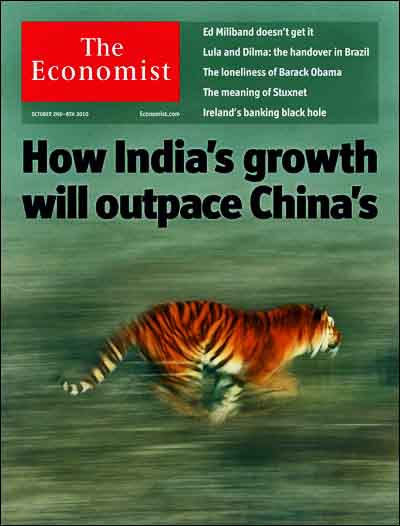
The cover for The Economist of October 2 – 8, 2010, is betting on a race that cannot be won by India.


I opened the magazine and read the two pieces that the cover was about.  One is about India’s surprising economic miracle and the second piece was A bumpier but freer road.

On page 11, I read, “many observers think China has done a better job than India of curbing corruption…”

On page 77, a Western banker was quoted saying, “It’s much easier to deal with the well-understood ‘org chart’ of China Inc than the freewheeling chaos of India.”

After reading both pieces comparing China with India, it was obvious that India would never beat China economically.

The Economist wants India to win this race, because it is called a democracy as is the U.S., but what isn’t mentioned is that China is becoming a republic with a Chinese twist, which is what Dr. Sun Yat-sen wanted.

The reason The Economist is wrong about India is because America’s Founding Fathers hated democracy and they had a good reason.

The Live Journal goes into detail on this topic.  To quote the Live Journal, “It would be an understatement to say that the (U.S.) Founding Fathers hated democracy. They warned against it vehemently and relentlessly. They equated it – properly – with mob rule.

“in a democracy, two wolves and a sheep take a majority vote on what’s for supper, while in a constitutional republic (which China is becoming), the wolves are forbidden on voting on what’s for supper and the sheep are well armed.…

“The Founders, who hated democracy, gave us a free country (a republic). Our (meaning many Americans) ignorance of history, which has lead to a love of democracy, is causing us to surrender our freedoms at an alarming rate.”

Dr. Sun Yat-sen (1866 – 1925), known as the father of modern China, said he wanted to model China’s government after America but by combining Western thought with Chinese tradition.

When he said this, it was 1910, and America, by definition, was still a republic. Once you read the two pieces in The Economist, you may understand why India’s democracy cannot beat China’s evolving republic.

This topic is continued (with more details and facts) at India Falling Short

_______________

Lloyd Lofthouse is the award-winning author of My Splendid Concubine [3rd edition]. When you love a Chinese woman, you marry her family and culture too. This is the love story Sir Robert Hart did not want the world to discover.

Subscribe to “iLook China”!
Sign up for an E-mail Subscription at the top of this page, or click on the “Following” tab in the WordPress toolbar at the top of the screen.

About iLook China