The India, China battle to eliminate poverty and illiteracy

November 2, 2010

Chris Devonshire-Ellis wrote a convincing piece at China Briefing that India‘s economic growth would speed past China in the near future. 

He says, “It (India’s) growth rate could overtake China’s by 2013… Some economists think India will grow faster than any other large country over the next 25 years.”

However, there are flaws in that opinion.

Once again, the foundation of this prediction is based on India being a democracy “where entrepreneurs are all furiously doing their own thing” while China is a culture of secrecy and censorship. Chris mentions a few of China’s other flaws too, which China is struggling to overcome.

What Chris doesn’t mention is the difference in poverty and illiteracy between India and China.

India and China both became independent about the same time—China in 1949 and India in 1947.  Due to Chairman Mao’s policies, China suffered horribly from 1949 to 1976 and little progress was made.

For China, most of the progress has taken place in the last three decades. India, on the other hand, has had more than 60 years to solve its problems.

Let’s see what each has accomplished.

The World Bank says, “that China’s record of poverty reduction and growth is enviable. Between 1981 and 2004 the fraction of the population consuming less than a dollar-a-day fell from 65% to 10% and more than half a billion people were lifted out of poverty.”

For India, the World Bank says, “poverty remains a major challenge. According to the revised official poverty line, 37.2% of the population (about 410 million people remains poor, making India home to one-third of the World’s poor people.” UNICEF shows the poverty in India to be 42%.

World Bank studies also established the direct and functional relationship between literacy and productivity on the one hand and literacy and the overall quality of human life on the other.

India’s literacy rate was about 12% when the British left in 1947. Today, literacy is 68%.

In China, literacy is more than 93% with a goal to reach 99% in the next few years.

This means that India has about 800 million literate people competing with 1.2 billion in China.

As for India succeeding, MeriNews.com says, “At a time when we (India) are poised on the threshold of becoming a superpower, the rampant malnutrition and prevalence of anemic children and women to the extent of 48 per cent of the population is a definitive indicator that we have failed as a democracy in ensuring the fundamental requirements of our citizens.”

It appears that China—with its censorship, secrecy and socialist government—has done a much better job of taking care of its citizens.

See the other posts on this topic at India Falling Short and Comparing India and China’s Economic Engines

______________

Lloyd Lofthouse is the award-winning author of the concubine saga, My Splendid Concubine & Our Hart. When you love a Chinese woman, you marry her family and culture too. 

If you want to subscribe to iLook China, there is a “Subscribe” button at the top of the screen in the menu bar.


Every Vote Counts

October 28, 2010

Fear tactics still grab votes or American conservatives would stop using them.

Since America’s 2010 midterm elections are being held in November, the Citizens Against Government Waste (CAGW) ran a political video designed to exploit fear of China.

Abraham Lincoln said, “You can fool most of the people some of the time and some of the people most of the time…” 

Evidently, the CAGW decided they could fool some of those people in time to make sure they vote against Democrats.

New York Magazine ran a piece, Is this Really the Best Political Ad This Year, which proves why it is dangerous to be a democracy instead of a republic.

Ben Smith of POLITICO writes, “This slickly-produced new ad from Citizens Against Government Waste … attacks spending in the Mandarin-speaking voice of a gloating, future Chinese professor.”

The sad thing is that millions of Americans believe these distortions.

According to the PEW Global Attitudes Project, 36% of Americans view China with an unfavorable view.

It is no secret that Rush Limbaugh is a Sinophobe and has between 14 and 30 million listeners (depending on who you read).  Glenn Beck has about two to three million. 

In fact, the people that Rush and Beck appeal to must be some of the voters the CAGW is hoping to influence.

The National Center for Educational Statistics shows us that forty-three percent of Americans read at or below basic, which means 93 million votes could be influenced through fear of China.

After all, the illiterate and semiliterate are the easiest voters to fool and that’s why they shouldn’t be allowed to vote.

Learn more at Democracy, Deceit and Mob Rule

______________

Lloyd Lofthouse is the award-winning author of the concubine saga, My Splendid Concubine & Our Hart. When you love a Chinese woman, you marry her family and culture too. 

If you want to subscribe to iLook China, there is a “Subscribe” button at the top of the screen in the menu bar.


The Mongol Empire & Yuan Dynasty (1279 – 1368 AD) – Part 1/5

October 19, 2010

Kublai Khan was the first significant non-Chinese to rule over the entire Chinese empire. He also had a goal to rule the entire world.

Like his grandfather, Genghis Khan, he defeated and crushed his enemies with brutal force.

However, after the conquest, he ruled his empire peacefully setting up governments and creating systems of taxation while promoting culture and commerce.

He also made Beijing the capital of the biggest empire the world has ever seen.

Kublai Khan’s empire stretched from the East China Sea to the Danube River in Europe – more than five thousand miles or eight thousand kilometers from east to west.

His military career started late in his life but his skills as a conqueror were the best.

In addition, throughout his reign, he courted the most sophisticated, intellectual, scientific and artistic minds of the day.

The Mongols were a nomadic people and Kublai Khan’s skills as a military leader would eventually lead to the conquest of the Song Dynasty of Southern China.

One of greatest influences over Kublai Khan while he was a child was his mother.  Mongol women often fought beside their men and ruled tribes and territories. She insisted that he be educated in Chinese culture.

Continued in the Yuan Dynasty – Part 2

______________

Lloyd Lofthouse is the award-winning author of The Concubine Saga. When you love a Chinese woman, you marry her family and culture too. This is the love story Sir Robert Hart did not want the world to discover.

Subscribe to “iLook China”!
Sign up for an E-mail Subscription at the top of this page, or click on the “Following” tab in the WordPress toolbar at the top of the screen.

About iLook China


Comparing India and China’s Economic Engines

October 13, 2010

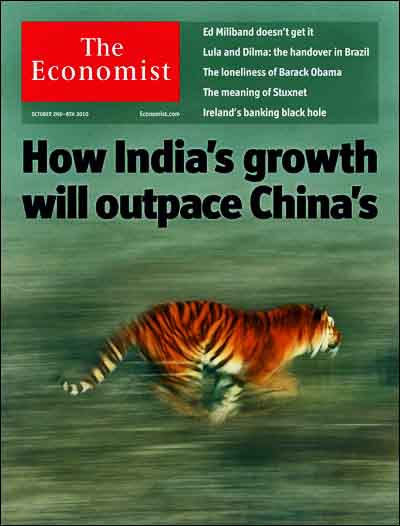
The cover for The Economist of October 2 – 8, 2010, is betting on a race that cannot be won by India.


I opened the magazine and read the two pieces that the cover was about.  One is about India’s surprising economic miracle and the second piece was A bumpier but freer road.

On page 11, I read, “many observers think China has done a better job than India of curbing corruption…”

On page 77, a Western banker was quoted saying, “It’s much easier to deal with the well-understood ‘org chart’ of China Inc than the freewheeling chaos of India.”

After reading both pieces comparing China with India, it was obvious that India would never beat China economically.

The Economist wants India to win this race, because it is called a democracy as is the U.S., but what isn’t mentioned is that China is becoming a republic with a Chinese twist, which is what Dr. Sun Yat-sen wanted.

The reason The Economist is wrong about India is because America’s Founding Fathers hated democracy and they had a good reason.

The Live Journal goes into detail on this topic.  To quote the Live Journal, “It would be an understatement to say that the (U.S.) Founding Fathers hated democracy. They warned against it vehemently and relentlessly. They equated it – properly – with mob rule.

“in a democracy, two wolves and a sheep take a majority vote on what’s for supper, while in a constitutional republic (which China is becoming), the wolves are forbidden on voting on what’s for supper and the sheep are well armed.…

“The Founders, who hated democracy, gave us a free country (a republic). Our (meaning many Americans) ignorance of history, which has lead to a love of democracy, is causing us to surrender our freedoms at an alarming rate.”

Dr. Sun Yat-sen (1866 – 1925), known as the father of modern China, said he wanted to model China’s government after America but by combining Western thought with Chinese tradition.

When he said this, it was 1910, and America, by definition, was still a republic. Once you read the two pieces in The Economist, you may understand why India’s democracy cannot beat China’s evolving republic.

This topic is continued (with more details and facts) at India Falling Short

_______________

Lloyd Lofthouse is the award-winning author of My Splendid Concubine [3rd edition]. When you love a Chinese woman, you marry her family and culture too. This is the love story Sir Robert Hart did not want the world to discover.

Subscribe to “iLook China”!
Sign up for an E-mail Subscription at the top of this page, or click on the “Following” tab in the WordPress toolbar at the top of the screen.

About iLook China


Bamboo

October 12, 2010

Chinese culture considers Bamboo lucky because Bamboo is the Chinese symbol for strength.

Bamboo demonstrates strength by growing fast and adapting to new environments. Because of this, many in China see Bamboo as a symbol of luck, which explains why Bamboo is often given as a gift.


Bamboo Flute Music & Beautiful China

In fact, Bamboo is the most popular plant in China.  Most Chinese, even in high-rise apartments, have Bamboo plants around in small pots.

Bamboo represents the spirit of summer, simplicity and humility, and respect for elders among other things.

Painting Bamboo goes back centuries. Musical instruments have been made of Bamboo.

China’s first cannons were made of Bamboo.


Painting Chinese Bamboo

My wife has planted Bamboo in the yards of every house we’ve lived in.  When my father-in-law visits from China, he has his picture taken in front of the healthiest, tallest stand of Bamboo in the yard.

In Feng Shui, Bamboo is a symbol of strength, fortitude, and rapid growth. When given as a gift, Lucky Bamboo is said to be at its luckiest.

Chinese tradition also gives meaning to the number of stalks given as a gift. Two stalks is a symbol for love, three or six represent happiness while five or seven impart health.  The more stalks there are, the more luck there will be.

Sources: The Feng Shui meanings of lucky Bamboo and Living Arts Originals

Discover Fifteen Facts that will Blow Your Mind about China

______________

Lloyd Lofthouse is the award-winning author of The Concubine Saga. When you love a Chinese woman, you marry her family and culture too. This is the love story Sir Robert Hart did not want the world to discover.

To subscribe to “iLook China”, look for the “Subscribe” button at the top of the screen in the menu bar, click on it then follow directions.