The Chinese in America – Part 3/3

June 9, 2011

Almost half a century after her death, Anna May Wong (1905 to 1961) has not been forgotten.

In fact, her life is another example of the continued discrimination against Asian-Americans and Chinese in the US by other ethnic groups, which includes Caucasions, African Americans and Latinos.

The first indication of this discrimination and racisim in the US against Chinese and/or Asian Americans appeared during the  California Gold Rush, which John Putnam wrote of in Chinese in the Gold Rush.

As a child, Anna loved going to the movies and even cut school to go to the show.

Between 1919 and 1961, she acted in 62 films. The Internet Movie Data Base says she was the “first Chinese-American movie star”.

However, to act, Anna had to play the roles she was given. The Western stereotype cast her as a sneaky, untrustworthy woman that always fell for a Caucasian man. The dark side of achieving her dream of acting in movies was that Anna had to die so the characters she played got what they deserved.

Anna often joked that her tombstone should read, “Here lies the woman who died a thousand times.”

Until Chinese started to emigrate to the U.S. in the mid-19th century, they had never encountered a people who considered them racially and culturally inferior.

The discrimination against the Chinese in America was only exceeded by the racism and hatred directed at African-Americans.

Then in the 1960s, many of the anti racist laws enacted during the Civil Rights era focused on protecting African-Americans, which created a protected class.

Since the Chinese—due to cultural differences—often did not complain, they were left behind.

In many respects, racism toward the Chinese still exists in the US and manifests itself through the media as China bashing, which supports the old stereotype.

When Anna May Wong visited China in 1936, she had to abandon a trip to her parent’s ancestral village when a mob accused her of disgracing China.

After her return to Hollywood, she was determined to play Chinese characters that were not stereotypes, but it was a losing battle. To escape the hateful racism, she lived in Europe for a few years.

Since U.S. law did not allow her to marry the Caucasian man she loved, and she was afraid that if she married a Chinese man he would force her to give up acting since Chinese culture judged actresses to be the same as prostitutes, she never married.

Anna May Wong smoked and drank too much. She died of a heart attack in Santa Monica, California at age 56.

Return to Part 2 or start with The Chinese in America – Part 1

This post first appeared on November 10, 2010 as Anna May Wong – The Woman Who Died a Thousand Times

______________

Lloyd Lofthouse is the award-winning author of the concubine saga, My Splendid Concubine & Our Hart. When you love a Chinese woman, you marry her family and culture too.

To subscribe to “iLook China”, look for the “Subscribe” button at the top of the screen in the menu bar, click on it then follow directions.


The Chinese in America – Part 1/3

June 7, 2011

While reading John Putnam’s guest post of the Chinese during the California Gold Rush, I thought of several other posts I wrote about the Chinese in America.

Putnam wrote, “White miners soon arrived and pushed the Chinese out…”

The first major wave of Chinese immigrants came to the US after the California gold rush of 1849.

Then in 1882, The Chinese Exclusion Act formalized an ugly American prejudice. In fact, there are still Americans who feel this way evidenced by a few comments left on this Blog. However, we are fortunate that more Americans appear open minded and accepting than those who do not feel that way.

This act stayed in effect de facto until 1965, when racist provisions of U.S. immigration law were removed during the Civil Rights era, liberalizing immigration by all non-European groups.

Most of these Chinese immigrants worked hard in industries like railroads, mines and canneries. The Chinese were willing to work for lower wages than European immigrants were demanding.

When there were labor strikes, companies often used Chinese workers as strikebreakers. This led to hate among European immigrants and demands that led to the Chinese Exclusion Act, which banned Chinese laborers from entering the US.

This was the first time the US passed a law to bar a specific race or ethnicity from entering the country. Source: Tenement Museum

Continued on June 8, 2011 in The Chinese in America – Part 2

This post first appeared on August 30, 2010 as Discrimination Against the Chinese in America

_______________

Lloyd Lofthouse is the award-winning author of the concubine saga, My Splendid Concubine & Our Hart. When you love a Chinese woman, you marry her family and culture too.

To subscribe to “iLook China”, look for the “Subscribe” button at
the top of the screen in the menu bar, click on it then follow directions.


Chinese in the Gold Rush – Part 2/2

June 6, 2011

Guest post by John Putnam

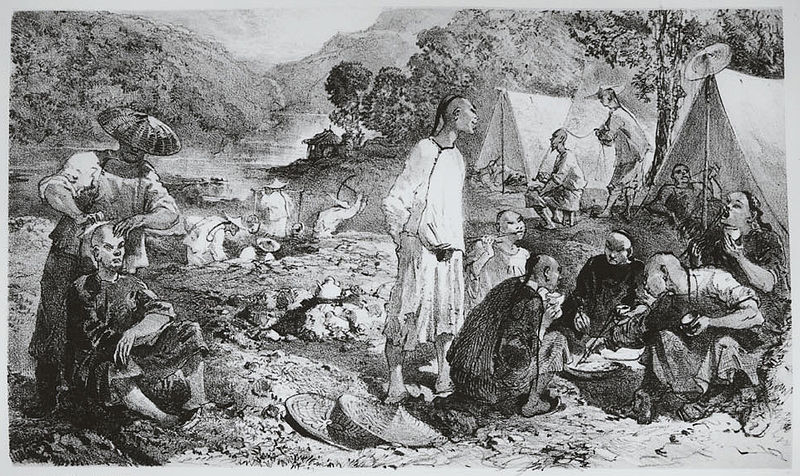
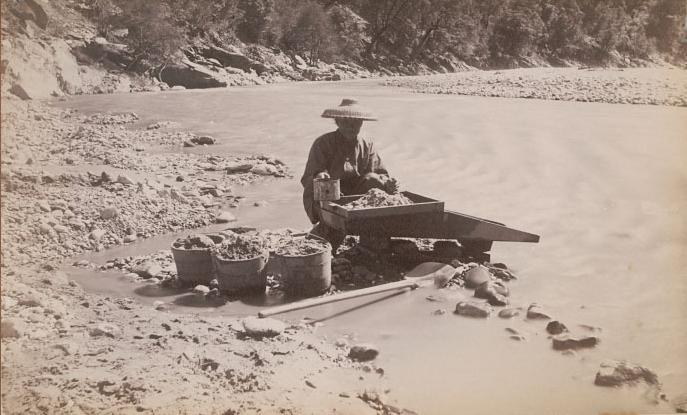
In the mines the Chinese were often forced to work sites that others had abandoned as no longer productive and, by hard work, made these claims pay.

As more men arrived in the gold fields and the amount of surface gold dwindled, tensions increased. Thirty-five Chinese showed up at Camp Salvado in 1849 where men from El Salvador had worked and here they found rich placer deposits.

White miners soon arrived and pushed the Chinese out, but they were taken in at another nearby site called Camp Washington where still more gold was found

Chinese flocked to a place where they were accepted and Tuolumne County’s Chinese Camp survives to this day.

But by 1850, a $20 per month tax on each foreign miner was imposed.

By 1852 Chinese were forced from Mormon Island and Horseshoe Bar along the American River, then from Colombia in the southern mines and Yuba City in the northern.

In 1856 Chinese paid $70,000 for the right to mine in Mokelumne Hill.

By 1868 almost all Chinese had left the mines to work on the transcontinental railroad or in Chinese operated businesses.

Return to Chinese in the Gold Rush – Part 1

____________________

Reprinted by permission. First published May 23, 2011 in My gold rush tales John Putnam is the author of Hangtown Creek, a thrilling saga of the early California gold rush.

To subscribe to “iLook China”, look for the “Subscribe” button at the top of the screen in the menu bar, click on it then follow directions.


Natural Gas, Biogas – Let’s all have Gas “Naturally!”

June 4, 2011

Recently, a friend sent me a link to news that warned of new US government regulations on hydraulic fracturing that could stop shale exploration.  If this happened, what the consumer would lose is access to the natural gas produced from shale. Source: Natural Gas for America

Earlier this week, the White House said the natural gas industry should support “common sense” regulation to ease public worry about potential water contamination from fracturing, a drilling practice vital to the U.S. shale gas boom.

In fact, according the Natural Gas.org, the US has about 100 years of supply (if developed) at current rates of consumption, while Reason.com reports that the IEA says world natural gas supplies could last more than 250 years.

While development of natural gas from shale may come to a stop in the US due to environmental concerns, China is looking at the production and resources of shale gas in the United States and is learning from America.

China’s technically recoverable resources of shale gas are estimated to be about 50 percent higher than those in the United States.

EIA.DOE.gov says, “The outlook for unconventional natural gas production is more positive in China than in OECD Europe first and foremost because China’s geology suggests a greater unconventional resource potential than in Europe. Further, although natural gas production from conventional resources in China, as in Europe, cannot keep up with domestic demand, China’s government strongly supports unconventional gas development, and public resistance is likely to be less of an impediment in China than in OECD Europe and the US.”

While developing natural gas resources in China, there is also Biogas development in rural China, which the two embedded videos talk about. China is taking advantage of waste to produce energy, which results in higher standards of living for those involved.

Imagine the biogas from 1.3 billion people and the animals raised to feed those people.

Discover The One Party Advantage, Water – Two Countries Tell a Tale, Volting China into the 21st Century or Greenpeace China

______________

Lloyd Lofthouse is the award-winning author of the concubine saga, My Splendid Concubine & Our Hart. When you love a Chinese woman, you marry her family and culture too.

To subscribe to “iLook China”, look for the “Subscribe” button at the top of the screen in the menu bar, click on it then follow directions.


Abducted, Found and Home Again

June 3, 2011

According to Missing and Exploited Children, about 800,000 children younger than 18 were reported missing (globally) in a one-year period of time studied resulting in an average of 2,185 children being reported missing each day.

China’s share of the number of abducted children was less than 10% of the global total. According to China’s Missing Children, it is estimated that 70,000 children go missing in China every year or an average of 192 a day.

These youngsters are often kidnapped and made to perform hard labor in illegal businesses, or sold into the sex trade. Traffickers also sell children to couples who are either unable to have children or who want male heirs, which is still the tradition in large parts of the country.


The Hunt for Missing Children reunites son with Chinese Parents two years after abduction. Technology was critical.

The China Daily reported on Cheng Ying that had a daughter abducted. After meeting other parents (that lost children) online last year, Cheng Zhu set up the “Parents of Lost Children League” and began to plan a month-long trip that would take his van through nine provinces, regularly stopping to not only hunt for his lost daughter but also to raise awareness of child trafficking.

The “Parents of Lost Children” is not the only organization like this in China.

“Baby Come Home” is an organization in China with about 20,000 volunteers that helps parents of missing children. Zhang Baoyan, director-general of Baby Come Home said, “People feel more comfortable with others who share the same experiences and they support each other. It is the collective power.”

Police in China are also learning how to deal with the growing crime of child abduction.

In 2009, Police in China solved 4,420 cases related to the trafficking of women and children as part of a special operation to crack down on the problem, according to the Ministry of Public Security. The mission resulted in almost 1,000 gangs being rounded up and 6,200 arrests.

With the help of a DNA database, which through a large investment has been developed into a nationwide network of laboratories, the police were able to correctly identify 298 of the 2,169 rescued children, according to figures released by the ministry.

Discover why Adoptions in China are Changing

______________

Lloyd Lofthouse is the award-winning author of the concubine saga, My Splendid Concubine & Our Hart. When you love a Chinese woman, you marry her family and culture too.

To subscribe to “iLook China”, look for the “Subscribe” button at the top of the screen in the menu bar, click on it then follow directions.