China’s [Politically Motivated?] Science Fiction Craze – Part 3/4

November 22, 2011

The history of science fiction in China predates the CCP’s encouragement today, and that interest started in the late nineteenth and early twentieth centuries — a cultural phenomenon that emerged from Western Europe’s Industrial Revolution. One site I visited while researching this topic even dated science fiction to ancient China.

In Sci-fi books? China’s got tons of those, Asia Obscura.com says, “When it comes to sci-fi movies, China’s really falling behind. One that really did impress me, though, was the very first to be produced in China: 1980′s gorgeous, fun, and campy ‘Death Ray on Coral Island’ (珊瑚岛上的死光).

“In ‘Death Ray,’ a good-hearted team of Chinese scientists, based in what appears to be San Francisco, finally succeed in completing their fabulous futuristic invention. That is, until the sinister back-stabbing Americans, played with Bond-villainous glee by Chinese actors in whiteface and prosthetic noses, decide to steal the invention for their evil plots…”, which reveals another perspective of the US.

Then Foreign Policy.com introduces us to The Prosperous Time: China 2013, written by 58-year-old Hong Kong novelist Chen Guanzhong, who has lived and worked in Beijing for much of his life.

China 2013 presents an ambivalent vision of China’s near future: outwardly triumphant (a Chinese company has even bought out Starbucks), and yet tightly controlled”, which may be a prediction that China’s one party republic is here to stay.

Continued on November 23, 2011 in China’s [Politically Motivated?] Science Fiction Craze – Part 4 or return to Part 2

View as Single Page

Note: You may read more on this topic [written by British thriller writer O. C. Heaton] over at A Rush of Green.

______________

Lloyd Lofthouse is the award-winning author of The Concubine Saga. When you love a Chinese woman, you marry her family and culture too. This is the love story Sir Robert Hart did not want the world to discover.

Subscribe to “iLook China”
Sign up for an E-mail Subscription at the top of this page.

About iLook China


China’s [Politically Motivated?] Science Fiction Craze – Part 2/4

November 21, 2011

The British Telegraph’s HG Wells on Google: which of his predictions came true? reminds us that H. G. Wells first mentioned genetic engineering in The Island of Dr. Moreau (1896), lasers in The War of the Worlds (1898), the first moon landing in The First Men in the Moon (1901), nuclear power and weapons in the World Set Free (1914), and the Second World War in The Shape of Things to Come (1933).

In addition, Computer Science Schools.net lists 15 Science Fiction Predictions that came True, while Blog Tutor.com lists eight.

Blog Tutor says, “At the time of their writing, these science fiction ideas often seemed impossible to fantastic to ever come true—and yet today’s technology seems to keep pace with the dreams of writers past.

Although Cyberspace hasn’t quite reached the level of technology William Gibson predicted in 1986’s Burning Chrome, no one can deny that the Internet’s alternative worlds … are working towards the virtual…”

With that introduction, it may not come as a surprise that science fiction fits with China’s goals to catch up with and possibly surpass the West and reclaim its heritage and history of being the most powerful and technological advanced country and culture on the planet as it was for more than two thousand years before the 19th century and the Opium Wars.

In fact, we learn from The Race is On that “China’s Government actively encourages its citizens to read Science Fiction… Mark Charan Newton calls this the “Cult of Science Fiction – that is, the faith in dreaming up Big Ideas… So perhaps the Chinese are onto something with their focus on science fiction: a genre that weds the scientific to the artistic.”

Continued on November 22, 2011 in China’s [Politically Motivated?] Science Fiction Craze – Part 3 or return to Part 1

View as Single Page

Note: You may read more on this topic [written by British thriller writer O. C. Heaton] over at A Rush of Green.

______________

Lloyd Lofthouse is the award-winning author of The Concubine Saga. When you love a Chinese woman, you marry her family and culture too. This is the love story Sir Robert Hart did not want the world to discover.

Subscribe to “iLook China”
Sign up for an E-mail Subscription at the top of this page.

About iLook China


China’s [Politically Motivated?] Science Fiction Craze – Part 1/4

November 20, 2011

This Blog explored (with Tom Carter’s guest post) how Harlequin Romance Invaded China without mentioning that romance literature in China has a history reaching back before the Dream of the Red Chamber (1715-1763), which has a tragic Romeo and Juliet love story between its covers.

I’ve also written of the rise of China’s film industry in Hollywood to Bollywood to a Rising Chinawood, while exploring the folklore and films of China’s Vampires.

As a child, I read many historical texts on Genghis Khan, Alexander the Great, the Napoleonic Wars, the British Empire, and historical fiction on similar subjects.

Then as an adolescent in middle and then high school I devoured science fiction and fantasy novels often one or two a day.

Today, I mostly read mysteries and literature but find my science fiction fantasy fix from film productions such as The Lord of the Rings, TV’s Stargate and Star Trek franchises in addition to George Lucas‘s Star Wars Saga.

Recently, I’ve been watching the complete series of Earth 2 while reading mysteries and thrillers.

In fact, the future we live with today was predicted in the early pages of Western science-fiction literature and China has noticed that science fiction literature often predicts and precedes scientific innovations such as laptop computers, the Internet, the Amazon Kindle and even doors that open automatically.

Continued on November 21, 2011 in China’s [Politically Motivated?] Science Fiction Craze – Part 2

View as Single Page

Note: You may read more on this topic [written by British thriller writer O. C. Heaton] over at A Rush of Green.

______________

Lloyd Lofthouse is the award-winning author of The Concubine Saga. When you love a Chinese woman, you marry her family and culture too. This is the love story Sir Robert Hart did not want the world to discover.

Subscribe to “iLook China”
Sign up for an E-mail Subscription at the top of this page.

About iLook China


The ordinary side of urban China delivered by Chi Li

November 19, 2011

My wife and daughter returned from China last summer with a crate of Chinese movies on DVDs—there wasn’t one American movie in the mix and many do not have English subtitles.

Therefore, it is strange that the one Chinese film that impressed me the most (so far) was one I discovered at a local Half Priced Books. The movie was Life Show (2002) adapted from a book by Chinese author Chi Li.

Since the late 1980s, Chi Li has been considered a pioneer of “new realism” and her work depicts ordinary life in China so critics have identified her work with the Western school of “existentialism”.

In fact, it was the “ordinary element” of her work that I saw in the film which captured my curiosity to learn more. Since I’ve traveled to China several times since 1999 and not with tour groups, I’ve visited streets similar to the ones that appear in the film. I’m sure most foreign visitors to China that visit on packaged tours do not see the ordinary side of China as I have.
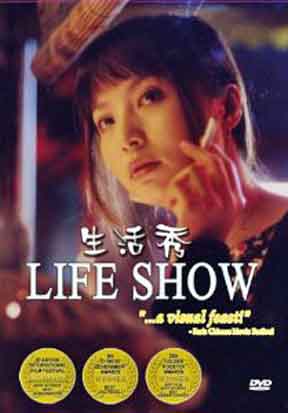
My wife says Chi Li is one of her favorite Chinese authors. The first time I was introduced to Chi Li’s work was through Life Show, which tells the story of Lai Shuangyang, a restaurant owner played by Tao Hong. Shuangyang’s life is busy dealing with family and business but she is lonely until one of her long-time customers, played by Tao Zeru, shows a romantic interest in her.

Zeru plays a middle-aged businessman, and Shuangyang takes a risk and the two strike up a romance that ends when she discovers he is the developer behind the modernization of the area where she has her restaurant.  He offers to take care of her but it is obvious that Shuangyang values her personal freedom and independence and in a fiery scene, she breaks up with him.

Lai Shuangyang’s life is filled with complications. Her younger brother Jiuju is a drug addict in jail/rehab.  The woman that loves Jiuju is Mei, who works for Shuangyang in her restaurant. Mei attempts suicide because Jiuju is not interested in her, and then Shuangyang arranged a marriage for Mei to another man, who is mentally ill.

Her sister in law, Xiaojin, is trying to regain the Lai family’s home, which was given to a neighbor during the Cultural Revolution. In addition, Shuangyang is at risk of losing her restaurant due to a redevelopment project in Wuhan.

Chi Li, the author of Life Show, is one of China’s best-known writers and several of her novels have been translated into French by publisher Actes Sud.

Chi Li was born 1957 in Wuhan, Hubei province, graduated from the Chinese Language Department of Wuhan University and then worked as an editor of a literary magazine called Fang Cao (Fragrant Grass).

Chi Li rarely travels and avoids “literary circles”.  “If my unsociability is thought to be a flaw, I admit I’m a person with a flaw,” Chi has said.

Chi Li, Chinese author of "Life Show"

During the Cultural Revolution, like millions of other young Chinese, she was sent to the countryside to become an “educated youth”. Later she studied medicine and practiced for five years before becoming a teacher.

Today, she is a member of the National People’s Congress (NPC), which provides an opportunity to discuss politics with other representative of the NPC providing an understanding/education of China’s policies and political atmosphere.

Chi Li’s work relates to love, marriage, divorce and extramarital affairs of contemporary Chinese life, while her characters are imbued with common human traits such as ambition, deceit, jealousy, and sexual desire. Her work, Comes and Goes, was a story of extramarital affairs occurring in Wuhan and became a TV series of same name.

The city of Wuhan comes alive in her work—enough to be considered a character. Although many of her novels have been translated into French, there are no English translations yet, which is a shame.

Discover Balzac and the Little Chinese Seamstress or Not One Less

______________

Lloyd Lofthouse is the award-winning author of The Concubine Saga. When you love a Chinese woman, you marry her family and culture too. This is the love story Sir Robert Hart did not want the world to discover.

Subscribe to “iLook China”
Sign up for an E-mail Subscription at the top of this page.

About iLook China


Mao’s ‘alleged’ Guilt in the Land of Famines – Part 8/8

November 18, 2011

More than one book has examined this topic from a scholarly perspective (instead of inflammatory unsubstantiated and inflated claims), but Mao’s Western critics have mostly ignored this work.

In China: Land of Famine (published in 1926 by the American Geographical Society) by Walter H. Mallory , we have a book that casts doubt on the inflammatory claims, which have been popularized in the West about the post-1949 Mao era. Mallory offers another perspective for understanding what really may have happened during Mao’s Great Leap Forward.

Then from Stanford University Press, in the Economic Cold War by Shu Guang Zhang (August 2002), “the author argues that while the immediate effects (of the complete American embargo of China) may be meager or nil, the indirect and long-term effects may be considerable; in the case he reexamines, the disastrous Great Leap Forward and Anti-Rightist campaign (The Cultural Revolution) were in part prompted by the sanctions imposed by the United States and its allies.”

In other words, if the West had been supportive of China by lifting the complete embargo after the Korean conflict (1950 – 1953), these events may never have taken place.

Once all the facts are taken into consideration and weighed without bias and emotional baggage, there is only one conclusion to reach regarding the editors of “Eating Bitterness” and the authors of “Hungry Ghosts: Mao’s Secret Famine“,  “Catastrophe and Contention in Rural China” and “Mao’s Great Famine“.

These books are frauds supporting a hoax.

It is also a fact that there are millions of people with closed minds that will refuse to accept this verdict that if Mao was guilty of anything, he was guilty of distrust and/or incompetence and not murder — at least not the deaths from the famine that took place during the Great Leap Forward in China: Land of Famines.

If you have watched the nine videos embedded with this series, ask yourself, who is guilty of starvation murder today? That “old” friend of mine I mentioned in Part 1 is against abortion and believes we should trust in God in all things, which is based on this “old” friend’s interpretation of the Bible.

World Hunger.org reports, “Poor nutrition plays a role in at least half of the 10.9 million child deaths each year, which is more than five million deaths.” This means every three to nine years, the number of children (not counting adults) that die from hunger in the world equals the 15 to 45 million that Mao’s critics claim died of starvation in China  during the Great Leap Forward (the actual number may be closer to three million).

In fact, between 13 and 18 million men, women and children die of starvation each year, which is one person every three and a half seconds.

Nevertheless, World Hunger.org says, “The world produces enough food to feed everyone. World agriculture produces 17 percent more calories per person today than it did 30 years ago, despite a 70 percent population increase.”

Ask yourself, will God feed the thousands that starve in the world daily, while 75% of Americans are overweight and 25% are obese.

Meanwhile, a few well-fed authors are writing books that perpetuate a hoax about Mao, who has been dead for 35 years, so who will they blame next? Maybe they should look in a mirror.

Return to Mao’s ‘alleged’ Guilt in the Land of Famines – Part 7 or start with Part 1

View as Single Page

Recommended reading on this topic for those who seek the unblemished truth: From the Monthly Review, Did Mao Really Kill Millions in the Great Leap Forward? by Joseph Ball

From Griffith University, Australia, Poverty, by David C. Schak, Associate Professor

______________

Lloyd Lofthouse is the award-winning author of The Concubine Saga. When you love a Chinese woman, you marry her family and culture too. This is the love story Sir Robert Hart did not want the world to discover.

Subscribe to “iLook China”
Sign up for an E-mail Subscription at the top of this page.

About iLook China