Tibet Inside China – 4/5

April 12, 2010

From recent news, it appears that rough times may be ahead for the People’s Republic of China (PRC). In China sees US as hedge for Taiwan, Tibet (Asia Times) by Peter Lee, the author says, “After the Dalai Lama is gone, there is a strong possibility that motivated and organized pro-independence activists (militants) will be able to win power in the Tibetan government in exile.”

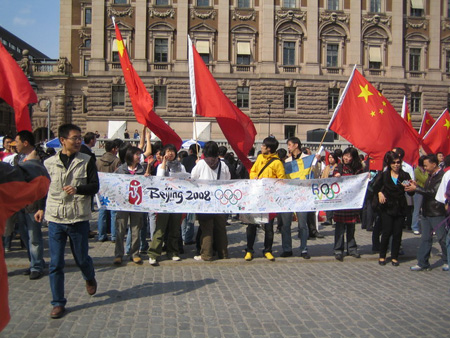
Chinese Protesting Against Tibetan Supporters

Militant Tibetan separatist groups have not been happy with the Dalai Lama’s call for autonomy talks with China instead of calling for a fight to gain independence. Tibetan militant groups want Tibet to break from China even if it means taking a violent path—one the Dalai Lama does not advocate.

What would Tibet be like if the separatists had their way and broke free from China?

Would they return to the system of landowners and serfs (slaves)?

Would the Tibetan Buddhists require that every family send at least one son to become a Buddhist monk as before?

Would mandatory schooling (as we have in the United States) be shut down so the literacy rate would plummet from the high 90% back to a single digit like it was prior to 1950?

Would the wealth and the land be returned to the one percent that had it all before Mao’s troops occupied Tibet?

Learn about the Media Slugfest Using Taiwan or go to Tibet Inside China – Part 5

View as Single Page

_______________

Lloyd Lofthouse is the award-winning author of My Splendid Concubine [3rd edition]. When you love a Chinese woman, you marry her family and culture too. This is the love story Sir Robert Hart did not want the world to discover.

Subscribe to “iLook China”!
Sign up for an E-mail Subscription at the top of this page, or click on the “Following” tab in the WordPress toolbar at the top of the screen.

About iLook China


Tibet Inside China – Part 3/5

April 12, 2010

The most damaging evidence against Rinpoche’s claims come from the October 1912 issue of The National Geographic Magazine (I have a copy—it cost me $20 on e-bay). Since the earliest evidence of Communists in China was about 1920, and it wasn’t until 1949 that the Communists came to power under Mao, there is no way the Chinese doctor who wrote that 1912 piece could have lied for the Communists.

Ming Dynasty 1368-1643

On page 979, Dr. Shaoching H. Chuan wrote, “Tibet is governed by the Dalai Lama as politco-religous head and two “Ambans” as the political dictators. The Ambans are appointed by the Chinese Emperor every four years. All governmental affairs have to undergo examination by the two Ambans, and all government policy must be sanctioned by them before it can be put into operation. Literally, the Dalai Lama is under the authority of the two Ambans…” (Page 979)

Go to Tibet Inside China – Part 4

View as Single Page

_______________

Lloyd Lofthouse is the award-winning author of My Splendid Concubine [3rd edition]. When you love a Chinese woman, you marry her family and culture too. This is the love story Sir Robert Hart did not want the world to discover.

Subscribe to “iLook China”!
Sign up for an E-mail Subscription at the top of this page, or click on the “Following” tab in the WordPress toolbar at the top of the screen.

About iLook China


Tibet Inside China – 1/5

April 11, 2010

In 2008, I wrote a post about Tibet on another forum. Someone with a Tibetan sounding name left a comment in crude English calling me a “Communist rabbit”.

Name-calling seems to be popular these days. In America, people like Glenn Beck (FOX network), Rush Limbaugh (600 radio stations) and the Tea Baggers have developed name-calling into an art form—not much substance but colorful and angry.

The Tibetan government in exile’s Prime Minister Samdhong Rinpoche was quoted in “Good” magazine’s May/June 2008 Issue that six-million Tibetan Buddhists still lived in Tibet. He also said that Tibet has never historically been part of China. That isn’t true. Tibet was ruled by three of China’s Imperial Dynasties.

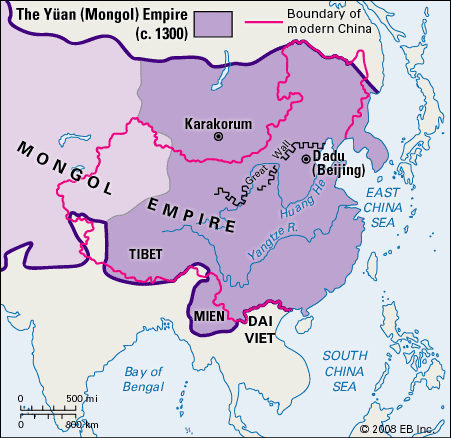
Yuan (Mongol) Dynasty 1277 – 1367

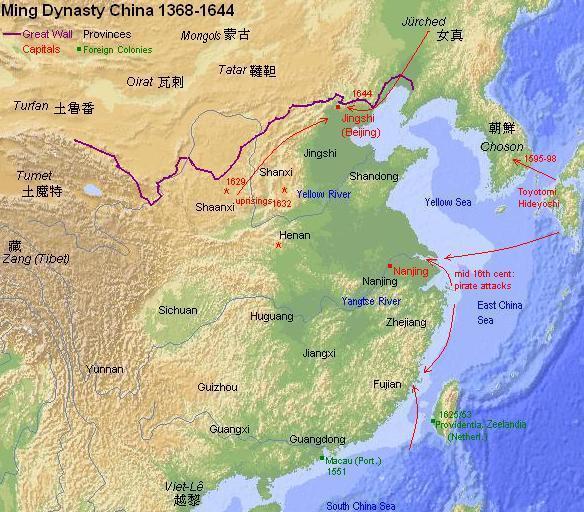
Tibet was first ruled by China during the Yuan Dynasty (1277-1367). Then, when the Ming Dynasty (1368-1643) reclaimed China, a Ming Imperial army was sent to Tibet to drive out the last of the Mongols–holdovers from the Yuan Dynasty. The Ming emperor ordered his army to stay.

When the Ch’ing (Manchu) Dynasty (1644-1911) came to power, the Chinese empire expanded further and Tibet remained in China. Later, I’ll provide evidence from a 1912 National Geographic magazine as proof.

Discover Wearing China’s Shoes or go to Tibet Inside China – Part 2

View as Single Page

_______________

Lloyd Lofthouse is the award-winning author of My Splendid Concubine [3rd edition]. When you love a Chinese woman, you marry her family and culture too. This is the love story Sir Robert Hart did not want the world to discover.

Subscribe to “iLook China”!
Sign up for an E-mail Subscription at the top of this page, or click on the “Following” tab in the WordPress toolbar at the top of the screen.

About iLook China


Dictatorship Defined

April 7, 2010

There is so much misleading information on the Internet and from the Western media regarding China that it boggles the mind. For example, China’s President is listed as a dictator but by definition, he cannot be a dictator.

Dictatorship: 1) government by a ruler who has complete power 2) a country that is ruled by one person who has complete power (source: Longman Advanced American Dictionary)

Chinese Constitution: Article 1

Article 1. The People’s Republic of China is a socialist state under the people’s democratic dictatorship led by the working class and based on the alliance of workers and peasants. The socialist system is the basic system of the People’s Republic of China. Sabotage of the socialist system by any organization or individual is prohibited. Source: Chinese Constitution

I asked my wife, “How can China use the term dictatorship in Article 1 if China isn’t ruled by a dictator?”

She replied, “In Chinese, ‘people’s democratic dictatorship‘ means the people have the power. It’s a translation error.”

I then Googled dictatorship and discovered Parade’s Annual list of…the World’s 10 Worst Dictators.

Parade’s definition of a dictator says, “A ‘dictator‘ is a head of state who exercises arbitrary authority over the lives of his citizens and who cannot be removed from power through legal means.” Hu Jintao, China’s president, was number six on Parade’s list, but the claims used to include Hu Jintao are wrong.
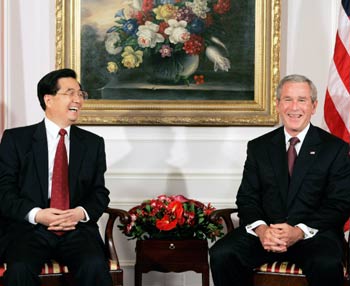
Presidents Hu Jintao and George Bush

For example, Parade claims that at least 400,000 residents of Beijing were forcibly evicted from their houses prior to the 2008 Olympics. That’s not true—the people sent from Beijing before the 2008 Olympics was transient labor and did not have residence cards and could not own property in Beijing. They were not legal residents and many transient laborers in China rent rooms shared with others in a communal environment crowded with bunk beds crammed in every possible space—like a military barracks. I know, because I’ve seen places like this in Shanghai. I also learned that the government paid for the transportation costs.

The reason Beijing sent those people away was because some were from Tibet and Xinjiang and may have been separatists, who might have staged protests to embarrass China—something the Chinese government avoids like the plague. The truth is, those people were sent home to their villages and were allowed to return to work after the Beijing Olympics. For them, it was like a vacation. Most also return to their villages during the Chinese New Year to be with their families because that’s where their homes are.

Since the Chinese Constitution rules China, Hu Jintao does not exercise arbitrary authority over the lives of his citizens. In fact, I doubt if he makes any legal decisions since the Chinese Constitution puts that power in the hands of China’s legal system. Discover more at China Law and Justice System

Parade is also wrong that China’s president cannot be removed from power through legal means.

Article 79 says, “The term of office of the President and Vice-President of the People’s Republic of China is the same as that of the National People’s Congress, and they shall serve no more than two consecutive terms.”

Article 59. The National People’s Congress is composed of deputies elected by the provinces, autonomous regions and municipalities directly under the Central Government, and by the armed forces.

Article 63. The National People’s Congress has the power to recall or remove from office the following persons:

(1) The President and the Vice-President of the People’s Republic of China;

(2) The Premier, Vice-Premiers, State Councillors, Ministers in charge of Ministries or Commissions and the Auditor-General and the Secretary-General of the State Council;

(3) The Chairman of the Central Military Commission and others on the commission;

(4) The President of the Supreme People’s Court; and

(5) The Procurator-General of the Supreme People’s Procuratorate.

Discover Stereotypes and/or The Failure of Multiculturalism in the United States

______________

Lloyd Lofthouse is the award-winning author of The Concubine Saga. When you love a Chinese woman, you marry her family and culture too. This is the love story Sir Robert Hart did not want the world to discover.

To subscribe to “iLook China”, look for the “Subscribe” button at the top of the screen in the menu bar, click on it then follow directions.

Human Rights the Chinese Way

April 5, 2010

In the West, the individual is more important than the whole. In China, the whole is more important than the individual.

Just like China created capitalism Chinese style, the Chinese are building a bridge to human rights the same way. However, they see things different from Western democracies that are burdened with debt, crime, serious drug problems and swelling prison populations. To allow the freedoms that led to these problems in the West would be a loss of face for China’s leaders.

Due to Confucius’s teachings twenty-five hundred years ago, most Chinese value family and piety first—something that has all but vanished in the West.

Luo Haocai

“China believes that human rights, like other rights, are not ‘absolute’ and the rights enjoyed should conform to obligations fulfilled. China opposes separating rights from obligations,” said Luo Haocai at the Beijing forum on human rights.

Many Chinese know what Western freedom is like. After all, many Chinese have attended universities in Western countries. Most of these individuals have experienced freedom Western style and learned that the Western concept of freedom doesn’t match Chinese values. Family obligations come first in China.

To understand the Chinese better, learn about The First of All Virtues

______________

Lloyd Lofthouse is the award-winning author of the concubine saga, My Splendid Concubine & Our Hart. When you love a Chinese woman, you marry her family and culture too. 

If you want to subscribe to iLook China, there is a “Subscribe” button at the top of the screen in the menu bar.