Note from Blog host — another example of East meets West through business and trade:Sexy Beijing says they are an “Internet TV station run by an in-house production team. We also work with a handful of contributors in the editing room and on productions. Our shows have also aired on NBC in Los Angeles, Hunan TV, China Educational TV, and many other stations around China as well as conferences around the world… From the BBC to CNN.com to Hunan Satellite TV, Sexy Beijing has been glowingly covered on television, radio and in print, in both the English-language and Chinese media.”
New Yorker.com says, “Sexy Beijing’s creator is Anna Sophie Loewenberg (Note: she graduated from University of California at Santa Cruz with a BA in Literature and went on to earn a master’s degree in Journalism from Columbia University in New York City. Sophie arrived in China in 1996). She is the star and producer of ‘Sexy Beijing,’ an online series of sly, knowing videos about a hapless, curious foreigner which has proved popular among expats, language students, and mainland Chinese.”
(Note: There are more photos at the original site. The Nanjing Road photo here does not appear at Speak Without Interruption.)
Wherever people normally congregate in groups—shopping areas, elevators, subways, airports, city streets, and the like—there are a lot more people in China congregating in those same places. Again, I can only use my own experiences – in these types of crowds in China – but I was amazed how tolerant people were of each other.
In some cases I was squeezed to the people next to me so closely that I could almost feel their hearts beating. In these situations – personal space was at zero.
I was crammed into a subway once and could literally stand – without holding on to anything – because we were packed so close together (not that I really had anything to hold on to anyway). The exit from this subway was orderly and people were polite to each other – and me. At our stop, we had to ask people to move, which was difficult for them, but we got off with no problems or delays.
Normal crowd for Nanjing Road in Shanghai
I am not certain the Chinese people have a choice living – and working – among that many other people. However, I saw it as another attribute of China and its people.
As a “Westerner” I could have easily been accosted by anyone in these large crowds as most of the time I was the only non-Chinese among them. But this never happened. No one stared at me or otherwise acknowledged me as anything other than one of them.
Perhaps I am reading too much into these situations, but I will go with my feelings here and believe this is a nation of extremely tolerant individuals.
Places I went did not always have these types of crowds, but in the locations where large crowds congregated, I was always impressed by the politeness of my fellow “Crowdies”. I can’t say the same for other crowds, in which I have found myself, in the US and other parts of the world. I think China is unique in this area and its people have Tolerance to Infinity.
Note from Blog host – If you plan to do business in China, I recommend visiting the China Law Blog first.
Lloyd Lofthouse is the award-winning author of The Concubine Saga. When you love a Chinese woman, you marry her family and culture too. This is the love story Sir Robert Hart did not want the world to discover.
Subscribe to “iLook China” Sign up for an E-mail Subscription at the top of this page.
Note from Blog host — another example of East meets West through business and trade:The Wall Street Journal reported, “Beijing Brews Up Its Own Craft Beers… With the recent opening of Slow Boat Brewery in Beijing, the city’s number of American-style microbreweries officially doubled — to two. Mr. Jurinka and Slow Boat co-founder Daniel Hebert are looking to open a tap room and sell their beer directly to local bars and restaurants… The other brewpub in town is Great Leap Brewing, set in a classic hutong in Beijing’s Gulou neighborhood… Great Leap’s owner, Carl Setzer, has been living in China and Taiwan for eight years… U.S. microbrew beer exports to China hit a record in 2010, with sales reaching $546,000, five times the level just five years ago…”
_____________________
Guest Post by Bob Grant — publisher/editor for Speak Without Interruption, an international online magazine.
As I write about my personal experiences in China, I again want to note that they are strictly that—my “personal” experiences. I am certain there are people, who have visited China who could contradict everything that I have, or will write. The products I imported perhaps did not lend themselves to the typical “Sweat Shop” stereotype in terms of the factories that produced them.
However, I never saw or visited any factory that, in my mind, would fit that definition.
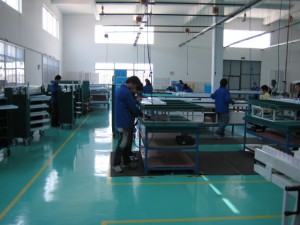
If the factories were not what I would call “modern”—they were certainly clean. The employees (factory workers) wore uniforms at most places I visited. They seemed proficient in their work and the products produced, and for the most part, were without quality problems—certainly no different from products produced in other countries.
Most of the factories tended to be in Industrial Parks that were quite large. Usually, the factories were a “small city” into themselves. There was housing provided for the employees on the factory grounds along with areas for recreation. I don’t suppose there was another way of doing it, but I saw a lot of laundry hanging from outside the housing units plus commercial apartments buildings I saw throughout China.
Most factories had certifications that were either the same or similar to those held by US factories. I saw elaborate R&D sections in most of the factories I visited. The office space was usually as modern and pleasant as any I had visited in the US.
A ritual that I truly enjoyed was at every meeting when hot tea was served. Sometimes the owner or general manager had tea to make in their office and other times it was brought in. However, I can’t recall a meeting where tea was not offered.
Being a non-smoker, another ritual I did not enjoy was in almost every meeting I attending most of the parties present smoked. I heard a figure once that 85% of Chinese men smoked. I can attest that this is probably a good estimate. Once inside the office or meeting room, the smoke became quite thick and uncomfortable for me; however, I was their guest and felt I could put up with the discomfort in the course of conducting my business affairs.
I have fond memories of my factory visits and discussions. I think the fact that I came to China, and met with the factory personnel aided my business immensely versus doing business in name only.
Note from Blog host – If you plan to do business in China, I recommend visiting the China Law Blog first.
Lloyd Lofthouse is the award-winning author of The Concubine Saga. When you love a Chinese woman, you marry her family and culture too. This is the love story Sir Robert Hart did not want the world to discover.
Subscribe to “iLook China” Sign up for an E-mail Subscription at the top of this page.
In August 2010, the China Daily reported, “The number of private enterprises reached 7.5 million, accounting for half of China’s gross domestic product, 70 percent of the nation’s technical innovations and 60 percent of its patents.” In addition, “China’s top 500 private companies have surpassed State-owned enterprises in many indicators, especially tax payments and employment creation, according to a report from the All-China Federation of Industry and Commerce.”
In fact, Bloomberg.com says, “Many of the world’s richest self-made women are Chinese,” and Psychology Today.com tells us, “Women own more than 40% of private businesses in China.”
Meet one of those women. Judy Leissner was 24 when she became the CEO and President of 168-acre Grace Vineyard in Shanxi province, south of Beijing after she quit her job at Goldman Sachs.
The first grape-vine plantings were in 1997 and the first vintage in 2001. Judy started the winery because her father liked to drink. Today, Judy produces a quality wine—about 700,000 bottles annually.
Most people do not know that quality wine is produced in China. In fact, Judy has competition since there are about 400 wineries in China.
Judy says there is an opportunity in China to make a lot of money in a short period of time, because the country is developing and growing.
The difference between the wine market in China and the rest of the world is that most drinkers in China must drink because they have to. It’s part of the culture of doing business and developing guanxi.
In an update, Grape Wall of China.com visited Grace Vineyard in September 2011, and Jim Boyce says he visited Grace CEO Judy Leisser. He says, “About a week ago, she sent an email that the wines Grace bottled under screw cap earlier this year are doing fine and, if all goes well with final trials, the winery will switch closures this year for its entry level and premium level wines. Grace’s Premium Chardonnay ranks among the better Chinese wines and is found in top hotels and restaurants in Beijing and Shanghai.”
In addition, in an interview at 24×75.com with Judy Leissner October 17, 2011, she was asked how different the work environment for Grace Vineyard was compared to Goldman Sachs where she worked prior to becoming CEO of the vineyard in Shanxi Province. She said, “Goldman Sachs is a fast-pace, can-do, efficient place.” However, for the winery, she said, “The whole atmosphere was rather sleepy.”
In another question, Judy was asked about social responsibility and what those two words mean. She responded with, “We guarantee our growers basic income… Grace is a perfect example of an environmentally friendly and sustainable business. We provide many jobs for people from nearby villages.”
______________
Lloyd Lofthouse is the award-winning author of The Concubine Saga. When you love a Chinese woman, you marry her family and culture too. This is the love story Sir Robert Hart did not want the world to discover.
Subscribe to “iLook China” Sign up for an E-mail Subscription at the top of this page.
Back in November 2010, I wrote about IKEA Sleepovers in Beijing. When I wrote that post about customers snoozing at IKEA’s Beijing store, I had no idea that napping was a custom in much of China. I thought it was because the beds at IKEA were more comfortable than the ones at home. If you have ever slept on an average Chinese bed, you may know what I mean.
The reason I didn’t know this was because my wife does not take naps. However, my father-in-law, who is age 82, naps every afternoon, but I thought it was due to his age.
Then after more than a decade of marriage, I asked my wife if her father had always taken afternoon naps. She said yes and that even at work in Shanghai during the Cultural Revolution, the Chinese Communist Party bosses made everyone take a long nap after lunch—about two hours each day.
Deciding to learn more on this topic, I turned to Google. Middle Kingdom Life.com, says. “The Chinese, particularly those in the southern and south-eastern regions, take what could be called an afternoon siesta that lasts from approximately 12 noon to 2:30 p.m.”
I learned that afternoon naps in China are common, but that doesn’t mean everyone does it. Using Google, I also learned that the Internet and the modern-urban lifestyle has cut into the old habit of napping.
In fact, micro-blogging in China has had an impact on this centuries old custom. MSNBC.com reported that the Chinese government “sensitive to public opinion, especially stories of lazy or corrupt bureaucrats carried by massively popular micro-blogging sites,” cracked down on napping at meetings in an attempt to “instill a greater sense of duty into its officials.”
If this trend continues, this might seriously impact public health, creativity and learning in China.
In addition, the New York Times reported, “New research has found that young adults who slept for 90 minutes after lunch raised their learning power, their memory apparently primed to absorb new facts.”
“Other studies have indicated that sleep helps consolidate memories after cramming, but the new study suggests that sleep can actually restore the ability to learn,” which may explain why “Most Chinese schools have a half-hour nap programmed straight after lunch.” Source: Wiki.answers.com
Then from the China Post, I discovered, “According to the advocates, a short 10-20 minute nap in the middle of a working day can increase productivity by over 30 percent and alertness by 100 percent as well as improve memory and concentration. They also claim that it can reduce stress and the risk of heart disease by 34 percent.”
Maybe I should consider cultivating an afternoon nap.
______________
Lloyd Lofthouse is the award-winning author of The Concubine Saga. When you love a Chinese woman, you marry her family and culture too. This is the love story Sir Robert Hart did not want the world to discover.
Subscribe to “iLook China” Sign up for an E-mail Subscription at the top of this page.
Pub Med Central provides a better history of the one-child policy.
“In 1979, the one-child family policy was developed and implemented in response to concerns about the social and economic consequences of continued rapid population growth,” Pub Med said, and, “implementation was more successful in urban areas than rural areas.”
Pub Med says, “It was hoped that third and higher order births could be eliminated and that about 30% of couples might agree to forgo a second child… In some of the largest and most advanced cities like Shanghai, sizeable proportions of couples already chose to have only one child (regardless of the law).
“As a result, it was not long before 90 percent of couples in urban areas were (easily) persuaded to restrict their families to a single child.”
However, Pub Med says, in rural areas of China the opposite happened, and 90 percent of women with one child went on to have a second (regardless of the law) and there wasn’t much the Communist Party could do to stop them.
AP’s Louise Watt writes, “Under China’s one-child policy in place for the last three decades to control population growth, couples can be penalized for having more than one child. In Beijing, the penalty is a one-off fee 3-10 times the city’s average income, a maximum of 250,000 yuan ($40,000).”
Watt also tells us that among the 20,000 Chinese with at least 100 million yuan ($15 million) 27 percent have already left China and 47 percent are considering it, and they want to leave so they can have more children on the cheap and buy land that does not belong to the government.
These wealthy Chinese Louise Watt writes of may be surprised to discover that if the U.S. wants to build a school, park, freeway or shopping center, and your house is in the way, it will be bought and bulldozed.
The law for this is called Eminent Doman and 60 Minutes at CBS Newsreported on possible abuses of this in the United States in February 2009. Rebecca Leung of CBS News wrote, “But did you know the government can also seize your land for private use if they can prove that doing it will serve what’s called ‘the public good’?”
In addition, it would be interesting to discover if some or all of the wealthy Chinese claiming to have left China to have more children and buy a home left for other reasons they are not talking of.
In The Danger of False Truths, I mentioned that thousands of corrupt Chinese officials stole more than $120-billion U.S. and fled overseas—and the U.S. was a top destination.
If so, the real reason many of these “wealthy” Chinese left China may have been to avoid going to prison or being executed.
In addition to Eminent Domain, if an American cannot pay the annual property tax or income tax in the United States, the house will be lost to the government. I estimate that the property tax I paid since I first owned a home in 1973 would have paid the penalty for a dozen extra children in China.
In fact, due to property tax, no one really owns their homes in America and everyone is just a tenant, and the U.S. Government is the landlord. In China, they call it like it is, while in the US, most people believe in fairy tales.
And if you were worth $15 million dollars and wanted a second or third child, $40,000 a child would not dent that fortune. In addition, in China when someone buys a house for that 70-year lease, the property tax is paid only once at the time of the purchase and currently there is no law that says you have to pay any property tax again unless it is an investment property.
When these rich Chinese arrive in the US and buy a million dollar house, they will be paying property tax annually. Taxes on land and the buildings on it are the biggest source of revenue for local governments.
In California, for example, property tax for a million dollar house costs about $10,000 a year, and forty years of property tax would cost about a half million dollars, which is much more than $40,000 for the second child and another $40,000 for the third child.
Maybe Louisa Watt should have also mentioned that U.S. citizenship is for sale for foreign millionaires and the details may be found at All Voices.com, and most Americans could not afford this legal bribe (sorry, I meant deal).
In fact, there’s a lot about China’s one-child policy that Louise Watt isn’t revealing, and what she writes may have to do with America’s busy-body, do as I say morality, which interferes as often as possible in the domestic philosophies and affairs of other countries—something China does not do.
For decades, China’s one-child policy has been criticized in America and/or the West mostly by evangelical, fundamentalist Christians that represent one of American’s squeaky wheels with a political agenda to force their beliefs on others.
However, what these critics do not know may shock them, but I doubt if it will deter their misguided zeal.
In the September/October 2011 issue of Foreign Policy magazine, Phillip Longman wrote The World Will Be More Crowded With Old People, and said, “Another related megatrend is the rapid change in the size, structure, and nature of the family. In many countries such as Germany, Japan, Russia, and South Korea, the one-child family is now becoming the norm (without a law)… Today about one in five people in advanced Western countries, including the United States, remains childless.”
AP’s Louise Watt also doesn’t tell us the one-child policy does not apply to the hundred million people in China that belong to one of the fifty-six minorities or many of the Han Chinese living in rural China where most Chinese don’t pay property tax, rent or a mortgage payment since the land is owned collectively and may not be sold.
Since minorities in China are a small segment of the population, China’s government practices flexibility with the minority birth rate in order to keep minorities an important part of China’s culture.
For example, Tibetans may not live the feudal, nomadic lifestyle with the 35-year lifespan they once had under the Dalai Lama (the average lifespan in Tibet today is more than 60 without the Dalai Lama), which they had before Mao sent the People’s Liberation Army (PLA) into Tibet in 1950.
Isn’t it horrible how the Tibetans were forced to give up that shorter average lifespan and feudal servitude?
However, as a minority, Tibetans may have as many children as they want and the penalty Louise Watt writes of does not exist for them.
We often hear of the Uighur Muslims since this minority has an Islamic separatist movement in the northwest near Afghanistan where the US is fighting a war against a similar insurgency, but the Uighurs are a minority so the one-child policy also does not apply them, and they are not the only Muslims in China.
The Hui are unique among the fifty-six officially recognized minorities of China in that Islam is their only unifying identity. They do not have a unique language as the other minorities do and often intermarry with Han Chinese.
In fact, many live outside the Hui autonomous region. Since the Hui are considered a minority, the one-child policy also does not apply to them.
The Chinese government says if it weren’t for the one-child policy, there would be another four-hundred million mouths to feed and provide shelter for. Instead of 1.3 billion people in China, there would be almost 2 billion—more than six times the population of the US, and China cannot grow crops on about 90% of its land.
Chinese law allows married couples in Shanghai that are both the only child of their parents to have two children even if they are Han Chinese.
To make sure these married couples are aware of this exception, China provides support from government run family planning centers that check on women’s health and inform them of their rights and responsibilities to have more than one child.
The Shanghai government encourages married couples eligible to have more than one child to do so, which, in Shanghai, means most married couples.
The Shanghai Family Planning Commission first promoted this policy in 2009. The reason for this campaign lies in Shanghai’s population demographics.
Because of the one-child policy, Shanghai has been particularly hard hit by an age disparity, and 22 percent of the citizens of Shanghai are over sixty and these numbers are expected to grow.
Xu Xihua, the director of Shanghai’s Aging Development Center says that by adjusting the one-child policy in Shanghai, this disparity in ages can be partially reduced and giving couples an opportunity to have two children is part of the plan.
However, the central government stresses it is not abandoning its family planning policies or its control over the number of births. Fear of overpopulation and potential famines remains high in a country that has a history of droughts, floods and famines, which is something the U.S. has not yet experienced in its brief history.
France 24 International Newsalso reported how one Chinese couple wanted to have more than one child and the couple took advantage of loopholes in the one-child policy to have three.
The mother’s first child was a boy, and she was desperate to have a girl.
Since fines are less for a second child if delivered in a remote rural province, the couple moved south.
However, the mother discovered she was pregnant again soon after the birth of the second child, which was a girl, and the doctor told her that because of health reasons she couldn’t have an abortion.
And recently, authorities in China’s most populous province have asked Beijing to ease the one-child policy.
In addition,wealthy Chinese businessmen, television and movie stars often avoid the one-child policy since they have money to pay the fine Louise Watt writes of in her AP piece, and ten percent of rich Chinese have an average of three children and this practice is spreading among the upper-middle class. Since they stay in China, these wealthy Chinese avoid paying annual property tax in America.
Peng Xizhe, dean of social development and public policy at Fudan University, says “In the Maoist era everyone was controlled by his work unit. It’s over now. Many workers are independent. It becomes more and more difficult for the government to pressure people to having only one child.”
In fact, according to some experts, China will adopt a two-child policy in several years.
However, unexpected problems besides an aging population may have developed from the one-child policy, which is explained by a NPR All Things Considered report by Louisa Lim’s Lightning Divorces Strike China’s ME Generation.
Lim says Beijing has the highest divorce rate in China with 39 percent of all marriages ending in a split.
One Beijing woman, Cheng, tells Lim of her six-month marriage that ended as fast as it started. Cheng blamed the divorce on belonging to the generation of spoiled singletons (one-child), known as the post-1980’s generation.
Dr. Perry, a professor of economics and finance in the US, agrees that the upsurge in China’s divorce rate is because of the selfish and narcissistic generation of spoiled one-child children in China (have you already forgotten that many of these urban parents decided to have only one child before or in spite of the law).
But hold on, there may be another explanation why Beijing’s divorce rate is soaring. Eight years ago, a married couple needed permission from their work unit to divorce. Today, couples have the freedom to divorce in China without asking.
Although it may be difficult to link China’s changing divorce rate to the one-child policy, there is another outcome that cannot be denied.
China may have cut off a foot to save its stomach from starvation.
Studies predict that China will soon be short 24 million wives. It doesn’t matter that it is illegal in China to take a test for non-medical reasons that determines the sex of the fetus.
Since China’s culture traditionally prefers boys to girls, many parents go to underground private clinics to find out what the sex of the fetus is. If it is a girl, many terminate the pregnany with an illegal abortion.
The results is a growing shortage of women leading to illegal forced marriages and prostitution (sex slaves), which is a challenge for the police and courts to deal with.
After you learn more of the details of China’s one-child policy, you discover that it was a law without many teeth and didn’t deserve the criticism it received, which leads to the conclusion that the American and/or West’s reaction is due mostly to racist Sinophobia.
______________
Lloyd Lofthouse is the award-winning author of The Concubine Saga. When you love a Chinese woman, you marry her family and culture too. This is the love story Sir Robert Hart did not want the world to discover.
To subscribe to “iLook China”, look for the “Subscribe” button at the top of the screen in the menu bar, click on it then follow directions.





 Posted by Lloyd Lofthouse
 iLook China