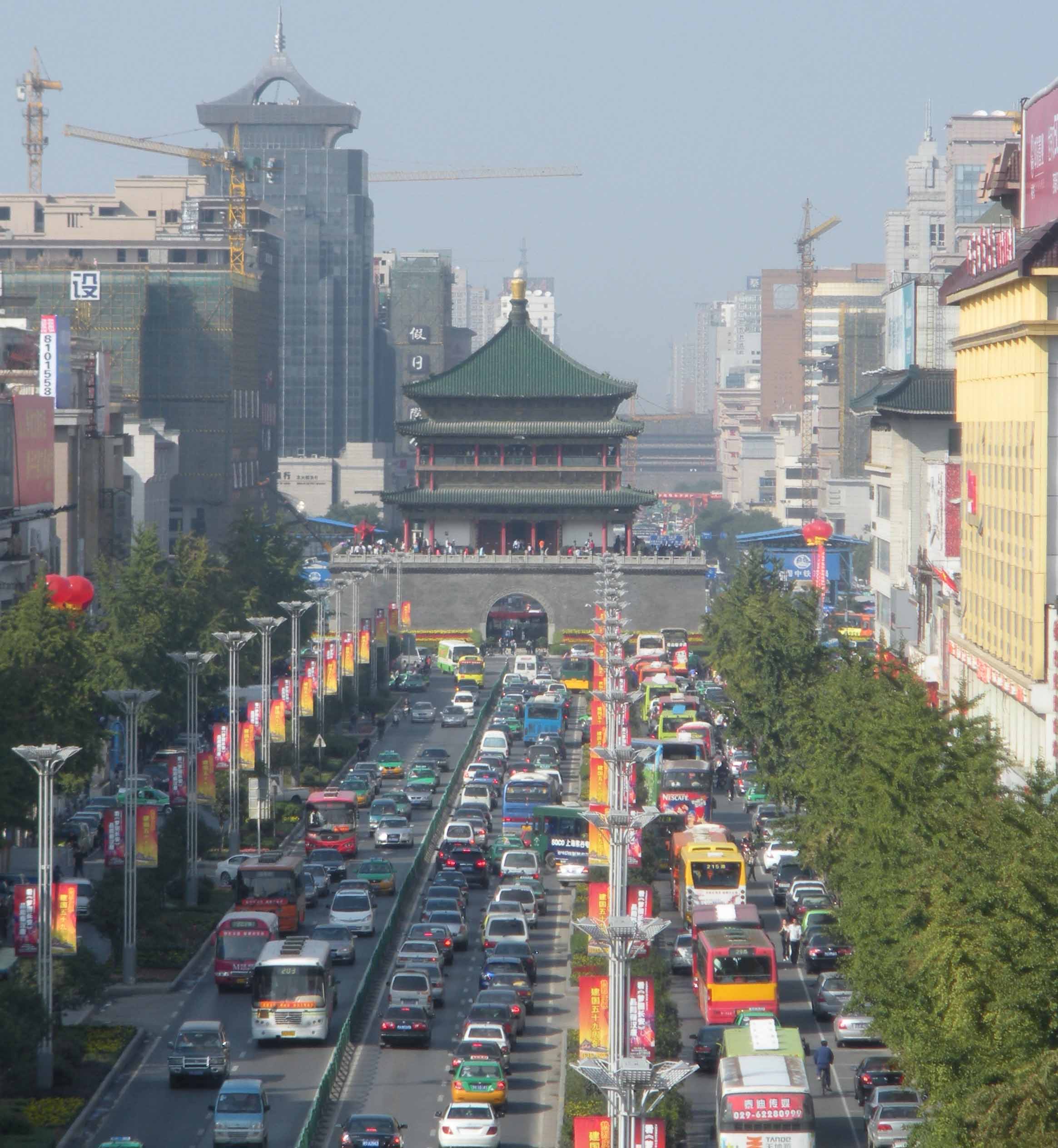
We are taking a quick trip to Xian (in pictures that is). Xian was China’s ancient capital for more than a thousand years before being moved to Beijing.
After landing in Xian in 2008, (our third visit to the city since 1999) we found a great driver. He was honest and knowledgeable. Here’s the cell phone number he had at the time (136-0916-251). If you visit Xian, I recommend you book him for the entire stay. He also introduced us to some experiences we’d never had on previous trips.
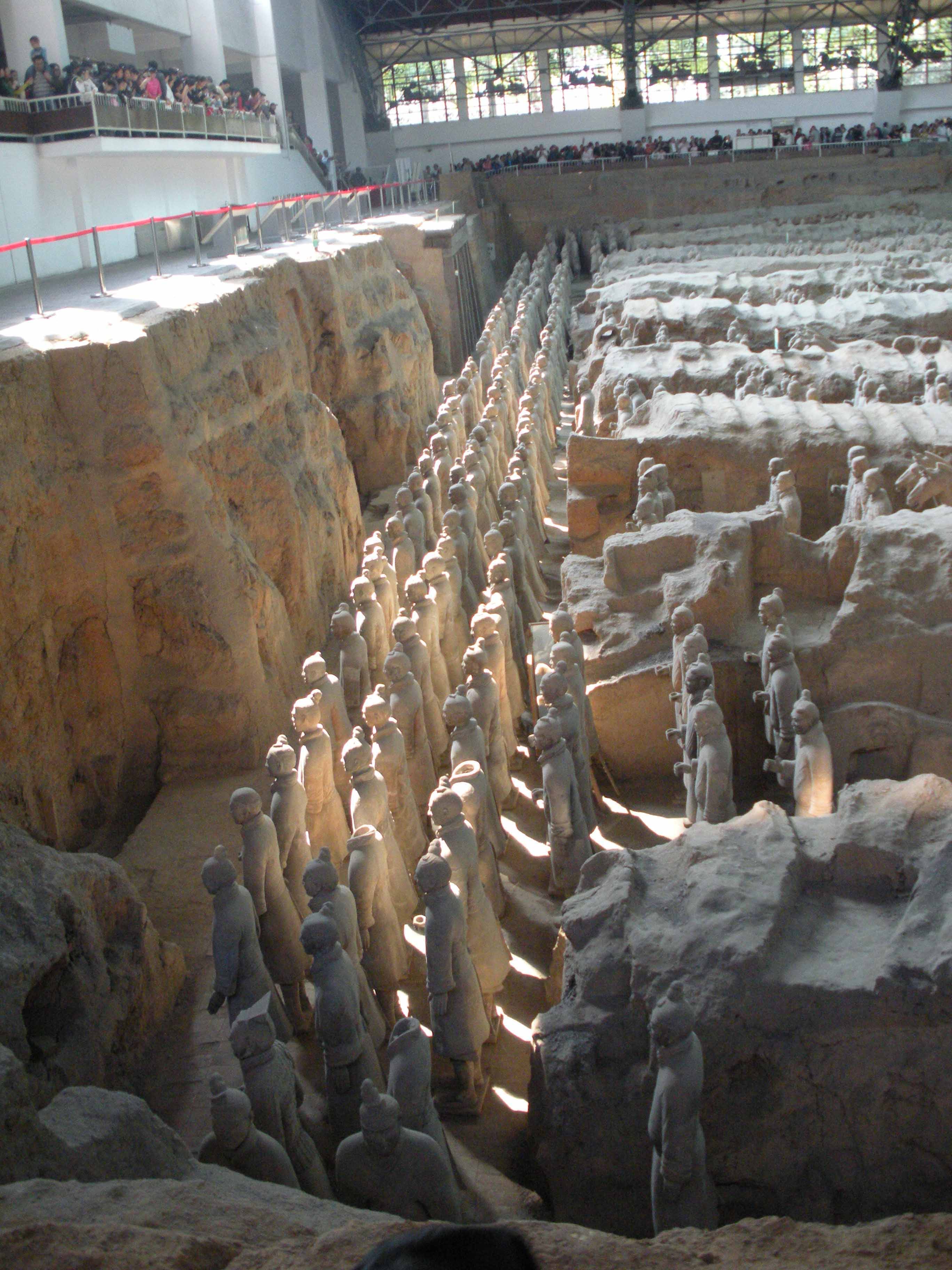
The Famous Terra Cotta warriors were created to guard China’s first emperor Qin Shi Huangdi (221-204 B.C.). Qin Shi Huangdi made Xian China’s first capital until Kublai Khan moved the capital to Beijing where he ruled his Khanbalik Empire, from 1264 to 1267.
Xian was known as Chang’an before the Ming Dynasty and is one of the four great ancient capitals of China having held that distinction under several of the most important dynasties in China’s history. In fact, Xian was a cultural center more than a thousand years before Jesus Christ was born.
______________
Lloyd Lofthouse is the award-winning author of The Concubine Saga. When you love a Chinese woman, you marry her family and culture too. This is the love story Sir Robert Hart did not want the world to discover.
Subscribe to “iLook China” Sign up for an E-mail Subscription at the top of this page.
I’m sure that you have never heard of a dictator that had term limits—in fact, two different term limits. You may often hear that the president of China is a dictator and that China is a dictatorship. However, the facts say otherwise unless the definition for this term has been changed in recent years to fit China.
However, the Longman Dictionary of Contemporary English says that a dictator is “a ruler who has complete power over a country, especially one whose power has been gained by force.”
The Oxford Dictionary (the world’s most trusted dictionaries – according to them) says, that a dictator is “a ruler with total power over a country, typically one who has obtained control by force.”
Wiki says “A dictator is a ruler who assumes sole and absolute power but without hereditary ascension such as an absolute monarch… In modern usage, the term ‘dictator” is generally used to describe a leader who holds and/or abuses an extraordinary amount of personal power, especially the power to make laws without effective restraint by a legislative assembly.”
Therefore, when the president of China is limited to two, four-year terms and/or must retire at age sixty-eight (whichever comes first) and there is a legislative body that has the power to make laws while the courts enforce them (but may not overrule or interpret those laws), does that mean that president is a dictator too? I’ll leave that answer up to the reader.
Newsmakers 2011 – Xi Jinping
In addition, Article 62 of China’s Constitution says that The National People’s Congress (NPC) “elects the President and the Vice-President of the People’s Republic of China… In Article 63, it also says the NPC has the power to recall or remove from office the President and the Vice-President, which hasn’t happened yet but to be fair, it hasn’t happened in the United States either.
Then in Section 2, Articles 79 to 84 you may discover what the power of China’s president is. In Article 80, it says, “The President of the People’s Republic of China, in pursuance of decisions of the National People’s Congress and its Standing Committee, promulgates statutes … confers state medals and titles of honour; issues orders of special pardons; proclaims martial law; proclaims a state of war; and issues mobilization orders.”
Anyway, these two posts are about the man that may rule China as its president for the next four to eight years. Earlier this month, that man visited the United States and his name is Xi Jinping.
We will learn more about him as a person in the next post.
But first, it helps to learn more about how China’s government works. Patrick Chovanec is a professor at Tsinghua University’s School of Economics and Management in Beijing, China. He says, “In China there is the Party, the Army, and the State. Unlike in the U.S., where the three branches are co-equal and are specifically designed to check and balance each other’s powers, in China the Party is supreme and rules over the other two elements. China’s ‘leadership transition’ involves coordinated handovers of power involving all three parts of the political system.”
Chovanec says, “Since the late 1990s, a semi-official mandatory retirement age of 68 has applied to all Politburo members. If that rule is applied in 2012 (and there is no reason to expect that it won’t), all seven members of the current Politburo Standing Committee besides Xi and Li (including Hu and Wen) will retire, and be replaced by new appointees.”
I recommend clicking on this link to Chovanec’s Blog to read the rest of his post on this topic. It may be worth your time to learn more about how China works.
Lloyd Lofthouse is the award-winning author of The Concubine Saga. When you love a Chinese woman, you marry her family and culture too. This is the love story Sir Robert Hart did not want the world to discover.
Subscribe to “iLook China” Sign up for an E-mail Subscription at the top of this page.
Do a Google search on “News of a coup in China” and you may end up with as many hits as I had, which was more than 110,000,000 when I was researching the topic of this post. Amazing!
I suspect this viral Internet topic has to do with dreams of democracy sweeping the world leading to global peace and prosperity for eternity, but that ain’t going to happen anytime soon.
The last time there was this much Internet excitement over revolutions was in December 2010 when the Arab Spring swept across the Middle East and North Africa toppling governments, but at what price.
In November 2011, US News and World Report said that 3,500 had died in Syria (and the fighting isn’t over yet), 250 in Yemen, a 100 in Bahrain, 30,000 in Libya, 900 in Egypt, and 300 in Tunisia. In addition many more were injured/wounded.
Al Jazeera reported almost 11 months after the Arab uprising that “freedom is not free, and there are now some clear financial costs emerging,” and the cost has reached a grand total of $55.84 billion. (Source: International Monetary Fund)
However, as the Arab Spring blossomed and spread, in America and the West there was a sense of euphoria that democracy was sweeping the globe and would arrive in China, which did not materialize as life went on as usual in the Middle Kingdom.
Then, as if prayers had been answered, on March 19, 2012, there were rumors of a coup in China and the Blogosphere and the media exploded with speculation.
If anything happened in China on March 19, it was probably a political protest by supporters of Bo Xilai, who was yanked from his position of power that week, and Bo Xilai is and was not a democracy advocate.
In fact, what he advocated was closer to a return to the era of Mao’s Cultural Revolution. Bo Xilai was also a populist figure and the last time China had a populist figure that was equal parts showman and strongman, his name was Mao Zedong, and he ruled China for twenty-six years and is infamously known in the West for his political purges, the failure of The Great Leap Forward and his closing act, The Cultural Revolution.
Hannah Beech of Global Spin, a blog about the world, its people and its politics, says, “Last May, I said on my blog that Bo Xilai wanted to become Mao Zedong,” Yang told me after Bo’s dismissal. “But he failed because in today’s China there is no need for a Mao.”
In the video, China analyst Jennifer Richmond dispels rumors of a recent coup attempt in Beijing and explores the intensifying political and economic reform debate happening in China ahead of its 2012 leadership transition.
Then the BBC reported, “Damaging coup rumours ricochet across China. Have you heard? There’s been a coup in China! Tanks have been spotted on the streets of Beijing and other cities! Shots were fired near the Communist Party’s leadership compound!
“OK,” the BBC says, “before you get too agitated, there is no coup. To be more exact, as far as we know there has been no attempted coup.
“To be completely correct we should say we do not know what’s going on. The fact is there is no evidence of a coup. But it is a subject that has obsessed many in China (and outside of China) this week.
“Photographs of tanks and armoured cars on city streets were flying around Twitter and elsewhere,” the BBC report continued. “On closer inspection though, some of the pictures seemed to be old ones from rehearsals for military parades, others did not even seem to be of Beijing, as they claimed, but different Chinese cities.”
Then in another report covering this rumor, Shanghaiist.com said, “In other countries, you might see reporters offhandedly refer to their unnamed contacts inside the Prime Minister’s Office, or the White House, or whatever institution they’re covering. Even when I worked in famously enigmatic Russia, I had a few ‘Kremlin sources’ I could occasionally turn to.”
“Not in China,” Shanghaiist continued. “I know many of the foreign journalists based here, and more than a few of the Chinese ones. None have ever claimed to me, or their readers, that they have a contact inside, or even close to, the decision-making Standing Committee of the Politburo of the Communist Party of China.”
Meanwhile, what about an update on the Arab Spring, the so-called democracy movement in North Africa and the Middle East that this post started with?
Heritage.org says, “Any kind of political instability has important policy implications for development in general, and for sustainable economic growth in particular. The recent turmoil in the Middle East is no exception…”
The Heritage.org study by Nahid Kalbasi Anaraki, Ph.D. asked three questions:
Is terrorism more likely to appear under more corrupt regimes?
Is there a long-run relationship between a country’s level of economic freedom and terrorism?
What is the impact of terrorism on foreign direct investment (FDI) and gross domestic product (GDP) per capita?
Anaraki says, “The results point to a high risk that the hopes of the revolutionary movements will founder on the rocks of terrorism and corruption.”
For more on this, Professor Timur Kuran of the Cline Center for Democracy said, “A striking feature of these uprisings is the lack of an existing opposition or charismatic revolutionary leaders. These have been truly popular revolutions. While the popular character adds legitimacy to the ideals and aspirations of these uprisings, it may also prove a weakness on the path to actual democracy. Due to decades of severe oppression, the opposition forces in almost every transforming country in the region lack recognized leadership, partisan organization, and coherent political ideology. In fact, the only organized political force in this region comes from conservative Islamist groups. Meanwhile, the emergent transitional governments are being formed under the tutelage of defecting, formerly authoritarian elites and their militaries.”
In conclusion, an Arab Spring leading to democracy, a Jasmine Revolution in China, or any revolution by any other name does not guarantee an American and/or Western style democracy will emerge in time. The only guarantee is that people in Western democracies will get excited and then soon forget they were excited as the next sensation appears, since attention spans and memories in the West are often short and opinionated.
In fact, to many in the West, the Arab Spring and rumors of a coup in China were entertainment, and the same people will soon switch to American Idol or another show such as America’s Next Top Model or maybe Survivor.
Lloyd Lofthouse is the award-winning author of The Concubine Saga. When you love a Chinese woman, you marry her family and culture too. This is the love story Sir Robert Hart did not want the world to discover.
Subscribe to “iLook China”!
Sign up for an E-mail Subscription at the top of this page, or click on the “Following” tab in the WordPress toolbar at the top of the screen.
Note from Blog host — another example of East meets West through business and trade: “Avon, the first direct-sales company in China, has 85,000 agents knocking on doors and yurts in every region except Tibet, racking up sales of $68 million in 1996. A year before, Mary Kay opened its first cosmetics plant outside the U.S. in Hangzhou. Demand has been so keen that the Texas-based firm has already broken ground on a new China factory, 15 times larger than the first one…
“China’s American embrace is most fervent at the cathedral to Yankee culture, the cinema. Beijing still allows distribution of a handful of imported flicks each year, but the ration is no longer a forced diet of scratchy Hollywood flops. These days Chinese eschew the patriotic reels still churned out by government filmmakers for the latest Sylvester Stallone and Tom Cruise blockbusters, which laud Western excesses…
“Mainland TV, undergoing its own revolution, offers another shock to seasoned sinologists. Thanks partly to satellite TV, Chinese soaps and historical serials now compete against programs that would have seemed unimaginable only a few years ago: episodes of Baywatch and The X-Files.” Source: The Americanizaton of China
______________________
Part 2 – In the PBS documentary of foreign entrepreneurs in China we discover (when the US financial crises hit the world causing more than $64US trillion in global loses while those who caused the crises walked away with fortunes) China experienced a slowdown in economic growth in 2008.
One foreign entrepreneur, Ed Hung, talks of the clothing store he co-founded, NLGX Design, which opened in Beijing in 2008. He said rent was still increasing.
Ed Hung was born and raised in San Francisco. His business partner, Michel Sutyadi, was born and raised in Germany. They met in Beijing while studying Mandarin in 2005.
Ed Hung says modern Beijing is becoming a consumer culture.
Then Doug Ma, a co-founder of Go Tour-ING, talks of how the global financial crisis (which was started in America) has affected business.
In the spring of 2008, Dough Ma left his job at an investment bank to travel. He wrote a post for Jet Set Zero in July 2009, and said, “It has been quite a challenge starting up Tour-ING. For one thing, it has been a tough year for the tourism industry. Less people are traveling due to the global economy and the outbreak of swine flu has hindered a lot of travel plans.”
Brian Sloan, CEO of Robotic Blow Job, says the sex toys he manufactures and sells seem more popular in hard economic times since people spend less money going out and stay home more so they need a method of self-entertainment.
Due to legal problems in Chicago, Sloan took his business to China because, “In China, people respect what I do as a business,” he says.
Note from Blog host – If you plan to do business in China, I recommend visiting the China Law Blog first.
Lloyd Lofthouse is the award-winning author of The Concubine Saga. When you love a Chinese woman, you marry her family and culture too. This is the love story Sir Robert Hart did not want the world to discover.
Subscribe to “iLook China” Sign up for an E-mail Subscription at the top of this page.
Note from Blog host — another example of East meets West through business and trade:Recently, the Future of US China Trade.com reported the results of a survey of 434 multinational companies doing business in China. “78% percent of companies surveyed rank China among their top three priority locations for investment. Only 7% rank China as ‘not a high priority’.”
_______________________
Part 1 – Young and Restless in China was filmed over a period of four years starting in 2004 for the Public Broadcasting Service (PBS).
Paris Franz, a student, blogger and writer with a passion for history, art and travel, wrote a post about Young and Restless in China for Suite 101.com.
This two-part segment is about foreign entrepreneurs in China. I plan to also feature other segments of this PBS Frontline documentary because it demonstrates how much China is changing. The more I learn, the more it appears that there is more freedom in China than most people outside China are aware of.
Franz wrote, “The film highlights what is unique about China at the beginning of the twenty-first century.
“The entrepreneurs – starting up tailoring, hotel and internet café businesses – are full of optimism, supremely confident that their hard work is going to make them rich. As one of them says, China today is “the land of opportunity.”
Part One starts with “there is this misconception of China that it is not modern, that it is still changing, but if you come and see with your own eyes you will discover that (urban) China (where about 500 million people live) is as modern as any city in the world.
One entrepreneur says, if you visit Beijing and see the architecture, you will see that it is leaps and bounds ahead of the US.
Another entrepreneur says, China is a melting pot for all types of entrepreneurs in Beijing… For young entrepreneur it is cheap to start something new in China compared to the US.
In fact, as the economic tide turns against the west, younger, foreign talents are taking their entrepreneurial ambitions to China because the market is right for starting a business.
One American entrepreneur says he graduated from law school at Penn State in 2005. He then talks about how he arrived in China to create, manufacture and sell his own brand of sex toys and fetish clothing.
Note from Blog host – If you plan to do business in China, I recommend visiting the China Law Blog first.
Lloyd Lofthouse is the award-winning author of The Concubine Saga. When you love a Chinese woman, you marry her family and culture too. This is the love story Sir Robert Hart did not want the world to discover.
Subscribe to “iLook China” Sign up for an E-mail Subscription at the top of this page.



 Posted by Lloyd Lofthouse
  iLook China