China’s Annual New Year Migration

December 31, 2012

We visited China and traveled during one of China’s national holidays in 2008.

My sister and her youngest daughter went with us—both are evangelical Christians and mentioned they didn’t believe in China’s one-child policy. I heard this more than once but after they arrived in China and experienced that migration, both stopped preaching about the one-child policy.

It was so crowded, it was as if we were swimming through an ocean of people.

That’s when I decided that my next trip to China will not be during any of China’s national holidays.

In fact, to deal with this migration, inhabitat.com says, “China has released a massive rail development program, which will expand the high-speed rail service to 42 more high-speed lines by 2012.”

This Al Jazeera report is about China’s annual New Year Migration of 2010. For readers who haven’t been to China, this may be your only chance to experience a taste of what it is like to live in a country with more than 1.3 billion people.

Tony Birtley of Al Jazeera, reports from a train heading south from Beijing to Hebei province.

Birtley says, “Welcome to the Chinese New Year and to the world’s biggest annual migration.… There’s something like 2,000 people on this train and you can hardly move.”

The rail system in China barely manages to move the average 220 million people traveling home to celebrate the Chinese New Year with family. But the Chinese lunar New Year is on Sunday, February 10, 2013.  That’s when you want to avoid visiting China unless you want to experience this holiday with the  Chinese. If so, pick a city and avoid traveling.

It is possible that a passenger will have to stand for a trip of 16 to 48 hours to reach their destination.

Discover Harbin’s Winter Wonderland

______________

Lloyd Lofthouse is the award-winning author of The Concubine Saga. When you love a Chinese woman, you marry her family and culture too. This is the love story Sir Robert Hart did not want the world to discover.

Subscribe to “iLook China”!
Sign up for an E-mail Subscription at the top of this page, or click on the “Following” tab in the WordPress toolbar at the top of the screen.

About iLook China


The Complex Evolution of Sex in China

October 10, 2012

A Guest Post by Richard Burger of The Peking Duck

One of the questions I hear the most is whether the Chinese people’s attitude toward sex is conservative or open-minded. And the answer is that it’s complicated.

First, there is more than one China: there’s rich China and poor China, urban and rural China, young China and older China.

Generalizations are tricky, and there always have to be qualifiers. It’s safe to say that in the larger cities like Beijing and Shanghai people are far less hung up than they were about sex twenty years ago.

Even in most of the second-tier cities you’ll find gay bars, sex shops, young couples holding hands and a lot of young people finding one-night stands over the Internet.

Sexologist Li Yinhe estimates that more than 50 percent of young urban Chinese have premarital sex, something that was unheard of thirty-five years ago. In the countryside that number is probably far lower, but most young people are leaving their rural hometowns to find work in the larger cities.

At the same time, however, traditional Chinese beliefs still hold sway over many of these young people.

For example, sex is not something you talk about openly.

In addition, when it comes time to choose a spouse, nearly all young Chinese will include their parents in the process, striving to make it a family decision.

Many if not most husbands still place a high premium on virginity and expect to see blood on the sheets the night of their honeymoon. This attitude is so fixed that every year hundreds of thousands of Chinese women have an operation to restore their hymens, or buy inexpensive artificial hymens that seep artificial blood.

This is an anomaly: more Chinese young people are having premarital sex yet men still expect their wives to be virgins.

China is in a tug of war between its conservative past and the lure of Western-style sexual freedom.

Looking at the trends and how quickly China’s sexual revolution has progressed, I would have to predict that sexual openness and tolerance will increase, and eventually China will shake off the vestiges of the sexual puritanism that prevailed under Mao.

However, for now, sex remains a touchy subject, even in the cities. Sex education, for example, is mandatory but often biology teachers who are supposed to teach it are too squeamish and simply skip to the next chapter. When they do teach this subject, the focus is on biology and anatomy, with little or no reference to contraception or sexual morality, such as the woman’s right to say no.

Here, too, there are signs of improvement in the larger cities, but it is very slow going. Sex remains a taboo subject that most Chinese are not comfortable discussing outside of their bedroom.

Discover more of China’s Sexual Revolution

____________________________

Richard Burger is the author of Behind the Red Door: Sex in China, an exploration of China’s sexual revolution and its clash with traditional Chinese values.

Subscribe to “iLook China”!
Sign up for an E-mail Subscription at the top of this page, or click on the “Following” tab in the WordPress toolbar at the top of the screen.

About iLook China


Chinese Police Officer in Action

October 2, 2012

One summer while we were in Beijing, a friend of my wife told us about an incident her neighbor was involved in.  The neighbor was a single man in his forties. His former girl friend was in her early twenties, who called the police from his apartment.

“He raped me. Arrest and punish him,” she said to the officer. The neighbors crowded the hall outside the open door to witness what was happening. The officer heard both sides. There was no rape. It turned out that the woman had discovered he had two other girlfriends.

“He asked me to strip,” she said. “He is corrupt.”

The officer studied her and then the man—the woman was taller and twenty pounds heavier. “You have legs. You could leave. But you stripped. Is that correct?”


Chinese Police in court with a Murder Suspect

There was the sound of laugher from the hallway audience. My wife’s friend was one of them.

The soon-to-be former girl friend nodded.

“No laws have been broken,” the police officer said. “He is a single man and can date anyone he likes. You could have said no. If you feel that you have been abused, there’s a woman’s organization that will help you. Do you want the phone number?”

“I already went to them. They won’t punish him either.”

The officer shook his head. “You will never come to this apartment again,” the officer said, as he wrote his verdict in a notebook.

China’s police do not have to read a suspected criminal his or her Miranda rights. In China, the police have more power. We often hear about China’s human rights violations. Read China’s response in China chides U.S. on rights record.

Maybe that difference helps explain why the United States has a prison population of 743 for each 100,000 of national population (total of 2,293,133) and China has 122 per 100,000 (1,650,000). The only country close to the United States is the Russian Federation with 568 in prison of each 100,000.

Discover more about China’s Legal system or learn about Tom Carter’s first-hand experience with Crime in China.

______________

Lloyd Lofthouse is the award-winning author of The Concubine Saga. When you love a Chinese woman, you marry her family and culture too. This is the love story Sir Robert Hart did not want the world to discover.

Subscribe to “iLook China”!
Sign up for an E-mail Subscription at the top of this page, or click on the “Following” tab in the WordPress toolbar at the top of the screen.

About iLook China


What, Hooters in China!

September 4, 2012

Beware, after reading this post, your image of China may change.

The score: United States 170 vs. China 4

That score shows how fast China is changing as the Middle Kingdom evolves into an Asian Super Power beginning to look more like the US than the US. As America’s political system drifts toward socialism, China is roaring toward capitalism with all the trappings of a consumer society. Will the two meet at a “Hooters” balanced in the middle?


Hooters girls of Beijing

I’ve never been to a Hooters, but on my next trip to China, I may visit one since they are in Shanghai, Pudong, Beijing and Chingdu. I’ve already watched the YouTube videos. See for yourself. It’s fun.


Hooters girls of Shanghai

As fast at McDonald’s, KFC, Pizza Hut, Starbucks, GM, and Ford are all growing in China (and making money), it’s easy to imagine that Hooters may have more stores in China than the US in time.


Hooters, Chengdu

“After 26 years, Hooters is running a at full steam with over 450 Hooters restaurants in 43 states in the US and 24 countries like the UK, Spain, and Singapore. … The first Hooters China restaurant opened in October, 2004.”

Discover Understanding How to do Business in China

______________

Lloyd Lofthouse is the award-winning author of The Concubine Saga. When you love a Chinese woman, you marry her family and culture too. This is the love story Sir Robert Hart did not want the world to discover.

Subscribe to “iLook China”!
Sign up for an E-mail Subscription at the top of this page, or click on the “Following” tab in the WordPress toolbar at the top of the screen.

About iLook China


Visiting The Great Wall Part – Part 3/3

July 25, 2012

On our way back to Beijing from the Great Wall at Mutianyu, our driver stopped at a factory-showroom where we learned about the manufacturing techniques for Cloisonné brass vases.

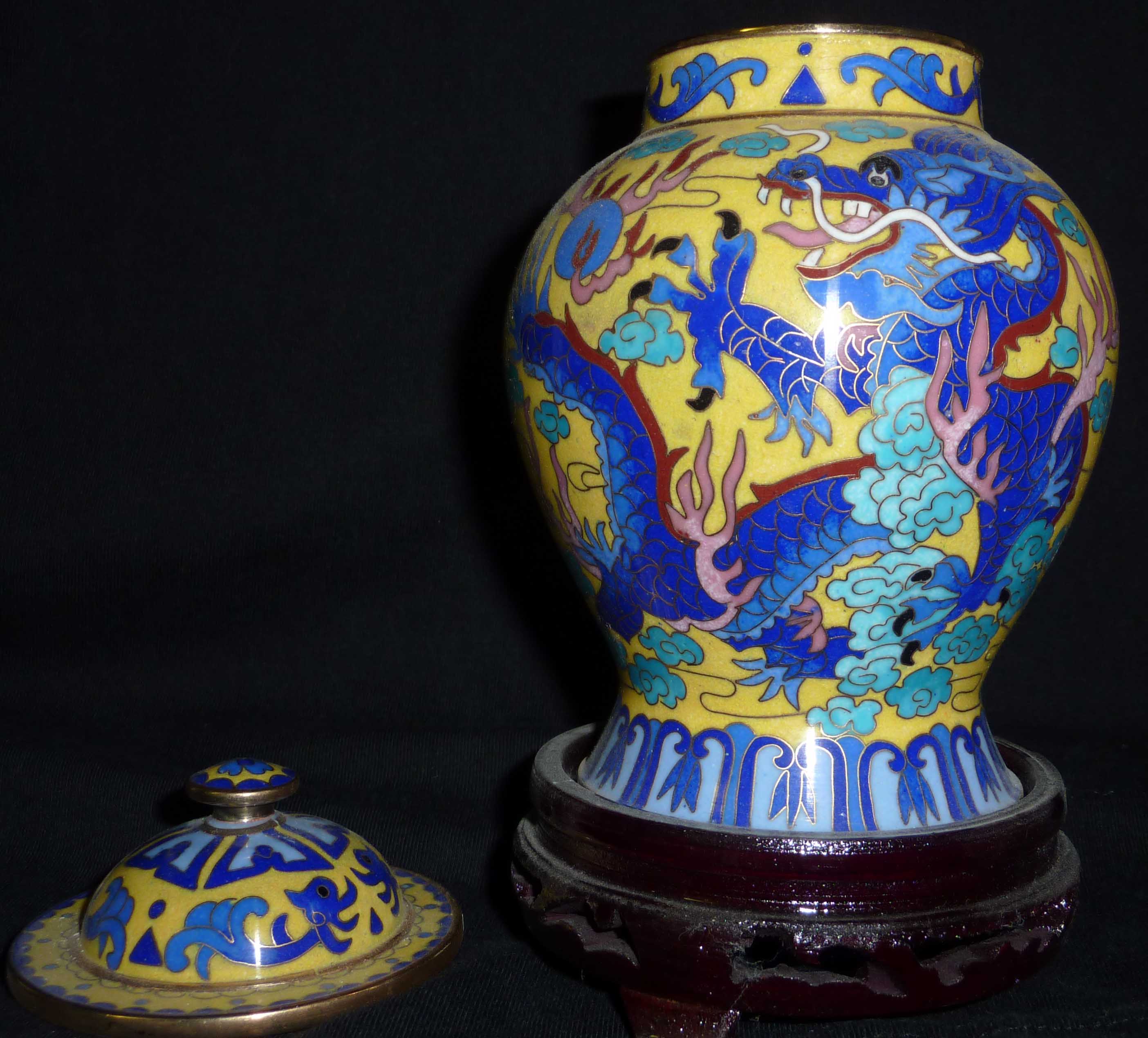
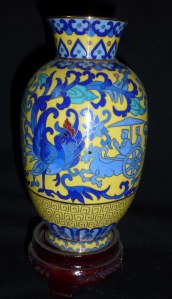
I’ve read some tourists/expatriates complain of these sort of stops, but I enjoy window shopping and this was something new—sometimes I even buy something.  In this case, I bought three vases (photos are included here).

First, we went on a tour where we watched men and women creating vases. Once the tour was over, we went into the showroom.

The vases I bought (after negotiating the price) are yellow with a blue trim.  One has a blue dragon on it, the second a phoenix beside a chariot, and the third running horses. Each one is about the size of my hand (see photos)

The cloisonné process is enamel on copper craftwork. It first appeared in Beijing in the Yuan Dynasty (1271-1368) and continued during the Ming Dynasty (1368-1644). Cloisonné vases are crafted by using a copper porcelain process. The vase is made from copper with brass wires soldered to the body. Then a porcelain glaze is applied to cells between the brass wires.

After a series of complex procedures, such as burning, burnishing and gilding, the cloisonné vase is done. Chinese name: 景泰蓝(jǐng tài lán)

Return to Visiting The Great Wall – Part 2 or start with Part 1

______________

Lloyd Lofthouse is the award-winning author of The Concubine Saga. When you love a Chinese woman, you marry her family and culture too. This is the love story Sir Robert Hart did not want the world to discover.

Subscribe to “iLook China”!
Sign up for an E-mail Subscription at the top of this page, or click on the “Following” tab in the WordPress toolbar at the top of the screen.

About iLook China