China’s Capitalist Revolution (Part 2 of 9)

July 1, 2010

In 1978, Deng was elected leader of the Communist Party beating the Maoists.  His goal was to have China’s economy catch up with the West within 20 years. “In this new age we will focus our efforts on modernizing industry, agriculture, technology and national defense to transform the country by the end of the century in a Chinese way.”

The first challenge was to grow food for China’s starving peasants. During Mao’s failed programs, millions had died. At the end of 1979, peasants in Anhui had started a private farming system. In one year, food production had increased three fold.

Deng was happy to support whatever worked, but local party bosses resisted change after 30 years of Maoism. There was a saying, “We’d rather have the weeds of socialism than the fruits of capitalism.”

Deng surprised the Maoists by giving his blessing to the farmers of Anhui, and by 1981, Anhui was feeding itself. They said, “We’ve been liberated. It’s not like in the past when peasants were rounded up like an army.”

The next step was to modernize China’s industry and that meant China had to work with the United States. Deng also wanted and ally because of threats from the Soviet Union.

Return to China’s Capitalist Revolution Part 1 or go to Part 3

_________________________

 Lloyd Lofthouse is the award-winning author of The Concubine Saga. When you love a Chinese woman, you marry her family and culture too. This is the love story Sir Robert Hart did not want the world to discover.

To subscribe to “iLook China”, look for the “Subscribe” button at the top of the screen in the menu bar, click on it then follow directions.


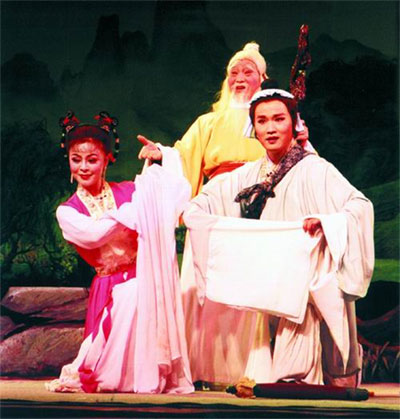
Huangmei Opera

April 17, 2010

Anqing, in Anhui Province, is regarded as the ‘hometown’ of Huangmei Opera and Hui Opera. Anqing was first built in 1217 and is almost eight-hundred years old, but Huangmei Opera first appeared about two centuries ago as a simple drama of song and dance.

Huangmei opera did not involve the traditional opera gestures which often-used sleeves and step movements. The music is performed with a pitch that hits high and stays high and does not sound like the typical rhythmic Chinese opera.

Huangmei Opera Troupe

Chinese opera together with Greek tragic-comedy and Indian Sanskrit Opera are the three oldest dramatic art forms in the world.  For an example of Huangmei Opera, watch Cowherd and Weaver Girl.

To learn more about Chinese opera, see “Peking Opera” http://wp.me/pN4pY-lf

Sign up for an RSS Feed for  iLook China


Peking Opera

April 1, 2010

Peking Opera is a combination of several styles of Chinese opera.

The metamorphosis started during the Qing Dynasty (1644-1911), about two hundred years ago.

Peking Opera focuses on historical events, legends about emperors, ministers, generals, geniuses and great beauties.

Performances are a combination of singing, dialogue, pantomime and acrobatic fighting and dancing.

Today, Peking Opera is considered the highest expression of Chinese culture.

The origins of Peking Opera did not begin in Peking (Beijing).  The opera had its start in the Chinese provinces of Anhui and Hubei.

Experts say the opera was born in 1790 and was originally staged for the royal family and then the public.

There are thousands of these operas that cover the history and literature of China. Peking operas can be divided into two categories.

“Civil” operas focus on singing while “Martial” operas feature acrobatics and stunts.  Some are a combination of both.

If Peking Opera interests you, see Chinese Yu Opera with Mao Wei-tao

______________

Lloyd Lofthouse is the award-winning author of The Concubine Saga. When you love a Chinese woman, you marry her family and culture too. This is the love story Sir Robert Hart did not want the world to discover.

Subscribe to “iLook China”!
Sign up for an E-mail Subscription at the top of this page, or click on the “Following” tab in the WordPress toolbar at the top of the screen.

About iLook China