Vice.com reports, “Sales for at least five major sex toy brands have seen significant increases throughout 2020, seemingly in step with instructions to stay inside and avoid other people.”
In the first week of April, the sale of sex toys in Denmark increased by 100%
Real Sex Reviews.com reports, “China as a whole has been estimated to produce more than 80% of the sex toys in the world, with the industry being valued at $6.6 billion and employing more than a million people.”
One of those toys is the full-sized sex doll. According to The Atlantic, “Since ancient times, men have been getting it on with synthetic women.”
Inside a Chinese sex doll factory
The New York Daily Post reports, “Naturally antibacterial’: Sex doll companies trying to cash in on coronavirus. … Sex doll companies have an important public service message: Self-isolating can be fun and safe at the same time. Self-isolating doesn’t have to be the worst! All RealDolls are made from Platinum Grade Silicone and are naturally antibacterial and nonporous! Want one?”
What explains this increase in sex-toy sales and traffic to porn sites?
Psychology Today says, “Some research has found that when we are faced with the prospect of our own mortality, this prompts sexual desire and behavior as a coping mechanism. To the extent that the COVID-19 pandemic is making mortality more salient, it would make sense that you’d see a rise in horniness right now, which could partly explain why more porn is being consumed.”
China’s public health bureau recently published a chart showing how important it is for everyone to wear masks in public because of the COVID-19 pandemic.
If you have not seen the chart, here is a simple translation:
ONE: The risk of infection is 100% when a healthy person without a mask is exposed to an infected person without a mask.
TWO: When a healthy person wearing a mask is exposed to an infected person without a mask, the risk factor is 70%.
THREE: When an infected person is wearing a mask and the healthy one isn’t, the risk factor is 5%
FOUR: When both the healthy and infected people wear masks, the risk factor is 1.5%.
Without the ability to test people weekly to discover who is immune because they carry the antibodies that protect them from the virus, or to learn if they are infected or healthy, individuals…
China is a collectivist culture based on valuing the needs of a group or a community over the individual.
Better the Future.org says, “The traditional Chinese diet consists of low or moderate amounts of meat or fish and plenty of vegetables accompanied by starches like rice or noodles. Tea is often served with dinner instead of soft drinks. Desserts are generally not part of the meal but fresh fruits can be served to help with digestion.”
The BBC reported, “China reported the cases to the World Health Organization (WHO), the UN’s global health agency, on 31 December.… The mayor of Wuhan has previously admitted there was a lack of action between the start of January – when about 100 cases had been confirmed – and 23 January, when city-wide restrictions were enacted. …
The United States is an individualist culture. Very Well Mind.com says, “Individualistic cultures are those that stress the needs of the individual over the needs of the group as a whole.”
Health.gov tells us about the Current Eating Patterns in the United States. “The typical eating patterns currently consumed by many in the United States do not align with the Dietary Guidelines. … About three-fourths of the population has an eating pattern that is low in vegetables, fruits, dairy, and oils.
“More than half of the population is meeting or exceeding total grain and total protein foods recommendations (and) … are not meeting the recommendations for the subgroups within each of these food groups.
“Most Americans exceed the recommendations for added sugars, saturated fats, and sodium.
“The high percentage of the population that is overweight or obese suggests that many in the United States overconsume calories. As documented, more than two-thirds of all adults and nearly one-third of all children and youth in the United States are either overweight or obese.”
How do these cultural and lifestyle choices translate to death by COVID-19?
On May 6, 2020, Statista reported that the United States was 1st place for COVID-19 deaths worldwide.
1st Place: The United States with 72,284 deaths
2nd place: the UK with 29,427 deaths (the UK is also an individualist culture)
11th place: China with 4,633 deaths (where the pandemic started)
The Smithsonian Magazine reports that “U.S. Life Expectancy Drops for Third Year in a Row, Reflecting Rising Drug Overdoses, Suicides,” and Global News reported, “The novel coronavirus is a bundle of proteins. It doesn’t care about faith, freedom, jobs or right-wing conspiracy theories, but that hasn’t stopped hundreds of Americans from defying all medical advice to protest against lockdown measures meant to keep them safe — often while standing unmasked and shoulder to shoulder.”
What about life expectancy in China? Macrotrends says, “The Current Life expectancy for China in 2020 is 76.96 years, a 0.22 percent increase from 2019.” In fact, China has seen a slow and steady increase in life expectancy since 1950. Click the link in this paragraph to see for yourself.
It is apparent that the price for individual freedoms in the U.S. means shorter lifespans and a higher risk of death by COVID-19. What freedom means in the United States depends on each individual.
If it is possible to learn from history, the world may be fortunate that the stability of Chinese civilization for several thousand years left behind a well-documented historical record.
In 2017, Scientific American reported, “Records from Ancient China reveal link between Epidemics and Climate Change. By analyzing Chinese records throughout nearly 2,000 years of history, researchers have found that climate-driven disturbances like floods, droughts and locust outbreaks were associated with disease epidemics. …
“The new research underscores the idea that climatic changes may affect human health in a variety of ways. Present-day concerns about climate change and infection often focus on the potential of higher temperatures to facilitate the spread of disease vectors, like mosquitoes.”
Contagion Live reports on The Ripple Effect of Climate Change on Epidemic Risk. “Increases in extreme weather events, as predicted by climate scientists, may also lead to increases in infectious disease outbreaks. Epidemics have previously been seen in the wake of natural disasters, which can lead to displaced and crowded populations, hotbeds for infection transmission. Severe rainfall or flooding is particularly effective at creating environments suitable for the transmission and propagation of infectious diseases such as measles or cholera. Conditions, as currently seen on the devastated island of Puerto Rico, are often more amenable for mosquitoes to breed in flood-affected regions and as a result, may increase disease risk in those areas.”
What did China learn over the centuries?
The Journal of Biosafety and Biosecurity reports, “Since ancient times, China has acquired a rich experience in both the prevention and cure of infectious diseases. As early as in the Warring States period (475 BC – 221 BC), China began to develop theories on epidemic diseases. In the Qin Dynasty (221 BC – 206 BC), an integrated response system, including prevention, diagnosis, and isolation, was established.
“Later, during the Han Dynasty (206BC – 220 AD), people began to pay attention to the control of infection sources. Whereas, vaccination methods were created in the Song Dynasty (960 – 1270 AD, composed by the Northern Song Dynasty and Southern Song Dynasty), they were popularized throughout the Ming (1368 – 1644 AD) and Qing (1644 – 1912) Dynasties.
“However, at that time, China had not established a biosafety prevention system based on modern microbiological studies on infectious diseases, lacking a comprehensive scientific understanding of them. It was in the middle and late Qing Dynasty, with the arrival of missionaries and the return of overseas students, that advanced western science and technology were introduced into China, allowing the implementation of scientific infectious disease prevention and control measures and giving rise to modern biosafety means.”
For modern civilization to survive, the world’s leaders must cooperate, and that includes the United States. However, current President Donald Trump is always looking for someone else to blame. For sure, Donald Trump is not a role model for how to survive a pandemic. That is not how to survive climate change and the epidemics to come. COVID-19 might be just the beginning. Are you ready?
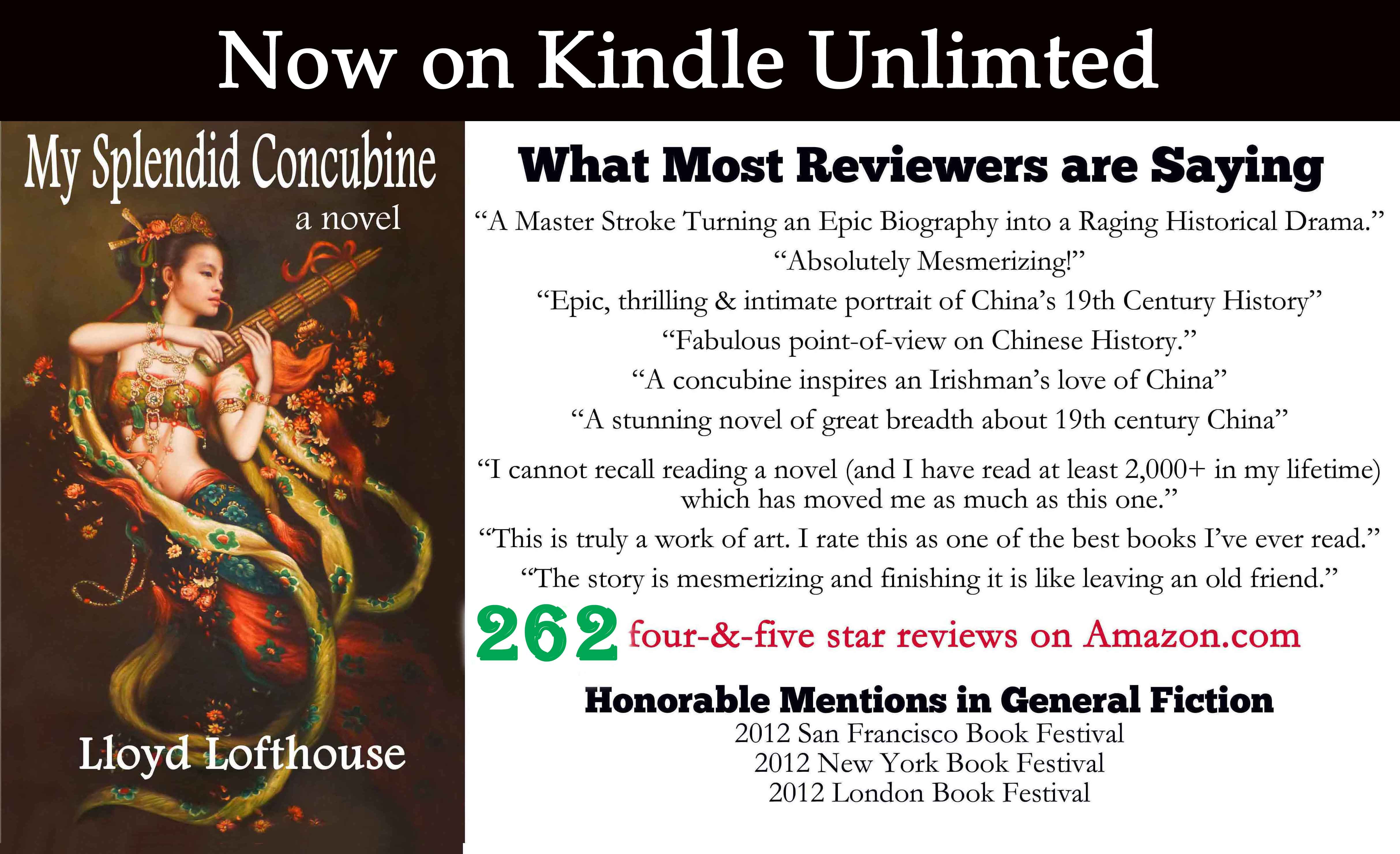
The reason I launched iLookChina in January 2010, was to build a social media platform to attract readers for “My Splendid Concubine”, my first published novel, and it worked. The 1st edition of the book was released in December 2007 and two years later the novel had sold 562 copies. By New Years of 2010, another 2,375 copies had been sold thanks to the blog. Fast forward a decade to February 2020, and Concubine has reached 64,399 readers (more if their copies were loaned to friends and family), and that is not counting the near quarter-million page reads through Kindle Unlimited.
This journey did not start in 2007. It started December 1999, when Anchee and I visited China together for the first time on our honeymoon. By then, I had already I started the nine years of research, writing, editing and revisions that led to the novel.
By the end of 2007, I thought I knew a lot about China. I could not have been more wrong. The truth was I didn’t know much at all as I was soon to discover.
That brings me to 2009, when I was a member of the California Writers Club (the 2nd oldest writers club in the United States), and I took an all-day workshop through the South Bay Branch of the club where we learned what we had to do to attract interested readers for our books.
Without word-of-mouth, readers are not going to find our books. We had to find the readers first.
In that workshop, we were told not to write about being writers as many authors do, but to write about something our book was a small part of. For me, that meant China. The instructor said if we wanted to be found on the first page of a Google search we had to publish 1,000 posts in the first year. I went home and did everything I had learned in that workshop and started posting three times a day until I hit the one thousand mark. Good thing I was a retired teacher by then, because that turned out to be more than a full-time job. After reaching 1,000 posts, I slowed down to one new post a day for the next few years before I ended up where I am now, once a week.
The first post was American Hypocrisy published on January 28, 2010. The first paragraph says, “Why am I writing about China? Simple—many Americans do not respect the differences between cultures. They say they do, but I don’t believe them. During the 2008-2009 school year, our daughter returned home one day to tell us that her history teacher talked about China and said the people had to be very depressed to live under a totalitarian government like the Communists.”
While China has an authoritarian one-party government, it isn’t a totalitarian state like North Korea, not even close, and I never met any Chinese depressed by their government during my trips to China. In fact, Shanghai turned out to be the Paris of Asia, a colorful, thriving city filled with life.
The day I launched the blog, I had been married to Anchee Min for a decade and had visited China nine times with my family to learn more about the country, its culture, and people, and even that wasn’t enough.
Long before the end of 2010, I ran out of stuff to write about by the time I reached the hundredth post. Most of what I knew about China was what I had learned while writing that historical fiction novel set in the middle of the 19th century. It was based on a true story and the main character was an Irishman named Robert Hart who was 19 when he arrived in China in 1854. Beginning as a student interpreter in the consular service, Hart arrived in China at the age of 19 and stayed for 54 years, except for two short leaves in 1866 and 1874. Hart has been credited as the most important and most influential Westerner in Qing dynasty China.
I had to learn more about China, or the blog was going to die a slow death. I started studying China’s history going back thousands of years. I wrote about the Great Wall, the Grand Canal, the first emperor, the different dynasties, the best emperors, the worst emperors, the inventions that came out of China, Chinese medicine, Daoism Confucianism, Buddhism, and the food, et al.
I also learned about China’s 1911 revolution, and Dr. Sun Yat-sen, known today as the Father of the Nation, both in Taiwan and Mainland China. Sun had been sent by his family to go to school in Hawaii as a boy where he learned about the U.S. Constitution. He returned to China as a young man and joined the revolution to replace the Qing Dynasty with a republic modeled on the United States but adapted to fit Chinese culture. After several failures, Sun successfully recruited the Chinese Communist Party (CCP), the Nationalist Party, and other smaller parties to work together and form a multi-party republic.
Then Dr. Sun Yat-sen died unexpectedly in 1925 before the job was done, and the alliance he had built fell apart starting China’s long and brutal Civil War (1927 – 1949). The CCP did not start that Civil War. Chiang Kai-shek did that when he formed an alliance with the criminal triad gangs in Shanghai to destroy the newly forming labor unions and the young Chinese Communist Party that was organizing the unions. Without warning, Chiang Kai-shek’s troops, with help from Shanghai’s ruthless criminal triads, hunted down and executed, without trials, every member of the Communist Party they could find and the leaders of the labor unions along with the workers that had joined the unions.
To keep publishing posts and attracting readers interested in learning more about the real China, I had to keep learning, but I couldn’t do that by turning to the misleading, biased propaganda that often gets published and broadcast about China in the U.S. media. I had to find material published before 1911 and from other academic sources like from Australia, and the media from other countries like the BBC, France 24, and Al Jazeera English, headquartered in Doha, Qatar.
Since iLookChina’s launch, there have been more than 2,434 posts (most of them researched and written by me), 4,966 comments, and 802,366 hits (visitors). Sometimes I have paid a price when a China hating American accuses me of being an evil Communist and a traitor to the United States, because I strive to reveal the real China and not the fabricated one we often read about in the U.S. Media.