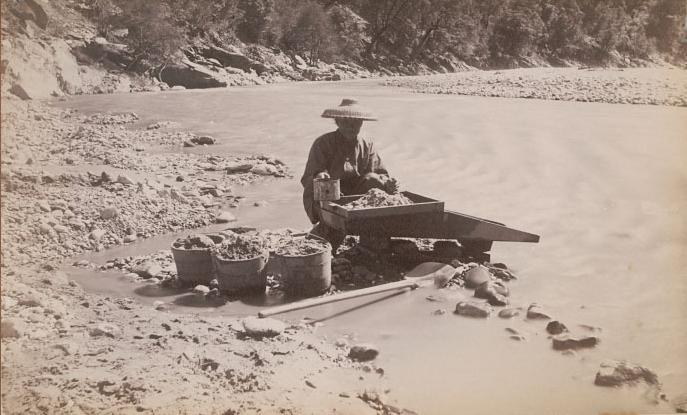
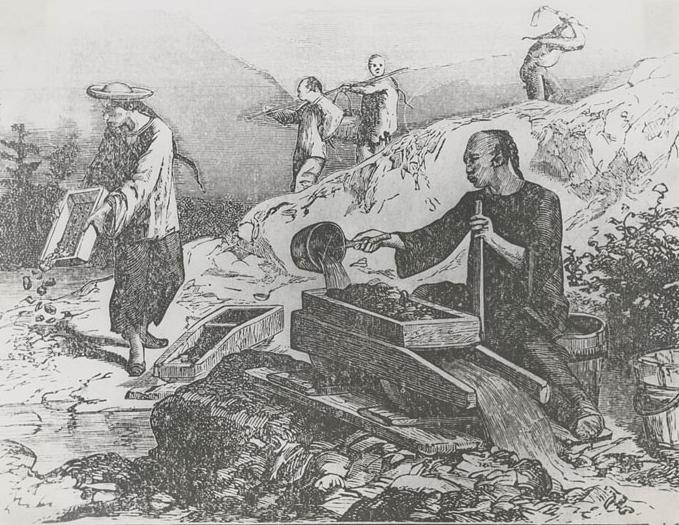
In the mines the Chinese were often forced to work sites that others had abandoned as no longer productive and, by hard work, made these claims pay.
As more men arrived in the gold fields and the amount of surface gold dwindled, tensions increased. Thirty-five Chinese showed up at Camp Salvado in 1849 where men from El Salvador had worked and here they found rich placer deposits.
White miners soon arrived and pushed the Chinese out, but they were taken in at another nearby site called Camp Washington where still more gold was found
Chinese flocked to a place where they were accepted and Tuolumne County’s Chinese Camp survives to this day.
But by 1850, a $20 per month tax on each foreign miner was imposed.
By 1852 Chinese were forced from Mormon Island and Horseshoe Bar along the American River, then from Colombia in the southern mines and Yuba City in the northern.
In 1856 Chinese paid $70,000 for the right to mine in Mokelumne Hill.
By 1868 almost all Chinese had left the mines to work on the transcontinental railroad or in Chinese operated businesses.
Of all the diverse peoples that poured into California after the discovery of gold, none stood out more than the Chinese. Radically different in dress, language and culture these new men were first welcomed because of their willingness to work hard for low wages at any task presented them.
John McDougall, the 2nd Governor of California, described them as “one of the most worthy of our newly adopted citizens.”
At the start of 1849 only 54 Chinese were in California. By1852 there were nearly 12,000 living here and only seven of them women. Because of turmoil in Canton another 20,000 would arrive that same year.
A community of Chinese Americans quickly grew in San Francisco. They marched in Fourth of July parades and rejoiced at California’s statehood, but celebrated their lunar new year in their traditional way.
In 1852 a Cantonese opera was performed at the American Theater and in 1854 a Chinese language newspaper began publishing.
The Kong Chow Association formed to help the new arrivals adapt to their new home. Then another, the Chew Yick, elected Norman As-sing, an English speaking owner of the Macao and Woosung Restaurant as their leader. Soon there were six associations called tongs that combined to form the Six Companies to better represent Chinese interest.
Some time ago, a friend sent me a link to news that warned of new U.S. government regulations on hydraulic fracturing that could stop shale exploration—but not much changed.
Back then, the White House said the natural gas industry should support “common sense” regulation to ease public worry about potential water contamination from fracturing, a drilling practice vital to the U.S. shale gas boom. At the time, I didn’t know much about fracturing, but now I know it’s pretty bad, becase we now know that fracturing contaminates drinking water water and causes earthquakes.
While development of natural gas from shale might eventually come to a stop in the U.S. due to these environmental concerns, China is looking at the production and resources of shale gas in the United States and is learning from America.
China’s technically recoverable resources of shale gas are estimated to be about 50 percent higher than those in the United States.
EIA.DOE.gov says, “The outlook for unconventional natural gas production is more positive in China than in OECD Europe first and foremost because China’s geology suggests a greater unconventional resource potential than in Europe. Further, although natural gas production from conventional resources in China, as in Europe, cannot keep up with domestic demand, China’s government strongly supports unconventional gas development, and public resistance is likely to be less of an impediment in China than in OECD Europe and the US.”
World Oil.com reports, “Over the past 25 years, China has attempted to develop its substantial CBM resources, estimated by China’s Ministry of Land and Resources (MLR) at more than 1,000 trillion cubic ft (Tcf). Currently, there are more than 20,000 wells producing a total of 0.36 billion cubic ft per day (Bcf/d) of CBM (coalbed methane) in China. However, CBM well productivity in China is significantly lower than in countries such as Australia and the U.S.”
While developing natural gas resources in China, there is also Biogas development in rural China that the two embedded videos talk about. China is taking advantage of waste to produce energy, which results in higher standards of living for those involved.
For instance, China’s Hebei Rural Renewable Energy Development Project. “The Project Development Objective (PDO) for the Hebei Rural Renewable Energy Development Project in China is to demonstrate sustainable biogas production and utilization to reduce environmental pollution and supply clean energy in rural areas of Hebei Province.” – The World Bank.org
Imagine the biogas from more than 1.3 billion people and the animals raised to feed those people.
______________________________
Lloyd Lofthouse is the award-winning author of My Splendid Concubine [3rd edition]. When you love a Chinese woman, you marry her family and culture too. This is the lusty love story Sir Robert Hart did not want the world to discover.
Subscribe to “iLook China”!
Sign up for an E-mail Subscription at the top of this page, or click on the “Following” tab in the WordPress toolbar at the top of the screen.
My reason for writing this post was to show how cultural differences bring about biased opinions due to religious, spiritual and/or cultural beliefs.
For instance, my mother would have burned My Splendid Concubine, because she grew up in a country with the soul of a church. After my mother died, I found her videos of the Bible, an audio version and about thirty different translations/versions.
I didn’t know until then that there was that many ways to speak for one God. In fact, Biblicasays, “Would you believe that there are literally hundreds of different translations of the Bible into English? For many people this huge variety is totally confusing and they just don’t know which Bible to choose.”
After my father died, mother spent her last decade to age 89 studying the Bible several hours a day. This was her attempt to discover the answer to salvation that haunted her most of her life.
My mother loved to read other books too, as did my father, who was not a religious person. However, if my mother ran into a vivid sex scene in a novel, she threw the book in the fireplace.
Since I was born and raised a Catholic, and when I was 12 my mother switched to the Jehovah Witnesses, I know why she would’ve burned my novel.
To Catholics, Jehovah Witnesses, and most devout Christians of all sects, lust is a mortal sin.
In fact, Catholic Questions in a Secular World says, “The seven deadly sins are pride, avarice, envy, wrath, gluttony, sloth and lust.… Lust is the self-indulgent desire for gratification … without the sanctifying graces of marriage.”
For instance, when I was single in my thirties, I had a relationship with a lawyer, who ended the relationship due to her Christian guilt. She wasn’t a Catholic but she attended two different Christian churches on Sundays, and she made it clear that it was the guilt that drove her to stop seeing me. She said she went to two churches to hear two sermons each Sunday, because it was the only way should heard what she wanted to hear.
My Splendid Concubine is historical fiction based on a real Irishman who went to China in 1854, bought a concubine and stayed until 1908 to become the most powerful Westerner in China’s history and the only foreigner trusted by the Emperor.
Books have been written on the subject of sex in America that explains why my mother would have burned My Splendid Concubine. America’s War on Sex: The Attack on Law, Lust, and Liberty by Marty Klein, Ph D. is one example, which “Spotlights the political, legal and civic battles raging in this country against what is arguably our most private and pluralistic right – sexual freedom.”
Another example is an anonymous reviewer called “colorado outback” who posted a one-star review on Amazon of My Splendid Concubine and said, “You should Not Buy This Book – Seriously, just Soft Porn.”
My mother would have agreed with “colorado outback”, because she was influenced by her religion.
Outback says: “this seemed more like the sexual fantasy of the author and NOT the historical novel it is purported to be.”
However, “outback” was wrong. The idea to write My Splendid Concubine didn’t originate from a sexual fantasy, as I’ll explain.
Since writing My Splendid Concubine was not motivated by sexual fantasies, I responded to “outback’s” biased opinion, and outback replied that my novel doesn’t “come up to par with Anchee Min, John Steinbeck, Kurt Vonnegut, Alice Walker, Charles Dickens, Amy Tan, Pearl S. Buck, James Michener, Eudora Welty, Harper Lee, Isabel Allende, Gabriel Garcia Marquez, Aleksandr Solzhenitsyn, Tom Robbins and so on.”
I’d have to agree. I’ve never thought that I was equal to or better than the authors outback listed or any author. In fact, I don’t compare my writing to any other author and if I compete with anyone, it is with my own writing with the goal to improve.
Outback claimed to have read all of the books by the above authors and thousands more yet he only had two, one-star reviews posted on Amazon (at the time I was writing this post). Where are all those five-star reviews extolling the virtues of the work he admired?
If I didn’t write such a lusty novel from personal sexual fantasies as “outback” claims, why did I write it?
The answer is simple.
I wanted to show the clash between different cultures and Sterling Seagrave wrote in Dragon Lady, “To take the pain out of learning, his Chinese tutor suggested that (Robert) Hart might buy a concubine and study the local dialect with her.
“Hart wrote in his journal, ‘Here is a great temptation. Now, some of the China women are very good looking: You can make one your absolute possession for from 50 to 100 dollars and support her at a cost of 2 or 3 dollars per month. … Shall I hold out or shall I give way?'”
Seagrave writes in the next paragraph, “By early May he (Robert Hart) had a sleep-in dictionary, his concubine, Ayaou. He had just turned twenty; Ayaou was barely past puberty.”
Then the editors of Entering China’s Service: Robert Hart’s Journals wrote on page 8, “But anyone who reads the journals through knows that his mental struggles about women were not soon or lightly won; whether the relapse was to daydreams or to a Chinese mistress, it caused him ambivalence and anguish.”
In China, the concubine is a trophy showing a man’s success, and no major religion on earth has had a lasting impact on the Chinese culture in more than a thousand years.
In fact, the concept that lust is a mortal sin doesn’t exist in China unless a Chinese adopts Christianity as their religion.
That does not mean China is without morals but the moral codes of China exist without the sin of mortal lust as Catholics and many devout Christians believe. In fact, I’ve known mainland Chinese that are extremely moral and would put most Puritans to shame.
The idea to focus on Robert Hart’s struggles with his Victorian, Christian morals while living in 19th century China’s concubine culture sprouted when I first read his journals and letters published by Harvard University Press.
Other influences were Anchee Min’s Empress Orchid and The Last Empress: A Novel—both novels go into detail about the lives of the more than three thousand concubines that belonged to the emperor.
In fact, in 19th century China, the more power and wealth a man had, the more women he owned.
Another influence was the movie directed by Zhang Yimou in 1991, Raise the Red Lantern, which “focuses on the ever-shifting balance of power between the various concubines while the husband ignores much of what is going on — taking his pleasures when he feels like it.”
______________________________
Lloyd Lofthouse is the award-winning author of My Splendid Concubine [3rd edition]. When you love a Chinese woman, you marry her family and culture too. This is the lusty love story Sir Robert Hart did not want the world to discover.
Subscribe to “iLook China”!
Sign up for an E-mail Subscription at the top of this page, or click on the “Following” tab in the WordPress toolbar at the top of the screen.
Ai Weiwei was warned by representatives of the lawful government of the People’s Republic of China (PRC) to stop his illegal activities (according to Chinese law).
In such cases, it is common to receive an invitation to tea, which may not be refused, where the person responsible for what is considered counter-revolutionary activities (or another crime against the state) is told to stop or face the full might of China’s law. China is not like Hitler’s Germany where the Gestapo showed up without warning and carried citizens off to be roasted or gassed by the millions.
The facts speak for themselves. Ai Weiwei refused to cooperate, and he violated Chinese law, and he was locked up in 2011, but he isn’t locked up now because he was released the same year.
CNN doesn’t mention Ai Weiwei was alleged to have been in violation of the 1982 Chinese Constitution, which says in Article 28, “The state maintains public order and suppresses treasonable and other counter-revolutionary activities; it penalizes actions that endanger public security and disrupt the socialist economy and other criminal activities, and punishes and reforms criminals.”
US Marines Marching
The PRC did not hiding anything except where Ai Weiwei was locked up and the details behind his crime. Even in the US, the authorities are often denied the right to talk about an alleged criminal and the facts behind a legal case to the press.
I’ve read in the past where some Western critics say that Chinese law is difficult to interpret and has loopholes that the PRC may use to the Party’s advantage.
Since when was any law in any country easy to understand? If you aren’t an American lawyer, how easy is if to understand the U.S. legal system, and doesn’t the U.S. have loopholes that the wealthy and corporations take advantage of not to pay taxes in America? In fact, President Ronald Reagan didn’t pay any tax one year, and he said loopholes in the law allowed it.
Compare the language of the 1982 Chinese Constitution to the U.S. Constitution and anyone can see the differences.
In addition, Article 53 of the Chinese Constitution says, “Citizens of the People’s Republic of China must abide by the constitution and the law, keep state secrets, protect public property and observe labour discipline and public order and respect social ethics.”
PRC Troops and Flag Ceremony
An amendment to Article 13 was revised to say, “Citizens’ lawful private property is inviolable” and “The State, in accordance with law, protects the rights of citizens to private property and to its inheritance” and “The State may, in the public interest and in accordance with law, expropriate or requisition private property for its use and shall make compensation for the private property expropriated or requisitioned.”
In fact, nowhere in the CNN piece does it explain that no one owns land or houses in China as they do in the U.S. It’s more like a lease with the right to pass that property on to someone else in the family after death.
What happens in the U.S. if the property tax isn’t paid? Does anyone really own the house and land they live on?
China’s flag isn’t red, white and blue. Instead, it is red and gold.
The red of the Chinese flag symbolizes the communist revolution, and it’s also the traditional color of the people. The large gold star represents communism, while the four smaller stars represent the social classes of the people. In addition, the five stars together reflect the importance placed on the number five in Chinese thought and history. Source: World Atlas
Maybe Ai Weiwei forgot which flag flies over his country or is he color blind?
Lloyd Lofthouse is the award-winning author of My Splendid Concubine [3rd edition]. When you love a Chinese woman, you marry her family and culture too. This is the lusty love story Sir Robert Hart did not want the world to discover.
Subscribe to “iLook China”!
Sign up for an E-mail Subscription at the top of this page, or click on the “Following” tab in the WordPress toolbar at the top of the screen.
 Guest post by John Putnam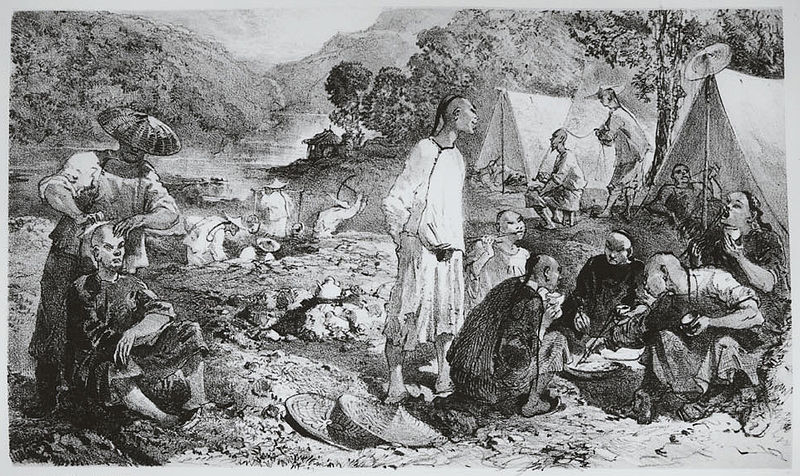


 Posted by Lloyd Lofthouse


 iLook China