Chinese Crossbow and other Inventions (2/4)

July 31, 2010

The invention of gunpowder did not come from weapons makers but from alchemists. Chinese alchemy has a long tradition that is interwoven with other areas of learning.

There was no clear line between alchemy and politics.  In Chinese, the word for politics and finding a cure meant the same thing.

All Chinese alchemists had sulfur, charcoal and saltpeter. They just hadn’t combined them. Since saltpeter is white and many other powders used by China’s alchemist were white, there was a simple test to make sure.  If a small amount of the saltpeter were heated in a charcoal fire, there would be a purple flame.

The first account of the discovery of gunpowder comes from about 850 AD.  Soon after, they envisioned new kinds of weaponry.  By the 11th century AD, there were gunpowder weapons—crude rifles, cannons, etc.

The first gun or “fire lance” was produced in 905 AD. The next innovation was to add bullets to the fire lance.

Go to Chinese Crossbow and other Inventions – Part 3 or return to the Chinese Crossbow and other Inventions Part 1

______________

Lloyd Lofthouse is the award-winning author of The Concubine Saga. When you love a Chinese woman, you marry her family and culture too. This is the love story Sir Robert Hart did not want the world to discover.

To subscribe to “iLook China”, look for the “Subscribe” button at the top of the screen in the menu bar, click on it then follow directions.


The Kaifeng Jews

July 11, 2010

The Jews settled in Kaifeng, Henan Province in 960 AD after arriving along the Silk Road.  The Jews who first arrived in China were welcomed by the  Imperial government, which encouraged them to retain their cultural identity by building a synagogue, which was finished in 1163 AD.

The Kaifeng Synagogue had a Torah written on sheepskin.  The architecture of the buildings reflects Jewish culture.  Evidence indicates that  the Kaifeng Jews were very traditional and obeyed Kosher dietary laws and practiced circumcision for males.

The Jewish community in China thrived for centuries before it was assimilated into Chinese culture through intermarriage.   By the middle of the 18th century, little survived of the Jewish community.

In 1849, the Yellow River flooded causing what was left of the Jewish community to break apart. Today there are about 500 descendents of the Kaifeng Jewish community who hope to reclaim their Jewish tradition.

See Blaming The Jews-Again!

______________

Lloyd Lofthouse is the award-winning author of the concubine saga, My Splendid Concubine & Our Hart. When you love a Chinese woman, you marry her family and culture too.

If you want to subscribe to iLook China, there is a “Subscribe” button at the top of the screen in the menu bar.


With or Without Paper

July 8, 2010

Imagine the rise of civilization to today’s level of technology without paper. Would men have walked on the moon?

Papermaking is one of the four significant inventions from ancient China. Almost 2,000 years ago, the discovery of paper was made in China.

in 105 AD, Cai Lon submitted his discovery to the Han emperor. He had invented a way to make paper. This method soon spread to the rest of China, and the emperor rewarded Cai Lon by making him a member of the nobility.

The basic principles of papermaking invented by Cai Lon are still in use today. To make paper was a six-step process, and paper manufactured properly lasts for centuries. Buddhism arrived in China about the time of the invention of paper and this helped spread Buddhist ideas, which contributed to the spread of civilization.  By the 12th century, the paper making process reached Europe.

See China Points the Way

_________________________

Lloyd Lofthouse is the award-winning author of the concubine saga, My Splendid Concubine & Our Hart. When you love a Chinese woman, you marry her family and culture too. 

To subscribe to “iLook China”, look for the “Subscribe” button at the top of the screen in the menu bar, click on it then follow directions.


China Pointed the Way

July 7, 2010

In the last post, I wrote about Zhang Heng, the man who invented the first seismograph centuries before anyone in the West would consider it.  In this post, you will discover that the Chinese were the first to notice that the lodestone pointed one way, which led to the invention of the compass. The first compass was on a square slab, which had markings for the cardinal points and the constellations. The needle was a spoon-shaped device, with a handle that always pointed south.

Archeologists have not been able to discover the exact time the ancient Chinese discovered magnets. But it was first recorded in a book, Guanzi, written between 722 BC – 481 BC.

Later in the 8th century AD, magnetized needles would become common navigational device on ships. The first person given credit for using the compass  in this way was Zheng He (1371 – 1435), who made the voyages made famous in book by Louise Levathes, When China Ruled the Seas.

Since the Chinese value education above all else, including business and the military, it makes sense that Chinese invented and used devises like the compass and the seismograph centuries before the West did.

Besides being used to avoid getting lost, the Compass was also considered a symbol of wisdom. About the 12th century, through trading, the technology spread to Arabia and last to Europe.

Learn about the seismograph and/or The First Emperor: The Man Who Made China

_________________________

Lloyd Lofthouse is the award-winning author of the concubine saga, My Splendid Concubine & Our Hart. When you love a Chinese woman, you marry her family and culture too. 

To subscribe to “iLook China”, look for the “Subscribe” button at the top of the screen in the menu bar, click on it then follow directions.


Measuring Earthquakes During the Han Dynasty

July 6, 2010

When critics accuse the Chinese of stealing technology from the West, consider that China was the most technologically advanced nation in the world at one time. In fact, the Han Dynasty (206 BC – 220 AD) put the Roman Empire (27 BC – 476 AD) to shame.

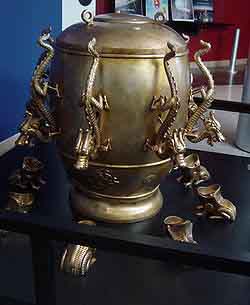
One example of China’s technological abilities was when the first seismograph was invented in 132 AD.  When Zhang Heng‘s device measured an earthquake in 134 AD, Zhang predicted the location. Han Ministers didn’t believe the scientist. Then a courier arrived and reported that an earthquake had taken place where Zhang said it did. For more information about Zhang Heng, see China Culture.

Zhang Heng's seismograph

In 1951, Chinese scientists from China’s National Museum worked on recreating Zhang Heng’s seismograph. Since there was a limited amount of information, it took until 2007 to complete the reconstruction.

In comparison, it wasn’t until the 18th century (AD) that there is any record that Western scientists worked on developing a seismograph.

Discover more about Earthquakes

_________________________

Lloyd Lofthouse is the award-winning author of the concubine saga, My Splendid Concubine & Our Hart. When you love a Chinese woman, you marry her family and culture too.

To subscribe to “iLook China”, look for the “Subscribe” button at the top of the screen in the menu bar, click on it then follow directions.