Buddhism’s Arrival and Influence in China

June 6, 2017

Siddartha Guatama, an Indian Prince, became the Buddha in the 6th century BC. Recorded history says Buddhism first arrived in China about four hundred years later more than two centuries before the birth of Jesus Christ.

After the Buddha died, tradition says that Buddhism split into difference sects. Christianity and Islam also split into two major branches that divided again several times over the centuries after the founders died.

Today Buddhism has about 379-million followers and is the world’s fifth largest religion.

The Bodhidharma was a Buddhist monk and a teacher who lived during the fifty and/or sixth century AD about twelve-hundred years after Buddha.

Britannica.com says, “The accounts of Bodhidharma’s life are largely legendary, and historical sources are practically nonexistent. Two very brief contemporary accounts disagree on his age (one claiming that he was 150 years old, the other depicting him as much younger) and nationality (one identifies him as Persian, the other as South Indian). The first biography of Bodhidharma was a brief text written by the Chinese monk Daoxuan (flourished 7th century) about a century after Bodhidharma’s death.”

The Buddhist monk Bodhidharma was known as Da Mo in China.

Da Mo establishes the Shaolin Temple as the birthplace of Zen and the Martial Arts. In ancient China, bandits and thieves were widespread and Buddhist temples were vulnerable to attack. The Da Mo taught a fighting system for the monks to defend themselves, and it proved successful. Over time, the Buddhist Shaolin style of martial arts evolved to what it is today.

Discover The Return of Confucious

Lloyd Lofthouse is the award-winning author of My Splendid Concubine, Crazy is Normal, Running with the Enemy, and The Redemption of Don Juan Casanova.

Where to Buy

Subscribe to my newsletter to hear about new releases and get a free copy of my award-winning, historical fiction short story “A Night at the Well of Purity”.

About iLook China

China’s Holistic Historical Timeline


The Complex History of Buddhism

November 1, 2016

Siddhartha Gautama, the historical Buddha, lived in the 5th or 6th Century B.C. He was born in Nepal and his father was the king of the Sakya people.  After he attained enlightenment at the age of thirty-five, Buddha preached the Dharma in an effort to help others reach enlightenment too.

Unlike the other major religions, Buddhism does not have a god like the Christian, Jewish or Islamic God.  Buddha is not a deity or supreme being. The Buddha believed that religious ideas and especially the god concept have their origin in fear.

Several centuries later during the Han Dynasty in the first century B.C., trade with Central Asia introduced Buddhism to China.  Over the centuries, interest in Buddhism grew.  However, due to Confucianism and Taoism, the Chinese adapted Buddhist scripture to fit the Chinese culture creating the Mahayana sect that spread to Korea and Japan.

Like most major religions, there are subdivisions within Buddhism but most may be classified into three. This is why Southeast Asian Buddhists differ from the Chinese.  The Theravada form of Buddhism is found in Southeast Asia in countries like Burma, Thailand, Cambodia and Laos.

Tibetan Buddhism incorporates other beliefs, and there are four principal schools or types of Tibetan Buddhism. The Dalai Lama is the spiritual leader of one of the four, the Yellow Hat sect.

Buddhism in China reached its high point during the Tang Dynasty, 618 to 907. However, in 845 AD, the Tang emperor suppressed Buddhism and destroyed thousands of monasteries, temples and shrines.

Soon after Mao and the Communists won China’s Civil War with the Nationalists under Chiang Kai-shek, Buddhism flourished for a time but was repressed during the Cultural Revolution (1966 – ‘76) along with all other religions. Many monasteries and Buddhist texts were destroyed. After Mao died in 1976, many of the major monasteries were rebuilt under the leadership of Deng Xiaoping.

In 2012, the Pew Research Center reported there were about 488 million Buddhists worldwide, and about 244 million, half, are in China.

Discover Wu Zetian, China’s only female emperor

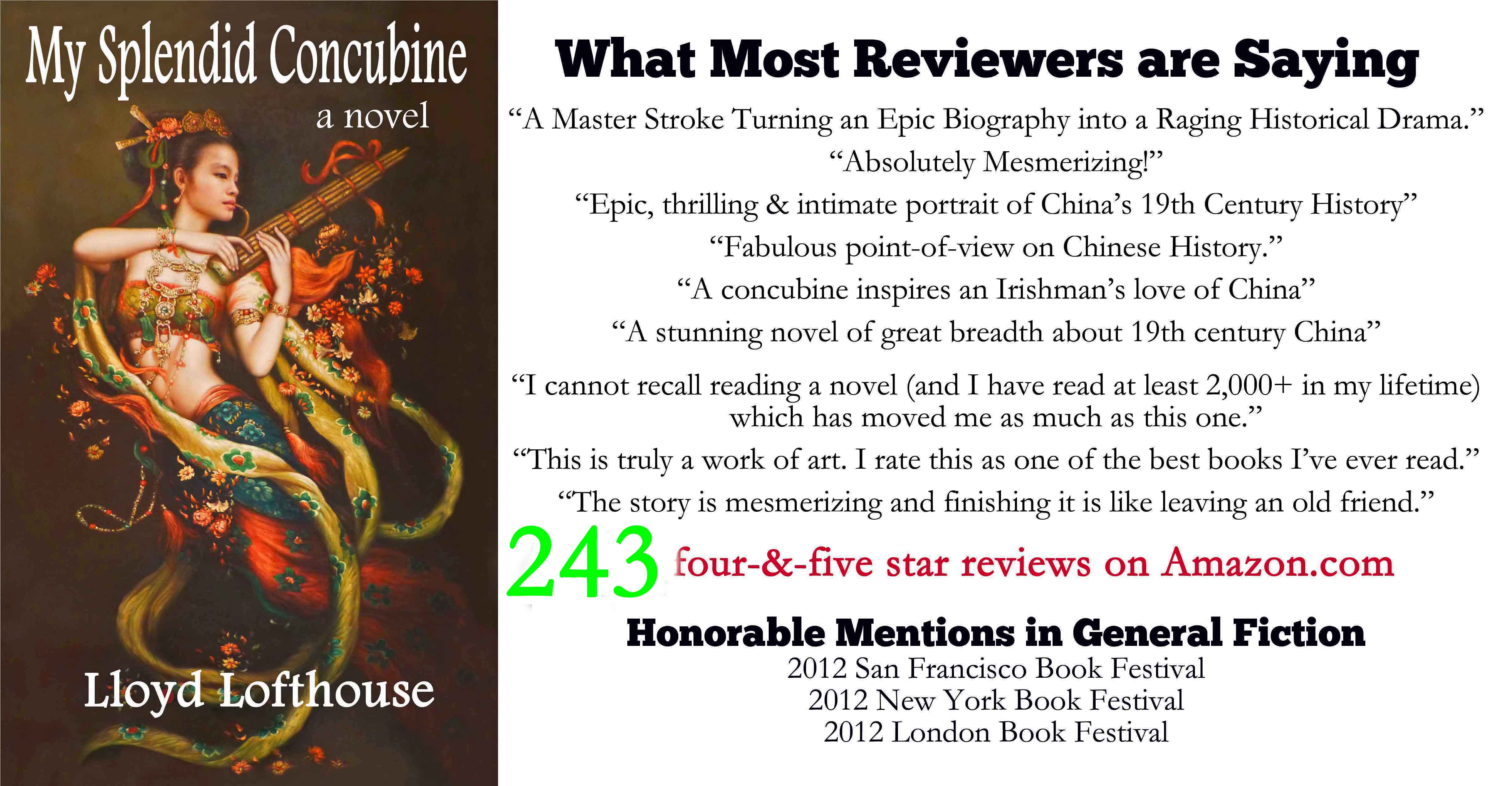
Lloyd Lofthouse is the award-winning author of My Splendid Concubine [3rd edition]. When you love a Chinese woman, you marry her family and culture too. This is the unique love story Sir Robert Hart did not want the world to discover.

on-sale-october-november-2016

Where to Buy

Subscribe to “iLook China”!
Sign up for an E-mail Subscription at the top of this page, or click on the “Following” tab in the WordPress toolbar at the top of the screen.

About iLook China

China’s Holistic Historical Timeline


The Chinese Perception of Christianity Explained

June 22, 2016

Christianity has existed in China since at least the seventh century during the Tang Dynasty (618 – 907 AD). Yet after more than twelve hundred years there are only 30 to 40 million self-identifying Christians in China. That’s less than 3% of China’s total population compared to more than 87% that are not religious who mostly follow the teachings of Confucius and/or Taoism, and Muslims (Islam arrived in China in the 6th and 7th centuries) represent less than 2% of the people.

Christianity hasn’t had much success in Japan either. The first known appearance of organized Christianity in Japan was the arrival of the Portuguese Catholics in 1549 more than four hundred years ago but only 2% of Japan’s population are Christians today.

Why?

For an answer, let’s turn to what Lin Yutang had to say on this subject.

Lin Yutang (1895 – 1976) was a Chinese writer, translator, linguist and inventor. He was one of the most influential writers of his generation. In 1933, he met Pearl S. Buck in Shanghai and she introduced him, and his writings to her American publisher.

Lin Yutang says, “For most Chinese the end of life lies not in life after death, for the idea that we live in order to die, as taught by Christianity, is incomprehensible, nor in Nirvana, for that is too metaphysical, not in the satisfaction of accomplishment, for that is too vainglorious, nor yet in progress for progress’ sake, for that is meaningless.

“The true end, the Chinese have decided in a singularly clear manner, lies in the enjoyment of a simple life, especially the family life, and in harmonious social relationships.”

“The Chinese are a nation of individualists. They are family-minded, not social-minded.  …  It is curious that the word society does not exist as an idea in Chinese thought. In the Confucian social and political philosophy we see a direct transition from family, ‘chia’, to the state, ‘kuo’, as successive stages of human organization. …

“The Chinese, therefore, make rather poor Christian converts, and if they are to be converted they should all become Quakers, for that is the only sort of Christianity that the Chinese can understand. Christianity as a way of life can impress the Chinese, but Christian creeds and dogmas will be crushed, not by a superior Confucian logic but by ordinary Confucian common sense. Buddhism itself, when absorbed by the educated Chinese, became nothing but a system of mental hygiene, which is the essence of Sung philosophy.”

My Country and My PeopleLin Yutang. Halcyon House, New York. 1938. Pgs 94; 101; 103; 172, and 108

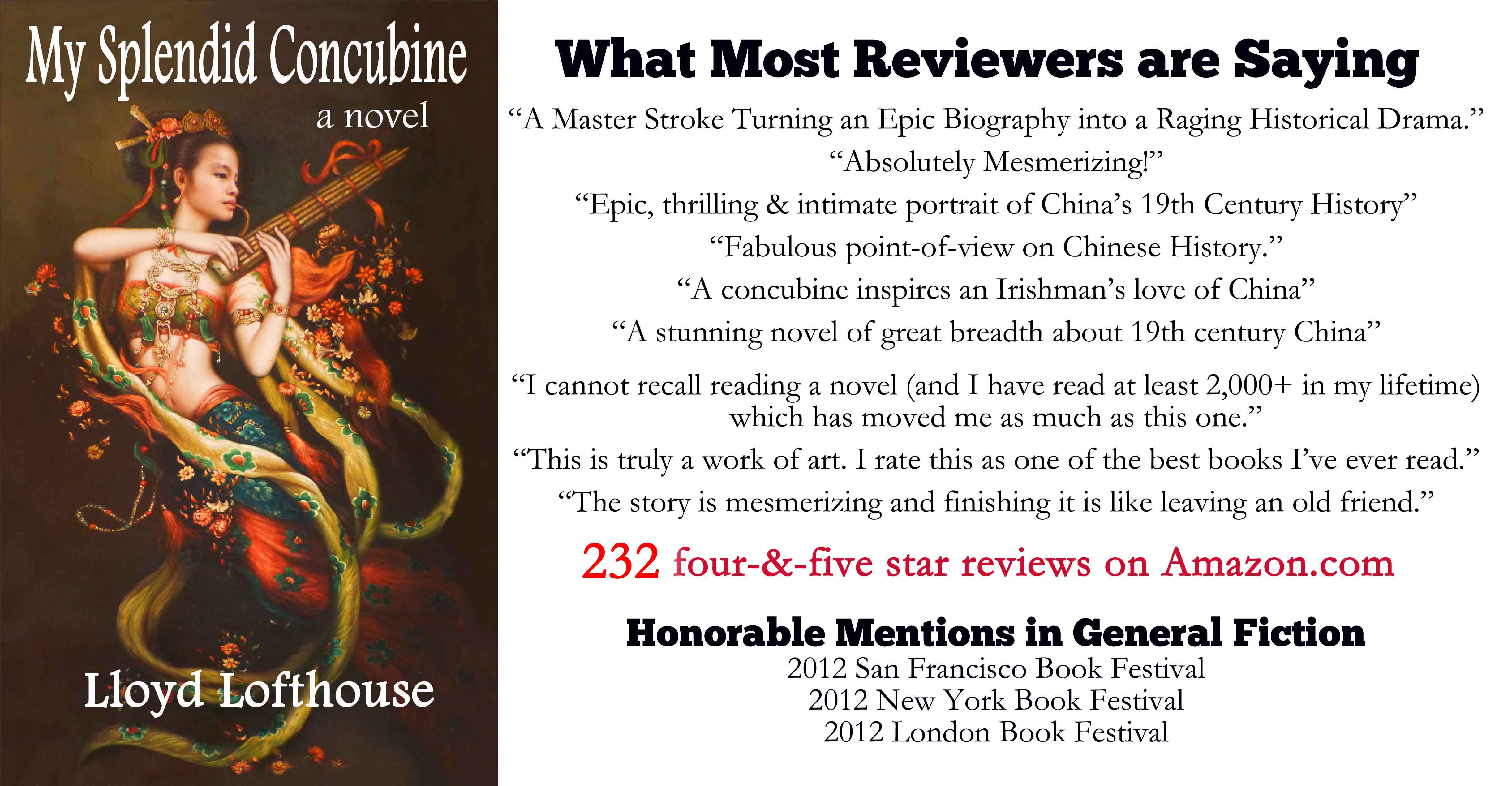
Lloyd Lofthouse is the award-winning author of My Splendid Concubine [3rd edition]. When you love a Chinese woman, you marry her family and culture too. This is the unique love story Sir Robert Hart did not want the world to discover.

A1 on March 13 - 2016 Cover Image with BLurbs to promote novel

Where to Buy

Subscribe to “iLook China”!
Sign up for an E-mail Subscription at the top of this page, or click on the “Following” tab in the WordPress toolbar at the top of the screen.

About iLook China

China’s Holistic Historical Timeline


An Islamic Pilgrimage from China: Part 2 of 2

June 1, 2016

Al Jazeera introduces us to another devout Chinese Muslim in Xian who is proudly transcribing the Quran into Chinese using traditional Chinese brush calligraphy. He says it took him over a year to transcribe the entire Quran this way. Now he is working on a second copy.

Wanting to pass down this tradition to the next generation, he has also taught his son and his grandsons how to write with the Chinese brush .

His son says that every generation should try their best to transcribe the Quran with the Chinese brush, as it is also a good way to reinforce their faith.

The original copy of the Quran in this family is over four hundred years old, a priceless relic transcribed by the Chinese imams. There are only a few remaining copies left in the world.

Jia Wen Yi, a hajj pilgrim, says the trip to Mecca is important to him and his wife, an elderly couple. They have done a lot of preparation for the hajj, and Mr. Jia goes into detail about the planning.

Going on the hajj for Yi and his wife, Jia Wang Yi, has been a dream for over two decades as they saved to have enough money.

Mr. and Mrs. Jia will be part of a group of 250 pilgrims leaving for the hajj from the city of Xian. It was a matter of saving most of their lives until they could afford the trip.

Since these Muslims are considered a minority in China, they are not restricted by the one-child policy, as you would see in the video when the family and friends gather to say goodbye before Mr. and Mrs. Jia leave on the long journey to Mecca.

There is no direct flight from Xian to Mecca, so the pilgrims will take a train to Beijing where they will board a flight to Saudi Arabia.

Whenever pilgrims leave Xian to go on the hajj to Mecca, thousands of Chinese Muslims show up at the railway station to say goodbye. This is the first time Mr. and Mrs. Jia have left China. They have never been apart from their family before.

Return to Part 1

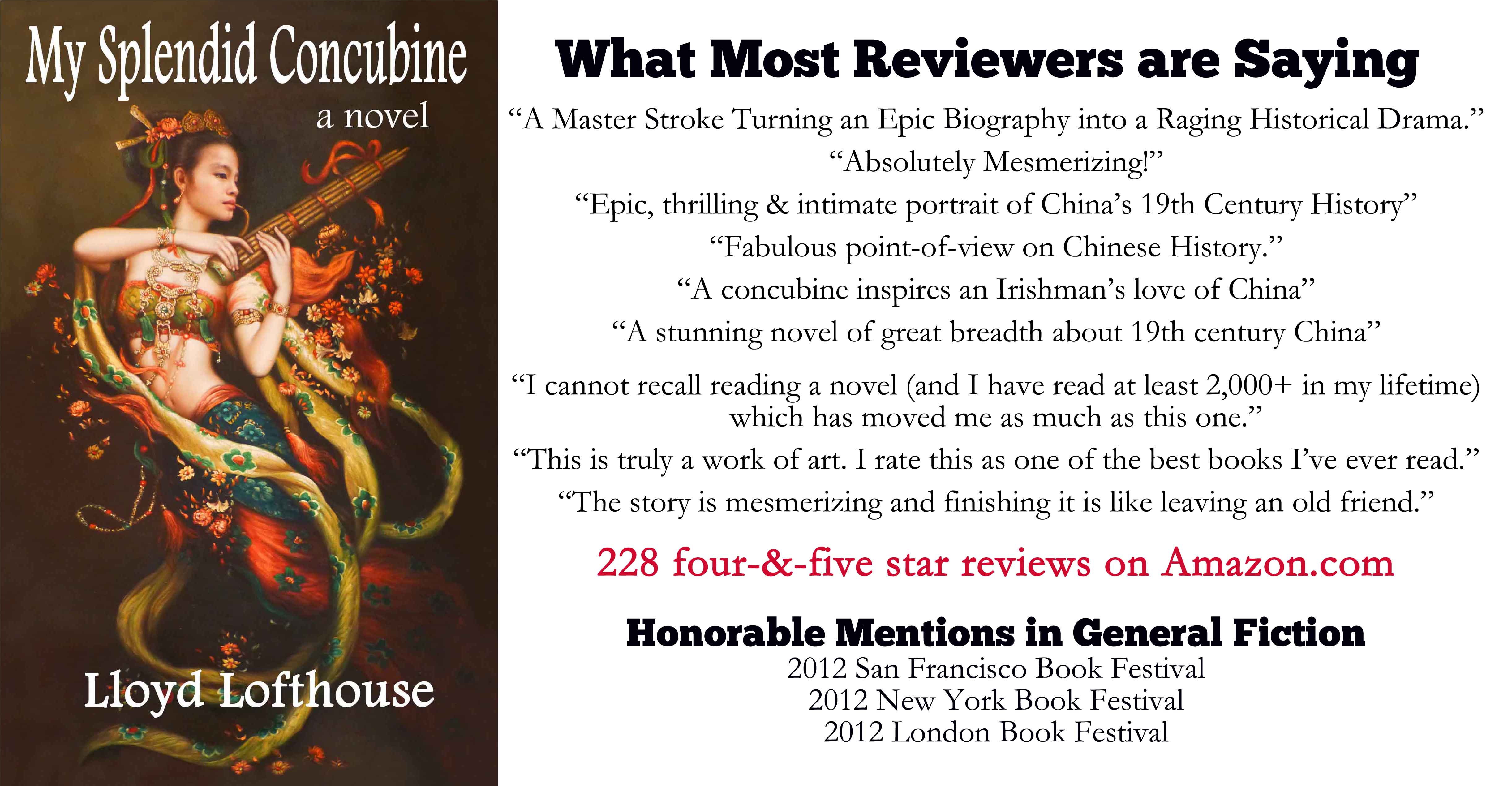
Lloyd Lofthouse is the award-winning author of My Splendid Concubine [3rd edition]. When you love a Chinese woman, you marry her family and culture too. This is the unique love story Sir Robert Hart did not want the world to discover.

A1 on March 13 - 2016 Cover Image with BLurbs to promote novel

Where to Buy

Subscribe to “iLook China”!
Sign up for an E-mail Subscription at the top of this page, or click on the “Following” tab in the WordPress toolbar at the top of the screen.

About iLook China

China’s Holistic Historical Timeline


An Islamic Pilgrimage from China: Part 1 of 2

May 31, 2016

The hajj is an annual Islamic pilgrimage to Mecca, and a mandatory religious duty for Muslims that must be carried out at least once in their lifetime by all adult Muslims who are physically and financially capable of undertaking the journey, and can support their family during their absence.

From Xian in China to Mecca in Saudi Arabia it is a distance of 6,812 km or 4,232.781 miles.

This post might be a surprise to many in the West that think there is no religious freedom in China, but China handles religious freedom similar to how Singapore does it. And Singapore is seldom if ever criticized in the Western media for its religious restrictions.

The U.S. Department of State says that Singapore’s government has broad powers to limit citizens’ rights and handicap political opposition, and it does. One of those restrictions is a limited freedom of religion.

For instance, Singapore bans the Jehovah’s Witnesses and the Unification Church by making public meetings illegal. The Falun Gong, banned in China, also has problems in Singapore.

China recognizes five religions — Buddhism, Taoism, Islam, Catholicism and Protestantism but has banned certain new religious movements that are considered cults. China does not recognize cults as religions.

In the video embedded with this post, Al Jazeera follows Chinese Muslims as they prepare to undertake the hajj pilgrimage to Mecca from Xian in China.

The ancient city of Xian in Shaanxi province is home to about 60,000 ethnic Chinese Muslims.

Xian claims it has a Muslim history going back more than thirteen hundred years when Islam was first introduced to China in 650 AD, and the oldest mosque in China was built in 685-762 AD in Xian during the reign of Emperor Xuanzong of the Tang Dynasty.

Chinese Imam Ma Yi Ping speaks both Chinese and Arabic. He studied at the Islamic University of Medina and has made the hajj several times. He was taught in secret to be a devout Muslim by his parents when Mao ruled China and the mosques in China were closed.

Despite the persecutions that took place during China Cultural Revolution (1966 – 1976) for all religons, Islam survived.

Ma Yi Ping says that after Mao and the Gang of Four were gone and China opened for trade with the world, he did not have to study the Quran in secret anymore.

Since the 15th century, Xian Muslims have been going to Mecca in Saudi Arabia for the annual hajj pilgrimage.

In the past, during the ancient days of the Silk Road, these journeys started and ended in Xian’s Muslim quarter. Today is no different.

Continued in Part 2 starting June 1, 2016

Lloyd Lofthouse is the award-winning author of My Splendid Concubine [3rd edition]. When you love a Chinese woman, you marry her family and culture too. This is the unique love story Sir Robert Hart did not want the world to discover.

#1 - Joanna Daneman review posted June 19 2014

Where to Buy

Subscribe to “iLook China”!
Sign up for an E-mail Subscription at the top of this page, or click on the “Following” tab in the WordPress toolbar at the top of the screen.

About iLook China

China’s Holistic Historical Timeline