Three times George Washington acted in a way that would insure the newly born US Republic would survive.
His first act was in 1782, when Colonel Lewis Nicola wrote a letter to Washington suggesting that Washington should set up a constitutional monarchy because of the inefficiency of the Continental Congress.
Washington was offended at such a suggestion and wrote to Nicola telling him to banish such thoughts from his mind. George Washington – Legends and Myths
His second act took place in 1783, when he stepped in and saved the republic by ending the Newburgh Conspiracy, a plot in the military to seize power and create a military dictatorship. Source: Early America
The third act was when Washington stepped down as President (1789 – 1797) and returned to his farm.
When King George III asked his American painter, Benjamin West, what Washington would do after winning independence, West replied, “They say he will return to his farm.”
“If he does that,” King George said, “he will be the greatest man in the world.” Cato Institute
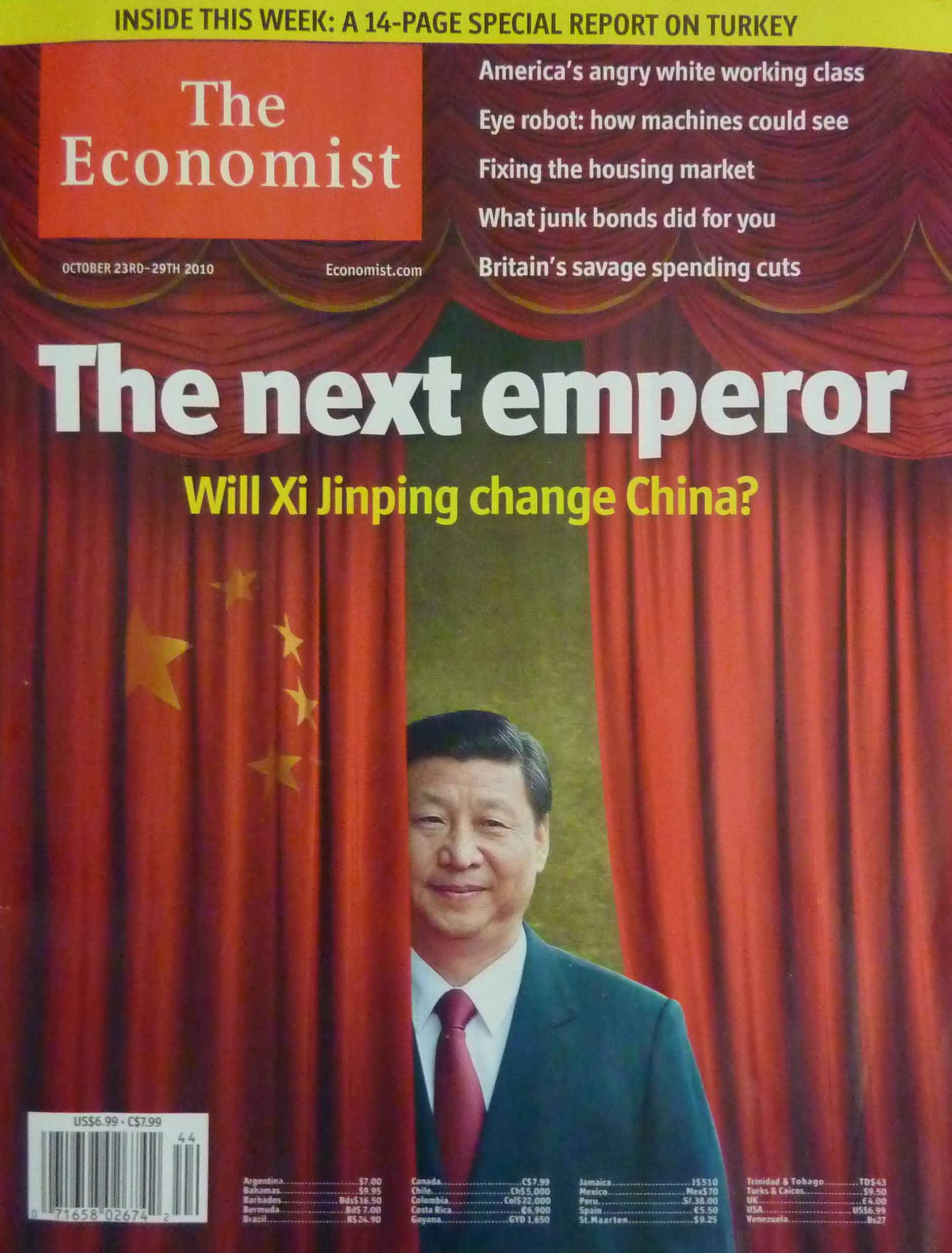
The cover of The Economist for October 23, 2010—in the best tradition of biased and Yellow Journalism— SHOUTED: “The next emperor – Will Xi Jinping change China?”
As I read the feature article on page 13, I laughed when I saw, “Mr. Xi’s appointment was eerily similar to the recent anointment of Kim Jong-un in North Korea.”
The reason I saw humor in this absurd statement was that there is nothing similar. Kim Jong Un inherited his for-life position as Supreme Leader of North Korea. He is the son of Kim Jong-il, and the grandson of Kim Il-sung, the founder of North Korea.
The Economist implied in the October 23, 2010 issue of the magazine, that China is a monarchy.
However, China is not a monarchy as the Kim Dynasty in North Korea has become or a dictatorship-monarchy as many in the West think.
In North Korea, what started as a Socialist Dictatorship modeled on Maoism has become a Socialist Maoist Monarchy.
China, on the other hand, started as a Socialist Dictatorship under Mao (1949 to 1976) and is becoming a fledgling republic with Western critics looking for cockroaches and slugs under rocks.
In fact,Dr. Sun Yat-sen, the father of China’s Republic, wrote that he wanted to model China’s government after America but by combining Western thought with Chinese tradition.
He didn’t say he wanted China to be a clone of America’s Republic.
America was still a Republic prior to World War II. The US wouldn’t become a full-fledged democracy until the 1960s.
Unfortunately, Dr. Sun died in 1925 before he could finish what he started.
It wouldn’t be until after Mao died in 1976, that the leaders of the Communist Party under Deng Xiaoping would start the long journey to implement Sun’s dream of a Republic against great pressure from Western democracies to copy them.
Before we move on, let’s take a brief look at the Athenian democracy that was developed around the 5th century B.C. in the Greek city-state of Athens. Even though there is evidence that democratic forms of government existed before the 5th century, ancient Athens is generally believed to be the first democracy.
What did that democracy look like? Athens had a system of direct democracy, in which participating citizens voted directly on legislation and executive bills. But participation was not open to all residents: to vote, one had to be an adult, male citizen, and the number varied between 30,000 and 50,000 out of a total population of around 250,000 to 300,000—about 150,000 were slaves.
In comparison, the membership of the Chinese Communist Party (CCP) is now 86.7 million—men make-up 77 percent of CP’s membership, while woman make up 23 percent—making the CCP the world’s largest political party representing more than 6 percent of China’s population, and slavery is illegal just like it is in the U.S.
Regardless of what critics claim, China is becoming more like the republic Dr. Sun Yat-sen might have imagined by combining Western thought with Chinese traditions.
After Mao died, The Communist Party worked for several years to draft the 1982 Constitution, which included term limits of two five-year terms for elected government officials.
If you have read the Chinese Constitution carefully, it is obvious that the U.S. Constitution was used as a model. However, these two documents are not the same.
If the Party leadership is not happy with China’s president, he can be removed after one five-year term. There is even an article of impeachment in China’s Constitution.
China’s first president was Li Xiannian (1983 to 1988). He served one, five-year term, and then he stepped down.
From 1988 to 1993, Yang Shangkun would be China’s president for one five-year term. Deng Xiaoping (born 1904 – died 1997) was the Chairman of the Communist Party from 1983 to 1993, which was ten years—what China’s 1982 Constitution calls for, but Deng never served as the country’s president.
Due to how the Tiananmen Square incident in 1989 was handled, President Yang had to step down at the end of his first, five-year term. The only other way to remove him would have been through impeachment.
In 1993, Jiang Zemin became President and Chairman of the Communist Party. Then in 2003, Hu Jintao became President and Chairman of the Party. His term ended in 2012 when Xi Jinping became president of China.
Deng Xiaoping was China’s George Washington. What he did was what Dr. Sun Yat-sen wanted. China is a republic that combines Western thought with Chinese tradition.
However, the task to create China’s Republic fell to the Communist Party so China is a Socialist Republic with capitalist tendencies.
In China, Piety is important and advice from elders is often followed as if it is the law. Due to this, elder statesmen such as Jiang Zemin have great power in the government even after he no longer has a political title. After all, this is a Chinese tradition.
The Economist mentioned disagreements within the CCP among China’s leaders over what the country’s priorities should be—both on the economy and on political reform.
Whatever the final decisions will be, the consensus of the CCP will be guided by Chinese tradition and not Western thought.
The changes that “some” want to see take place in China will probably not arrive in a hurry if the wisdom of the I-Ching, The Book of Changes, is followed, which says change should come slowly.
In fact, China has proven it is a republic because none of China’s first four presidents are the sons of previous presidents and eventually death removes the elders. China’s presidents did not inherit that title due to heredity as kings do or the leader of North Korea did.
_______________
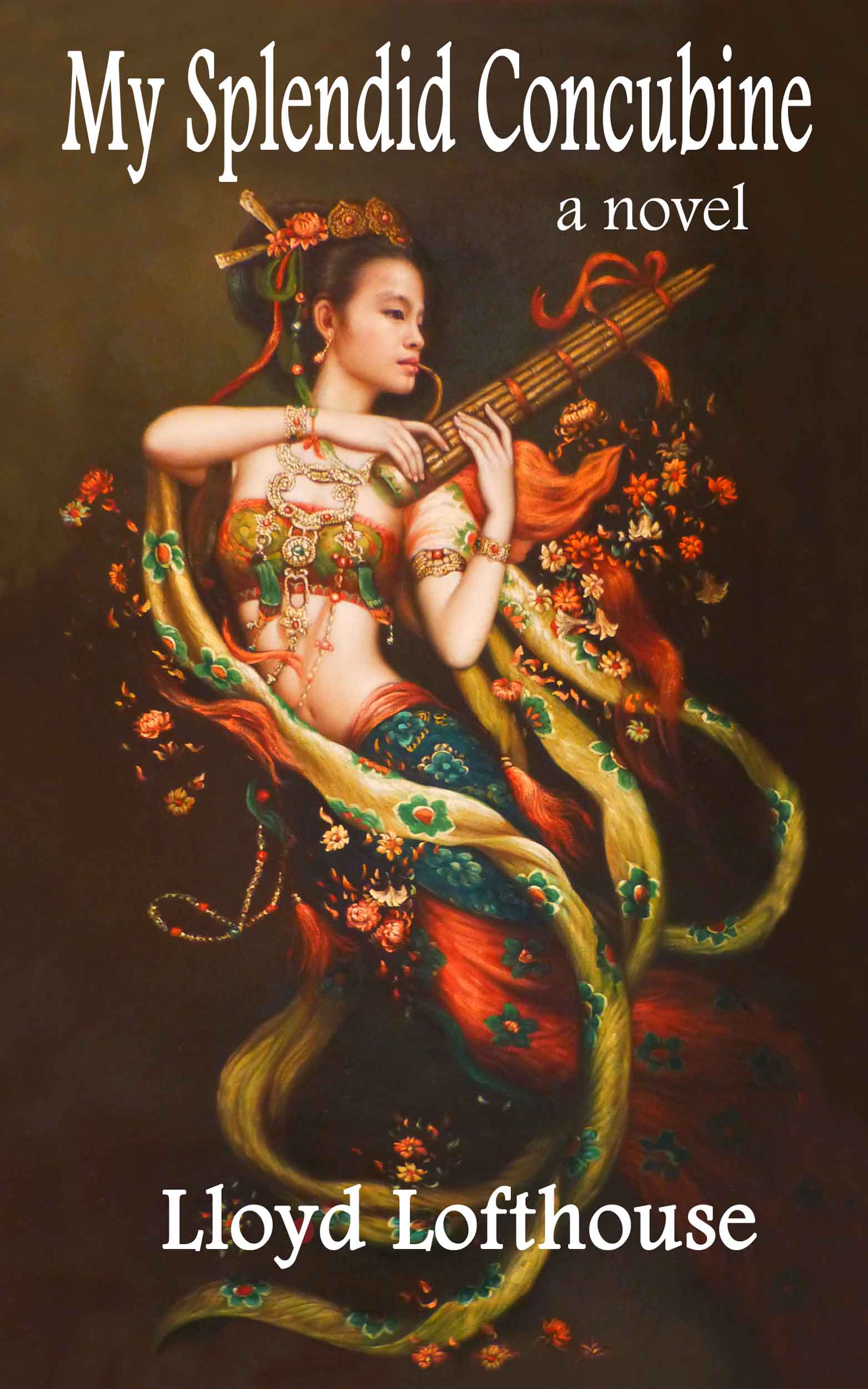
Lloyd Lofthouse is the award-winning author of My Splendid Concubine [3rd edition]. When you love a Chinese woman, you marry her family and culture too. This is the love story Sir Robert Hart did not want the world to discover.
Subscribe to “iLook China”!
Sign up for an E-mail Subscription at the top of this page, or click on the “Following” tab in the WordPress toolbar at the top of the screen.
The loss of life during China’s last Great Famine—in the West and especially the United States—has been blamed on Mao and the Chinese Communist Party, but finding blame on a famine in China isn’t that easy when you know the history of droughts and famines in that country.
It’s no secret that many in the United States think that Mao was a monster worse that Adolf Hitler or Stalin, and that Mao was responsible for killing 30 to 60 million people during what is known as China’s Great Famine.
Until recently, I also believed this because that’s all I have ever heard through the U.S. media—the details that may have caused this famine are not common knowledge, and it appears that no attempt by the Western media has ever been made to reveal them.
However, after discovering what happened in China and the world during Mao’s Great Leap Forward, what was once a certainty—at least to me—is now a mystery and possibly another hoax equal to the hoax that Tibet was never part of China before 1950 and there was a massacre in Tiananmen Square in 1989, which Wiki Leaks recently proved wrong.
There’s no mention of drought, floods and severe weather that cut crop yields, and the number of deaths quoted in the video cannot be supported with evidence. In fact, evidence that does exist supports far fewer deaths. Everything else is based on guessing.
I think discovering why Mao might be a victim of this hoax is worth examining, because in 1949 when Mao came to power, life expectancy in China was age 35, but by 1960 life expectancy had improved to age 60, while the population of China had increased by 19.5% with child mortality rates improving dramatically.
If Mao’s policies were responsible for these improvements in life expectancy and population growth, how could he also be the monster responsible for causing a famine that killed millions?
My research revealed that other factors might have contributed to the deaths and all but one of those factors did not deliberately cause people to die of starvation.
After learning of these other factors and completing the puzzle, it is obvious—at least to me— that Mao and the Communist Party did not order the deaths of 20 to 70 million mostly rural peasant in remote areas of China, and the numbers quoted in the West vary widely because different people have made different claims without valid evidence to support those claims. However, there is evidence that supports the lower number. In fact, the actual number of Chinese who starved is probably much lower than what is commonly believed in the United States.
Before I started researching this series of posts, I believed that Mao’s agricultural reform policies were mostly responsible for the famine, and then I learned that drought and severe weather also played a role in the famine.
The other factors that may have contributed to China’s so-called Great Famine will be listed in order of influence with the most damaging factor listed first and the least damaging last.
In 1959 and 1960, the weather was less favorable due to droughts and floods in some provinces, and the situation grew considerably worse, with several of China’s provinces experiencing a severe famine.
Droughts, floods, and bad weather caught China completely by surprise, and in July 1959, the Yellow River flooded in East China and directly killed—through starvation from crop failure or drowning—an estimated 2 million people.
In 1960, at least some degree of drought and more bad weather affected 55 percent of cultivated land in China where only 10 percent of the land area is arable, while an estimated 60 percent of northern agricultural land received no rain at all. –Great Leap Forward – Climate Conditions and famine in China (Wiki)
In addition, it helps to know that droughts and famine are common in China. Between 108 BC and 1911 AD, there were no fewer than 1,828 major famines in China or one nearly every year in one or more provinces.
The first time I heard that droughts and extremely bad weather also played a role in the so-called Great Famine was early July 2011, and it was an accident. I was researching another topic for this Blog and stumbled on that mostly unknown fact.
Then I discovered another more insidious factor when I started working on this post that may have contributed to the deaths of millions of Chinese, who starved during what is known as the Great Famine.
This insidious factor I’m talking about was influenced by America’s paranoia with Communism caused by the War in Korea(1950 – 1953), McCarthyism (1947 – 1957), Vietnam (1955 – 1975), and the Cold War with the USSR (1945 – 1991) set the stage for what may have contributed to mass deaths by starvation in China during the Great Leap Forward.
The US embargo on China was a “complete embargo” that must have contributed to the death toll of the Great Famine, a factor never mentioned before.
During the McCarthy era (1947 – 1957), thousands of Americans were accused of being Communists or communist sympathizers and became the subject of aggressive investigations and questioning before government or private-industry panels, committees and agencies.
In 1950, because China fought alongside North Korea against allied UN forces under the leadership of the US, the United States implemented a “complete embargo” that forbade all financial transaction with Communist China.
The US also convinced many of its allies to join this “complete embargo” to cut China off from the world.
After the Korean war, the United States did not lift this embargo for the next twenty years (1949-1969), with a goal to disrupt, destabilize, and weaken China’s communist government by causing the people to suffer and this “complete embargo” was one of the tools to achieve this.
Sources in the U.S. government have admitted that the objective of the economic warfare was aimed at causing a breakdown of Communist China. The thinking was that problems in the Chinese economy would lead to loss of support from the people causing the collapse of the Communist Republic. –China for all.info and Asia for Educators – Columbia.edu
This embargo was lifted in 1969, when Richard Nixon was President, but by then it was too late—millions of Chinese suffered and died during the Great Famine. –Washington Post.com
While people were starving in China, and US officials were waiting for Communist China to collapse, Washington D.C. had no idea how much suffering the Chinese people were capable of, and that even with the drought and famine, most Chinese were still better off than they had been for centuries.
How bad was life in China before 1949? Field-studies in the 1930s revealed that in all parts of China, large numbers of landless laborers lived in tremendous poverty, and their situation had not changed since the sixteenth century.–China for all.info
The evidence that the quality of life was improving in China started in 1949. When Mao came to power, life expectancy in China was 35, but by 1960 life expectancy had improved to age 60, while the population of China had increased by 19.5% with child mortality rates improving dramatically.
We might never know how much of an impact America’s economic warfare against China crippled its ability to import food to feed its starving people in a time of drought and famine. In fact, this may have also influenced Mao’s decisions to have the world see China as strong and capable of feeding itself.
The last damaging factors that might have led to millions of deaths due to famine and starvation was the statistical lies of rural farmers and local party bosses reporting crop yields in rural China and Mao’s impossible goals to create a miracle in five years to impress the world.
Mao’s five-year plan for the Great Leap Forward set quotas (goals) to develop agriculture and industry so China would catch up to America and the other Western nations that had invaded China during the 19th century (England, France, Japan, Germany, Russia, America, etc.) starting with the Opium Wars that forced China to allow the foreign powers to sell opium to its people alongside an invasion of Christian missionaries who were allowed to go wherever they wanted to convert the Chinese heathens.
That might be why Mao believed that both agriculture and industry had to grow fast to make China strong enough to resist another invasion—after all, China was still surrounded by enemies and wars against Communism were being waged in Korea and Vietnam, two countries on China’s doorstep.
Industry could only prosper if the workers were well fed, while the agricultural workers needed industry to produce the modern tools for modernization.
For this to happen, rural China was reformed into a series of giant communes.
The droughts, floods and other severe weather arrived soon after the five-year plan to modernize and grow strong enough to resist another war was implemented and set the stage for a tragedy caused by nature and supported by America’s “economic warfare” in the form of a “complete embargo” of China.
Due to quotas set by Mao’s agricultural policies, no one wanted to be seen as a failure and/or unpatriotic and this generated boastful claims about output that were followed by more boastful claims of incredible crop yields.
Nobody—least of all the central government in Beijing—knew the real output figures. There was a sense of general euphoria in Beijing that China was succeeding.
While rural farmers and local party bosses lied about crop yields, Beijing started exporting rice and wheat to other countries as a source of revenue, because Beijing thought there was a bumper crop. The result was that urban areas suffered with reduced rations but with still enough food to survive.
Food shortages were bad throughout the country. However, the provinces, which had adopted Mao’s reforms with the most energy, zeal and with the most fake bragging, such as Anhui,Gansu and Henan, suffered the most.
In fact, Sichuan, one of China’s most populous provinces, known in China as “Heaven’s Granary” because of its fertility, is thought to have suffered the greatest absolute numbers of deaths from starvation due to the energy that provincial leader Li Jinquan undertook Mao’s reforms.
Once the central government in Beijing discovered the truth, the Chinese Communist Party acted quickly to correct the errors in national agricultural decision-making, to conserve food, and to save as many lives as possible implementing drastic measures to feed those in need and to restore agricultural productivity.
Grain exports were stopped, and imports from Canada, France and Australia (in spite of America’s complete embargo) helped to reduce the impact of the food shortages. –Library Index.com
The final question is: Would Mao’s Great Leap Forward have been more successful if there had been no drought, no floods and no “complete (U.S.) embargo”, and the provincial party bosses had not lied about crop yields to Beijing?
It’s no secret that millions of rural people starved to death in China during the famine of 1959 – 1960, but it was a “great” tragedy caused by a complex series of circumstances and blunders—it was not a deliberate mass murder ordered by Mao or the CCP.
In addition, the actual number of deaths was significantly lower than what has been claimed in the West.
The CCP’s lofty goal was to prove to the world that the Party ruled China successfully by boosting crop yields and industrial output.
Another reason the CCP set such unrealistic goals for the five-year plan that contributed to the tragedy that was Great Leap Forward was because of Taiwan, which was recognized by the world as the official government of China and still held its seat in the United Nations.
It wouldn’t be until 1971 that the U.N. recognized the People’s Republic of China instead, and the United States wouldn’t switch diplomatic relations with China from Taipei to Beijing until 1979, finally recognizing the Communist Party as the legitimate ruler of China.
Recommended reading on this topic for those who seek the unblemished truth: From the Monthly Review, Did Mao Really Kill Millions in the Great Leap Forward? by Joseph Ball, and from Griffith University, Australia, Poverty, by David C. Schak, Associate Professor
In addition, more than one book has examined this topic from a scholarly perspective—instead of inflammatory unsubstantiated and inflated claims—but Mao’s Western critics have mostly ignored this work.
In China: Land of Famine (published in 1926 by the American Geographical Society) by Walter H. Mallory, casts doubt on the inflammatory claims, which have been popularized in the West about the post-1949 Mao era. Mallory offers another perspective for understanding what really might have happened during Mao’s Great Leap Forward.
Then from Stanford University Press, in the Economic Cold War by Shu Guang Zhang (August 2002), “the author argues that while the immediate effects (of the complete American embargo of China) may be meager or nil, the indirect and long-term effects may be considerable; in the case he reexamines, the disastrous Great Leap Forward and Anti-Rightist campaign (The Cultural Revolution) were in part prompted by the sanctions imposed by the United States and its allies.”
My wife then mentioned some memoirs published in Chinese and written by soldiers from Division A-341 of the People’s Liberation Army (PLA) that guarded Mao when he lived in the Forbidden City in Beijing.
These memoirs revealed that when Party members told Mao that rural Chinese in a few provinces were starving due to droughts and low crop yields, Mao didn’t believe what he was told.
To discover the truth, Mao sent people he trusted—troops from PLA Division A-341, who came from rural China—to their villages to investigate the claims of a famine.
When Mao’s trusted bodyguards returned from their home villages to Beijing in late 1960/early 1961 and reported the claims were true, Mao acted swiftly, cancelled the five year plan for the Great Leap Forward two years early and sent the peasants back to their villages from the collectives, and directed the Party to seek help from other countries to feed China’s starving people.
In fact, Roderick MacForquhar wrote in The Origins of the Cultural Revolution that in May 1961, China entered into long-term arrangements with Canada and Australia to insure grain supplies until production in China recovered in addition to imports of American grain laundered through France to avoid the complete American embargo.
Even Henry Kissinger, in his book,On China, wrote, “The Great Leap Forward’s production goals were exorbitant, and the prospect of dissent or failure so terrifying that local cadres took to falsifying their output figures and reporting inflated totals to Beijing.”
In conclusion, do you remember how many droughts and famines China has suffered from for more than 2,000 years? The answer is in Part 2 of this series: There were no fewer than 1,828 major famines in China or one nearly every year in one or more province. What I find really interesting is that the U.S. government and the traditional private sector U.S. media hasn’t reported this information, and the impressive fact that since 1961, there have been no famines in China for the first time in China’s history. In addition, in the last thirty years, China is responsible for 95% of all poverty reduction in the world.
_______________
Lloyd Lofthouse is the award-winning author of My Splendid Concubine [3rd edition]. When you love a Chinese woman, you marry her family and culture too. This is the lusty love story Sir Robert Hart did not want the world to discover.
Finalist in Fiction & Literature – Historical Fiction The National “Best Books 2010” Awards
Honorable Mentions in General Fiction 2012 San Francisco Book Festival 2012 New York Book Festival 2012 London Book Festival 2009 Los Angeles Book Festival 2009 Hollywood Book Festival
Subscribe to “iLook China”! Sign up for an E-mail Subscription at the top of this page, or click on the “Following” tab in the WordPress toolbar at the top of the screen.


 Posted by Lloyd Lofthouse
 iLook China