What’s the color of your flag? Part 1 of 2

October 27, 2015

The world’s most popular sport is Soccer with an estimated 3.5 billion fans. In America the number one sport is Football (NFL) with less than 156 million fans. The CIA’s World Factbook lists every country by its government type. In fact, click this link from Maps of the World, and explore all the different types of governments on the planet by just moving your curser over the map. There are 196 countries in the world, roughly 4,200 religions, and eight major ethnic groups and each of those groups can be broken up into smaller ethnic factions. There are 24 full democracies in the world and 51 authoritarian regimes similar to China. Can you subtract 196 from 24, and if so, once you have the answer, then tell me why the U.S. seems to only want to change China?
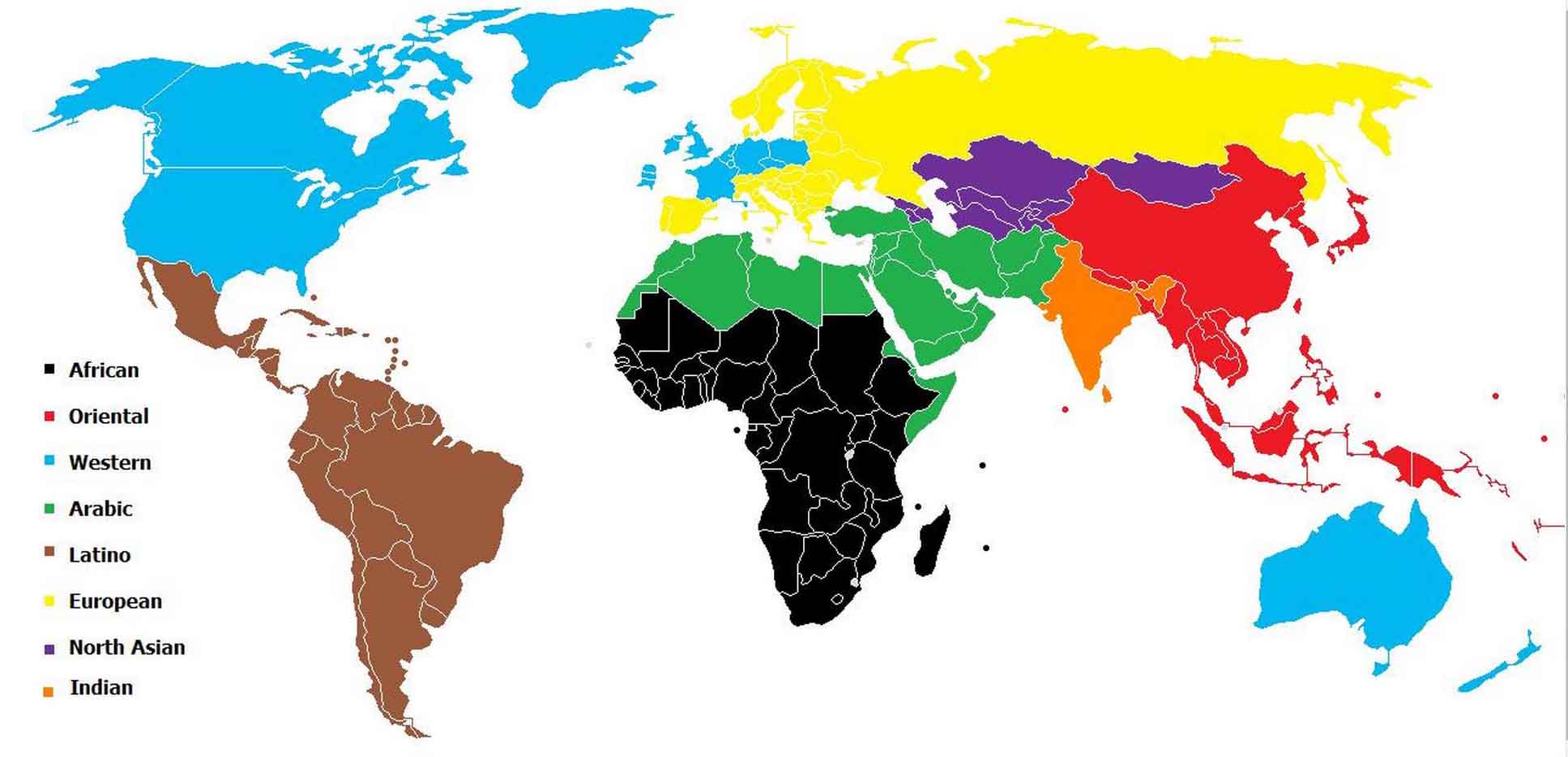
World Ethnic Groups

The last time I looked the U.S. flag was red, white and blue with 50 stars and 13 stripes, and 70.6 percent of its citizens identify themselves as Christians. – pewforum.org

The Declaration of Independence of 1776 and the U.S. Constitution were written by a group of white men influenced by Western republican/democratic governments dating back to the Greeks before the birth of Christ. In fact, Athenian statesman and member of the exiled Alcmaeonidae aristocracy, Cleisthenes is considered the father of democracy. Before his rise around 510 B.C., Athenian governance was left to aristocratic families who represented the wealthy. There is no similar figure in Asia.

Important historical figures in China were Confucius and Sun Tzu, who wrote the Art of War. From India, we get Buddha and Indira Gandhi. In the Middle East there was the Islamic prophet Muhammad. If you want a better idea of the diversity of the world, just scroll through Current World Population.

At this point someone who is ignorant might pop up and shout, “The Dalai Lama,” is from Asia and he promotes democracy, but no Dalai Lama has ever promoted a democracy similar to the United States or other European Republics.  When the Tibetans ruled themselves, they were first ruled by kings and then by a theocracy, and the Dalai Lama is still Tibet’s living god for life. Is there another country on the planet with a living god?

Tibet has never been a republic or a democracy, and its government in exile—even though they have sham elections and claim to have been a democracy since September 2, 1960—is headed by the 14th Dalai Lama and Prime Minister Lobsang Sangay. There are no political groups and no term limits. There are about 150,000 Tibetans living in exile and 7.5 million living in the Tibet Autonomous Region in China. Yes, there are elections in China too but there is only one political party—not much different than the 14th Dalai Lama’s government in exile, except the Chinese change their leaders every 5 to 10 years.

If you are an American, do you have a copy of both the Declaration of Independence and the Constitution? I do. Have you read it, and if you have, how much do you remember besides the Pursuit of Happiness, the right to own a firearm and the freedom to say just about anything without fear of being tossed in prison?

China may start with the letter “C” as California does, but it is not part of the U.S., and its founding fathers were men such as Sun Yat-sen, Mao, and Deng Xiaoping, and less than 3% of Chinese are Christians while more than 87% are not religious or do not belong to any organized religion.

In April, 2011, CNN ran a piece on its CNN Wire service of a Chinese artist and citizen of the People’s Republic of China, (PRC). His name is Ai Weiwei.  The title of the piece was, “China says Ai Weiwei is being held for economic crimes“.

If you read the entire CNN piece, you will discover that the artist was taken into custody in route to Hong Kong. The piece quotes his wife and mother, who both believe he is innocent and that he was arrested and locked up because he refused to listen to warnings that he should stop his “reckless collision against China’s basic political framework and ignorance of China’s judicial sovereignty to exaggerate a specific case …”

Ai Weiwei is also one of China’s best-known artists. He helped design the Bird’s Nest stadium for the 2008 Beijing Olympics. Ai Weiwei is more than an artist. He is also a democracy activist and a critic of his government.

Sure, the US Constitution protects U.S. citizens when they criticize the government.  However, the Chinese Constitution does not offer the same protections. In fact, most countries don’t. In Saudi Arabia, woman cannot work or drive and criminals are often executed by beheading—a practice once common in China but no more.

And China is not the only country in the world with an autocratic government. Scroll back to the top and you will discover China is only one of 51.

In fact, the American CIA has taken advantage of foreign laws such as those in Saudi Arabia and Egypt when terrorists have been sent for torture and questioning without the due process of law as guaranteed in the U.S. (not outside of it).

Continued in Part 2 on October 28, 2015

______________________________

Lloyd Lofthouse is the award-winning author of My Splendid Concubine [3rd edition]. When you love a Chinese woman, you marry her family and culture too. This is the lusty love story Sir Robert Hart did not want the world to discover.

#1 - Joanna Daneman review posted June 19 2014

Where to Buy

Subscribe to “iLook China”!
Sign up for an E-mail Subscription at the top of this page, or click on the “Following” tab in the WordPress toolbar at the top of the screen.

About iLook China

China’s Holistic Historical Timeline


Who has the bloodiest hands—China, the United States or India?

September 2, 2015

Back in 2006, China was crucified in the Western media due to one unarmed Tibetan being shot dead attempting to illegally cross the border into India. It was called the Nangpa La Pass Shooting Incident. If you Google it, you’ll find a lot of anger and allegations about what happened.

USA Today reported, “China said Thursday that soldiers posted near its border with Nepal clashed with some 70 people attempting to flee the country, killing one person on the spot and injuring two others, including one who died later of altitude sickness.” io9.com says, “Altitude sickness is relatively unstudied because of how quickly and unpredictably it goes from nausea to coughing up blood to death.”

Another headline shouted: “International Anger Grows Over Tibet Shooting. Human Rights groups are calling for a UN Investigation into the killing of a nun by Chinese border patrol guards, writes Jonathan Watts in Beijing.”

Then I read another story I’d never heard of before that the U.S. media has ignored.  I read this in The Economist, a publication in the UK, of another border where similar killings happen often, but I couldn’t find any demand of a UN Investigation in the Western media or from human rights groups for those killings. Even The Economist, that reported the story, didn’t call for an investigation.

Maybe the difference is that the border killings reported by The Economist took place between two democracies—India and Bangladesh. After all democracies are special, aren’t they?


I couldn’t find a report of this India-Bangladesh incident in English on YouTube

The Economist reported, “On January 7th India’s Border Security Force (BSF) shot dead Mr. Nur Islam’s 15-year-old (daughter) Felani, at an illegal crossing into Bangladesh from the Indian state of West Bengal. Felani’s body hung from the barbed-wired fence for five hours. Then the Indians took her down, tied her hands and feet to a bamboo pole, and carried her away. Her body was handed over the next day and buried in the yard at home.”

“The BSF (India’s Border Security Force) kills with such impunity along India’s 4,100-kilometer (2,550-mile) border with Bangladesh that one local journalist wonders what the story is about. According to Human Rights Watch, India’s force has killed almost 1,000 Bangladeshis over the past ten years.”

Should we conclude from this that the one Tibetan killed attempting to illegally cross China’s border is worth more than the 1,000 who were shot dead attempting to illegally cross the border from Bangladesh to India?

What about deaths along the US border?

According to Rodolfo Acuña, Professor Emeritus of Chicano Studies at California State University, “Mexico’s Ministry of Foreign Affairs reported 117 cases of human rights abuses by US officials against migrants from 1988 to 1990, including fourteen deaths. During the 1980s, Border Patrol agents shot dozens of people, killing eleven and permanently disabling ten.”

On May 28, 2010, Anastasio Rojas, a 42-year-old Mexican migrant worker, was tased and beaten at the San Ysidro border crossing by more than a dozen U.S. Customs and Border Protection officers. According to the witnesses, he was face down on the ground and handcuffed.

On June 2010, a 15-year-old Mexican citizen was shot to death on the Mexican side of the border near El Paso, Texas. The U.S Border Patrol reported that the officers responded to a group of suspected illegal immigrants who were throwing rocks at them.

Hey, China, did you get that? China’s border guards are not allowed to shoot anyone who is illegally crossing its borders, but the United States and India can kill as many as they want—sort of like the fictional character James Bond, who has a license to kill from another democracy.

______________________________

Lloyd Lofthouse is the award-winning author of My Splendid Concubine [3rd edition]. When you love a Chinese woman, you marry her family and culture too. This is the lusty love story Sir Robert Hart did not want the world to discover.

IMAGE with Blurbs and Awards to use on Twitter

Subscribe to “iLook China”!
Sign up for an E-mail Subscription at the top of this page, or click on the “Following” tab in the WordPress toolbar at the top of the screen.

About iLook China

China’s Holistic Historical Timeline


a democracy in name only – a bumbling empire for sure

June 17, 2015

The China Mirage, supported by overwhelming factual evidence that was willingly suppressed or ignored for decades, clearly reveals that America is not the peace loving democracy that most Americans think it is.

The reality is that the U.S. is a global empire that took its first step toward World War II in the Pacific on July 8, 1853, when Commodore Matthew Perry commanded a U.S. Navy squadron that sailed into Tokyo harbor. Perry—under orders from President Millard Fillmore—demanded a treaty permitting trade and the opening of Japanese ports to U.S. merchant ships. The reluctant Japanese leaders, who wanted to be left alone, were not given a choice if they wanted to avoid the same invasions China had suffered mainly at the hands of the British and French during the Opium Wars.

After being forced to open its doors to Western trade so American corporations could profit—to protect itself in the future—Japan industrialized and built a powerful and ruthless modern military.

The second step toward war in the Pacific took place about fifty years later when President Theodore (Teddy) Roosevelt started to meddle in Asia’s affairs. The book reveals that Teddy urged Japan to invade Korea leading eventually to Japan’s invasion of China, because Teddy was obsessed with the Japanese and felt strongly that Japan’s role should be to protect Asia from being colonized by the European colonial powers even if it meant Japan’s military would dominate all of Asia.

The third step toward war in the Pacific would be the bumbling, ignorant, secretive, back-stabbing, dysfunctional and manipulative administration of President Franklin D. Roosevelt—with help from the powerful and wealthy lying Christian China Lobby that based its thinking on a faulty premise that the Chinese loved democracy and wanted to become a Christian country just like the United States.

The powerful China Lobby’s ignorant and severely flawed agenda would cause the deaths of more than 25 million civilians (mostly Chinese) and 6 million troops (mostly Chinese) in addition to the bombed out devastation of Southeast Asia, China, Korea and Japan.

Following World War II and the Korean Conflict, the same ignorant and arrogant thinking led to the Vietnam War where U.S. troops fought for almost 20 years, and the United States dropped more bombs on Southeast Asia than it did in all of World War II.

Readers will discover that Henry Luce, the publisher of Time and Life Magazines, who was called the most influential private citizen in America at the time, was a perfect example of how anyone who has too much power and wealth can create their own reality based on lies that often evaporate later leaving future generations to deal with the damage caused by these fools.

Today, Henry Luce had been replaced by other ignorant, arrogant, wealthy and powerful fools, and they go by the names of, for instance, Bill Gates, Eli Broad, the Koch brothers, and the Walton family. I think if we looked at history closely we would discover that the rich and powerful have often meddled with the lives of others and then either die or refuse to admit they were wrong.

The First Amendment of the U.S. Constitution that protects the media from government intervention and meddling does not mean the media is balanced and honest. In fact—most of the time—the opposite is true. The so-called free U.S. media is often a propaganda machine that churns out fictions masquerading as truth—mostly owned and controlled by six corporations and at the top six powerful dictatorial oligarchs just like Henry Luce.

To be clear, those media corporations might be doing business in a democracy, but they are not democracies, and they have the power to fool and manipulate the people, the U.S Congress and even the President of the United States.

______________________________

Lloyd Lofthouse is the award-winning author of My Splendid Concubine [3rd edition]. When you love a Chinese woman, you marry her family and culture too. This is the lusty love story Sir Robert Hart did not want the world to discover.

IMAGE with Blurbs and Awards to use on Twitter

Subscribe to “iLook China”!
Sign up for an E-mail Subscription at the top of this page, or click on the “Following” tab in the WordPress toolbar at the top of the screen.

About iLook China

China’s Holistic Historical Timeline


Comparing China’s Tiananmen Incident to the U.S. War on the Philippine People

April 22, 2015

China has admitted that some of its citizens and troops were wounded and killed during the unrest known as the Tiananmen Incident and/or Massacre. On Wiki, you will read that there were 241 – 2,600 deaths and 7,000 – 10,000 injured. In addition, on June 19, Beijing Party Secretary Li Ximing reported to the Politburo that the government’s confirmed death toll was 241, including 218 civilians (of which 36 were students), 10 PLA soldiers and 13 People’s Armed Police, along with 7,000 wounded (5,000 soldiers and police along with 2,000 civilians).

Now for the barbaric war the United States waged on the Philippine people. If you haven’t heard about this war before, don’t be surprised, because it has been suppressed (not censored). I mean, when’s the last time you’ve heard about it in the U.S. media compared to the number of times you’ve heard of China’s Tiananmen Square Massacre in 1989. In fact, when I posted What really happened in Tiananmen Square in 1989, Michael Brant left this comment, “This could have been written by the PRC media spin department.”  I wonder what Brant would say about the U.S. war against the Philippine People—if he’s ever heard of that brutal war.

After the Spanish American War, America took possession of the Philippine islands and waged war against the native people killing between 300k – 1 million noncombatants. This conflict was caused by the struggle of the First Philippine Republic to gain independence from the United States following the latter’s acquisition of the Philippines from Spain after the Spanish–American War.

There is a 2010 film about this war called Amigo. I think the odds favor that you have never heard of this film that doesn’t portray the U.S. as the freedom loving country most Americans think it is. In fact, the film’s widest release in the U.S. was in 10 theaters and total domestic earnings were $184,705.  The production budget for the film was $1.5 million, and it never had a global release. The film is available through Amazon as an instant video to stream, but no DVD is available. I haven’t seen this film yet, because I’m still waiting for the DVD.

I think it’s always good to have the facts before passing judgment, and history does count if you are aware of it as long as it isn’t suppressed or revised.

Jesus Christ said, So when they continued asking Him, He lifted Himself up and said unto them, “He that is without sin among you, let him first cast a stone at her.” John 8:7

If we take what He said seriously, then does any American have a right to annually condemn China for what happened during the Tiananmen incident in 1989 without also condemning the United States for what it did in the Philippines?

______________________________

Lloyd Lofthouse is the award-winning author of My Splendid Concubine [3rd edition]. When you love a Chinese woman, you marry her family and culture too. This is the love story Sir Robert Hart did not want the world to discover.

2015 Promotion Image for My Splendid Concubine

Subscribe to “iLook China”!
Sign up for an E-mail Subscription at the top of this page, or click on the “Following” tab in the WordPress toolbar at the top of the screen.

About iLook China

China’s Holistic Historical Timeline


The China Daily, a branch of Xinhua

April 15, 2015

The China Daily is the English language edition for one of China’s state-run newspapers. If you look at the internet address, you will also see Xinhua (http://www.chinadaily.com.cn/xinhua/), and Xinhua is the official press agency of the People’s Republic of China. Xinhua operates more than 170 foreign bureaus worldwide and maintains one for each province in China. Today, Xinhua News Agency delivers its news across the world in six languages: Chinese, English, French, Russian, Spanish, and Arabic.

The editorial office is in Beijing and there are branch offices in most major cities of China as well as several foreign capitals. For instance, one office was established in New York City in 2009. You may also access the paper on-line (click above link).

The paper is regarded in the West as the English-language mouthpiece for China’s central government.

However, don’t think of the China Daily as only a source of propaganda. It’s a serious newspaper, and the people on the staff are professionals who see that the content of the paper fits the collective culture of China.

Any censorship usually doesn’t come from the leadership of the central government but from the reporters and editors of the paper. In fact, there have been times when the paper has been called by the central government and asked to cover a topic considered too sensitive by the staff.

Since China is still changing at a rapid pace, any opinions you hold about China may be obsolete. The country, culture, and lifestyles of the people are changing as fast as the economy.

 
If you are interested in hearing from an insider who worked at the China Daily in 1997, I recommend reading Around the Bloc: My Life in Moscow, Beijing, and Havana by Stephanie Elizondo Griest.

______________________________

Lloyd Lofthouse is the award-winning author of My Splendid Concubine [3rd edition]. When you love a Chinese woman, you marry her family and culture too. This is the love story Sir Robert Hart did not want the world to discover.

2015 Promotion Image for My Splendid Concubine

Subscribe to “iLook China”!
Sign up for an E-mail Subscription at the top of this page, or click on the “Following” tab in the WordPress toolbar at the top of the screen.

About iLook China

China’s Holistic Historical Timeline