China’s Greatest Emperors

November 25, 2010

China’s longest lasting dynasties survived due to one or more great emperors.

After China was unified by Qin Shi Huangdi (221 – 207 BC), there were only five dynasties that survived for long periods — the Han, Tang, Sung, Ming, and Qing Dynasties.

Although China’s civilization survived, the country’s history is rampant with rebellions, palace coups, corruption among palace officials, and insurrections. Between the five longest dynasties, the country usually fell apart into warring states as it did after 1911.

The most successful emperors managed to stabilize the country while managing wisely as the Communist Party has done since 1976.

Emperor Han Wudi (ruled 141 – 87 B.C.) of the Han Dynasty (206 B.C. – 219 A.D.) was fifteen when he first sat on the throne.

Wudi is considered one of the greatest emperors in China’s history. He expanded the borders, opened the early Silk Road, developed the economy, and established state monopolies on salt, liquor and rice.

After the Han Dynasty collapsed, China fell apart for almost 400 years before the Tang Dynasty was established (618 -906). The Tang Dynasty was blessed with several powerful emperors.

The first was Emperor Tang Taizong (ruled 627-649).

According to historical records, Wu Zetain, China’s only woman emperor also ruled wisely.

Emperor Tang Zuanzong , Zetain’s grandson, ruled longer than any Tang emperor and the dynasty prospered while he sat on the throne.

After the dynasty fell, there would be short period of about 60 years before the Sung Dynasty reestablished order and unified the country again.

The second emperor of the Sung Dynasty, Sung Taizong (ruled 976 – 997) unified China after defeating the Northern Han Dynasty. The third emperor, Sung Zhenzong (ruled 997-1022) also deserves credit for maintaining stability.

The Sung Dynasty then declined until a revival by Sung Ningzong (ruled 1194 – 1224) After he died, the dynasty limped along until Kublai Khan defeated the last emperor in 1279.

After conquering all of China, Kublai Khan founded the Mongol, Yuan Dynasty (1277-1367). Not long after Kublai died, the dynasty was swept away.

In 1368, a peasant rebellion defeated the Yuan Dynasty and drove the Mongols from China.

The Ming Dynasty (1271 – 1368) is known for rebuilding, strengthening and extending the Great Wall among a list of other accomplishments.

Historical records show that the rule of the third Ming Emperor, Ming Chengzu (ruled 1403 – 1424), was the most prosperous period.

After Chengzu, the dynasty would decline until 1567 when Emperor Ming Muzong reversed the decline.

His son, Emperor Ming Shenzong, also ruled wisely from 1573 to 1620.

After Shenzong’s death, the Ming Dynasty quickly declined and was replaced by the Qing Dynasty in 1644.

The Opium Wars started by England and France and the Taiping Rebellion led by a Christian convert in the 19th century would contribute to the fall of the Qing Dynasty in 1911.

The Qing Dynasty was fortunate to have three powerful, consecutive emperors: Emperor Kangxi (1661 – 1722), Yongzhen (1722-1735) and Qianlong (1735-1796). For one-hundred-and-thirty-five years, China remained strong and prosperous.

After the corrupt Qing Dynasty was swept aside in 1911 by a rebellion led by Dr. Sun Yat-sen, China fell apart and warlords fought to see who would rule China.

When Sun Yat-sen died, the republic he was building in southern China fell apart when Chiang Kai-shek broke the coalition that Sun Yat-sen had formed between the Nationalist and Communist Parties. Mao’s famous Long March shows how the Communists survived.

Then Japan invaded, and China would be engulfed in war and rebellion until 1945 when World War II ended. After World War II, the rebellion between the Nationalist and Communists ended in victory for the Communists in 1949.

This victory was made possible because the Communists were supported by China’s peasants that hated, despised and distrusted the Nationalist Party, which represented China’s ruling elite.

The Communists gained the support of the peasants by treating the peasants with respect and promising reforms that would end the suffering.

Then Mao’s Great Leap Forward and the Cultural Revolution extended the peasants suffering.

However, since the early 1980s, the Communist Party has been working to fulfill the promises made during the revolution, and the lifestyles of China’s peasants are slowly improving.

There are many impatient voices in the West and a few in China that are not happy with the speed of China’s reforms or how the Party has handled them.

In fact, China has modernized and improved lifestyles in China since the early 1980s at a pace that has never been seen before in recorded history.

_______________

Lloyd Lofthouse is the award-winning author of My Splendid Concubine [3rd edition]. When you love a Chinese woman, you marry her family and culture too. This is the love story Sir Robert Hart did not want the world to discover.

His third book is Crazy is Normal, a classroom exposé, a memoir. “Lofthouse presents us with grungy classrooms, kids who don’t want to be in school, and the consequences of growing up in a hardscrabble world. While some parents support his efforts, many sabotage them—and isolated administrators make the work of Lofthouse and his peers even more difficult.” – Bruce Reeves.

lloydlofthouse_crazyisnormal_web2_5

Subscribe to “iLook China”!
Sign up for an E-mail Subscription at the top of this page, or click on the “Following” tab in the WordPress toolbar at the top of the screen.

About iLook China

China’s Holistic Historical Timeline


The Sound of Laughter

November 25, 2010

What Richard Fernandez wrote about the current situation in Korea for Belmont Club of Pajamas Media was wrong. He wrote,” Barack Obama … is beaten before he starts” as if the only response is to declare total war on North Korea to punish them for what they did.

Anyone who studied and understands Sun Tzu’s The Art of War knows that retaliation of North Korea would be a lose-lose situation for everyone involved.

What was lost? Two South Korean soldiers were killed and a dozen injured. There was no invasion or huge loss of life.

Let us not forget that the Korean Conflict never ended in the 1950s. North and South Korea are technically still at war and these flare-ups are a continuation of that conflict.

The problem with invading or bombing North Korea is that millions of Koreans on both sides of the DMZ would die.

Then Fernandez spends time on North Korea’s nuclear weapons and writes about nonproliferation indicating that if Obama doesn’t use force to punish North Korea, then Japan, Australia, New Zealand, South Korea, Taiwan and Singapore will eventually take steps to acquire nuclear weapons making the world a more dangerous place.

Obama is not a cowboy from the neoconservative, nation-building hawks of the Bush Whitehouse.

Instead, Obama has borrowed a tactic from President Theodore Roosevelt. Obama talks softly but carries a big stick, and America’s enemies and allies in Asia know this.

After all, in 2010, President Obama sent another 30,000 troops to Afghanistan and you seldom win shooting wars without shedding blood.

The Nation says, “The Obama administration is trying to kill its way to victory in Afghanistan.”

In fact, Obama still uses the infamous Blackwater to find insurgent targets in Pakistan. The Nation says, “These are not people that believe that Barack Obama is a socialist, these are not people that kill innocent civilians. They’re very good at what they do.”

“Since President Barack Obama was inaugurated, The United States has expanded drone bombing raids in Pakistan,” The Nation says. “Obama first ordered a drone strike against targets in North and South Waziristan on January 23, and the strikes have been conducted consistently ever since.”

“The Obama administration has now surpassed the number of Bush-era strikes in Pakistan and has faced fierce criticism from Pakistan (without Obama backing down) …”

One comment to Richard Fernandez post about Korea says China would come across the Yalu River as it did in the 50s. That’s also wrong since America could destroy North Korea without a ground invasion. It could all be done from the air. Then we could ignore North Korea.

In fact, Mao ruled the China of the 50s. When Mao died in 1976, revolutionary Maoism was repudiated and the Maoists swept from power.

Then in 1982, China wrote a new Constitution with term and age limits for politicians. Since Mao died, China has had four presidents because the law says the president of China may only serve two five-year terms. The 1982 Constitution also has an article of impeachment.

Today, China is an open market, hybrid capitalist, socialist republic that spent the last three decades building a modern China. That could all be lost by sending troops across the Yalu River to support North Korea as Mao did.

Imagine what would happen if the US destroyed the Three Gorges Damn with cruise missiles.

Then there’s what Time said last year. “South Korea, backed by the U.S., doesn’t want war, because the North has some 13,000 artillery tubes aimed at Seoul and more than 10 million South Koreans living within 30 miles of the DMZ.

North Korea, backed by China, doesn’t want war because if it comes, it all but guarantees the collapse of Kim’s regime, which is also the family business.

______________

Lloyd Lofthouse is the award-winning author of the concubine saga, My Splendid Concubine & Our Hart. When you love a Chinese woman, you marry her family and culture too.

If you want to subscribe to iLook China, there is a “Subscribe” button at the top of the screen in the menu bar.


Death by Execution or Murder

November 23, 2010

The Huffington Post and other media reported that Ambassador Mark Sedwill, NATO’s Senior Civilian Representative in Afghanistan, said that youngsters living in Afghan’s capital probably are safer than in other big cities like London or New York.

The knee jerk reaction of the virtual mob judged Sedwill wrong without evidence.

However, he was right!

Between 2001 to June of 2010, direct deaths of “all” civilians killed in Afghanistan as a result of insurgent actions was estimated to be 4,949 to 6,499 or an average of 550 to 722 a year.

In the US, total murders 2001 to 2009 were 137,840 people. Forcible rape was about a million. Aggravated assault was about eight million. Source: FBI

About 260,000 children die globally each year in motor vehicle collisions and ten million are injured. That’s more than all the roadside and suicide bombings in both Iraq and Afghanistan since the wars started.

In the US, Child Help reported that 10,432 children died from abuse 2001 to 2007 and over 3 million reports of child abuse are made annually.

That leads me to the Western mob’s criticism of China’s convicted criminal execution rate.

Amnesty International estimated that 1,718 executions took place in 2008 in China.

The big difference is that most people executed in China at least get a trial and a chance to prove innocence before death. In a motor vehicle collision, murder or child abuse, the innocent victim has no chance.

It is wrong that criminals serving life sentences in the US without a chance for parole or execution cost taxpayers billions of dollars.

KPBS did a special on The Cost of Life in Prison. For 2,600 serving life sentences in California, the projected cost was about $6.4 billion.

Criminal Justice says, 140,610 people are serving life sentences in the U.S. and more than 40,000 are serving life without parole.

China’s justice system is doing the right thing. China has executed convicted child molesters. Source: Dream Catchers for Abused Children

Discover The Founding Fathers had it Right about the Death Penalty

______________

Lloyd Lofthouse is the award-winning author of the concubine saga, My Splendid Concubine & Our Hart. When you love a Chinese woman, you marry her family and culture too.

If you want to subscribe to iLook China, there is a “Subscribe” button at the top of the screen in the menu bar.


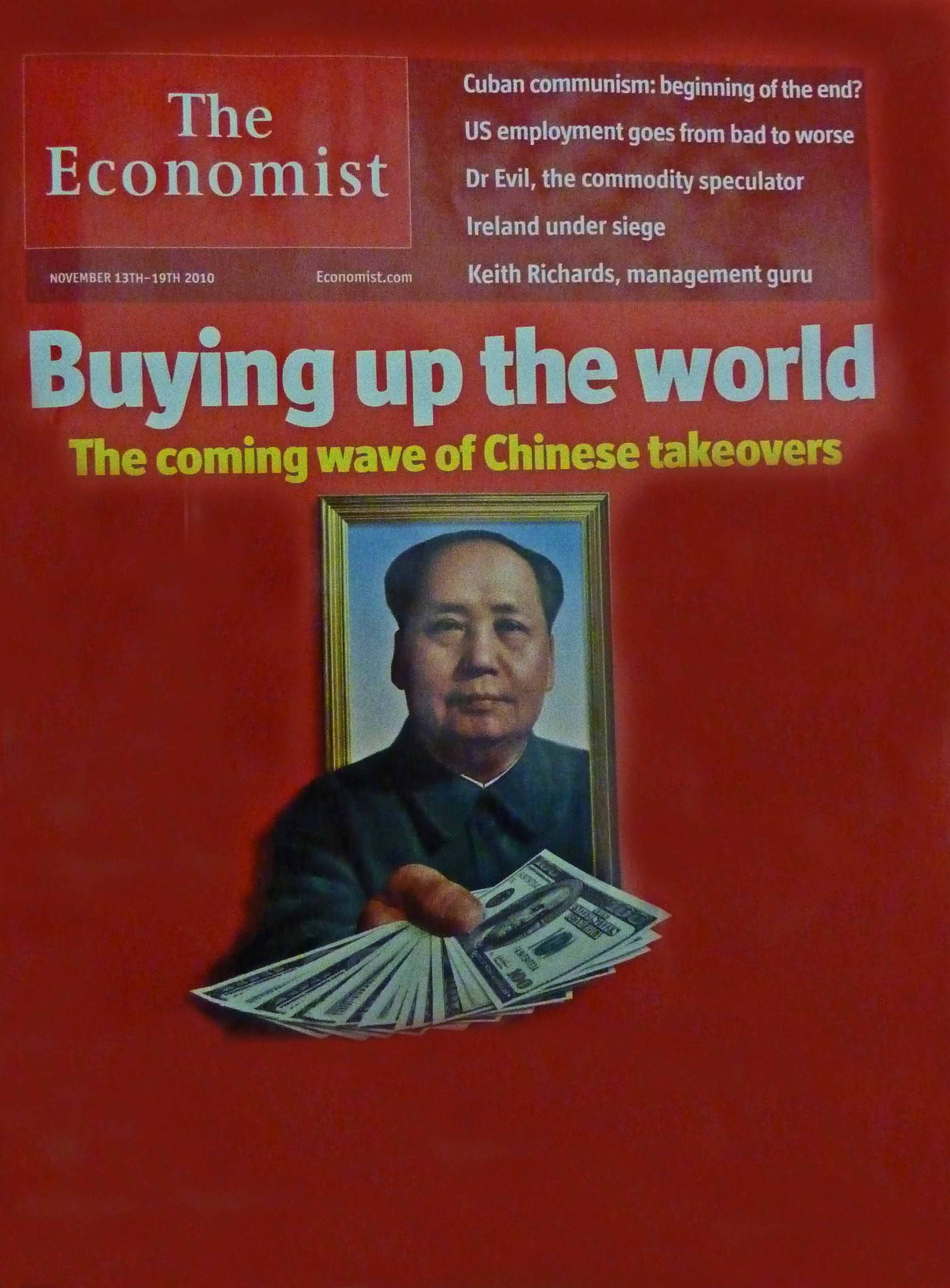
The Fear of Mao Buying the World

November 22, 2010

The cover of The Economist’s November 13 issue plays on fear to sell magazines.

I haven’t read Buying up the world, The coming wave of Chinese takeovers yet, which is the feature piece. I’ll probably write another post about that once I do.

Instead, I’m writing about the magazine’s cover, which is taking advantage of the West’s PTCSD (Post Traumatic Chinese Stress Disorder) that has roots in the “history” of a fear of the word “Communist”, the Korean Conflict and the Cultural Revolution.

I’m sure most Sinophobes that see this cover will have flashbacks of the People’s Liberation Army (PLA) and the rest of China dressed in drab Mao jackets marching across the world to take possession of everything China buys.

However, Mao isn’t the proper man to adorn The Economist’s cover.

Deng Xiaoping or one of China’s recent presidents (there have been four since the 1982 Constitution) would have been more appropriate.

Why? Because after Mao died in 1976, Deng Xiaoping and his allies rejected Maoist Revolutionary thought and embraced CAPITALISM in a very big way.

In fact, surviving Maoists consider the Party that rules China today to be traitors to Mao and the revolution.

Do you remember the 1980s, when wealthy Japanese spent billions buying property in America then a real estate bubble burst, Japan lost a lot of money, and its economy has been limping since?

If anyone should be afraid, it should be the Chinese fearing spending habits in the US, Canada and Europe where debt and plastic rule.

______________

Lloyd Lofthouse is the award-winning author of the concubine saga, My Splendid Concubine & Our Hart. When you love a Chinese woman, you marry her family and culture too.

To subscribe to iLook China, look for the “Subscribe” button at the top of the screen in the menu bar, click on it then follow directions


Ming Dynasty (1368 – 1643 AD) – Part 1, 1/3

November 21, 2010

The Red Turban Rebellion was started in the middle of the fourteenth century by Chinese peasants against the Mongolian Yuan Dynasty.

The Red Turban ideology included elements from White Lotus, a Buddhist sect from the late Southern Song Dynasty.

Soon, the White Lotus Society, led by Han Shantong, became the center of anti-Mongol sentiment. After Han Shantong was caught and executed, his son, Han Liner, came to power claiming to be the incarnation of the Maitreya Buddha.

When the Yung Dynasty fell in August 1368, Zhu Yuanzhang was the leader of the White Lotus Society (also known as the The Millennium Cult, with similarities to today’s Falun Gong religious cult).

Yuanzhang came from a poor background and did not trust the educated elite. He created an extremely authoritarian regime with harsh policies and ruled China from the city of Nanjing.

It would take several years before China recovered from the destruction caused by the rebellion.

The first hundred and fifty years of the Ming Dynasty saw an improvement in agricultural technology never before seen in China, which encouraged the development of the handicrafts industry and commerce.

Since the Roman Empire, products from China had already been known for their high quality and craftsmanship. During the Ming, these products reached even higher qualities.

The Yongle Emperor (1402 – 1424) moved the capital from Nanjing to Beijing where he built a new city.

In fact, after being neglected for decades, the Yongle Emperor had the Grand Canal restored.

The Yongle Emperor also send the Muslim, eunuch Admiral Zheng He with a huge fleet across the oceans to Africa and possibly to the Americas well before Columbus set sail. The emperor’s goal was to gain respect from distant foreign nations.

To build the Ming fleet required techniques and technologies never seen in the world. To achieve this feat, the Chinese invented what has been credited to Ford Motor Company between 1908 and 1915 — an assembly line five centuries before Ford.

______________

Lloyd Lofthouse is the award-winning author of The Concubine Saga. When you love a Chinese woman, you marry her family and culture too. This is the love story Sir Robert Hart did not want the world to discover.

To subscribe to “iLook China”, look for the “Subscribe” button at the top of the screen in the menu bar, click on it then follow directions.