If China government isn’t a Monarchy or a Dictatorship, what is it? Part 1 of 4

December 10, 2014

Three times George Washington acted in a way that would insure the newly born US Republic would survive.

His first act was in 1782, when Colonel Lewis Nicola wrote a letter to Washington suggesting that Washington should set up a constitutional monarchy because of the inefficiency of the Continental Congress.

Washington was offended at such a suggestion and wrote to Nicola telling him to banish such thoughts from his mind. George Washington – Legends and Myths

His second act took place in 1783, when he stepped in and saved the republic by ending the Newburgh Conspiracy, a plot in the military to seize power and create a military dictatorship. Source: Early America

The third act was when Washington stepped down as President (1789 – 1797) and returned to his farm.

When King George III asked his American painter, Benjamin West, what Washington would do after winning independence, West replied, “They say he will return to his farm.”

“If he does that,” King George said, “he will be the greatest man in the world.” Cato Institute
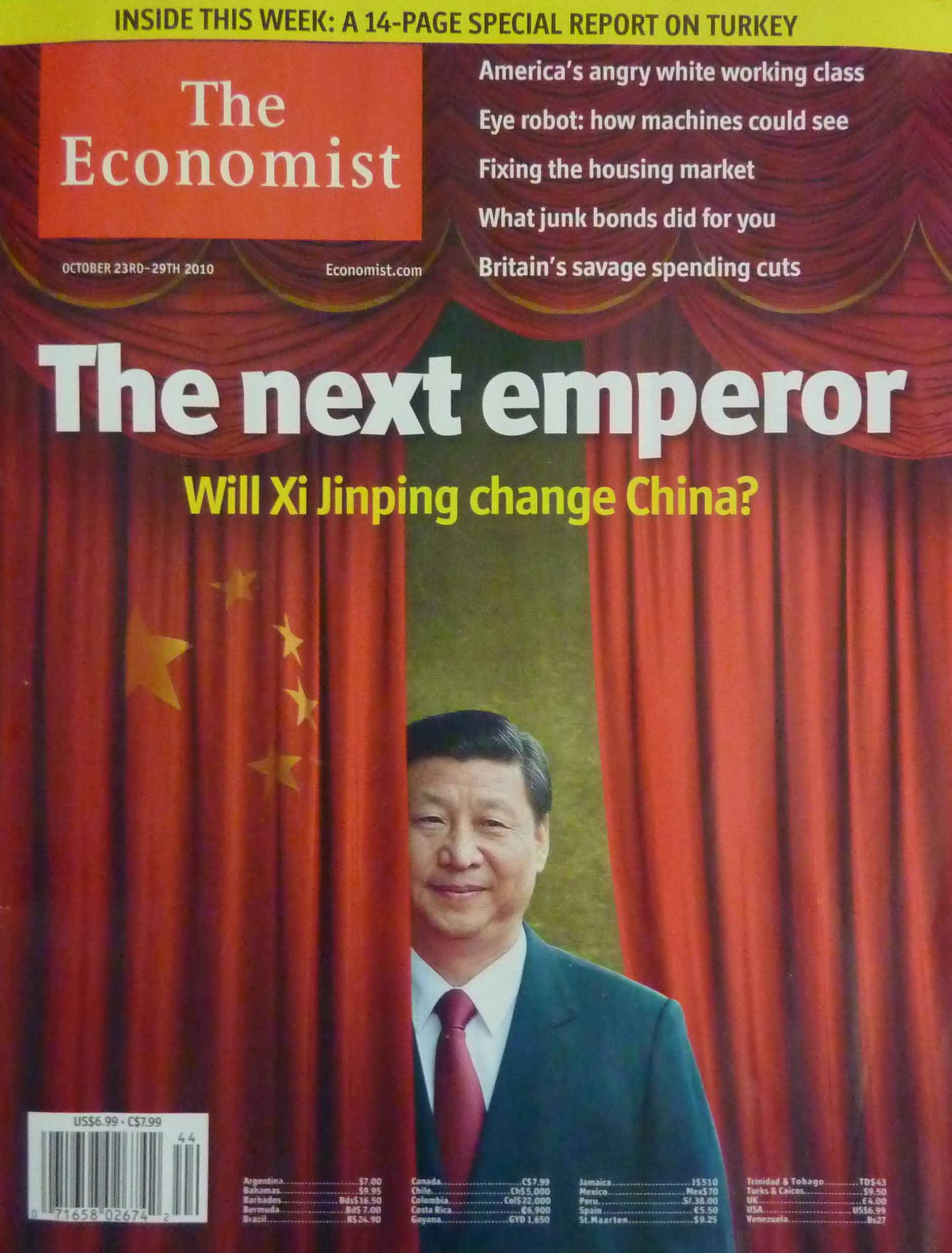
The cover of The Economist for October 23, 2010—in the best tradition of biased and Yellow Journalism—SHOUTED: “The next emperor – Will Xi Jinping change China?”

As I read the feature article on page 13, I laughed when I saw, “Mr. Xi’s appointment was eerily similar to the recent anointment of Kim Jong-un in North Korea.”

The reason I saw humor in this absurd statement was that there is nothing similar. Kim Jong Un inherited his for-life position as Supreme Leader of North Korea. He is the son of Kim Jong-il, and the grandson of Kim Il-sung, the founder of North Korea.

In Part 2 of this series that will appear on December 11, 2014, I will explain the difference between China’s one-party authoritarian Republic, and why it isn’t a dictatorship or a monarchy.

View as Single Page

_______________

Lloyd Lofthouse is the award-winning author of My Splendid Concubine [3rd edition]. When you love a Chinese woman, you marry her family and culture too. This is the love story Sir Robert Hart did not want the world to discover.

Low-Res_E-book_cover_MSC_July_24_2013

Subscribe to “iLook China”!
Sign up for an E-mail Subscription at the top of this page, or click on the “Following” tab in the WordPress toolbar at the top of the screen.

About iLook China

China’s Holistic Historical Timeline


The last days of Sun Yat-sen: Part 3 of 3

December 4, 2014

Later, it was discovered that the medical report of Sun’s condition was incomplete. Some of the samples and part of the report had been stolen and no one knows why.

During World War II, after the Japanese invaded China, Japanese troops occupied the hospital where Sun Yat-sen’s liver samples were kept.

Chinese representative requested the liver samples and the report be turned over to them.

Some of the liver samples were given to Dr. Tang Qiping, who worked at the Sino-Belgian Radium Institute in Shanghai.

Another man, Chu Minyi, forced Dr. Tang to give him those samples.

In 1946, Chu Minyi would go to prison as a traitor to China. He tried to use Sun Yat-sen’s liver samples to save himself. However, Chu was still executed by Chiang Kai-shek’s Nationalists.

Sun’s liver samples would be lost during the revolution between the Communists and Nationalists. Later, it would be discovered that the samples had been stolen again.

When the Nationalists launched their Northern Expedition to take China from the warlords, the warlord in Beijing, who met with Sun before his death, was their only ally.

When Sun died, his political advisor wrote, “If Dr. Sun Yat-sen had lived for a few years or even a few months longer, China’s situation would have changed completely.”

Soon after Sun’s death in 1925, the democratic government created by him after the 1911 revolution failed.

After a struggle, Chiang Kai-shek gained control of the Nationalists, and because he controlled the army. Chiang then gave orders to his troops to execute all the Communists starting the civil war that led to Mao’s famous Long March.

Return to Part 2  or start with  Part 1

View as Single Page


This film is in Mandarin with no English subtitles.

_______________

Lloyd Lofthouse is the award-winning author of My Splendid Concubine [3rd edition]. When you love a Chinese woman, you marry her family and culture too. This is the love story Sir Robert Hart did not want the world to discover.

Low-Res_E-book_cover_MSC_July_24_2013

Subscribe to “iLook China”!
Sign up for an E-mail Subscription at the top of this page, or click on the “Following” tab in the WordPress toolbar at the top of the screen.

About iLook China

China’s Holistic Historical Timeline


The last days of Sun Yat-sen: Part 2 of 3

December 3, 2014

After arriving in Beijing, Sun Yat-sen saw a French doctor who gave him injections to help with his illness.

With his health getting worse, a nurse that worked at a German hospital was sent to his Beijing hotel to care for him.

His condition was so bad that at times he could not talk.

Since the Western medicine wasn’t improving his health, he was convinced by advisors to talk to an herbalist doctor, Ge Lianfu.

Sun Yat-sen told Ge Lianfu that he would give the Chinese medicine to the Western doctors to see if they could copy it.

Ge said he wasn’t sure if Chinese and Western medicine were interchangeable.

Since Sun was a trained Western doctor, he didn’t believe that Ge’s treatment was going to work. Ge Lianfu concluded that Sun had liver disease, but Sun didn’t trust the diagnosis.

While staying in the Beijing hotel, Sun was treated by doctors from the US, Germany, Russia and the Peking Union Medical College Hospital.  However, the treatments didn’t help, and his condition worsened.

The western doctors concluded that he needed exploratory surgery. After they cut him open, they discovered liver disease as Ge Lianfu had diagnosed without surgery.

In fact, Sun was in the final stages of liver cancer. At the time, Western medicine had no treatment to deal with a disease that he must have had for years.

In 1916, Sun had often suffered from abdominal pain and the Western doctors treated him as if he had stomach trouble.

Continued in Part 3 on December 4, 2014 or start with Part 1

View as Single Page

_______________

Lloyd Lofthouse is the award-winning author of My Splendid Concubine [3rd edition]. When you love a Chinese woman, you marry her family and culture too. This is the love story Sir Robert Hart did not want the world to discover.

Low-Res_E-book_cover_MSC_July_24_2013

Subscribe to “iLook China”!
Sign up for an E-mail Subscription at the top of this page, or click on the “Following” tab in the WordPress toolbar at the top of the screen.

About iLook China

China’s Holistic Historical Timeline


The last days of Sun Yat-sen: Part 1 of 3

December 2, 2014

In October 1911, a revolution in China overthrew the Qing Dynasty and ended more than two-thousand years of imperial monarchy.

After the revolution, the Republic of China was founded but warlords still controlled much of China.

The leader of this revolution was Dr. Sun Yat-sen (1866-1925), and he served as the first president of the Republic of China.

The Chinese Communist Party persuaded Sun that if his Nationalist Party formed an alliance with the Communists, Sun would gain support from China’s peasants and industrial workers to help end the anarchy in China. Time Asia

But, by 1924, Sun Yat-sen’s health was not good. He was so sick he had to turn command of the Nationalist navy and army over to Hu Hanmin, who would later be a rival with Chiang Kai-shek for control of the Nationalists (Kuomintang) in the late 1920s.

The reason that Sun Yat-sen gave command of the navy and army to Hu Hanmin was because he wanted to go to the Baiyun Mountains of Guangzhou to recover from his illness.

However, Sun Yat-sen was invited to Beijing instead—the reason was to meet the warlord that controlled Beijing.

At the time, The Nationalists only held power in Southern China.

When he arrived by train, about 20-thousand people met him at the station.

The warlord had invited Sun Yat-sen to Beijing to talk about how to end the chaos and anarchy that still raged throughout much of China.

Continued in Part 2 on December 3, 2014

View as Single Page

_______________

Lloyd Lofthouse is the award-winning author of My Splendid Concubine [3rd edition]. When you love a Chinese woman, you marry her family and culture too. This is the love story Sir Robert Hart did not want the world to discover.

Low-Res_E-book_cover_MSC_July_24_2013

Subscribe to “iLook China”!
Sign up for an E-mail Subscription at the top of this page, or click on the “Following” tab in the WordPress toolbar at the top of the screen.

About iLook China

China’s Holistic Historical Timeline


Chiang Kai-shek, an American ally and a Brutal Dictator

November 25, 2014

Anyone in the United States who reads and/or listens to the news has probably heard of Mao’s brutality and the alleged brutality of the Chinese Communist Party, but what about Chiang Kai-shek and his KMT, an ally of the United States during and after World War II. In fact, you might be interested to discover how much the United States has spent just from 1990 on Taiwan’s defense from the Congressional Research Service to learn how much the U.S. is willing to spend to support a brutal regime.

The Taipei Times published a piece on the front page of the paper on Tuesday, February 27, 2007, and said, Former dictator Chiang Kai-shek was a murderer, and President Chen Shui-bian said Taiwan’s former authoritarian regime and its leaders were responsible for the massacre of tens of thousands of civilians slain in 1947.

On a site that lists the death tolls for the major wars and atrocities of the twentieth century, Chiang Kai-shek was given credit for 10,214,000 democides from 1921 to 1948.

Democide is a term revived and redefined by the political scientist R. J. Rummel as “the murder of any person or people by their government, including genocide, politicide and mass murder.”

In another post about Genocide and Crimes Against Humanity, enotes.com says, “From 1927 to 1949, Chiang’s troops used murder, torture and other brutal tactics to wipe out the communists.”

Then Scaruffi.com lists a century of genocides from 1900-2000 and Chiang Kai-shek was credited with the deaths of 30-thousand during popular uprising against his regime in Taiwan in 1947.

The Boston Examiner reported that several thousand protesters marched in Taipei on February 28, 1947 against the brutality—that took place the day before—but were met with bullets. Martial law was declared and even though things had settled down by the time the Nationalist soldiers arrived, the massacre began almost immediately.

East Asia posted an Austrian Perspective by Christian Schafferer, who said the infamous 1947 “2-28 Incident” resulted in ten-to-thirty thousand civilians killed and Taiwan’s governor executed.

In addition, I discovered a book on the topic, Representing Atrocity in Taiwan, The 2.28 Incident and the White Terror by Sylvia Li-Chun, who is the Notre Dame Assistant Professor of Chinese at the University of Notre Dame.

The most powerful evidence comes from the monument in Taiwan to the incident, which says, “Within a few months, the number of deaths, injured and missing persons amounted to tens of thousands.  Keelung, Taipei, Chiayi and Kaohsiung suffered the highest number of casualties. It was called the February 28 Incident.”

Then from the Asia Times, “They slaughtered civilians at random to terrorize the Taiwanese into submission, and carried out a targeted campaign to wipe out the Taiwanese elite—local leaders and intellectuals —who represented the biggest threat to KMT rule. To this date, the numbers killed are uncertain, but historians estimate 30,000.”

_______________

Lloyd Lofthouse is the award-winning author of My Splendid Concubine [3rd edition]. When you love a Chinese woman, you marry her family and culture too. This is the love story Sir Robert Hart did not want the world to discover.

Low-Res_E-book_cover_MSC_July_24_2013

Subscribe to “iLook China”!
Sign up for an E-mail Subscription at the top of this page, or click on the “Following” tab in the WordPress toolbar at the top of the screen.

About iLook China

China’s Holistic Historical Timeline