In 1969, the Soviet Union was planning a nuclear attack on China. The USSR only backed down when President Nixon’s administration warned Moscow that such a move would start World War Three since the US would bomb Russia in retaliation.
The United States, under President Nixon (1969-1974), clearly indicated that China’s interests were closely related to America’s. – Free Republic
At the time, I’m sure President Nixon had no idea how close those relations would become.
More than 43 years ago in February 1972, President Richard Nixon went to China and changed the course of history a second time. His motives may not have been meant to encourage China to become the economic powerhouse it is today.
However, if it weren’t for Nixon, the odds say the Soviet Union would have bombed China with nuclear weapons and China would have retaliated.
While flying to China, President Nixon made notes. Here are a few.
What they (China) want? Build up their world credentials, Taiwan, and get the U.S. out of Asia (In 1968, Nixon ran for President promising to get the U.S. out of Vietnam).
What we (the US and China) both want? Restraint on USSR
The BBC reporter in the embedded video says that Nixon’s trip to Beijing wasn’t to see if China would help get the US out of Vietnam. Instead, the trip was designed to put pressure on the USSR with a goal to make them agree to strategic arms limitations.
Soon after Nixon’s China trip, the Soviets were forced to negotiate and within three months signed two arms control agreements.
What I find interesting is how often US Presidents (and politicians) have been wrong about China.
In 1961, President John F. Kennedy said if China had nuclear bombs, it would swallow Southeast Asia. That never happened and today China has more than three hundred nuclear bombs with the missiles to deliver them to targets thousands of miles distant.
In 1965, China successfully tested its first nuclear bomb. President Lyndon Johnson said it was “the blackest and most tragic day for the free world”.
How was that day the “blackest and most tragic day for the free world”?
After all, China has never used a nuclear weapon on another country as the US did on Japan to end World War II by bombing Hiroshima and Nagasaki killing about a quarter million people.
In fact, about 25 American POWs were also killed in the first blast. Most of the Japanese dead were noncombatants—the elderly, women and children.
Di Text.com reports that the US firebombed (with napalm) 67 Japanese cities in World War II. More than half of Tokyo (one of the 67 cities) was destroyed. Estimates of the number killed in Tokyo range between 80,000 and 200,000.
Robert S. McNamara was reported to have said, “If we’d lost the war, we’d all have been prosecuted as war criminals.”
Has Communist China inflicted that many casualties on another nation’s civilian population? Don’t forget that Japan killed about 30 million Chinese during World War II.
Lloyd Lofthouse is the award-winning author of My Splendid Concubine [3rd edition]. When you love a Chinese woman, you marry her family and culture too. This is the lusty love story Sir Robert Hart did not want the world to discover.
Subscribe to “iLook China”!
Sign up for an E-mail Subscription at the top of this page, or click on the “Following” tab in the WordPress toolbar at the top of the screen.
In 1969, the Soviet Union was planning a nuclear attack on China. The USSR only backed down when President Nixon’s administration warned Moscow that such a move would start World War Three since the US would bomb Russia in retaliation.
The United States, under President Nixon (1969-1974), clearly indicated that China’s interests were closely related to America’s. –Free Republic
At the time, I’m sure President Nixon had no idea how close those relations would become.
More than 43 years ago in February 1972, President Richard Nixon went to China and changed the course of history a second time. His motives may not have been meant to encourage China to become the economic powerhouse it is today.
However, if it weren’t for Nixon, the odds say the Soviet Union would have bombed China with nuclear weapons and China would have retaliated.
While flying to China, President Nixon made notes. Here are a few.
What they (China) want? Build up their world credentials, Taiwan, and get the U.S. out of Asia (In 1968, Nixon ran for President promising to get the U.S. out of Vietnam).
What we (the US and China) both want? Restraint on USSR
The BBC reporter in the embedded video says that Nixon’s trip to Beijing wasn’t to see if China would help get the US out of Vietnam. Instead, the trip was designed to put pressure on the USSR with a goal to make them agree to strategic arms limitations.
Soon after Nixon’s China trip, the Soviets were forced to negotiate and within three months signed two arms control agreements.
What I find interesting is how often US Presidents (and politicians) have been wrong about China.
In 1961, President John F. Kennedy said if China had nuclear bombs, it would swallow Southeast Asia. That never happened and today China has more than three hundred nuclear bombs with the missiles to deliver them to targets thousands of miles distant.
In 1965, China successfully tested its first nuclear bomb. President Lyndon Johnson said it was “the blackest and most tragic day for the free world”.
How was that day the “blackest and most tragic day for the free world”?
After all, China has never used a nuclear weapon on another country as the US did on Japan to end World War II by bombing Hiroshima and Nagasaki killing about a quarter million people.
In fact, about 25 American POWs were also killed in the first blast. Most of the Japanese dead were noncombatants—the elderly, women and children.
Di Text.com reports that the US firebombed (with napalm) 67 Japanese cities in World War II. More than half of Tokyo (one of the 67 cities) was destroyed. Estimates of the number killed in Tokyo range between 80,000 and 200,000.
Robert S. McNamara was reported to have said, “If we’d lost the war, we’d all have been prosecuted as war criminals.”
Has Communist China inflicted that many casualties on another nation’s civilian population? Don’t forget that Japan killed about 30 million Chinese during World War II.
When President Nixon went to China, he met with Chairman Mao, who was suffering from poor health. In four years, he would die, and Nixon would be the only president in US history to resign while in office due to the Watergate Scandal.
After Nixon resigned as the US president, the Chinese offered him a home in China where he would be allowed to live in peace away from his political enemies.
Two months before his meeting with Mao in Beijing, Nixon had approved a bombing operation in North Vietnam.
Many called it the Christmas bombings since it took place over the holidays. It was the first continuous bombing in Vietnam since President Lyndon Johnson had halted bombing in 1968.
Over 20 thousand tons of bombs were dropped during the campaign. That’s forty million pounds of explosives.
Ironically, Nixon ran for election as the “Peace Candidate” in 1968. Can you think of other US politicians that have used similar promises (later broken) to win elections?
Because of Nixon’s record of being an anticommunist, no one would have thought that he would have unexpectedly gone to China to meet with Mao and the CCP’s top leaders.
“Newly released audiotapes and secret documents from the Richard Nixon Presidential Library show a president obsessed with controlling the media and his public persona during the latter stages of his doomed administration.”
I find it ironic that this comes from a former president of a country that often criticized China’s control of its media. Is it possible that US politicians are jealous and want the same control over the US media?
While in China, President Nixon gave a speech in the Great Hall of the People in Beijing.
This was the first time a U.S. president had visited the People’s Republic of China (PRC), and China was considered one of America’s greatest enemies.
While in China, Nixon would meet with Zhou Enlai, who was the first Premier of the PRC. Zhou Enlai (along with Deng Xiaoping) played an important role in the future development of the Chinese economy and restructuring Chinese society leading to the China of today.
In fact, Zhou Enlai not only avoided the purges of high-level Chinese Communist Party officials during the Cultural Revolution, but he also attempted to contain the damage caused by the teenage Red Guard and to protect others from them. This made him very popular with the people near the end of the Cultural Revolution.
Zhou Enlai supported peaceful coexistence with the West. He would die eight months before Mao.
It is ironic that one of the main reasons Richard Nixon became the vice-president of President Eisenhower was due to his strong anti-communist stance.
If you listen to Nixon’s speech in Beijing carefully, you will hear how he managed to slip in a veiled criticism of the fact that the media was free to report what they wanted in the US.
Nixon says of his visit to the Great Wall, “As I walked along the Wall, I saw the sacrifices that went into building it. I saw what is showed about the determination of the Chinese people to retain their independence throughout their long history. I thought about the fact that the Wall tells us that China has a great history and that the people who built this wonder of the world also have a great future.”
I wonder if Nixon realized how true his statement was.
Is it possible that Nixon’s trip to China provided Deng Xiaoping the support needed to reject revolutionary Maoism and launch China’s capitalist revolution a few years later?
______________________________
Lloyd Lofthouse is the award-winning author of My Splendid Concubine [3rd edition]. When you love a Chinese woman, you marry her family and culture too. This is the lusty love story Sir Robert Hart did not want the world to discover.
Subscribe to “iLook China”!
Sign up for an E-mail Subscription at the top of this page, or click on the “Following” tab in the WordPress toolbar at the top of the screen.
For thousands of years, the history of China has been defined by wars, rebellion, power struggles and famine, which explains why today’s central government worries about famine and allowing dissidents a voice.
Between 1911 and 1976, three Chinese men were responsible for much of the devastation and death that swept over China causing tens of millions of deaths (not counting what the Japanese did during World War II). Those Chinese leaders were: Yuan Shikai, Chiang Kai-shek and Mao Tse-tung.
In 1911 when the Qing Dynasty fell, Yuan Shikai was a general and commander of the most modern military force in Imperial China. He kept his position by supporting the revolutionaries that brought down the Qing Dynasty.
After the Qing Dynasty fell, rebellion spread through the Yangtze River Valley before revolutionaries from fourteen provinces elected Sun Yat-sen president of a provisional (temporary) government and in January 1912, Sun announced the establishment of the Republic of China.
However, generals controlled China’s provinces and refused to give up power. China’s young republic was essentially the capital city of Nanjing.
On March 20, 1913, Yuan Shikai’s agents assassinated Sung Chiao-jen, who helped Sun Yat-sen become the first president. Sun demanded that those responsible be brought to justice.
Yuan Shikai resisted, sparking a “so-called” second revolution and on September 15, 1913, he ordered Sun Yat-sen’s arrest. To survive, Sun fled to Japan as a political refugee. He wouldn’t return to China until a few months after Yuan Shikai’s death.
Yuan Shikai, supported financially by the British Empire, became China’s second president, but after 1914, World War I caused a reduction in Britain’s financial support.
Weakened, Yuan Shaikai was forced to accept twenty-one demands made by Japan, which included giving up Chinese territory. He agreed on May 7, 1916, which is now considered National Humiliation Day.
Yuan Shaikai was unable to establish control beyond Nanking so he declared himself emperor. His attempt to replace the republic with a monarchy and him as emperor touched off revolts in southwestern China followed by uprisings of Sun Yat-sen’s followers in several other provinces.
This resulted in twelve years of warfare between the warlord generals of China’s provinces and the weak Republic of China.
Yuan Shikai died in 1916, then Sun Yat-sen returned to lead the republic. Sun Yat-sen died in 1925, which led to the Civil War between the Chinese Communist Party and Chiang Kai-shek’s Nationalists.
______________________________
Lloyd Lofthouse is the award-winning author of My Splendid Concubine [3rd edition]. When you love a Chinese woman, you marry her family and culture too. This is the lusty love story Sir Robert Hart did not want the world to discover.
Subscribe to “iLook China”!
Sign up for an E-mail Subscription at the top of this page, or click on the “Following” tab in the WordPress toolbar at the top of the screen.
China has admitted that some of its citizens and troops were wounded and killed during the unrest known as the Tiananmen Incident and/or Massacre. On Wiki, you will read that there were 241 – 2,600 deaths and 7,000 – 10,000 injured. In addition, on June 19, Beijing Party Secretary Li Ximing reported to the Politburo that the government’s confirmed death toll was 241, including 218 civilians (of which 36 were students), 10 PLA soldiers and 13 People’s Armed Police, along with 7,000 wounded (5,000 soldiers and police along with 2,000 civilians).
Now for the barbaric war the United States waged on the Philippine people. If you haven’t heard about this war before, don’t be surprised, because it has been suppressed (not censored). I mean, when’s the last time you’ve heard about it in the U.S. media compared to the number of times you’ve heard of China’s Tiananmen Square Massacre in 1989. In fact, when I posted What really happened in Tiananmen Square in 1989,Michael Brant left this comment, “This could have been written by the PRC media spin department.” I wonder what Brant would say about the U.S. war against the Philippine People—if he’s ever heard of that brutal war.
After the Spanish American War, America took possession of the Philippine islands and waged war against the native people killing between 300k – 1 million noncombatants. This conflict was caused by the struggle of the First Philippine Republic to gain independence from the United States following the latter’s acquisition of the Philippines from Spain after the Spanish–American War.
There is a 2010 film about this war called Amigo. I think the odds favor that you have never heard of this film that doesn’t portray the U.S. as the freedom loving country most Americans think it is. In fact, the film’s widest release in the U.S. was in 10 theaters and total domestic earnings were $184,705. The production budget for the film was $1.5 million, and it never had a global release. The film is available through Amazon as an instant video to stream, but no DVD is available. I haven’t seen this film yet, because I’m still waiting for the DVD.
I think it’s always good to have the facts before passing judgment, and history does count if you are aware of it as long as it isn’t suppressed or revised.
Jesus Christ said, So when they continued asking Him, He lifted Himself up and said unto them, “He that is without sin among you, let him first cast a stone at her.” John 8:7
If we take what He said seriously, then does any American have a right to annually condemn China for what happened during the Tiananmen incident in 1989 without also condemning the United States for what it did in the Philippines?
______________________________
Lloyd Lofthouse is the award-winning author of My Splendid Concubine [3rd edition]. When you love a Chinese woman, you marry her family and culture too. This is the love story Sir Robert Hart did not want the world to discover.
Subscribe to “iLook China”!
Sign up for an E-mail Subscription at the top of this page, or click on the “Following” tab in the WordPress toolbar at the top of the screen.
In 1965, China’s Mao Zedong launched a cultural war against the excesses of capitalism, and this was led by the people, the workers and their children, and the capitalists in China and anyone who was accused of supporting the lifestyle of the rich and famous was targeted leading to millions of suicides.
For the last few decades, millions of people in the United States have been victims of its own cultural war, but this one is the reverse of the one that was led by Mao in China. America’s cultural war is being led by a handful of billionaire oligarchs who are transforming American into a money making paradise for those who have the most wealth and power.
This morning I read a piece in the Huffington Post that reported Kansas welfare recipients will be unable to get more than $25 per day in benefits under a new law sent this week to Republican Gov. Sam Brownback’s desk by the state legislature. To make life worse for people who live in poverty, the state also issues that welfare in the form of a government-issued debit card and required that they take the money out of debit machines that charge 85 cents for each withdrawal after the first one in a month—a windfall for banks and whoever owns those ATM machines but less money to buy food. The number of Kansans receiving benefits has also declined from 38,000 in 2011 to 15,000 last year, state data show.
It is no secret that Republicans (GOP) have waged war on people who live in poverty for decades—and recently GOP representatives have blamed poverty on the poor. Many in the GOP hate Social Security, Medicare, Obamacare, unemployment insurance, food stamps, abortion, marijuana, women, and even sexual orientation.
In addition, the GOP and the Democrats also have no problem handing out money to private sector corporations. For instance, the U.S. auto industry, banks, and Wall Street firms. In fact, there are elements in both parties who are handing our children to corporate Charters supported by hedge fund billionaires, the Walton family and the Bill and Melinda Gates foundation so those few individuals grow wealthier off taxes that were originally intended to support the transparent, nonprofit, democratic public schools.
How much does the state and federal government give away to corporations? The answer is more than the country spends on food stamps for people living in poverty, who are far from being lazy, because Recent studies show that 49% of all food stamp participants are children (age 18 or younger), and about 50% of the adults have jobs that pay mostly poverty wages, and, in 2013, for instance, the average SNAP client received a monthly benefit of $133.07, and the average household received $274.98 monthly—compare that number with the money corporations are getting from their state and federal welfare programs.
The New York Times spent 10 months investigating business incentives awarded by hundreds of cities, counties and states. Since there is no nationwide accounting of these incentives, The Times put together a database and found that local governments give up $80.4 billion in incentives given away each year compared to about $75 billion in food stamps to people who live in poverty, so they have enough money to eat and not starve.
Don’t forget, when the GOP blames the poor for their poverty and cuts food stamps to families, as Arkansas is doing, the GOP is waging a war against almost 20 million children living in poverty who can’t work to feed themselves.
However, according to The Times, the number of corporate welfare programs is 1,874. Have you heard Republicans or Democrats call for cuts to corporate welfare?
You might want to click on this link from the New York Times that leads to an interactive map and discover how much corporations are earning off federal and state welfare programs that tax payers are financing.
The New York Times identified 48 companies that have received more than $100 million in state grants since 2007. Some 5,000 other companies have received more than $1 million in recent years.
In fact, Politifact.com reports that it’s mostly true that 9 of the 10 poorest states are ruled by the GOP. PolitiFact.com also reports that it is mostly true that 97 of the country’s 100 poorest counties are in GOP ruled states.
The Washington Post reports, “Republican states have pursued economic and fiscal strategies built around lower taxes, deeper spending cuts and less regulation. They have declined to set up state health-insurance exchanges to implement President Obama’s Affordable Care Act. They have clashed with labor unions. On social issues, they have moved to restrict abortion rights or to enact voter-identification laws, in the name of ballot integrity, that critics say hamper access to voting for the poor and minorities.”
The cultural revolution in China that took place between 1965–1976, and the one being waged in the United States today have one thing in common: the public schools and the teachers who taught in them were attacked in China back then (but not today—after Mao died in 1976, China, under new leadership, started rebuilding its public schools and supporting its teachers) as they are being attacked in the United States today, because a transparent, non-profit, public education system where teachers have the freedom to express without fear what they think about current issues to the children they teach, who then talk to their parents, is a threat to the few who want to control the destructive cultural changes taking place, and it doesn’t matter if the cultural war is being led, for instance, by America’s Bill Gates, the Walton family, the Koch brothers or Mao Zedong in China. To drastically alter a culture, the few in power who are behind the changes must silence their critics and create an environment of punishment and fear, and this means silencing the teachers.
______________________________
Lloyd Lofthouse is the award-winning author of My Splendid Concubine [3rd edition]. When you love a Chinese woman, you marry her family and culture too. This is the love story Sir Robert Hart did not want the world to discover.
Subscribe to “iLook China”!
Sign up for an E-mail Subscription at the top of this page, or click on the “Following” tab in the WordPress toolbar at the top of the screen.


 Posted by Lloyd Lofthouse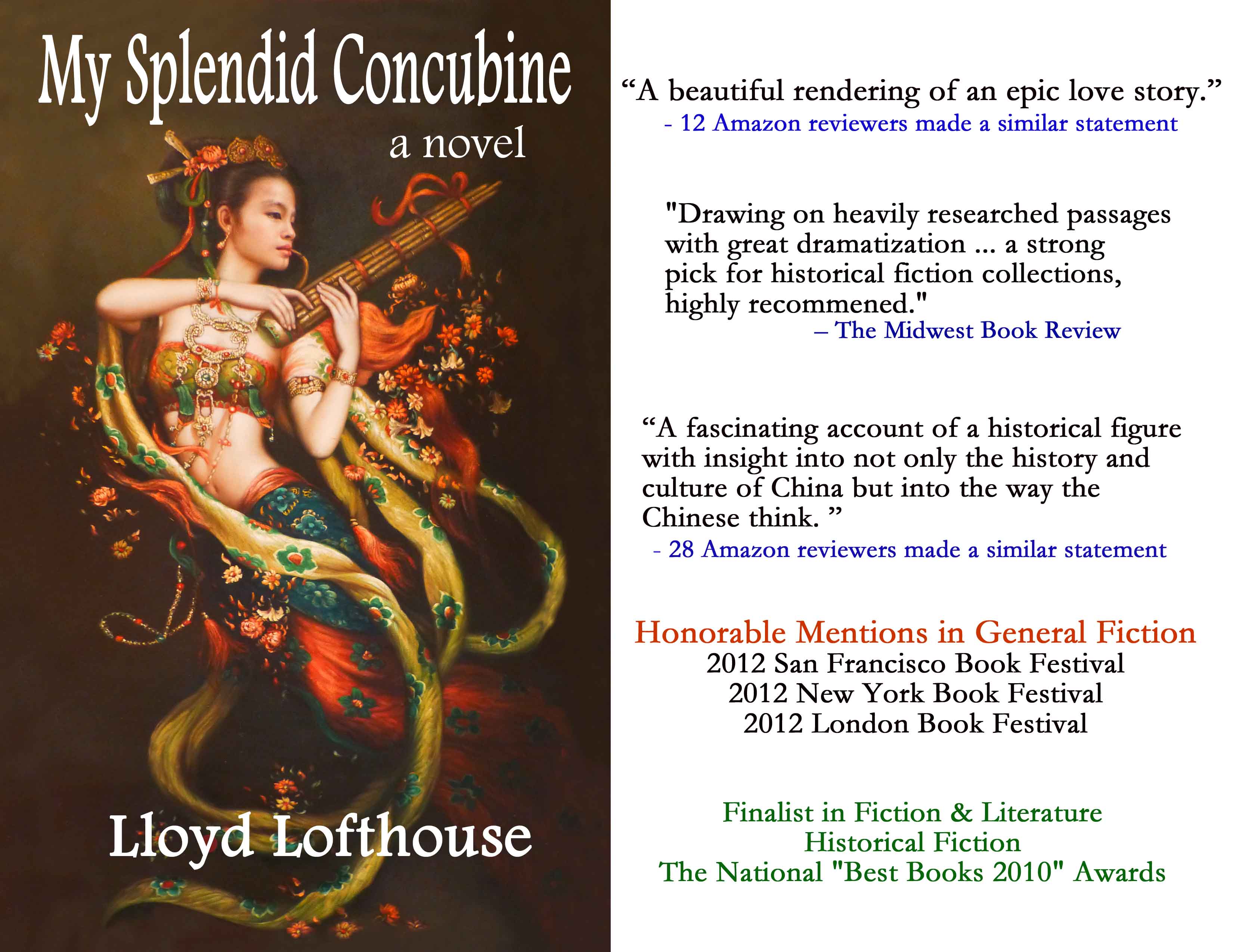
 iLook China