It’s ironic that during World War II, the United States fought alongside the Chinese, both the Nationalists and the Communists, against the Japanese until 1945. In fact, it was Mao’s Chinese Communist guerrilla troops who rescued some of Jimmy Doolittle’s B-25 crews when they crash landed in China after bombing Tokyo on April 18, 1942. The Chinese who helped save those American troops paid a horrible price. Click the link to discover how horrible.
Then a few years later Communist China and the United States became enemies fighting in North Korea until 1953, and China sent advisers to Vietnam to help fight the United States there (1955 to 1975).
To punish Communist China, the U.S. placed an embargo on China from 1949 to 1969. The Korean War ended in 1953 but the embargo didn’t end until 1969. The goal had been to disrupt, destabilize, and weaken China’s communist government by causing the people of China to suffer, and this “complete embargo” was one of the tools to achieve that goal. The embargo also helped set the stage for millions of Chinese to die of starvation during what’s known as Mao’s Great Famine.
Now President Donald Trump, the popular-vote loser by almost 3 million votes, is working overtime to turn China into an enemy of the U.S. again.
But in 1996, when the U.S. and China were trading partners and still friendly, Chinese farmers discovered a World War II American bomber’s wreckage and the remains of the ten-man crew on Little Cat Mountain (Mao’er Shan), Southern China’s highest peak.
These Americans were considered heroes to the Chinese, and the remains of the crew were returned to the United States for burial.
There’s a memorial stone near the crash site and Chinese tourists pay honor to these Americans by leaving flowers and other gifts.
To honor these American heroes further, the Chinese recovered some of the bomber’s parts and used them as a centerpiece for a museum in Xing’an, about a four-hour drive from the crash site.
Why is President Donald Trump going out of his way to make China an enemy of the United States while doing the opposite in Russia with the brutal Vladimir Putin?
Subscribe to “iLook China”!
Sign up for an E-mail Subscription at the top of this page, or click on the “Following” tab in the WordPress toolbar at the top of the screen.
By definition, as you will learn from this post, 21st century China is not a socialist and/or Communist country, even though it is still labeled as one. It is also not a capitalist country.
Socialism is a system where there is no private property and the means of production are owned and controlled by the state. But in 2014 Bloomberg reported that private companies are driving China’s growth. Only 25-percent of China’s industrial output came from state-owned enterprises in 2014.
Communism is a political theory derived from Karl Marx, advocating class war and leading to a society in which all property is publicly owned and each person works and is paid according to their abilities and needs. When Mao died in 1976, China moved away from this political theory by ending Mao’s Cultural Revolution and arresting the Gang of Four, who planned to lead China and continue the Cultural Revolution’s class war forever.
Then there is capitalism that is an economic system characterized by private or corporate ownership of capital goods, by investments that are determined by private decision, and by prices, production, and the distribution of goods that are determined mainly by competition in a free market.
Since about 25-percent of China’s industry is still state-owned, China clearly isn’t a capitalist system like the United States is. The evidence for this was on display soon after the 2007–08 global financial crises created by U.S. Banks and Wall Street greed that caused millions of Chinese to lose their jobs in private sector manufacturing.
That’s when China’s government stepped in.
The Global Economic Crises and Unemployment in China reports, “The state provided subsidies and basic entitlements to urban workers and their families in an effort to maintain social and political stability within the subsystem … the government has poured billions of dollars into public works designated for road and rail transportation improvements. These projects have created many jobs for migrant labor.”
What else do we know about today’s China?
China has one political party with 85-million voting members; it’s one of the largest political parties in the world. — Britannica.com
More than 600-million rural Chinese vote in village elections. New Politics reports, “Elections of Village Committees and Village Leaders in China’s approximately 950,000 villages began in 1989 as part of a wider village self-government movement.”
China has its own Constitution from 1982 that includes Amendments. For instance, the president of China is limited to two 5-year terms and can be impeached.
However, every year, China’s president is listed as one of the world’s dictators by elements of the U.S. media, but under China’s Constitution, the presidency is a largely ceremonial office with limited powers. This doesn’t fit the definition of a dictator who holds absolute, imperious, or overbearing power or control and who is not responsible to the people or their elected representatives.
How are China’s representatives elected? About.com reports, “China’s representative elections begin with a direct vote of the people in local and village elections operated by local election committees. In cities, the local elections are broken down by residential area or work units. Citizens 18 and older vote for their village and local people’s congresses, and those congresses, in turn, elect the representatives to provincial people’s congresses.
“The provincial congresses in China’s 23 provinces, five autonomous regions, and four municipalities directly ruled by the Central Government, special administrative regions of Hong Kong and Macao, and armed forces then elect the roughly 3,000 delegates to the National People’s Congress (NPC).
“The National People’s Congress is empowered to elect China’s president, premier, vice president, and Chair of the Central Military Commission as well as the president of the Supreme People’s Court and the procurator-general of the Supreme People’s Procuratorate.”
Let’s look at how the United States elects its president. Political Parties that are private sector organizations allow party members to vote in state primaries. These primaries are not public elections because most of them only allow registered party members to vote.
Donald Trump, for instance, only won a little more than 14-million votes from registered Republicans to end up representing the Republican Party as its presidential candidate in 2016, and this is in a country that has more than 200-million registered voters. Hillary Clinton had more than 16.8 million votes from the Democratic primaries.
The winners (Trump and Clinton) moved on to campaign in the national election that is held and monitored by the public sector in each state. In the 2016 election, Donald Trump won the Electoral College vote 303 to 235, but he lost the popular vote 62,979,879 votes to Hillary Clinton’s 65,844,954.
Does this seem strange? Is there any other republic in the world where the winner loses the popular vote?
Last, a republic is a state in which supreme power is held by the people and their elected representatives, and which has an elected or nominated president rather than a monarch.
After reading this post, what type of government do you think China has?
“China’s legislature has voted to remove presidential term limits from its Constitution. That change allows China’s current president, Xi Jinping, to potentially rule indefinitely.”
When the CCP recently revised China’s Constitution and did away with term limits for its current president, the future is uncertain for the type of China’s government. The 19th century’s British Lord Acton was right when he said, ” Power tends to corrupt and absolute power corrupts absolutely.” Now that Xi Jinping can be president of China for the rest of his life, will he become another Kim Jong-un, Donald Trump and/or Putin? Only time will reveal that answer.
Subscribe to “iLook China”!
Sign up for an E-mail Subscription at the top of this page, or click on the “Following” tab in the WordPress toolbar at the top of the screen.
The International Campaign to Abolish Nuclear Weapons says that China has 260 warheads. “Its warheads are deliverable by air, land, and sea.” Business Insider reports, “China now has dozens of nuclear-capable missiles that could target almost the entirety of the US, according to the Department of Defense’s 2015 report on the Chinese military. “
Global Firepower.com reports that China is ranked 3rd out of 126 countries for its military capability and available firepower.
The United States is ranked 1st for military capability and available firepower. Click Global Firepower.com to compare the U.S. with China.
Don’t forget that China would be fighting near and from its home base, but the United States is more than 6,000 miles away, and China has 4 ballistic missile submarines with more to be commissioned and more in development. They are not as advanced as America’s SSBNs but they still exist and are a threat. National Interest.org says, “Even if China acquires the technical capacity necessary for a survivable sea-based nuclear deterrent, the highly centralized PLA has no operational experience in maintaining deterrence patrols on the open seas. China has traditionally relied exclusively on its land-based intercontinental ballistic missiles (ICBMs) for deterrence and thus has never confronted the existential question of whether to predelegate SLBM launch authority to submarine commanders in case of crises.”
Why would Vladimir Putin want the United States to break with its old allies and start a war with China?
I think Putin wants to get rid of China and the United States as military powers. Newsweek reports “How Trump is Alienating Allies and making China Great Again.”
Without its historical allies, the United States would probably win the war with a Pyrrhic victory (a victory that inflicts such a devastating toll on the victor that it is tantamount to defeat) leaving Russia with the most powerful military on the planet and the only super power.
The U.S. would go after China’s infrastructure like the Three Gorges Dam (China has more dams than any country in the world), and end up destroying most of China’s infrastructure (dams, roads, airports, railroads, the power grid, bridges, etc.) destroying China as a modern technological state and economic power and plunging most of the survivors into extreme poverty.
Economically, many U.S. corporations do business in China. To understand how a war with China would devastate many U.S. corporations that make money from Chinese consumers, read this CNN Money report. In addition, The Wall Street Journal reveals how important Chinese consumers are to General Motors and Ford that sell millions of cars in China.
In fact, according to StatisticsTimes.com, the United States has the largest GDP in the world and China is in a distant second place.
In 2016, the United States had a GDP of $18,561,934 billion vs. China with $11,391,619 billion.
Where does Putin’s Russia fit on that global GDP list? 12th place with $1,267,754 billion.
If you look at the list, you will quickly learn that seven countries with GDP’s larger than Russia are historically allies of the United States, allies that President Trump is alienating.
And if Trump is planning to blast most or all of China’s major cities killing hundreds of millions of innocent civilians with nuclear weapons to punish China for not doing what he wants, I wonder if he knows which way the wind blows since he doesn’t pay attention to the environment. Pollution from China blows across the Pacific and blankets the United States just like pollution from the U.S. blows across the Atlantic to fall in Europe. Even the president of the U.S. can’t avoid the poisoned radioactive air, water, and replace the contaminated soil that grows the food we all eat in America.
Divided we fall.
What do you think the odds are that Trump will get the U.S. into a conventional and/or nuclear war with China, and will Russia finish off the winner?
Subscribe to “iLook China”!
Sign up for an E-mail Subscription at the top of this page, or click on the “Following” tab in the WordPress toolbar at the top of the screen.
What are the odds that President Trump will start a war with China? Please wait and answer the question after reading this two part series.
President Donald Trump continuous to talk about Putin with praise while badmouthing and challenging China.
Trump has a history of racism, and the Chinese are not Caucasians but Putin is.
Beijing is seriously concerned about Trump’s comments on One China policy says Politico.com.
In an interview with Fox News, Trump had signaled that the U.S. commitment to the policy that undergirds its relationship with China should be up for negotiation: “I don’t know why we have to be bound by a One China policy unless we make a deal with China having to do with other things,” he said.
Then the New York Post reports, “China lashes out after Mattis backs Japan in islands dispute.”
Politifact reports, Trump warned of China military might. “We have rebuilt China, and yet they will go in the South China Sea and build a military fortress the likes of which perhaps the world has not seen …”
Trump was wrong when he said the U.S. rebuilt China. After World War II, the United States, under the Marshall Plan, rebuilt Europe, but blockaded China and fought wars in Korea (1959 – 1953 with an estimated 2.5 million civilians killed/wounded) and Vietnam (1955 – 1975 with an estimated 1.3 million to 4.2 million civilian dead) that were wars that China saw as a threat.
American Foreign Relations.com reports, “During the Cold War in Asia, the United States imposed embargoes on North Korea, China, and North Vietnam. These were severe embargoes established under the Trading with the Enemy Act. The embargo on China and North Korea began in 1950, during the Korean War.” The United States wouldn’t lift the embargo with China until 1969 during the Richard Nixon administration.
To discover if the Trump White House is planning to start a war with China, The Guardian.com reported that Steve Bannon said, “We’re going to war in the South China Sea in five to 10 years. There’s no doubt about that.”
The Guardian went on: “Bannon’s sentiments and his position in Trump’s inner circle add to fears of a military confrontation with China, after secretary of state Rex Tillerson said that the US would deny China access to the seven artificial islands. Experts warned any blockade would lead to war.”
Subscribe to “iLook China”!
Sign up for an E-mail Subscription at the top of this page, or click on the “Following” tab in the WordPress toolbar at the top of the screen.
Mao Zedong walked a long and dangerous road on his way to leading China for 27 years starting in 1949 to 1976. His first step down that road was to survive the Civil War against the Nationalists under Chiang Kai-shek, a brutal dictator for life that the United States supported. To escape defeat, Mao avoided combat as much as possible to retreating on an almost impossible march known as Mao’s Long March that’s considered one of the most significant military campaigns in the 20th century, and one of the most amazing physical feats ever attempted.
Surrounded by hostile armies, 87,000 Communist troops escaped and started a retreat that covered nearly 6,000 miles in one year.
Meanwhile in China, Mao launched his Great Leap Forward that failed in the disaster of what’s still know as Mao’s Great Famine that I wrote about in Part 5.
Having failed, Mao stepped aside to let someone else run China. The large communes of the Great Leap Forward were abandoned and the peasants returned to their villages to farm the land,
Fearing the return of capitalism, Mao’s supporters printed a book with his slogans. Mao wanted to break the thinking and attitudes of old China. Through film, a propaganda campaign was launched so Mao could regain power, and in 1966, he launched the insanity of the Cultural Revolution.
Soon after Mao died in 1976, Deng Xiaoping ended the Cultural Revolution, led the revision of the Chinese Constitution to limit leaders to two 5-year terms so China would never have another Mao, a powerful dictator for life, and opened China to world trade, and in the last 40 years, thanks to Deng, China is not only responsible for ninety percent of the reduction in global poverty but also the growth of a U.S. style consumer middle class of about 300 million Chinese.
In fact, the Chinese middle class now leads the world in tourism, and sends more of their children to attend colleges in the United States, Canada, and Europe than any other country. More than 100 million Chinese freely leave China annually to visit, as tourists, other countries around the globe and then fly home.
One blight on China under Deng’s leadership was the alleged crushing of a student democracy movement in Beijing’s Tiananmen Square in 1989. The truth is the protests that took place in Tiananmen Square didn’t start as a democracy movement, and the Chinese Communist Party (CCP) does not deny that there were deaths, but the CCP says the deaths took place several miles from Tiananmen Square due to a bloody confrontation between the People’s Liberation Army and violent protestors throwing Molotov cocktails. What is the truth about Tiananmen Square?
As this 6-part series ends, you might be thinking about what was missing. For instance the Great Wall of China, the Grand Canal, or China’s ancient irrigation system, the Treasure of Sichuan, built more than 2,200 years ago, the oldest and only surviving non-dam irrigation system in the word. The next two posts will be about the Great Wall of China and the Grand Canal. Click the link in this paragraph to discover the Treasure of Sichuan, a UNESCO World Heritage Site admired by scientists from around the world.
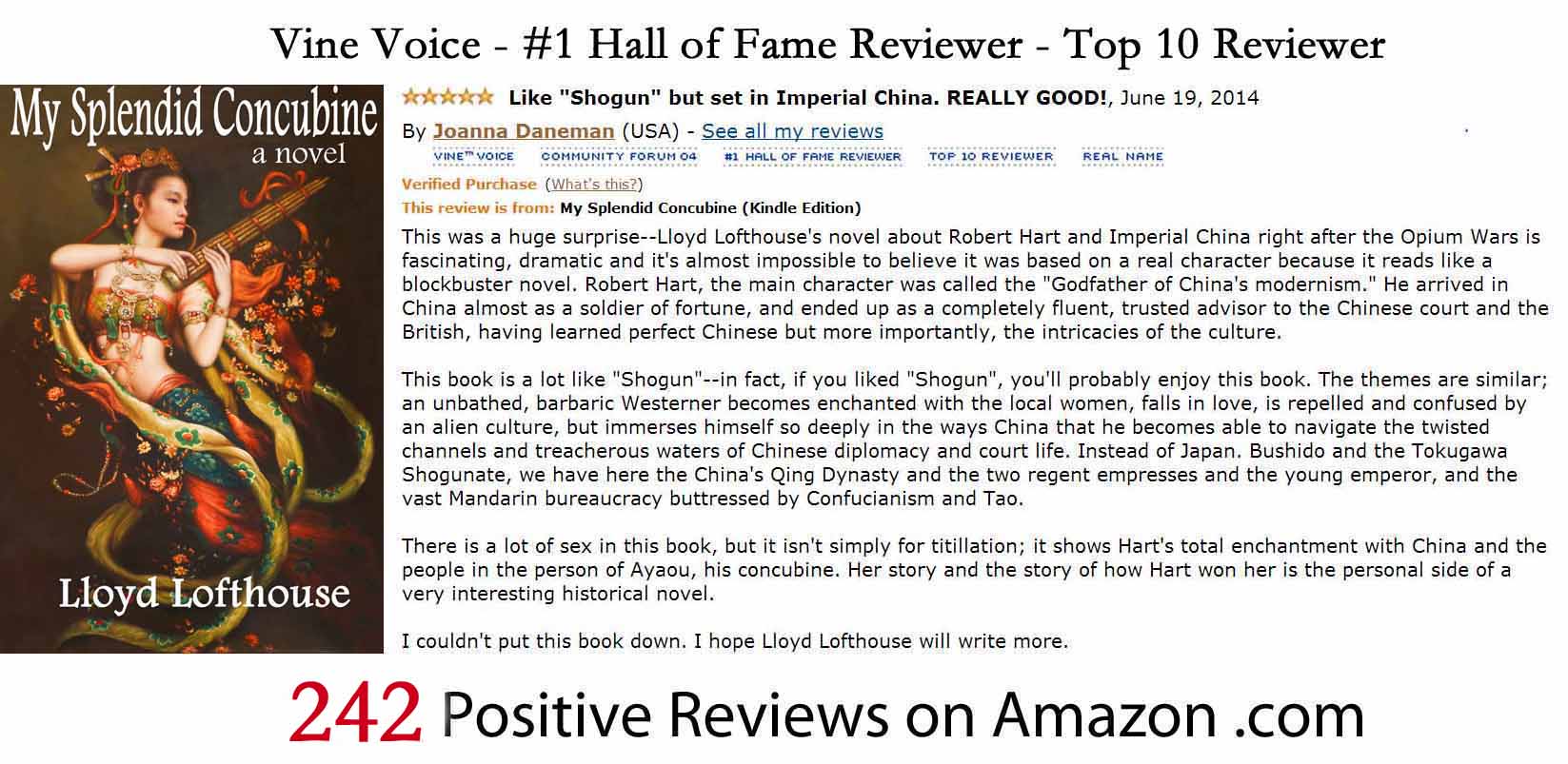
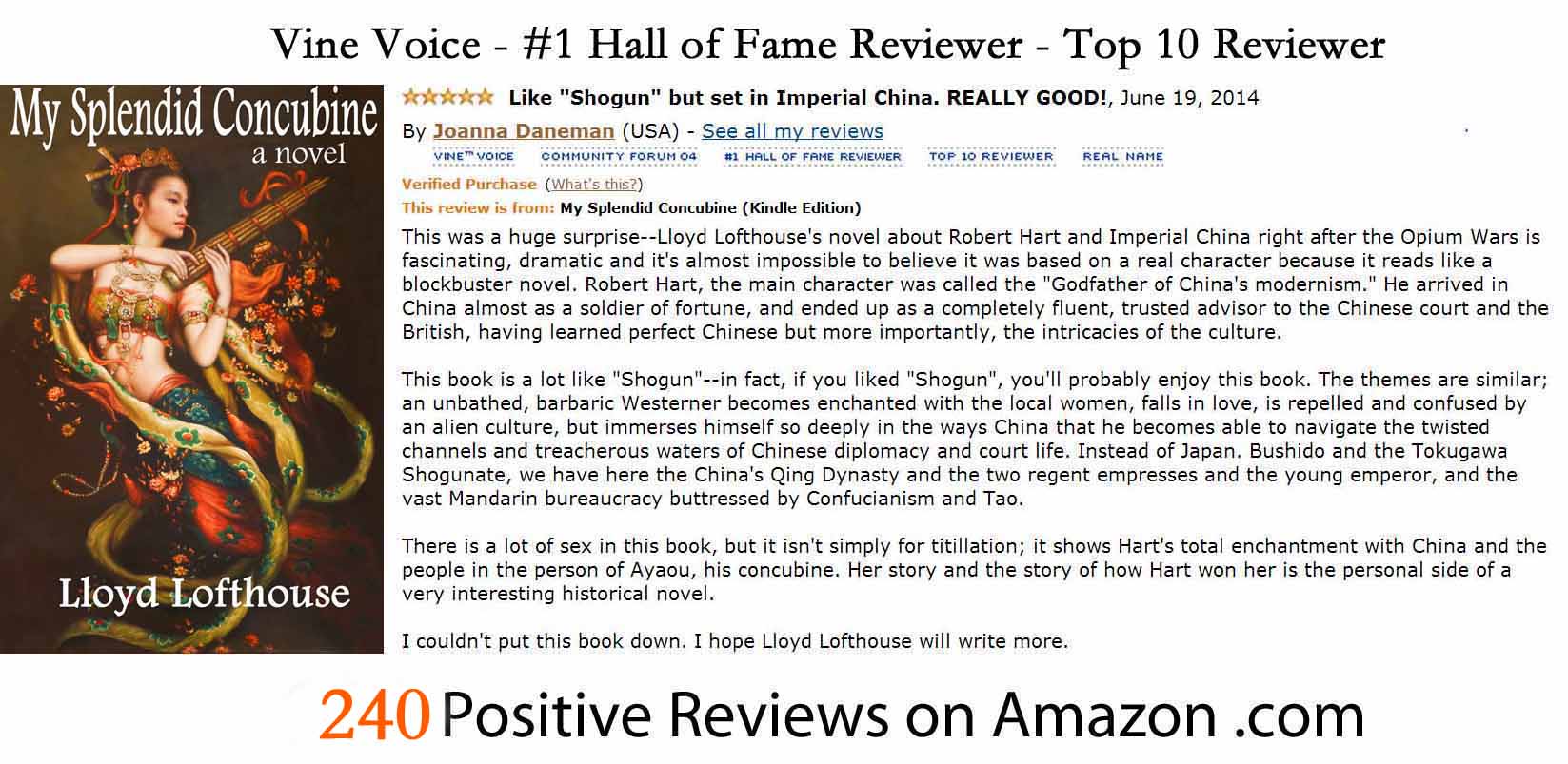
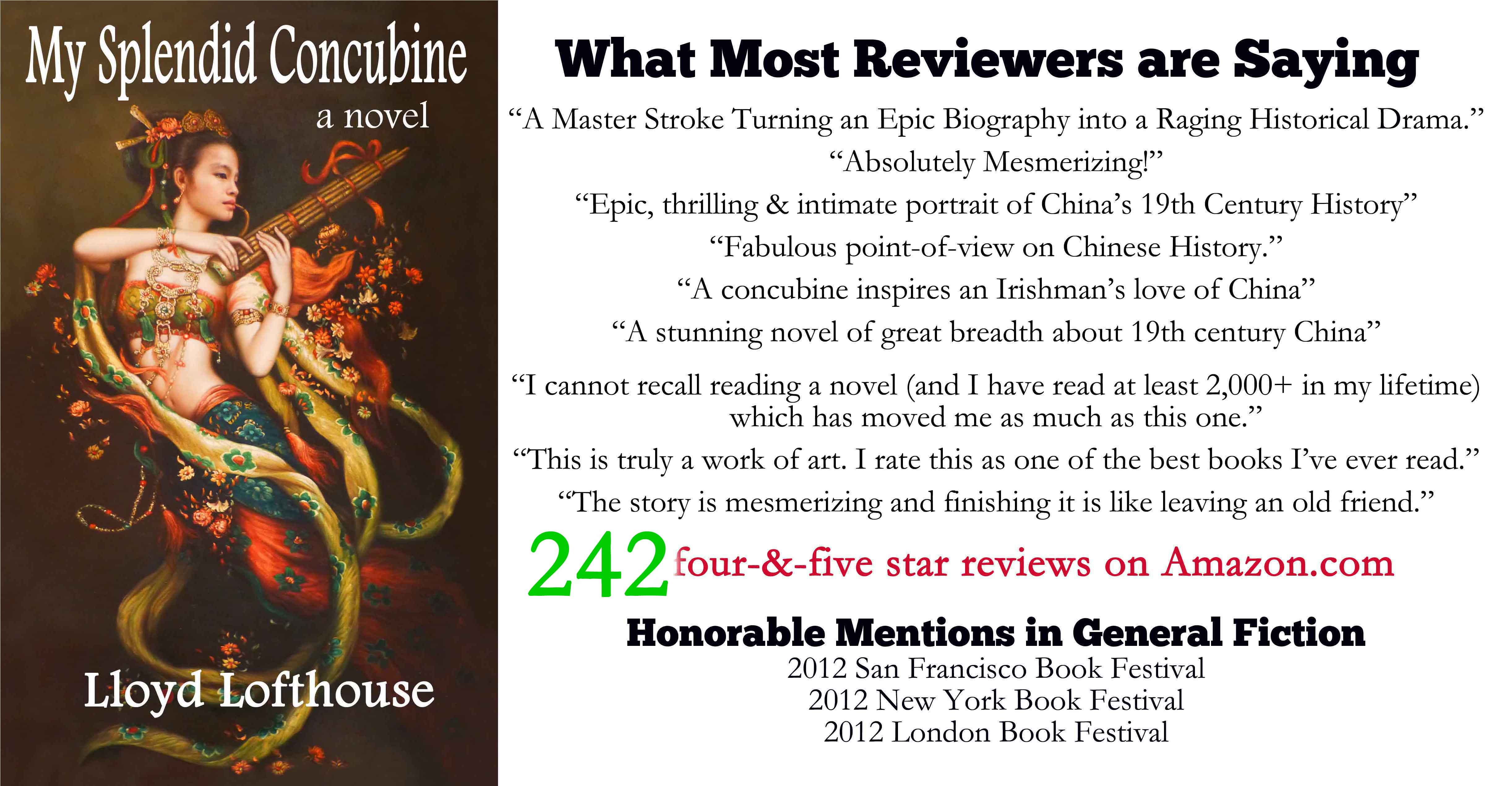
Lloyd Lofthouse is the award-winning author of My Splendid Concubine [3rd edition]. When you love a Chinese woman, you marry her family and culture too. This is the unique love story Sir Robert Hart did not want the world to discover.
Subscribe to “iLook China”!
Sign up for an E-mail Subscription at the top of this page, or click on the “Following” tab in the WordPress toolbar at the top of the screen.


 Posted by Lloyd Lofthouse