China’s One-Hundred-Thirty-Seven-Years of Turmoil and Madness 1839 – 1976: Part 1 of 3

June 26, 2018

The Encyclopedia Britannica reports that the Opium trade with China was developed in the 18th and 19th centuries.  Western countries, mostly Great Britain, exported opium grown in India and sold it to China.

“Early in the 18th century, the Portuguese found that they could import opium from India and sell it in China at a considerable profit. By 1773 the British had discovered the trade, and that year they became the leading suppliers of the Chinese market.”

When China attempted to end the epidemic caused by opium in 1839, England and France invaded China and ended up forcing opium and Christianity on China. There were two Opium Wars. The second one ended in 1860.

What many people don’t know is that five American families made their great fortunes from the dirty money that came from that opium trade.

The Astor Family: America’s first multimillionaire, John Jacobs Astor, joined the opium smuggling trade in 1816 when his American Fur Company bought 10 tons of Turkish opium and smuggled it into Canton.

The Forbes Family: John Murray Forbes and Robert Bennet Forbes worked for Perkins & Co. in its China trade. It was the brothers’ activities in the 1830s and 1840s in China that led to the Forbes family’s accumulated wealth.

The Russel Family: Samuel Wadsworth Russell started as an orphaned apprentice to a maritime trade merchant, made his initial investment capital on trading commissions while working for other traders, and eventually founded Russell and Co., the most powerful American merchant house in China for most of the second half of the 19th Century.

The Delano Family: Warren Delano, Jr., the grandfather of Franklin Delano Roosevelt, was chief of operations for Russell & Co., another Boston trading firm which did big business in the China opium trade in Canton. He first went to China at age 24 and spent a decade dealing dope on the Pearl River before returning to New York as a newly wealthy and very eligible bachelor.

The Perkins Family: Thomas Handasyd Perkins, a wealthy merchant, and Boston Brahmin par excellence made his bones as a young man trading slaves in Haiti, then peddled furs to China from the American Northwest before amassing a huge fortune smuggling Turkish opium into China.

After the Opium Wars, the British and Americans ended up controlling the industries in Shanghai, Nanking, Hankow, and Chunking.

The New York Times reported, “At the end of the 19th century, of a population of 300 million Chinese, 90 million were addicted to opium; the old Chinese empire was threatened by fragmentation, and the foreign powers were poised to divide it into economic zones of influence. The dismantling did not occur.”

Continued with Part 2 on June 27, 2018

Lloyd Lofthouse is the award-winning author of My Splendid Concubine, Crazy is Normal, Running with the Enemy, and The Redemption of Don Juan Casanova.
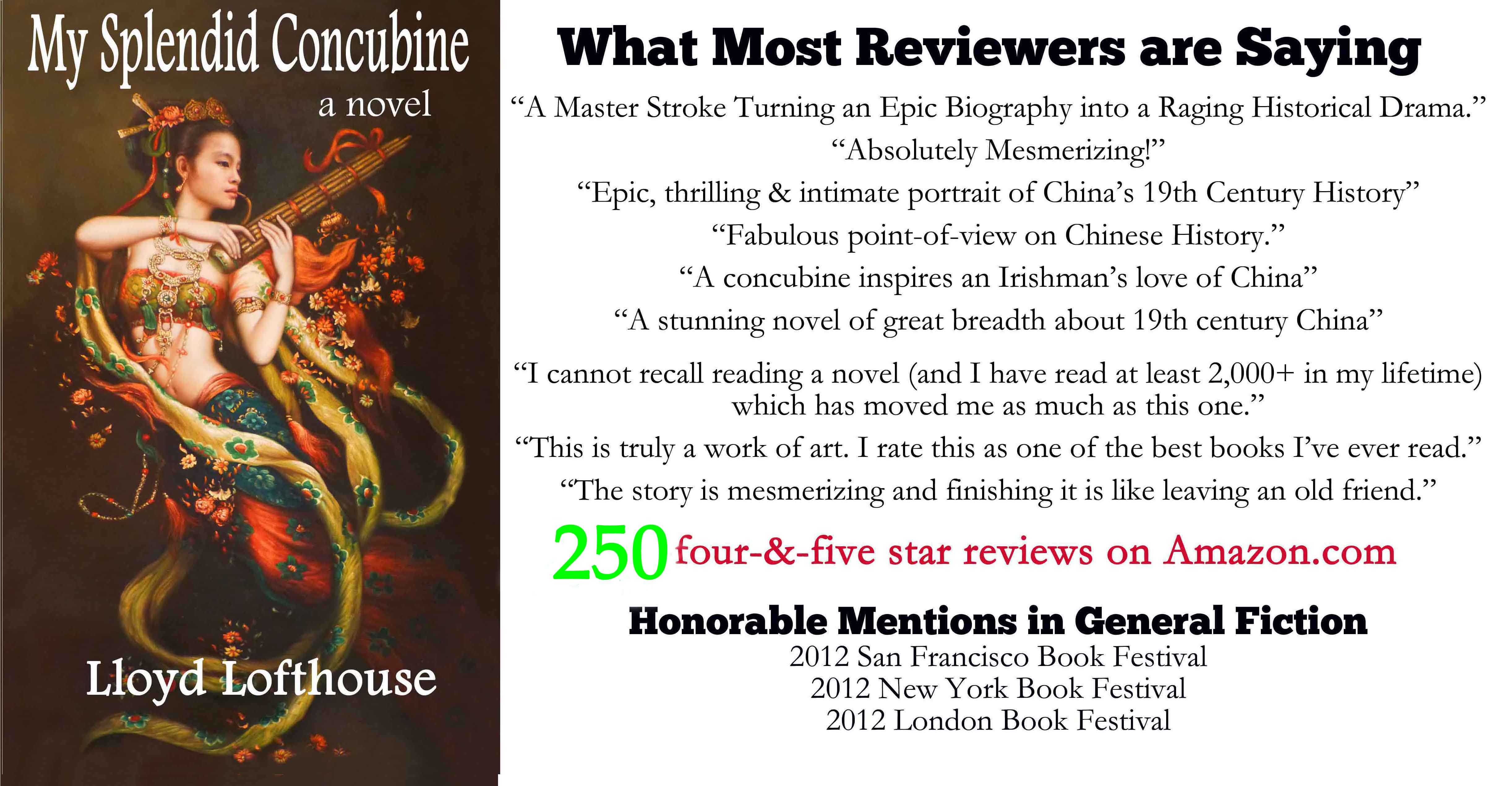
Where to Buy

Subscribe to my newsletter to hear about new releases and get a free copy of my award-winning, historical fiction short story “A Night at the Well of Purity”.

About iLook China


The Qing Dynasty’s Last Leader was a Woman: Part 2 of 2

June 20, 2018

The National Library of Australia reports, “Hugh Trevor-Roper, Regius Professor of Modern History at Oxford, was asked to examine the Backhouse manuscript by its Swiss custodians. In Hermit of Peking: The Hidden Life of Sir Edmund Backhouse, Trevor-Roper dismissed the autobiography as historically worthless fiction by a man he called a forger, confidence trickster and fantasist. He concluded, ‘Backhouse’s ‘memoirs’ are not an edifying work. They are a pornographic novelette’, and unpublishable.”

But Backhouse’s journalistic fraud served as the foundation for most history texts still used today that continue to slander Tzu Hsi.

To do Tzu Hsi justice and to discover the truth, one should read Seagrave’s Dragon Lady, The Life and Legend of the Last Empress of China.

To learn who the real woman was that ruled China pay attention to what Robert Hart wrote about Hzu Hsi in his letters and journals.  Robert Hart arrived in China from Ireland in 1854 to learn the language as an interpreter for the British consulate in Ningpo. In 1859, almost five years later, Hart quit his job with the British and went to work for the Emperor of China as an employee. He returned to England in 1908.

When I was researching Robert Hart’s life while working on my historical fiction novel My Splendid Concubine, I learned that Hart became Inspector General of Chinese Maritime Customs and worked closely with the Imperial ministers and Manchu princes. Before returning to England after living in China for fifty-four years, Hart met with the Dowager Empress in a private audience inside the Forbidden City.

Hart referred to Tzu Hsi as “the Buddha” and later “the old Buddha” since she was a devout Buddhist and it is obvious that he thought of her with affection and admiration.

In fact, Hart, who is considered the Godfather of China’s modernization, at no time indicated in anything he wrote that Tzu Hsi was conspiratorial, sinister or manipulative. However, he did indicate that she was strong-willed and hot-tempered, clever and had ability.

Tzu Hsi died in 1908 a few weeks after Robert Hart left China and returned to England to live out his final few years. The Qing Dynasty collapsed in 1911, the same year Robert Hart died.

Return to or Start with Part 1

Lloyd Lofthouse is the award-winning author of My Splendid Concubine, Crazy is Normal, Running with the Enemy, and The Redemption of Don Juan Casanova.

Where to Buy

Subscribe to my newsletter to hear about new releases and get a free copy of my award-winning, historical fiction short story “A Night at the Well of Purity”.

About iLook China


The Qing Dynasty’s Last Leader was a Woman: Part 1 of 2

June 19, 2018

Empress Dowager Tzu Hsi ruled the Qing Dynasty as a coregent after her husband, the Xianfeng Emperor died in 1861, and her son, The Tongzhi Emperor (1856 – 1875), was too young at age five to rule China.

Sterling Seagrave, the author of Dragon Lady, writes, “Absurdly little was known about her life. The New York Times printed a long, error filled obituary calling her Tzu An, the title of her coregent, who had died twenty-seven years earlier.”

Many current history texts continue to slander the Dowager Empress Tzu Hsi (1835 – 1908) without much evidence as one of history’s most monstrous women, an alleged ruthless Manchu concubine who seduced and murdered her way to the throne in 1861 to rule China through prevision, corruption and intrigue.

This is how many still think of Tzu Hsi. In addition, she was accused of murdering her son, and then years later her nephew, who died the day before she did.

Instead, her son died of syphilis because he preferred prostitutes to the hundreds of virgin concubines that belonged to him. Rumors claimed that Tzu Hsi had her nephew poisoned, but Yuan Shikai may have had him poisoned so he could become the next emperor. There is no evidence to support either allegation.

How did Tzu Hsi earn such a bad reputation?

It seems that she earned this reputation similar to how today’s China has been smeared in much of the Western media. Thanks to a liar and fraud by the name of Edmund Backhouse, who was a reporter for The London Times and his bestselling book “China under the Empress Dowagers”, Tzu Hsi’s fate to be labeled a monster and murderer  was guaranteed until 1976 when Backhouse’s fraud and lies were revealed.

Continued in Part 2 on June 20, 2018

Lloyd Lofthouse is the award-winning author of My Splendid Concubine, Crazy is Normal, Running with the Enemy, and The Redemption of Don Juan Casanova.

Where to Buy

Subscribe to my newsletter to hear about new releases and get a free copy of my award-winning, historical fiction short story “A Night at the Well of Purity”.

About iLook China


Jesus Christ’s Younger Chinese Brother

June 13, 2018

After China lost both of the Opium Wars started by the British and French, Christian missionaries flooded China along with a tsunami of opium.

Hong Xiuquan (1814 – 1865), a failed student of Confucian doctrine, converted to Christianity and woke up one morning claiming he was the younger brother of Jesus Christ. From there, he built a following and started the Taiping Rebellion (1850 – 1864) that lasted for more than a decade.

History of War says, “Conservative estimates of the dead in the 14-year Taiping Rebellion in southern China start at between 20 and 30 million. In contrast, around 17 million soldiers and civilians were killed fifty years later during the First World War. The devastating death toll between 1850 to 1864 certainly makes the uprising one of the bloodiest events in history, with more than 100,000 people killed in three days during the Third Battle of Nanking in 1864.”

Hong’s goals were to replace the Qing Dynasty and rid China of Opium. After achieving that goal, he was going to turn China into a Christian nation. He planned to be China’s first Christian emperor.

Since the English, United States, and French did not want the opium trade to end, these Christian nations helped the Ch’ing Dynasty defeat the Taipings even though the rebellion was a Christian uprising.

If the British and their western allies had sided with Hong Xiuquan, China would probably be a Christian nation today, but think of all the lost profits.

Lloyd Lofthouse is the award-winning author of My Splendid Concubine, Crazy is Normal, Running with the Enemy, and The Redemption of Don Juan Casanova.

Where to Buy

Subscribe to my newsletter to hear about new releases and get a free copy of my award-winning, historical fiction short story “A Night at the Well of Purity”.

About iLook China


China’s Last Imperial Dynasty was not ruled by the Han Chinese: Part 3 of 3

June 8, 2018

During the 19th century, the two Opium Wars started by Britain and France weakened the Qing Dynasty.

Besides the Opium Wars, there was also the Taiping Rebellion, which lasted more than a decade.

In 1900, the so-called Boxer Rebellion (known as “I-ho Chuan” or the “Righteous and Harmonious Fists”) was originally started to bring down the Manchu Qing Dynasty but the Qing government managed to redirect the rebellion against the foreigner invaders that had defeated China during the Opium Wars.

This ended in a worse defeat after the foreign powers formed an alliance and marched on Beijing slaughtering the rebels.

Back to the Qing Dynasty

How does a country innovate and prosper when it is fighting endless rebellions and wars. For a brief example, Business Insider estimates 25-million died during the Qing conquest of the Ming dynasty, a period of extreme political turmoil in China that lasted for sixty-five years. It is estimated that during the Taiping Rebellion 1850-1864, another 20-million died (some estimates allege the number was closer to 100-million). During the Dungan Revolt 1862-1877, another 10-million were killed.  If you click this link, you will discover a list of thirty wars and revolts that the Qing Dynasty was involved in. Do you see any comparison to the United States since the end of World War II?

The driving force behind the revolution of 1911 that ended the Qing Dynasty was Dr. Sun Yat-sen, who had been educated in Hawaii when it was an American territory. This exposure to the U.S. Republic motivated Sun Yat-sen to build a Republic to China but one that would fit the Chinese culture.

Return to Part 2 or start with Part 1

Lloyd Lofthouse is the award-winning author of My Splendid Concubine, Crazy is Normal, Running with the Enemy, and The Redemption of Don Juan Casanova.

Where to Buy

Subscribe to my newsletter to hear about new releases and get a free copy of my award-winning, historical fiction short story “A Night at the Well of Purity”.

About iLook China