“An individual should not have too much freedom. A nation should have absolute freedom.”
– Dr. Sun Yat-Sen (1866 – 1925)
He is referred to as the father of modern China. If there were no Sun Yat-Sen and his revolution, there would be no modern China as it is becoming today.
While attending a Christian school in Hawaii, he converted to Christianity, which may have shaped his revolutionary future. It was obvious that his writing was influenced by American thought. With the support he received from the Hawaiian Chinese community, he networked with Chinese people all over the world.
He went on to publish revolutionary ideas seeking to overthrow the Manchu Dynasty and create a democratic China. In 1904, he wrote that he wanted to model China’s government after America but by combining Western thought with Chinese tradition.
Yet, he was considered an idealistic dreamer – that his ideas were impractical.
He said, “The whole world is one family.” (1910)
______________________________
Lloyd Lofthouse is the award-winning author of My Splendid Concubine [3rd edition]. When you love a Chinese woman, you marry her family and culture too. This is the lusty love story Sir Robert Hart did not want the world to discover.
Subscribe to “iLook China”!
Sign up for an E-mail Subscription at the top of this page, or click on the “Following” tab in the WordPress toolbar at the top of the screen.
I find it interesting and amusing to read this obsession in the West about China’s labor practices. Most of what I read in the media and comments to Blog posts have a superior tone as if these people come from a culture that is paradigm of virtue.
No one in the West has earned a seat to sainthood. In an Associated Press piece by Elaine Kurtenbach, we see Western corporate greed dripping dollar signs from hungry vampire fangs in these quotes about China, “Many companies are striving to stay profitable by shifting factories to cheaper areas farther inland or to other developing countries, and a few are even resuming production in the West.… I have 15 major clients. My job is to give the best advice I can give. I tell it like it is. I tell them, put your helmet on, it’s going to get ugly,” said Goodwin…”
From BindApple.com comes this statement as if no one else in the world works these hours, “Foxconn and Inventec are two powerful brands that not many of you heard of. When Apple signed a partnership with these manufacturers, the average worker, lived and worked in the factory, doing more than 60 hours of work in a week.”
America and most Western nations are not paradigms of virtue. Labor in the West didn’t get where it is today without a struggle. All one has to do is look at history to discover what it took to earn more for less hours and be treated with “some” respect in the workplace.
If you spend time at the AFL-CIA’s Labor History Timeline in America, you will discover that in 1791, the first labor strike in the building trades took place in Philadelphia demanding a 10-hour workday bill of rights. In 1835, there was a general strike for a 10-hour workday in the same city.
When there was a national uprising of railroad workers in 1877, ten Irish coal miners were hanged in Pennsylvania and later nine more were hanged. Then in 1914, there was the Ludlow Massacre of 13 women and children and 7 men in a Colorado coal miners’ strike. In 1934, during the Great Depression, there was an upsurge in strikes, including a national textile strike, which failed.
Click on the Child Labor Public Education Project and you will learn that “Forms of child labor, including indentured servitude and child slavery, have existed throughout American history.” In fact, “(American) factory owners viewed them (children) as more manageable, cheaper, and less likely to strike.”
This situation in the US didn’t change until, “Child labor began to decline as the labor and reform movements grew and labor standards in general began improving, increasing the political power of working people and other social reformers to demand legislation regulating child labor.” Even then, it wasn’t until 1938 that child labor laws were enacted to protect America’s children from exploitation.
So, if you are one of those paradigms of virtue who feels the need to criticize what is going on in China today, consider America’s labor history before you open your mouth or finger dance your computer keyboard.
It took more than two-hundred years for the US to reach the place it is today with a standard 40-hour workweek with benefits and overtime pay for many workers, while removing child labor from the workplace.
China didn’t start until 1950, when Mao created laws that made women equal to men. Progress stopped during Mao’sGreat Leap Forward and his Cultural Revolution, which went on for almost thirty years.
Since 1980, China has had about thirty years to evolve, while in America the income gap between the rich and poor widens as if the US is taking backward steps while union membership shrinks.
In fact, Chinese manufactures may be building plants in the US to take advantage of cheaper labor. After all, Japanese companies like Toyota and Honda have already done that.
Lloyd Lofthouse is the award-winning author of the concubine saga, My Splendid Concubine & Our Hart. When you love a Chinese woman, you marry her family and culture too.
To subscribe to “iLook China”, look for the “Subscribe” button at the top of the screen in the menu bar, click on it then follow directions.
Qin Shi Huangdi (259 – 210 BC) unified China by using advanced weapons and brutal tactics. The Qin Dynasty arsenals made swords and other weapons with a precision unknown in Europe. Trigger mechanisms for crossbows and arrows were made in runs of tens of thousands.
The Qin military machine had one command—attack.
At this time, the Roman Empire had gathered 80,000 troops to defend Rome against Hannibal. In China, the king of Qin had an army of one-million.
Bravery was valued above all else. When a Qin soldier was killed in battle, it was up to his fellow troops to avenge his death. The penalty for cowardice was death. More than two million will die before Qin Shi Huangdi conquerors all China.
Qin’s officers were advanced in rank by winning in battle. If you wanted to be advanced in rank, you brought back the head of an enemy solider. The honorable way to treat prisoners of war was to bury them alive.
Emperor Qin Shi Huangdi was the father of a unified China. He was also brutal and ruthless.
Lloyd Lofthouse is the award-winning author of the concubine saga, My Splendid Concubine & Our Hart. When you love a Chinese woman, you marry her family and culture too.
Frazier says, “It is clear that migrant workers have gained a level of organizational sophistication and political awareness to make demands for higher wages, better working conditions, and in some cases, elections for union representatives.”
There are several books mentioned in the post.
Against the Law: Labor Protests in China’s Rustbelt and Sunbelt by Ching Kwan Lee.
The Chinese Worker after Socialism by William Hurst
The China Price by Alexander Harney
Some Assembly Required by Calvin Chen
State’s Gains, Labor’s Losses by Dorothy Solinger
Factory Girls by Leslie T. Chang.
The changes started with the land reforms under Mao, continued with Deng Xiaoping when he said, “Getting Rich is Glorious” introducing capitalism to China, then the growth of an urban middle class, and now capitalist exploitation of the worker while China’s Sexual Revolution is going strong.
However, what if the labor protests in China are from job losses caused by the global economic crises. People are angry. After all, millions have lost jobs already.
_________________________
Lloyd Lofthouse is the award-winning author of the concubine saga, My Splendid Concubine & Our Hart. When you love a Chinese woman, you marry her family and culture too.
There are more than 4 million security cameras in the UK—one for every fourteen people. Many have been installed by businesses but more than a million are cameras controlled by the government and/or police. Source: London Evening Standard
The lead paragraph says, “China has installed 40,000 security cameras throughout the capital of Xinjiang region days before the first anniversary of the country’s worst ethnic violence in decades.”
As usual, there is no mention that next-door a war is raging against the Taliban and Al-Qaeda. There is no mention of Pakistan’s struggle with the same enemy that NATO and US forces are fighting.
In fact, if you look at a map of the region, you will see that Urumqi, the capital of Xinjiang province, is close to Kyrgyztan, Kazakhstan, Afghanistan and Pakistan, all areas having trouble with Islamic fundamentalists but in China, the Muslims are a peaceful ethnic group according to the Western media. That’s interesting.
If Britain, a democracy, puts up more than 4 million security cameras to deal with crime and unrest in the UK, why can’t China do the same without being criticized? Did you know that local governments in the US are installing these cameras too? Source: MSNBC
Lloyd Lofthouse is the award-winning author of the concubine saga, My Splendid Concubine & Our Hart. When you love a Chinese woman, you marry her family and culture too.



 Posted by Lloyd Lofthouse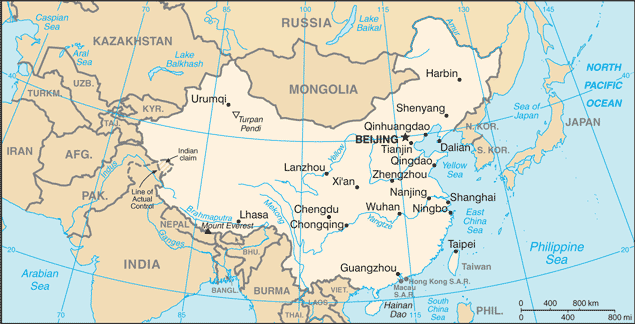
 iLook China