Since the episode with the punk kids, that mother who thought I needed reason for keeping them off our driveway doesn’t talk to me or acknowledge that I am alive if we pass each other on the street.
After all, I ratted out her precious, perfect child and called the police about his pack of unruly punks. In addition, one of the other children that wanted to play in our driveway argued with me after I politely asked them to go somewhere else.
Of course, I’ve heard the, “kids will be kids” crap as a teacher. However, I do not except that excuse for rudeness and unruly behavior.
My wife and I value our privacy. That’s why we bought a house at the end of a cul-de-sac. We also don’t like the liability of kids using our steep driveway for cheap thrills since we live in a litigation nation where everything you worked hard for can vanish in a court of law.
In reading this post from Always on the Verge, I discovered one of the idiots that advocates a world run by rude punks. I don’t think this author has ever considered the other side of the coin beyond her small world.
Lloyd Lofthouse is the award-winning author of the concubine saga, My Splendid Concubine & Our Hart. When you love a Chinese woman, you marry her family and culture too.
Subscribe to “iLook China” Sign up for an E-mail Subscription at the top of this page.
“Hey, old man, you can’t stop us. You can’t take our picture because it’s dark.” Those were the words I heard after dark one night during the summer of 2008 from a pack of kids taunting me as they raced in and out of our steep driveway on their bicycles.
I finally called the police, and the next day walked the neighborhood door to door seeking support to stop the harassment that had gone on for two years—mostly during the summers when school was out.
When I talked to the mother of one of these kids, she asked, “What was your reason for not letting them play on your driveway?”
Do I need a reason? In a piece about The Eternal Value of Privacy, the author never mentioned the tyranny of neighbors and punk kids.
Lloyd Lofthouse is the award-winning author of the concubine saga, My Splendid Concubine & Our Hart. When you love a Chinese woman, you marry her family and culture too.
Subscribe to “iLook China” Sign up for an E-mail Subscription at the top of this page.
Before I start to talking about Chinese parents and children, first let us have a look of the currently pretty hot arguing book, Battle Hymn of the Tiger Mother, which is a Chinese-AmericanYale law professor mom that wrote about how she was strict with her two daughters by making a lot of can’t doing rules, and she was acting like a wicked witch to push them to study.
I will not comment on which parenting method is better, Chinese or Western.
What I want to say is the book’s author Amy Chua’s way of parenting is typically Chinese though she is 4th-generation American.
Note from Blog host: Evidence of this may be found among reviews and comments on Amazon.UK. Rosie in the UK wrote, “I am Chinese now living in the UK and I admit I was outraged when I first read theWSJ excerpt of her (Amy Chua’s) book. My first thoughts were I can’t believe anyone would do something like that to their children. However, as I thought more about it and I guess living out here in the UK I’ve been so used to the numbing and dummying of our children’s perceived fragile self esteem and always making sure that their feelings and wants are met for fear of damaging them emotionally, I forgot that, hey, I was brought up pretty much the same way.”
Hanna says, “We Chinese have a long history of parents being strict with their children. From old days, the Ke Ju Kaoshi (official examination) was the only chance for people to change their fate and life.
“To achieve this, they must study really hard. We have an old saying about this “Shi Nian Han Chuang Ku Du Ri, Jin Chao Jin Bang Ti Ming Shi”, which means “Ten years of study at a cold window only for the day of passing the examination.”
“To study, students must be pushed even by using the stick.”
In addition, modern Chinese are also having many new chances but this still won’t change the way most Chinese parents raise children, because China now has the “Gaokao”, which is the high school examination to get into a university or college.
Because of the competition, parents can’t afford or wouldn’t dare to let the child just play and have fun. Children don’t know what is best for them.
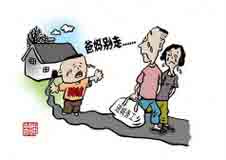
Parents must force them to study but spoil them at the same time. When the child gets the great score, that means everything to parents. The kids don’t have to do anything else in life but study. Therefore, the story is the boy went into a famous college but didn’t know how to peal the eggshell.
Note from Blog host: Another review from Amazon.UK supports what Hanna is saying. The reviewer wrote, “I know how appalling some of those things sound to many. Not me, since I am Chinese myself and I have been brought up that same way, if not more strict.…. However when I grow up (now 40), I see the vast difference of parenting among other people in different countries (I live in UK now with my English husband), and what repercussions it has on the kids when they grow up. I am glad I was brought up the way I was.”
Hanna says, “Chinese parenting is not about ‘feelings’, but it’s not to say that the parents do not care.”
The child has to finish the school homework to 10 pm at night five days a week. Then after school, the child goes to the special training to develop other skills such as piano. This is not about what the the child is interested but it’s what the parents decided based on what they believe is necessary. What we learn in China is that the children have to attend eight different hobbies classes. There’s no free time.
In fact, in China, children should not argue with their parents and the child must do what the parents say.
When the child is good at studying, it means “Guang Zong Yao Zu”, (bring honor to your ancestors).
When you get the low score (100% score is best. 60% means you barely passed the exam. 90% is good. However, even just 1% lower and the child gets the “cold face”).
This not only means teachers calling parents endless times for meetings and punishment from the parents but it embarrasses your ancestors too.
This means when children are doing the homework, parents watch them until they finish to insure no mistakes.
Another recent review from Amazon.US points out an interesting thought. “The (Amy Chua) book raises an important question: Is America’s assumed educational mediocrity really the fault of our public schools (as some believe) or is it the fault of an epidemic of indulgent parenting (as others believe)? Asian kids seem to do remarkably well in the public schools… and raising little complaint about the quality of the schools.”
As for myself, Hanna writes, I think I’m the lucky one born in a family offering more freedom. Luckily I was a good student so my parents didn’t have to pay as much attention to me.
Did they spoil me? Sure. Did they care about my feelings? Yes, because they allowed me talk and argue with them.
If your child is no good at school, you must still love them. However, being strict so they have a good future is not worth it if they hate you later. No matter what kind of family you live in – strict or spoiled – the important thing is to love. Then the world can be better place.
Chua says, “My memoir — seen in the West as a story about “extreme” parenting — is being marketed the opposite way in China, as a story about the importance of giving kids more freedom. Amusingly, the book’s title in China is Parenting by a Yale Professor: Raising Kids in America, and I was asked by one Chinese women‘s magazine to give its readers tips on “how to be friends with your kids.”
Chris Bewley has taught English as a foreign language for the past 10 years all over the world, including Japan, Korea, Mexico and Brazil.
__________________________
When I first arrived in China as an English teacher, I had lofty scholastic goals: I wanted to try a creative variety of class activities and apply a broad spectrum of teaching methods that my students could benefit from to make them competitive in academia and, later, the international job market.
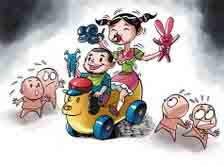
Almost 1 year later, my primary responsibility as a “Foreign Expert English Instructor” has been distilled down to little more than babysitting a bunch of spoiled, undisciplined children who for the most part want nothing to do with English.
At my crowded primary school in a small, semi-urban city in East China, there exists what I have coined the “20/20/20” split in each of my classes (60 kids per class): 20 eager/20 indifferent/20 bad. Basically, I’m teaching 20 while trying to control 40.
To make it fair for everyone, I have to dumb-it-down/ fun-it-up every class. Instead of actually teaching, I find myself playing games with them and jumping around for them like a monkey, which is the only way to retain their attention.
On the positive side, of the eager 20, there are several extremely smart students who I expect one day to be quite successful in what ever they do. Unfortunately, whenever those eager 20 are trying to learn, the other naughty 40 will try just as hard to spoil it for them.
In the past year, I’ve had only a handful of students ever raise their hand and ask ME a question about the English language. That’s 1,200 students/week x 30 weeks, which equals 36,000 (thirty-six thousand) chances for a student to raise a question, but only five ever have. On the rare occasion that my students do ask me questions, it’s usually regarding the price of my clothes or how much I get paid.
Criticism about my lessons that I have received from students, parents and Chinese teachers alike includes “it’s too difficult”, “it’s not fun enough”, “there’s not enough participation/activity,” but never have I ever heard that my classes are too easy, which in my opinion they most certainly are.
By now, I have figured out that English lessons in (urban) China are just a show; a clown show; a monkey show – starring myself as the foreign monkey.
For parents’ week last month, whilst dozens of “concerned” parents and school administrators observed my classes for 5 days in a row, rather than actually teach their children, I just played a bunch of silly games and sang some songs with them, and, guess what? That made all the parents really, really happy!
Most recently, I found myself having to literally, physically, throw out my Chinese teaching assistant (a recent college graduate with no classroom experience hired right off the street for a minimal salary) to avoid a mutiny from within.
You see, she absolutely refused to discipline the rowdiest students, and did nothing to help control their deafening volume when I was trying to teach.
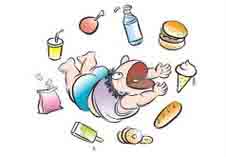
A quarter of China’s rural youth overweight!
When I approached her about this, her response was: “you are not a real teacher!” I imagine that this assistant was once (11 years ago, to be precise) a spoiled, indifferent primary school student herself; how sadly ironic that at age 21 she still indentified with the students rather than with me, the teacher.
China’s universities are being touted with utilitarian promise, a promise that trickles down all the way to the elementary school level. The Chinese’s fear of poverty has undermined intellectual diversity; plagiarism and cheating are rampant and go unpunished, reading books is not encouraged, greater importance has been placed on math than any other subject starting in the earliest years of child development, and there are no other languages other than English offered until university.
The
English “industry” in China is what I call “C.O.O.C”: completely out of control! There is literally a new, privately run children’s English “school” popping up on every other corner every other week. Nor is it an industry that has grown in a healthy, steady way from its infantile beginning; it is a product for infants in hyper-drive.
A perfect parallel to this is the car situation in China, which is also out of control.
I hate to say it because it has become an international cliché, but, truly, nobody in China knows how to drive or even park properly. Automobile ownership in China has, along with its economy, bloomed at an alarming rate in the past 5 years, resulting in massive congestion everywhere from the smallest towns to the largest cities.
It’s obvious that the people who own these cars use them primarily as status symbols rather than for necessity; it rarely rains in my city and there are no hills, yet every single day, 6 times a day, hundreds of parents dropping off/picking up their children in new, black Audis will cause an hour-long gridlock directly
in front of my school rather than be seen walking or riding a bicycle.
Please don’t get me wrong, I am not a “China-hater.”
Colorful street life, extremely friendly people, great food, affordable massage parlors, a handful of good friends both Chinese and foreign, and a decent income have been sufficient to keep me reasonably comfortable.
But in the end, I have to ask myself: what am I here for? Because it’s obvious that China doesn’t want me to actually teach anybody anything.
_____________________
Chris Bewley has taught English as a foreign language for the past 10 years all over the world, including Japan, Korea, Mexico and Brazil.
To subscribe to “iLook China”, look for the “Subscribe” button at the top of the screen in the menu bar, click on it then follow directions.


 Posted by Lloyd Lofthouse
 iLook China