China’s Great Wall

January 24, 2017

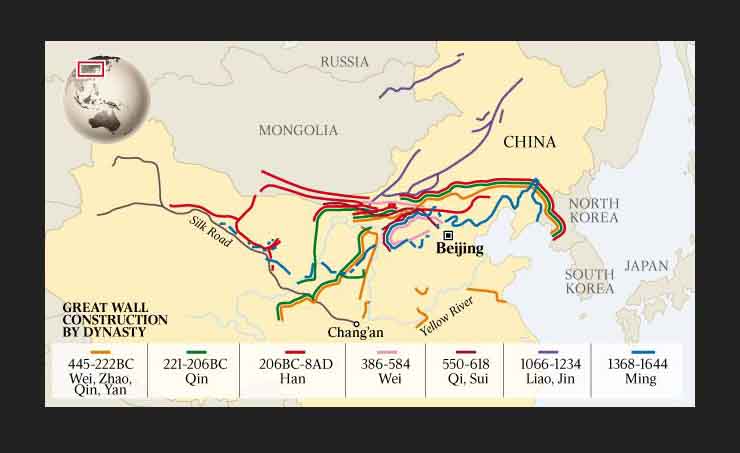
Like so much about China, The Great Wall is also the victim of myths that are not always true. Did you know that the history of the Great Wall of China started with fortifications built by various states during the Spring and Autumn (771 – 476 BC) and Warring States (475 – 221 BC) periods? But the best-known and best-preserved sections of The Great Wall was built in the 14th through 17th centuries A.D., during the Ming Dynasty, more than two thousand years later.

If you want to know more about The Great Wall plan a trip to China, or read Peter Hessler’s Country Driving. The first part of this book is about the months he spent driving the length of The Great Wall all the way to Tibet.

In the first 122 pages Peter Hessler rented a Chinese made Jeep Cherokee. In this section, I learned that the Wall was successful most of the time and not the failure historians have claimed it was.

Over a period of several thousand years, the wall failed a couple of times, but served its purpose and offered protection for China’s heartland for centuries. Hessler says that there is no archaeologist in the world that has studied the history of the Great Wall, but he wrote that there are amateur experts, and you will meet a few in his book along with a unique view of rural China.


The Great Wall of China – Unbelievable Secrets & Unknown Facts

The Wall failed when first Genghis and then Kublai Khan unified the Mongol tribes and invaded China in the 13th century, but it didn’t happen overnight. It took sixty years for the Mongols to conquer all of China and then they ruled the country for almost a century before the Han Chinese rose up and drove them out.

The sections of the Great Wall I’ve visited are an hour out of Beijing. The most popular site is at Badaling.  The second choice, Mutianyu, is more dramatic, because this portion of the Great Wall runs along the ridge of a mountain range and you have to hike up a steep slope to reach it or ride a ski lift to the top. Badaling starts in a fortress in a mountain pass, and the wall climbs the slopes from there.
great-wall-consruction-by-dynasty

Smithsonian Magazine reported, “Few cultural landmarks symbolize the sweep of a nation’s history more powerfully than The Great Wall of China. Constructed by a succession of imperial dynasties over more than 2,000 years, the network of barriers, towers and fortifications expanded over the centuries, defining and defending the outer limits of Chinese civilization. At the height of its importance during the Ming Dynasty (1368-1644), The Great Wall is believed to have extended some 4,000 miles, the distance from New York to Milan.

China’s Great Wall was not built by one country, king, or emperor. The wall was built in sections by the kings of several nations over a period of centuries. Those walls were eventually linked together by China’s first Emperor Qin Shi Huangdi, who brutally unified China through bloody conquest into one country with one written language, Mandarin, and many spoken languages.

Then there is the recent Great Wall film starring Matt Damon, a film that explores a mystery centered on the construction of the Great Wall of China. Of course it obvious this story is based on a fantasy. In the film’s trailer, I was hooked by, “What were they trying to keep out?”

Lloyd Lofthouse is the award-winning author of My Splendid Concubine [3rd edition]. When you love a Chinese woman, you marry her family and culture too. This is the unique love story Sir Robert Hart did not want the world to discover.
a1-241-positive-reviews-jan-7-2017_edited-4

Where to Buy

Subscribe to “iLook China”!
Sign up for an E-mail Subscription at the top of this page, or click on the “Following” tab in the WordPress toolbar at the top of the screen.

About iLook China

China’s Holistic Historical Timeline


Did Mao Zedong have Complex PTSD (C-PTSD)? – Part 2 of 2

July 13, 2016

Mao born in 1893 grew up during a period of madness in China’s history. To learn more, I suggest reading The Roots of Madness.

The Chinese Civil War lasted from 1926 to 1949 with a few years out to fight the horrors of the Japanese invasion of China during World War II.

The horrors of Mao’s Long March by itself was enough to cause PTSD in all 6,000 of its survivors from the more than 80,000 troops that started the year-long journey of retreat, battle, and severe suffering that was threatened by death on a daily basis.

After Mao was China’s leader, there was an assassination attempt by one of his most trusted generals, Lin Biao, a man Mao had named as his successor after he died.  In addition, during China’s Civil WarChiang Kai-shek ordered more than one failed assassination attempt on Mao.

However, the threats and violence that shaped Mao’s life began before The Long March and before he was a leader in the Chinese Communist Party.

As a child, he grew up among farmers and peasants with an average expected life span in China of 35 years. In the 1920s, as an idealist and a sensitive poet, he believed in helping the worker and led several labor movements that were brutally subdued by the Nationalist government led by Chiang Kai-shek.

Once, Mao barely escaped with his life.

In 1930, Yang Kaihu, his wife at the time — Mao was married four times — was arrested and executed. In addition, Mao had two younger brothers and an adopted sister executed by Chiang Kai-shek’s troops.

If you had several close calls with death; lost a wife, two younger brothers and an adopted sister in this way, how would that affect you?

To judge Mao by today’s Politically Correct Western values is wrong, because he grew up in a world ruled by a completely different set of values that shaped him to be tough enough to survive.

Anyone that survived and went on to rule China at that time would have been judged as brutal by today’s Politically Correct Western values. In fact, Chiang Kai-shek was a brutal dictator who ruled Taiwan — after he fled mainland China in 1949 — under military marshal law until his death in 1976. But Chiang didn’t have as many people to rule over so the death count he caused was smaller but no less significant.

The History of Humanitarianism shows us that this concept was born and nurtured in the West and developed slowly over centuries with the result that the individual was made more important than the whole.

However, in China, the whole is still more important than one person as it was during Mao’s time. If you were to click on the link to the History of Humanitarianism and read it, you would discover that China was not part of this movement while Mao lived. (Discover more about China’s Collective Culture)

PTSD as a war wound and a trauma was not recognized or treated until well after America’s Vietnam War.  Prior to its discovery, it was known as shell shock. The diagnosis of PTSD first appeared in the 1980s, and Mao died in 1976.

In fact, if Mao were alive today he would not be alone. In the United States, it is estimated that 7.8% of all Americans suffer from PTSD, and among that segment of the population, more than 300,000 Iraq and Afghanistan military veterans have PTSD in addition to 1.7 million Vietnam veterans.

Return to or start with Part 1

Lloyd Lofthouse, a former U.S. Marine and Vietnam combat vet, is the award-winning author of My Splendid Concubine [3rd edition]. When you love a Chinese woman, you marry her family and culture too. This is the unique love story Sir Robert Hart did not want the world to discover.

#1 - Joanna Daneman review posted June 19 2014

Where to Buy

Subscribe to “iLook China”!
Sign up for an E-mail Subscription at the top of this page, or click on the “Following” tab in the WordPress toolbar at the top of the screen.

About iLook China

China’s Holistic Historical Timeline


Did Mao Zedong have Complex PTSD (C-PTSD)? – Part 1 of 2

July 12, 2016

Was Mao the monster that the Western media often makes him out to be, or was he just a product of his environment and life?

Mao has been judged by a Western value system that did not exist in China or the United States during his lifetime. In addition, it is now known that who we grow up to become as adults is partially due to genetics but mostly from environmental and lifestyle influences.

Mao grew up in a world nothing like most in the West have ever experienced.  He was born into China’s collective culture where the individual was not more important than the whole.

There is a strong possibility that Mao also suffered from Post Traumatic Stress Disorder (PTSD), and this may have influenced his behavior and decisions during the years he ruled China [1949 – 1976].

Helping Psychology reports, “PTSD victims tend to be in a continuous state of heightened alertness. The trauma that precipitates the disorder essentially conditions them to be ever-ready for a life threatening situation to arise at any moment … But the continuous releases of brain chemicals that accompany this reaction time – and their inability to control when this heightened reactivity will occur – take psychological and biological tolls on PTSD victims over time.”

Then Medicine Net.com reports, “Complex posttraumatic stress disorder (C-PTSD) usually results from prolonged exposure to a traumatic event or series thereof and is characterized by long-lasting problems with many aspects of emotional and social functioning.”

American combat veterans are not the only people on this planet to suffer from PTSD. Every person is susceptible to the ravages of a violent trauma, and if we examine Mao’s life, it could be argued that PTSD played a strong role in the decisions he made as he aged.

We will examine Mao’s long history as a victim of violence in Part 2

Continued on July 13, 2016 in Part 2

Lloyd Lofthouse, a former U.S. Marine and Vietnam combat vet, is the best-selling, award-winning author of My Splendid Concubine [3rd edition]. When you love a Chinese woman, you marry her family and culture too. This is the unique love story Sir Robert Hart did not want the world to discover.

A1 on March 13 - 2016 Cover Image with BLurbs to promote novel

Where to Buy

Subscribe to “iLook China”!
Sign up for an E-mail Subscription at the top of this page, or click on the “Following” tab in the WordPress toolbar at the top of the screen.

About iLook China

China’s Holistic Historical Timeline


Vietnam versus China – 207 BC to Today

June 21, 2016

Compared to China, the few years the U.S. fought in Vietnam is insignificant, and based on history, the United States learned its lesson to get out in a much shorter time span than it took China. And the French learned this lesson in a much shorter time span between 1946 and 1954.

China’s most recent conflict with Vietnam started on February 15, 1979, when China invaded Vietnam to teach it a lesson.

Why did China do this? Well, after the death of Stalin, relations between the Soviet Union and China turned sour while the Russians and the Vietnamese developed a closer relationship.

To counter this perceived threat, China encouraged Cambodia to take aggressive action against Vietnam. Near the end of 1978, the Cambodians under the leadership of Pol Pot launched a series of attacks along the Vietnam border.

The Vietnamese retaliated with armored units and captured the capital of Cambodia on January 7, 1979.

Since ten-thousand Chinese military advisers in Cambodia became prisoners, China lost face, and invaded Vietnam to “teach it a lesson”.

The Vietnamese decided to hold back their regular army and defend the border with militia units using guerilla tactics in the hills and rainforest similar to how they fought America, the French and China in the past.

China took heavy casualties after attacking and soon pulled its troops out 3 weeks and 6 days after crossing the border.  Both sides declared victory. Border clashes between Vietnam and China would continue until 1990.

One would think that China would have learned its lesson long ago, because China has a long and bloody history with Vietnam. The first Chinese invasion and occupation of Vietnam took place in 207 BC to 39 AD. The second occupation was from 43 to 544 AD.  The third was from 602 to 905 AD.  The fourth event was between 1407 to 1427 AD. During this long history of invasions and occupations by China, the Vietnamese rebelled repeatedly to drive the Chinese out and regain their independence as a country.

France ruled over Vietnam from 1862 until the Japanese invaded during World War II. The French would return in 1946 and fight the Vietnamese until 1954.

The US and Vietnam, once enemies during the American-Vietnam War (1961 – 1975), are now allied to block China’s territorial claims in the South China Sea.  – Goldsea Asian American News

I seriously think many leaders do not study history to avoid repeating the same mistakes made by others before them.

Lloyd Lofthouse is the award-winning author of My Splendid Concubine [3rd edition]. When you love a Chinese woman, you marry her family and culture too. This is the unique love story Sir Robert Hart did not want the world to discover.

A1 on March 13 - 2016 Cover Image with BLurbs to promote novel

Where to Buy

Subscribe to “iLook China”!
Sign up for an E-mail Subscription at the top of this page, or click on the “Following” tab in the WordPress toolbar at the top of the screen.

About iLook China

China’s Holistic Historical Timeline


Korean War POWs compared to America’s Illegal Wars in Laos and Cambodia

August 5, 2015

Chinese history shows that since the time of Qin Shi Huangdi, China’s first emperor (221 – 207 B.C.), the standard practice in war was to execute POWs because they were a burden that might lead to defeat.  An army that doesn’t have to feed and guard POWs is more effective at fighting and winning.  Alexander the Great and Genghis Khan knew this fact too.

Some time ago I watched a documentary on the Korean War that mentioned that 87% of United Nations (U.N.) troops captured by the People’s Liberation Army or North Korean troops during the war died in captivity, but it doesn’t explain how they died.

In fact, while there was strong evidence that North Korean Troops executed U.N. POWs, the Chinese rarely executed prisoners like their North Korean counterparts did. Instead, mass starvation and diseases swept through the Chinese POW camps during the winter of 1950-51. “About 43 percent of all U.S. POWs died during this period.” The Chinese defended what happened because Chinese troops during this period also suffered mass starvation and diseases due to an incompetent logistics supply system. Even the civilian population behind the Communist lines didn’t have enough to eat. – wikipedia.org

Surviving U.N. POWs, however, have disagreed with this claim. Click on the previous link to see what the POWs had to say.

Even though the Wiki piece claims “both the Communists and United Nations forces were committed to the terms of the 1949 Geneva Conventions III, regarding the treatment of POWs,” China didn’t join the United Nations until October 25, 1971 — twenty years later, and North Korea wouldn’t become a member of the U.N. until September 1991.

The International Treaties on the Laws of War written in Geneva and the Hague in 1938 by the League of Nations was meant for the “Protection of Civilian Populations Against Bombing from the Air in Case of War,” but during World War II, the US Air Force killed hundreds of thousands of civilians in Germany and Japan. Many of the bombs dropped were napalm (jellied gasoline) and the innocent along with enemy troops were roasted alive and that included the elderly, women and children.

In addition, the Geneva Convention for the treatment of Prisoners of War was written in 1949, the same year the Chinese Communists won the Civil War in China, but the U.S. had been an ally of the Nationalist Chinese since well before World War II and protected Chiang Kai-shek’s Nationalists in Taiwan after 1949 in spite of the fact that Chiang Kai-shek was a brutal dictator who ruled Taiwan with martial law and was responsible for the killing of more than thirty-thousand civilians in 1947 in the 2/28 Massacre in Taiwan.

While the behavior of Chinese and North Korean troops when it came to POW’s was unacceptable by Western humanitarian written standards, US forces are just as guilty when it comes to killing innocent civilians. It is estimated that the US killed between 1.5 and 3.6 million people in Vietnam, Laos and Cambodia (note that the US bombings in Laos and Cambodia were illegal and were not approved by the U.S. Congress), and left behind a horrible legacy due to the use of Agent Orange.

“Not only did Nixon and Kissinger not seek the necessary approval from Congress to bomb Cambodia, (and Laos 1962-1969) they tried to conceal the bombing not only from the American public but Congress as well.” – Third World Traveler

In conclusion, written agreements seldom are practiced in war, and it is obvious these agreements do not save innocent lives. To learn more about the illegal US bombing in Laos, read National Geographic Magazine’s recent Life After the Bombs. “The total weight of the bombs dropped was many times greater than the weight of the people living in Laos, which at the time had a population of perhaps two million. It worked out to as much as a ton of bombs per person. … The bombs didn’t distinguish between communists and anticommunists any more than they distinguished between soldiers and children.”

______________________________

Lloyd Lofthouse is the award-winning author of My Splendid Concubine [3rd edition]. When you love a Chinese woman, you marry her family and culture too. This is the lusty love story Sir Robert Hart did not want the world to discover.

IMAGE with Blurbs and Awards to use on Twitter

Subscribe to “iLook China”!
Sign up for an E-mail Subscription at the top of this page, or click on the “Following” tab in the WordPress toolbar at the top of the screen.

About iLook China

China’s Holistic Historical Timeline