Did Mao Zedong have Complex PTSD (C-PTSD)? – Part 2 of 2

July 13, 2016

Mao born in 1893 grew up during a period of madness in China’s history. To learn more, I suggest reading The Roots of Madness.

The Chinese Civil War lasted from 1926 to 1949 with a few years out to fight the horrors of the Japanese invasion of China during World War II.

The horrors of Mao’s Long March by itself was enough to cause PTSD in all 6,000 of its survivors from the more than 80,000 troops that started the year-long journey of retreat, battle, and severe suffering that was threatened by death on a daily basis.

After Mao was China’s leader, there was an assassination attempt by one of his most trusted generals, Lin Biao, a man Mao had named as his successor after he died.  In addition, during China’s Civil WarChiang Kai-shek ordered more than one failed assassination attempt on Mao.

However, the threats and violence that shaped Mao’s life began before The Long March and before he was a leader in the Chinese Communist Party.

As a child, he grew up among farmers and peasants with an average expected life span in China of 35 years. In the 1920s, as an idealist and a sensitive poet, he believed in helping the worker and led several labor movements that were brutally subdued by the Nationalist government led by Chiang Kai-shek.

Once, Mao barely escaped with his life.

In 1930, Yang Kaihu, his wife at the time — Mao was married four times — was arrested and executed. In addition, Mao had two younger brothers and an adopted sister executed by Chiang Kai-shek’s troops.

If you had several close calls with death; lost a wife, two younger brothers and an adopted sister in this way, how would that affect you?

To judge Mao by today’s Politically Correct Western values is wrong, because he grew up in a world ruled by a completely different set of values that shaped him to be tough enough to survive.

Anyone that survived and went on to rule China at that time would have been judged as brutal by today’s Politically Correct Western values. In fact, Chiang Kai-shek was a brutal dictator who ruled Taiwan — after he fled mainland China in 1949 — under military marshal law until his death in 1976. But Chiang didn’t have as many people to rule over so the death count he caused was smaller but no less significant.

The History of Humanitarianism shows us that this concept was born and nurtured in the West and developed slowly over centuries with the result that the individual was made more important than the whole.

However, in China, the whole is still more important than one person as it was during Mao’s time. If you were to click on the link to the History of Humanitarianism and read it, you would discover that China was not part of this movement while Mao lived. (Discover more about China’s Collective Culture)

PTSD as a war wound and a trauma was not recognized or treated until well after America’s Vietnam War.  Prior to its discovery, it was known as shell shock. The diagnosis of PTSD first appeared in the 1980s, and Mao died in 1976.

In fact, if Mao were alive today he would not be alone. In the United States, it is estimated that 7.8% of all Americans suffer from PTSD, and among that segment of the population, more than 300,000 Iraq and Afghanistan military veterans have PTSD in addition to 1.7 million Vietnam veterans.

Return to or start with Part 1

Lloyd Lofthouse, a former U.S. Marine and Vietnam combat vet, is the award-winning author of My Splendid Concubine [3rd edition]. When you love a Chinese woman, you marry her family and culture too. This is the unique love story Sir Robert Hart did not want the world to discover.

#1 - Joanna Daneman review posted June 19 2014

Where to Buy

Subscribe to “iLook China”!
Sign up for an E-mail Subscription at the top of this page, or click on the “Following” tab in the WordPress toolbar at the top of the screen.

About iLook China

China’s Holistic Historical Timeline


Did Mao Zedong have Complex PTSD (C-PTSD)? – Part 1 of 2

July 12, 2016

Was Mao the monster that the Western media often makes him out to be, or was he just a product of his environment and life?

Mao has been judged by a Western value system that did not exist in China or the United States during his lifetime. In addition, it is now known that who we grow up to become as adults is partially due to genetics but mostly from environmental and lifestyle influences.

Mao grew up in a world nothing like most in the West have ever experienced.  He was born into China’s collective culture where the individual was not more important than the whole.

There is a strong possibility that Mao also suffered from Post Traumatic Stress Disorder (PTSD), and this may have influenced his behavior and decisions during the years he ruled China [1949 – 1976].

Helping Psychology reports, “PTSD victims tend to be in a continuous state of heightened alertness. The trauma that precipitates the disorder essentially conditions them to be ever-ready for a life threatening situation to arise at any moment … But the continuous releases of brain chemicals that accompany this reaction time – and their inability to control when this heightened reactivity will occur – take psychological and biological tolls on PTSD victims over time.”

Then Medicine Net.com reports, “Complex posttraumatic stress disorder (C-PTSD) usually results from prolonged exposure to a traumatic event or series thereof and is characterized by long-lasting problems with many aspects of emotional and social functioning.”

American combat veterans are not the only people on this planet to suffer from PTSD. Every person is susceptible to the ravages of a violent trauma, and if we examine Mao’s life, it could be argued that PTSD played a strong role in the decisions he made as he aged.

We will examine Mao’s long history as a victim of violence in Part 2

Continued on July 13, 2016 in Part 2

Lloyd Lofthouse, a former U.S. Marine and Vietnam combat vet, is the best-selling, award-winning author of My Splendid Concubine [3rd edition]. When you love a Chinese woman, you marry her family and culture too. This is the unique love story Sir Robert Hart did not want the world to discover.

A1 on March 13 - 2016 Cover Image with BLurbs to promote novel

Where to Buy

Subscribe to “iLook China”!
Sign up for an E-mail Subscription at the top of this page, or click on the “Following” tab in the WordPress toolbar at the top of the screen.

About iLook China

China’s Holistic Historical Timeline


A History Lesson from Mao on How to Win the War on Drugs in 24 Hours

June 8, 2016

From The Opium Monopoly by Ellen N. La Motte, we learn how opium addiction became an epidemic in China. Although The Chinese knew about opium for more than a thousand years, it wasn’t until the Portuguese arrived in the 18th century that the Chinese used it as a drug by smoking it. Merchants from Britain, France, Portugal, America and other nations became the drug cartels that plagued China into the 20th century.

In 1729, the emperor issued the first anti-opium edict, but the supply of opium flooding China went from 220 chests in 1729 to 70,000 in 1858.

It is estimated that before 1950, as many as 20 million Chinese were drug addicts. To solve this problem, Mao had the People’s Liberation Army execute the drug dealers and forced millions of addicts into compulsory treatment in a twenty-four hour period. — How Maoist Revolution Wiped Out Drug Addiction in China

Opium growers, who did not want to comply, fled into the Golden Triangle Region of Southeast Asia where many of Chiang Kai-shek’s nationalist troops had gone to escape defeat. Those generals also did business with the CIA, and American soldiers in Vietnam became the new customers. It is estimated that at least 20% of the almost nine million American troops that served in Vietnam became addicted.

China remained free of drugs until Deng Xiaoping declared, “Getting Rich is Glorious” and opened China to world trade. In 2003, it was estimated that China had four million regular drug users—even with China’s strict laws concerning illegal drug use.

And in America, where human rights are king and fear of Communism by Capitalists is supreme, drug users and sellers often end up in prison costing taxpayers an average of $47,000 annually explaining why America has more people serving time in prisons than any other country on the planet; that price tag is more than $90-billion a year. Where are the protests and the accusations? Instead, the U.S. has a presidential candidate, a billionaire called Donald who wants to build the Great Wall of Trump between the United States and Mexico.

Lloyd Lofthouse is the award-winning author of My Splendid Concubine [3rd edition]. When you love a Chinese woman, you marry her family and culture too. This is the unique love story Sir Robert Hart did not want the world to discover.

#1 - Joanna Daneman review posted June 19 2014

Where to Buy

Subscribe to “iLook China”!
Sign up for an E-mail Subscription at the top of this page, or click on the “Following” tab in the WordPress toolbar at the top of the screen.

About iLook China

China’s Holistic Historical Timeline


Will the U.S. Cultural Revolution, based on Greed and Power, rival Mao’s in Suffering and Loss?

February 9, 2016

The difference between the current Cultural Revolution in the United States and Mao’s in China (1950 – 1976) is that this unique American Revolution is from the top down instead of the bottom up. In China the majority of the people supported the Chinese Communist Party against the Nationalist Party in a Civil War that raged for decades (1927 – 1950).

But in the United States, the revolution is being led by the wealthiest 0.1% of Americans: for instance, Bill Gates, two of the four Koch brothers, the Walton Walmart family, Rupert Murdock, Wall Street, Corporate America, Hedge Funds, recently Mark Zuckerberg of Facebook, who was recruited into the Gates Cabal, and a few other poorer billionaires, for instance Eli Broad in California, a billionaire who made his money in real estate and who is currently funding a campaign to take half the children in the public schools in Los Angeles and move them into private sector, autocratic, opaque, often fraudulent, for-profit corporate charter schools that are often worse than the public schools they replace, according to more than one study out of Stanford. “75 percent of charter schools showed either no significant difference or were significantly weaker than traditional schools.” – Desert News

During Mao’s Cultural Revolution, the end goal was to end capitalism and support socialism to reduce the suffering of the majority of China’s people who lived in extreme poverty. In America’s current Cultural Revolution launched by President Ronald Reagan with his failed trickle-down economic theory, the goal has been to privatize and/or weaken the government by eliminating the public sector: public education, health care,  public police, health care for veterans through the Veterans Administration (VA), the U.S. Postal Service, the U.S. Military, Social Security, Medicare, Obamacare, etc.

The most recent incident of crimes against humanity in this U.S. Cultural Revolution that has been slowly gaining steam since Reagan are 10 Things They Won’t Tell You About the Flint Water Tragedy, but I Will by Michael Moore.

Moore starts with, “While the Children in Flint Were Given Poisoned Water to Drink, General Motors Was Given a Special Hookup to the Clean Water.” Click the link in the previous paragraph to read the details and to discover the other nine crimes.

The Washington Post reports, how do states support their public schools? Badly, a new 50-state report card shows. The highest grade was a C average (2.5 GPA), and only three states earned it: Iowa, Nebraska and Vermont.

Mother Jones says, It’s the Inequality, Stupid, and then explains what’s wrong with America in eleven charts. “A huge share of the nation’s economic growth over the past 30 years has gone to the top one-hundredth of one percent, who now makes an average of $27 million per household. The average income for the bottom 90 percent of us? $31,244.” Click the link in this paragraph to discover the horrid but true details.

Global Research asks, The Prison Industry in the United States: Big Business or a New Form of Slavery? “Human rights organizations, as well as political and social ones, are condemning what they are calling a new form of inhumane exploitation in the United States, where they say a prison population of up to 2 million – mostly Black and Hispanic – are working for various industries for a pittance. For the tycoons who have invested in the prison industry, it has been like finding a pot of gold. They don’t have to worry about strikes or paying unemployment insurance, vacations or comp time. All of their workers are full-time, and never arrive late or are absent because of family problems; moreover, if they don’t like the pay of 25 cents an hour and refuse to work, they are locked up in isolation cells.”

What has happened over the last 10 years? Why are there so many prisoners?

“The private contracting of prisoners for work fosters incentives to lock people up. Prisons depend on this income. Corporate stockholders who make money off prisoners’ work lobby for longer sentences, in order to expand their workforce. The system feeds itself,” says a study by the Progressive Labor Party, which accuses the prison industry of being “an imitation of Nazi Germany with respect to forced slave labor and concentration camps.”

The prison industry complex is one of the fastest-growing industries in the United States and its investors are on Wall Street.

When President Richard Nixon declared his war on drugs, the average prison population in the United States averaged for decades about 250,000 or less. Today that number is approaching 2.5 million, the largest prison population on the planet, and China is #2 with almost five times the total population.

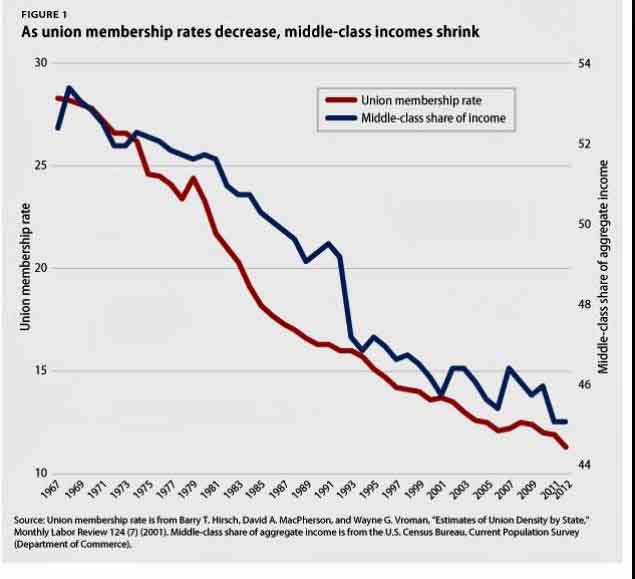
This American Cultural Revolution that is being led by the wealthiest and most powerful Americans has also waged war against labor unions since the 1960s and as union membership rates declined, middle class incomes shrunk.

Union Membership shrinks along with middle class incomes

The Military Times reports that veterans are against “plans to replace VA health care with a voucher system, an idea backed by some Republican lawmakers and presidential candidates.”

The United States was once proud to have an all-volunteer army but that isn’t true anymore. Foreign Policy.com reveals The New Unknown Soldiers of Afghanistan and Iraq and asks, “Did you know that private contractors in Afghanistan outnumber U.S. troops three to one?”

“Indeed, since 9/11, private contractors have been deployed at roughly the same — or even higher — rates as U.S. troops in support of the wars in Iraq and Afghanistan. This is hard to detail, because the U.S. military has never adequately tracked contractor personnel deployed in support of overseas operations, according to various Government Accountability Office (GAO) reports. (To give one highly disturbing anecdote demonstrating this, while in September 2011 the GAO found that the military could not reliably determine the number of contractor personnel that had been killed or wounded in Iraq or Afghanistan, over the same time period, the Pentagon had accurately been tracking the number of combat dogs killed in both countries.)”

What happens when for-profit corporations take over fighting America’s wars, and who do you think will end up doing the fighting?

Lloyd Lofthouse is the award-winning author of My Splendid Concubine [3rd edition]. When you love a Chinese woman, you marry her family and culture too. This is the unique love story Sir Robert Hart did not want the world to discover.

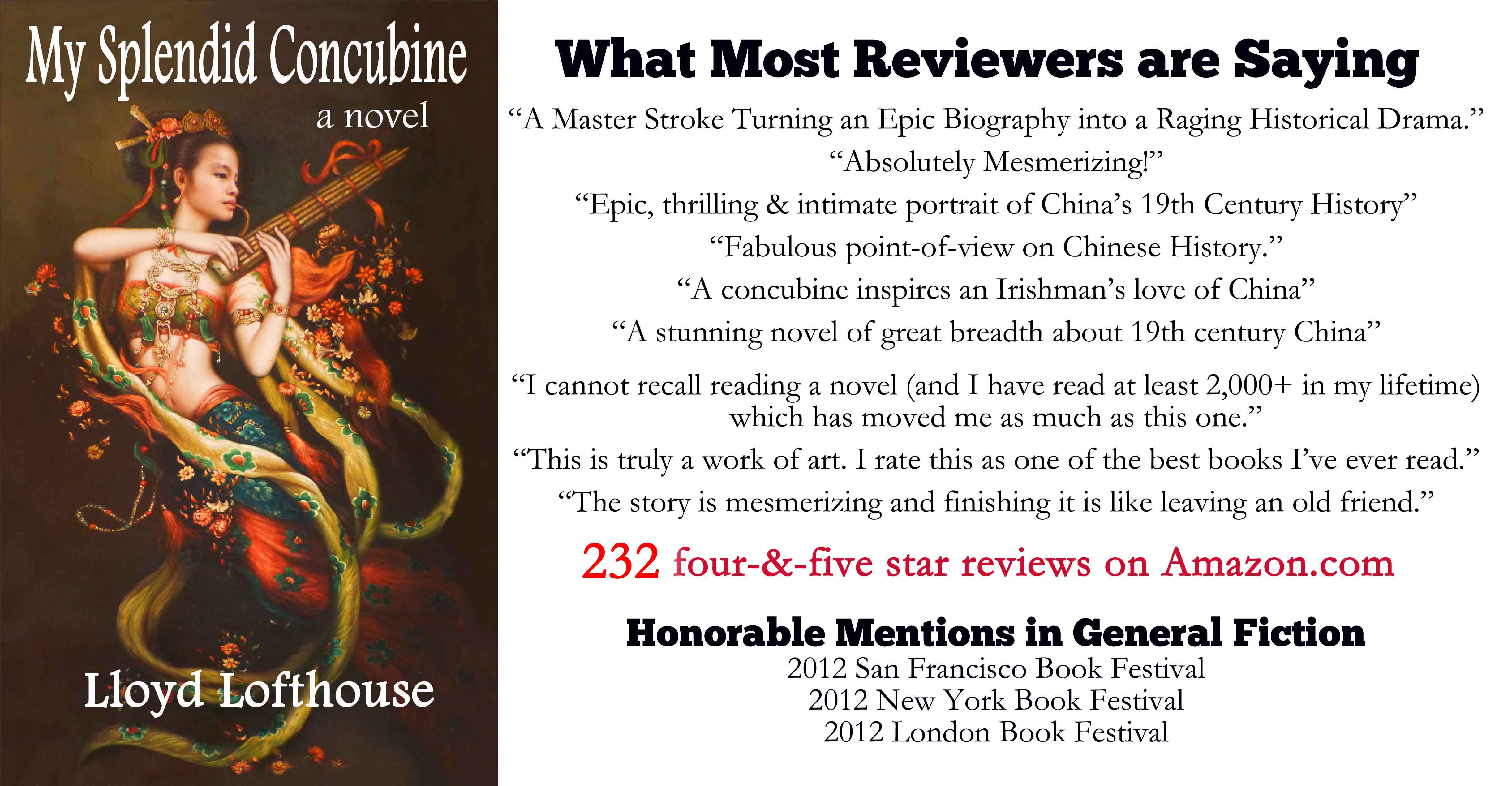
IMAGE with Blurbs and Awards to use on Twitter

Where to Buy

Subscribe to “iLook China”!
Sign up for an E-mail Subscription at the top of this page, or click on the “Following” tab in the WordPress toolbar at the top of the screen.

About iLook China

China’s Holistic Historical Timeline


Is Maoism still alive?

March 19, 2014

Caution—do not confuse Maoists with the Communist Party that currently rules China. Maoism, known as Mao Zedong thought, is a variant of Marxism derived from the teachings of the late Chinese leader Mao Zedong (1893 – 1976). 

Maoism was widely applied as the political and military guiding ideology in the Communist Party between 1949 and 1976, which led to the horrors of the Cultural Revolution.

But according to France 24, a new generation of Maoists in China thinks the CCP has “betrayed their leader’s roots by succumbing to capitalism and world trade.” And these “Maoists are very active on Chinese social networks.”

The Maoists in China want to roll back time to Mao’s Cultural Revolution where pure socialism rules with no capitalism.

After the death of Mao Zedong in 1976, the Communist Party under Deng Xiaoping repudiated revolutionary Maoism and embarked on the path toward a socialist-capitalist economic model that has led to prosperity for several hundred million people in China but more Chinese are not benefiting equally from economic growth in China—at least not as fast as they’d like, which explains why Maoism has not vanished.


China’s last Maoist village

Outside China, Maoism’s Revolutionary Internationalist Movement (RIM) was founded in 1984 and included the Communist Party of Peru (also known as the “Shining Path”).

In addition, there have been Maoist movements in Afghanistan, Bangladesh, Ecuador, India, Nepal, Palestine, Peru, the Philippines, Spain, Somalia, Turkey and even the United States (where poverty is increasing). However, the international Maoist movement doesn’t have a unified, global leadership.

Recently, the Chinese “Maoist” Communist Party thought they had a leader in Bo Xilai. Then in 2012, Bo was connected to a cover up linked to his wife’s involvement in the murder of a British citizen. Bo was tried and sentenced to life imprisonment for bribery, abuse of power and corruption. Bo’s wife, Gu Kailai, was convicted of murder and was given a suspended death sentence. She may spend the rest of her life in prison or get out on a medical parole after serving nine years.

In 2009, the Maoist Communist Party of Nepal formed a coalition government, which collapsed a few months later as different rebel factions fought with each other. The Maoist’s goal was to turn Nepal into a Marxist Republic. (Nepal Assessment 2010)

In India, there is an ongoing Naxalite-Maoist rebellion in Andhra Pradesh but by the end of 2013, the movement was weak and not the threat it had been years earlier. The Maoist influence in India was caused by the lack of progress to end starvation among rural Indians—thousands die daily—who have had no improvement in their lifestyles for decades. (Naxalite-Maoist insurgency)

In the US, the Black Panthers (1967) was a militant Maoist organization.

In Paris in 1968, the National Liberation Front, another Maoist group, was the cause of street combat.

Maoism is caused by too much poverty and suffering when the poor working class rises up in rebellion against the wealthy in an attempt to distribute the wealth more evenly, but historically this has led to brutal dictatorships and then more suffering and death.

Pure socialism hasn’t worked because historically, it’s inefficient, against the competitive nature of humans and leads to shortages and a waste of workers time.

_______________

Lloyd Lofthouse is the award-winning author of My Splendid Concubine [3rd edition]. When you love a Chinese woman, you marry her family and culture too. This is the love story Sir Robert Hart did not want the world to discover.

His latest novel is the multiple-award winning Running with the Enemy.

Subscribe to “iLook China”!
Sign up for an E-mail Subscription at the top of this page, or click on the “Following” tab in the WordPress toolbar at the top of the screen.

About iLook China

China’s Holistic Historical Timeline