The Chinese in America – Part 1/3

June 7, 2011

While reading John Putnam’s guest post of the Chinese during the California Gold Rush, I thought of several other posts I wrote about the Chinese in America.

Putnam wrote, “White miners soon arrived and pushed the Chinese out…”

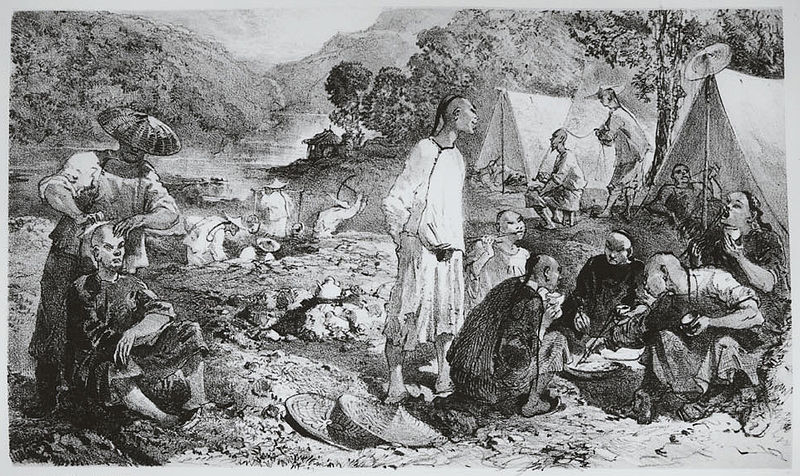
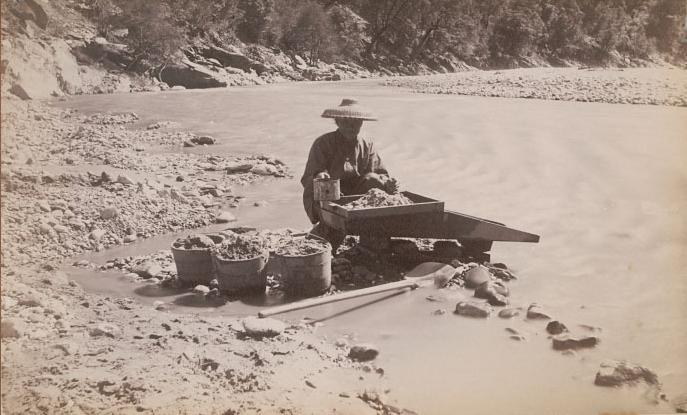
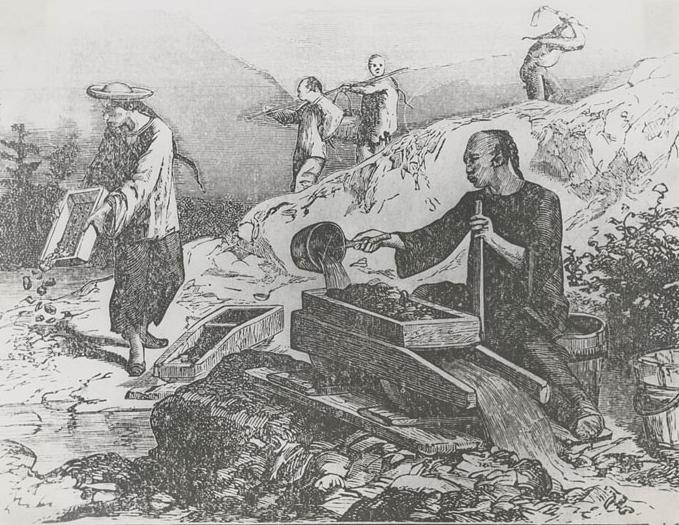
The first major wave of Chinese immigrants came to the US after the California gold rush of 1849.

Then in 1882, The Chinese Exclusion Act formalized an ugly American prejudice. In fact, there are still Americans who feel this way evidenced by a few comments left on this Blog. However, we are fortunate that more Americans appear open minded and accepting than those who do not feel that way.

This act stayed in effect de facto until 1965, when racist provisions of U.S. immigration law were removed during the Civil Rights era, liberalizing immigration by all non-European groups.

Most of these Chinese immigrants worked hard in industries like railroads, mines and canneries. The Chinese were willing to work for lower wages than European immigrants were demanding.

When there were labor strikes, companies often used Chinese workers as strikebreakers. This led to hate among European immigrants and demands that led to the Chinese Exclusion Act, which banned Chinese laborers from entering the US.

This was the first time the US passed a law to bar a specific race or ethnicity from entering the country. Source: Tenement Museum

Continued on June 8, 2011 in The Chinese in America – Part 2

This post first appeared on August 30, 2010 as Discrimination Against the Chinese in America

_______________

Lloyd Lofthouse is the award-winning author of the concubine saga, My Splendid Concubine & Our Hart. When you love a Chinese woman, you marry her family and culture too.

To subscribe to “iLook China”, look for the “Subscribe” button at
the top of the screen in the menu bar, click on it then follow directions.


Chinese in the Gold Rush – Part 2/2

June 6, 2011

Guest post by John Putnam

In the mines the Chinese were often forced to work sites that others had abandoned as no longer productive and, by hard work, made these claims pay.

As more men arrived in the gold fields and the amount of surface gold dwindled, tensions increased. Thirty-five Chinese showed up at Camp Salvado in 1849 where men from El Salvador had worked and here they found rich placer deposits.

White miners soon arrived and pushed the Chinese out, but they were taken in at another nearby site called Camp Washington where still more gold was found

Chinese flocked to a place where they were accepted and Tuolumne County’s Chinese Camp survives to this day.

But by 1850, a $20 per month tax on each foreign miner was imposed.

By 1852 Chinese were forced from Mormon Island and Horseshoe Bar along the American River, then from Colombia in the southern mines and Yuba City in the northern.

In 1856 Chinese paid $70,000 for the right to mine in Mokelumne Hill.

By 1868 almost all Chinese had left the mines to work on the transcontinental railroad or in Chinese operated businesses.

Return to Chinese in the Gold Rush – Part 1

____________________

Reprinted by permission. First published May 23, 2011 in My gold rush tales John Putnam is the author of Hangtown Creek, a thrilling saga of the early California gold rush.

To subscribe to “iLook China”, look for the “Subscribe” button at the top of the screen in the menu bar, click on it then follow directions.


Chinese in the Gold Rush – Part 1/2

June 5, 2011

Guest post by John Putnam

Of all the diverse peoples that poured into California after the discovery of gold, none stood out more than the Chinese. Radically different in dress, language and culture these new men were first welcomed because of their willingness to work hard for low wages at any task presented them.

John McDougall, the 2nd Governor of California, described them as “one of the most worthy of our newly adopted citizens.”

At the start of 1849 only 54 Chinese were in California. By1852 there were nearly 12,000 living here and only seven of them women. Because of turmoil in Canton another 20,000 would arrive that same year.

A community of Chinese Americans quickly grew in San Francisco. They marched in Fourth of July parades and rejoiced at California’s statehood, but celebrated their lunar new year in their traditional way.

In 1852 a Cantonese opera was performed at the American Theater and in 1854 a Chinese language newspaper began publishing.

The Kong Chow Association formed to help the new arrivals adapt to their new home. Then another, the Chew Yick, elected Norman As-sing, an English speaking owner of the Macao and Woosung Restaurant as their leader. Soon there were six associations called tongs that combined to form the Six Companies to better represent Chinese interest.

Continued on June 6, 2011 in Chinese in the Gold Rush – Part 2

____________________

Reprinted by permission. First published May 23, 2011 in My gold rush tales. John Putnam is the author of Hangtown Creek, a thrilling saga of the early California gold rush.

To subscribe to “iLook China”, look for the “Subscribe” button at the top of the screen in the menu bar, click on it then follow directions.


China’s Kung Fu Metamorphosis

May 22, 2011

Last June (2010), Tom Carter wrote five guest posts about Martial Arts in China, and the same month I wrote about a movie, The Karate Kid, starring Jaden Smith and Jackie Chang.

I’ve never been to Wudang Mountain (at last not yet), which is well known for its deep-rooted tradition of wushu (martial arts).

Watching Jackie Chang and Jaden Smith climb that long, narrow stairway reminded me of mountains I’ve climbed that challenged my breath and made my heart pound.

Tom Carter’s guest posts came with a few of the photos that he shot while there.

However, in the March 2011 National Geographic Magazine (NGM), we read of the Battle for the Soul of Kung Fu and discover that as the world and China changes, so does this ancient world of Martial Arts that has been steeped in tradition for millennia.

In Tom Carter’s first guest post on this subject, he wrote, “Located atop the western peak of the sacred Song Shan Mountain in northern Henan province, 800 year-old Shaolin Si has been destroyed and rebuilt time and again, weathering attacks by emperors, warlords, cultural revolutions, and now its most reoccurring invaders – the modern tour group.”

It’s the modern tour group Carter mentions that challenges China’s Kung Fu.

NGM says the city of Dengfeng (population about 600,000), China’s kung fu capital, boasts some 60 martial arts schools and attracts about 50,000 students from all over China.


Shaolin Si

A time line in the NGM piece shows the oldest Chinese reference to martial arts was in the 11th century B.C., more than three thousand years ago, and in 2010, the Shaolin Temple was named a UNESCO World Heritage site.

One element of the philosophy behind Kung Fu was explained by a master, “In each boy, he looks for respectfulness and a willingness to ‘eat bitterness’, learning to welcome hardship, using it to discipline the will and forge character.”

It seems the more things change, the more they stay the same.

______________

Lloyd Lofthouse is the award-winning author of the concubine saga, My Splendid Concubine & Our Hart. When you love a Chinese woman, you marry her family and culture too.

To subscribe to “iLook China”, look for the “Subscribe” button at the top of the screen in the menu bar, click on it then follow directions.


The “Mandate of Heaven’s” Gobal Revelation – Part 2/2

May 15, 2011

Global history shows that not all previous civilizations collapsed at the same time.

After the Western Roman Empire (500 AD) and the Han Dynasty (219 AD) were gone, the Byzantine Empire thrived in the Middle East for almost a thousand years (500 – 1453 AD), while the Tang Dynasty survived until 906 AD and the Yuan Dynasty (the Mongols) to 1368 AD to be replaced by the Ming then Qing Dynasties.

The British Empire survived until 1947 then vanished as an empire as the United States became a global super power after World War II.

However, many people are not aware of The Mandate of Heaven’s cycle, which leads to behavior that repeats the same mistakes that caused the fall of other civilizations.

American style democracy, capitalism, socialism, jet planes, the combustion engine, telephones, electricity, the Internet, and the iPad are not going to save civilization, as we know it today.

The reason for this is that human nature is what causes the downfall of civilizations.

History shows that during the good times at the height of a civilization such as Rome or the Han Dynasty, most people take the quality of life for granted as if it will never end.  Once that happens, the end begins.


The Mandate of Heaven explained on a global scale by Warren Edward Pollock

In the video, Warren Pollack explains how the Communist Party returned China to stability after chaos and anarchy swept China after the fall of the Qing Dynasty. If the Party continues to maintain domestic stability and keep people working, China may survive as the civilization it is becoming for a few centuries before the next collapse.

Since Mao died in 1976, the internal goal of the People’s Republic of China has been domestic stability. With domestic stability, we see China returning to that period in the dynastic cycle where harmony and prosperity rules leading to a period of stability.

To understand what happened in China, I suggest reading The Roots of Madness.

Edward Pollock says, “If China stood as the world’s top country, it would not act like the United States, which has been irresponsible, lazy and greedy and engaged in robbery and cheating. They (US)  have brought economic recession to the whole world.”

If we look to the dynastic cycle as a guide, it would seem that the United States has entered the cycle’s stage of decay moving toward a collapse.

However, with the weapons of mass destruction that America has in its arsenal (more than any other nation even the USSR), could the US, like a drowning man, pull the rest of global civilization down with it?

Return to The Mandate of Heaven’s Global Revelation – Part 1

______________

Lloyd Lofthouse is the award-winning author of the concubine saga, My Splendid Concubine & Our Hart. When you love a Chinese woman, you marry her family and culture too.

To subscribe to iLook China, look for the “Subscribe” button at the top of the screen in the menu bar, click on it then follow directions.