Anna May Wong – the Woman that Died a Thousand Times

February 10, 2012

Almost half a century after her death, Anna May Wong (1905 to 1961) has not been forgotten.

As a child, Anna loved going to the movies and even cut school to go.

Between 1919 and 1961, she acted in 62 films. The Internet Movie Data Base says she was the “first Chinese-American movie star”.

To act, Anna had to play the roles she was given. The Western stereotype cast her as a sneaky, untrustworthy woman that always fell for a Caucasian man. The dark side of achieving her dream of acting in movies was that Anna had to die so the characters she played got what they deserved.

Anna often joked that her tombstone should read, “Here lies the woman who died a thousand times.”

Until Chinese started to emigrate to the U.S. in the mid-19th century, they had never encountered a people who considered them racially and culturally inferior.

However, the discrimination against the Chinese in America was only exceeded by the racism and hatred directed at African-Americans.

In fact, in the 1960s, many of the anti racist laws enacted during the Civil Rights era focused on protecting African-Americans, which created a protected class, and since the Chinese—due to cultural differences often did not complain—they were left behind.

In many respects, this racism toward the Chinese still exists in the US today and manifests itself through the media as China bashing, which supports the old stereotype.

When Anna May Wong visited China in 1936, she had to abandon the trip to her parent’s ancestral village when a mob accused her of disgracing China.

After her return to Hollywood, she was determined to play Chinese characters that were not stereotypes, but it was a losing battle. To escape the hateful racism, she lived in Europe for a few years.

Since U.S. law did not allow her to marry the Caucasian man she loved, and she was afraid that if she married a Chinese man he would force her to give up acting since Chinese culture judged actresses to be the same as prostitutes, she never married.

Anna May Wong smoked and drank too much. She died of a heart attack in Santa Monica, California at age 56.

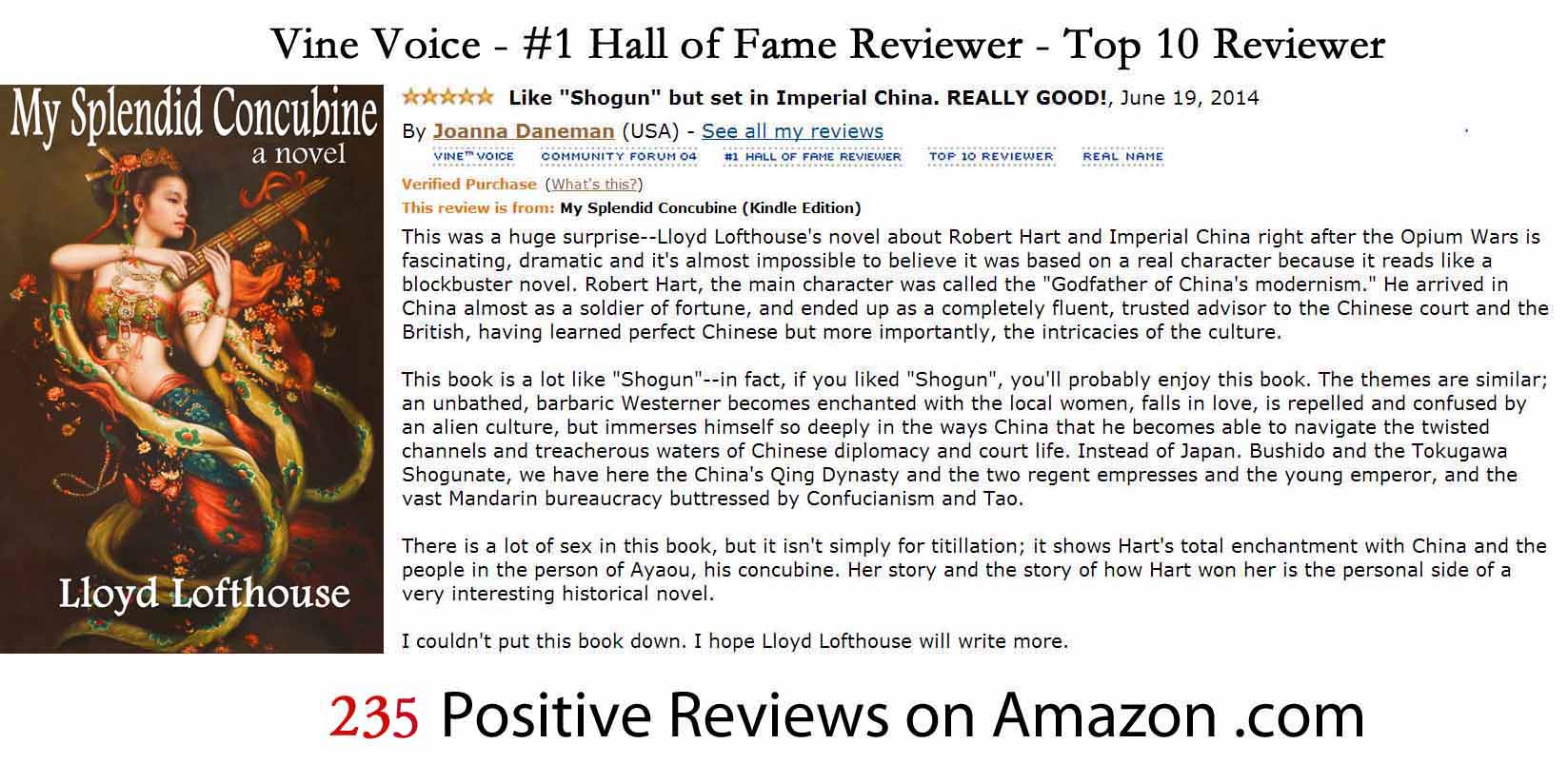
Lloyd Lofthouse is the award-winning author of My Splendid Concubine [3rd edition]. When you love a Chinese woman, you marry her family and culture too. This is the unique love story Sir Robert Hart did not want the world to discover.
1-joanna-daneman-review-updated-sept-21-2016_edited-3

Where to Buy

Subscribe to “iLook China”!
Sign up for an E-mail Subscription at the top of this page, or click on the “Following” tab in the WordPress toolbar at the top of the screen.

About iLook China

China’s Holistic Historical Timeline


China’s Bound-Feet Women

February 7, 2012

According to historical accounts, foot binding appeared in China during the Sung Dynasty (960-1276 AD).

The process of foot binding usually started between the ages of four and seven. Feet were soaked in a blood and herb mixture. Toes were broken. Then the arch was broken. There was extreme pain since no pain relief was used. It is estimated that in a thousand years about two billion women went through the process.


What would you do for beauty?

The Manchu leaders of the Qing Dynasty (1644 to 1911) tried with little success to stop foot binding, and Manchu women did not bind their feet. Mostly Han (the majority in China) women continued the practice.

In 1928, the Nationalist government announced plans to do away with foot binding. This attempt to end foot binding met with mixed success. In rural areas, large feet were still considered unattractive and unacceptable and the practice continued.

While working in China for National Geographic on a three part Marco Polo series, Michael Yamashita, a veteran photographer, went in search of women who had bound feet. He found them living in remote urban villages.

Even in 19th century San Francisco, there were Chinese girls and women with bound feet. Source: Virtual Museum of the City of San Francisco

In most of China, social and sexual customs resist rapid change. For millions of women, the practice would continue until 1949 when the Communists came into power.

Then the popularity of foot binding to enhance a woman’s beauty ended.

______________

Lloyd Lofthouse is the award-winning author of The Concubine Saga. When you love a Chinese woman, you marry her family and culture too. This is the love story Sir Robert Hart did not want the world to discover.

Subscribe to “iLook China”
Sign up for an E-mail Subscription at the top of this page.

About iLook China

Note: This post first appeared November 7, 2010.


Ancient Feminism in China

February 6, 2012

Britannica Concise Encyclopedia says Feminism is a social movement that seeks equal rights for women.

The dates the Britannica throws out are the Enlightenment, a European intellectual movement of the 17th and 18th centuries and the 1848 Seneca Falls Convention, which called for full legal equality with men.

Merriam-Webster’s definition is “the theory of the political, economic, and social equality of the sexes” and “organized activity on behalf of women’s rights and interests.”

In fact, for centuries, Western women had been treated as chattel—the property of men.

After watching the video and reading the entry in Britannica and the definition in Merriam-Webster, it’s obvious that feminism was alive and well in China more than a thousand years ago during the Tang Dynasty.

In fact, Emperor Wu Zetian (625 to 705 AD) was a very early feminist that ruled the Tang Dynasty as an emperor and was China’s only woman emperor.

The Tang Dynasty was a time of relative freedom for women. Women did not bind their feet (for a few more centuries) or lead submissive lives. It was a time in which a number of exceptional women contributed in the areas of culture and politics. Source: Women in World History

Wu Zetian demanded the right of an emperor and kept male concubines. She also challenged Confucian beliefs against rule by women and started a campaign to elevate the position of women.

______________

Lloyd Lofthouse is the award-winning author of The Concubine Saga. When you love a Chinese woman, you marry her family and culture too. This is the love story Sir Robert Hart did not want the world to discover.

Subscribe to “iLook China”
Sign up for an E-mail Subscription at the top of this page.

Note: This post first appeared on November 08, 2010


Tea for Emperors and Tibet – Part 4/5

January 20, 2012

After the “Puer” tea is ready, the journey begins.

For the Pu’erh that I buy, Emperor’s Pu’erh, it leaves Yunnan, reaches China’s coast and then crosses the Pacific to end on a shelf at a Whole Foods Market. However, before that, for centuries, Puer tea traveled to Tibet and China’s capital for the Emperor.


CCTV 9 Travelogue – Tea and Horse Road – Part 1 1/2

Most people have heard of or read about the Silk Road from China to Europe. I’m sure that few have heard of the Ancient Tea Horse Road, which I discovered in the May 2010 issue of National Geographic magazine.


CCTV 9 Travelogue – Tea and Horse Road – Part 1 2/2

Legend says that tea from China arrived in Tibet as early as the Tang Dynasty (618- 906 A.D.). After that, the Chinese traded tea for horses, as many as 25,000 horses annually.


CCTV 9 Travelogue – Tea and Horse Road – Part 2 1/2

But that isn’t what struck me the most about the piece. It’s the example that demonstrated why the peasants loved and possibly worshiped Mao Tse-Tung.


CCTV 9 Travelogue – Tea and Horse Road – Part 2 2/2

For more than a thousand years, men fed their families by carrying hundreds of pounds of tea on their backs across rugged mountains into Lhasa. Some froze to death in blizzards. Others fell to their deaths from the narrow switchbacks that climbed into the clouds.


CCTV 9 Travelogue – Tea and Horse Road – Part 3 1/2

This all ended in 1949 when Mao had a road built to Tibet and farmland was redistributed from the wealthy to the poor. “It was the happiest day of my life,” said Luo Yong Fu, a 92-year-old dressed in a black beret and a blue Mao jacket, whom the author of the National Geographic piece met in the village of Changheba.


CCTV 9 Travelogue – Tea and Horse Road – Part 3 2/2

Before ending the four posts on Puer [Pu’erh] tea and moving on to Kombucha Fermented Tea in Post 5, Numi Organic tea, Emperor’s Pu’erh, the one I buy at Whole Foods, says, “These old-growth rare Pu’erh trees are communally owned by the local villagers who pick them for their livelihood, ensuring that they continue to grow for generations to come… Pu’erh is an ancient healing tea picked from 500-year-old organic wild tea trees in Yunnan, China. Pu’erh has more antioxidant than most green teas.”

Continued on January 21, 2012 in Tea for Emperors and Tibet – Kombucha Fermented Tea – Part 5 or return to Part 3

______________

Lloyd Lofthouse is the award-winning author of The Concubine Saga. When you love a Chinese woman, you marry her family and culture too. This is the love story Sir Robert Hart did not want the world to discover.

Subscribe to “iLook China”
Sign up for an E-mail Subscription at the top of this page.

About iLook China

Note: This five-part series of posts on “Tea for Emperors and Tibet” first appeared May 2010, as The Magic of “Puer” Tea, The Tea Horse Road, and Kambucha Fermented Tea.


Tea for Emperors and Tibet – Part 3/5

January 19, 2012

The fermentation of “Puer” tea demands a perfect mix of water, moisture and air. This provides the conditions for the development of microbes and the necessary fermentation.

The fermentation of broad leaf “Puer” tea produces a substance called theaflavin often called the soft-gold of tea.

Clinical experiments show that theaflavin reduces blood fat and cardiovascular disease among other benefits.

In animal experiments, the mice fed theaflavin had their blood fat reduced by 30% compared to the control group’s 10% blood fat reduction.


Chinese Puer tea – Part 3/3

Due to the process of producing “Puer”, the tea may be stored as long as a century without losing its flavor or health enhancing benefits.

The 110 days of fermentation for “Puer” is important to achieve the best flavor and enhanced, health benefits—the time must not be shortened. The temperature and humidity must also be stable and many warehouses are built partially underground to achieve this.

I’ll bet you didn’t know much about the process the tea you may be drinking went through before filling your cup. The process to produce Puer tea represents almost two thousand years of China’s tea culture.

“Puer” got its name because it used to be sold in a town by the same name.

Continued on January 20, 2012 in Tea for Emperors and Tibet – Part 4 or return to Part 2

______________

Lloyd Lofthouse is the award-winning author of The Concubine Saga. When you love a Chinese woman, you marry her family and culture too. This is the love story Sir Robert Hart did not want the world to discover.

Subscribe to “iLook China”
Sign up for an E-mail Subscription at the top of this page.

About iLook China

Note: This five-part series of posts on “Tea for Emperors and Tibet” first appeared May 2010, as The Magic of “Puer” Tea, The Tea Horse Road, and Kambucha Fermented Tea.