While I was reading the reviews on Amazon of the memoir Mulberry Child, I thought that many critics in the West that crucify the Chinese Communist Party due to Mao’s Cultural Revolution (1966 – 1976) seldom mention similar suffering that is happening somewhere else in the world every day.
For example, in India, between 6,000 to 13,000 children die of starvation daily (depending on the source/study you read). Tens of millions have died of starvation and malnutrition since India became a democracy in 1947—constantly repeating a history of suffering generation after generation.
In fact, Mao’s Cultural Revolution is now history as slavery in the United States was (past tense—slavery has returned) history due to the bloody American Civil War (1861 – 1865) and the Civil Rights Movement in the US (1955 – 1968). Parents should learn from the mistakes of history and teach the children so they may avoid making the same mistakes.
Jian started writing the “Mulberry Child” memoir in the year 2000 when her daughter Lisa was still a teenager. The reason she wrote the memoir was because she was having difficulty communicating with her daughter and did not want her to forget where she came from (Lisa was born in China and came to the US at age four years six months). It took eight years for Jian to finish the memoir due to her demanding work schedule.
The memoir focuses on the past but the documentary focuses on the present—the relationship between a mother and daughter.
At first, when the documentary of the “Mulberry Child” went into production, Lisa, the daughter, resisted getting involved. Today, she is proud that she was part of the process, and she is still discovering what her Chinese heritage means.
However—it is obvious from watching the YouTube interview (above)—Lisa is more of an American member of the “Sex and the City” generation than she is a Chinese immigrant to the US.
Therefore, it is the duty of mothers/parents that love their children—that do not want them to repeat the mistakes of the past—to take them on this journey of discovery that Jian Ping took her daughter Lisa on.
Once the next generation forgets the suffering of the past, history may repeat itself.
Lloyd Lofthouse is the award-winning author of The Concubine Saga. When you love a Chinese woman, you marry her family and culture too. This is the love story Sir Robert Hart did not want the world to discover.
Subscribe to “iLook China”!
Sign up for an E-mail Subscription at the top of this page, or click on the “Following” tab in the WordPress toolbar at the top of the screen.
Over at CNN World, Stephen S. Roach wrote a post about America’s renminbi fixation. Many of the comments that responded to the post were obviously from Internet Trolls that lack the skills for an intellectually reasoned response. Instead, the trolls resort to logical fallacies to divert attention away from Roach’s message (I left a comment and a few replies too).
While many in the West have predicted for about three decades that China is going to have a hard landing after an economic bubble of some sort bursts, it hasn’t happened yet.
I Reblogged Roach’s piece and you may reach it by scrolling down or clicking on this iLook China link.
To research this post I Googled “financial crisis in China since 1980” and found no results that answered what I was looking for.
However, I found this at Princeton.edu, which said, “It is now just over twenty years after China initiated its economic reform in 1978. Since then the average rate of growth of GDP has been a phenomenal 9.5 percent per year. This essay reviews the reform process, discusses the impact of the current Asian financial crisis and attempts to assess the prospects of China’s economy in the future…
“In summary China’s reform process has been an experimental and gradual process. It was to be continued before the Asian financial crisis (1997). State-enterprise reform, financial reform and the opening of the Chinese economy have all been affected by the crisis, but there is no question that as soon as conditions allow the reform process will continue, incorporating the lessons learned from the crisis…
“In conclusion, economic reforms in China are likely to continue in the manner and directions as described above. Because of the strong fundamentals of China’s economy as demonstrated by its good performance during the financial crisis substantial growth will continue perhaps for another decade after the current crisis.”
The Harvard study said, “As the first paper employing this data, our aim is to illustrate some of the broad insights that can be gleaned from such a sweeping historical database. We find that serial default is a nearly universal phenomenon as countries struggle to transform themselves from emerging markets to advanced economies. Major default episodes are typically spaced some years (or decades) apart, creating an illusion that “this time is different” among policymakers and investors. A recent example of the “this time is different” syndrome is the false belief that domestic debt is a novel feature of the modern financial landscape. We also confirm that crises frequently emanate from the financial centers with transmission through interest rate shocks and commodity price collapses…
“The ability of governments and investors to delude themselves, giving rise to periodic bouts of euphoria that usually end in tears, seems to have remained a constant.”
Since not much time has passed since China’s economic reforms in 1978, we will look at the United States for examples.
The current total US deficit (national debt) as of today is more than $15.5 trillion and the average credit card debt per household based on 609.8 million credit cards held by US consumers is almost $16,000.
However, “Chinese households save a large share of their disposable incomes and their average saving rate has increased over the last decade and a half. This pattern is particularly pronounced for urban households, which account for about two-thirds of national income. After remaining relatively flat during the early 1990s, the average saving rate of urban households relative to their disposable incomes rose from 18% in 1995 to nearly 29% in 2009.”
In addition, if we study “Panics, Depressions and Economic Crisis Prior to 1930 in the United States”, we discover that “Those most disastrous have usually followed general injudicious speculation in lands or inflated securities. The crisis of 1816-1819 in the United States, it is claimed was due to the speculation and disorder following the War of 1812. The next occurred in 1825. A very memorable panic was that of 1837.” Source: The History Box.com
Akorra.com lists the Top 10 Worst Financial Crisis in U.S. History starting with the Crash of 1929/Great Depression; our current and continuing Mortgage Crisis of 2007; the Panic of 1893; The Banker’s Panic of 1907; the Panic of 1873; the Panic of 1819; the 2001-2002 Recession (known as the dotcom bubble that wiped out $5 trillion in market value of technology companies); the Kennedy Slide in 1962 which caused a 22.5% drop in the S&P 500; the Panic of 1837, and The Oil Crises of 1973.
In addition, there have also been recessions in 1937, which followed the Great Depression (1929 – 1933); 1945, 1949, 1953, 1958, 1960-61, 1969-70, and 1973-75.
As for China, the predictions of an economic crises/crash keep coming as if they were being manufactured on an assembly line — but one hasn’t arrived yet and it has been 34 years since China’s 1978 economic reforms, while for the same period in the US there have been several economic recessions running from January – July 1980; July 1981 – November 1982; July 1990 – 1991; March -November 2001, and December 2007 – June 2009.
When an economic crises does appear in China (the odds favor that it will), it may be part of a global universal phenomenon as the Princeton and Harvard studies reveal, so it is a good bet that sooner or later China’s economic critics will be able to step up on their soap boxes and crow, “I told you so (a hundred times over the last several decades that it would happen one day)!”
I suggest watching the two videos with this post to learn about manufactured financial panics in the United States, which leads to a question: Is the American fixation on China’s currency manufactured too?
______________
Lloyd Lofthouse is the award-winning author of The Concubine Saga. When you love a Chinese woman, you marry her family and culture too. This is the love story Sir Robert Hart did not want the world to discover.
Subscribe to “iLook China”!
Sign up for an E-mail Subscription at the top of this page, or click on the “Following” tab in the WordPress toolbar at the top of the screen.
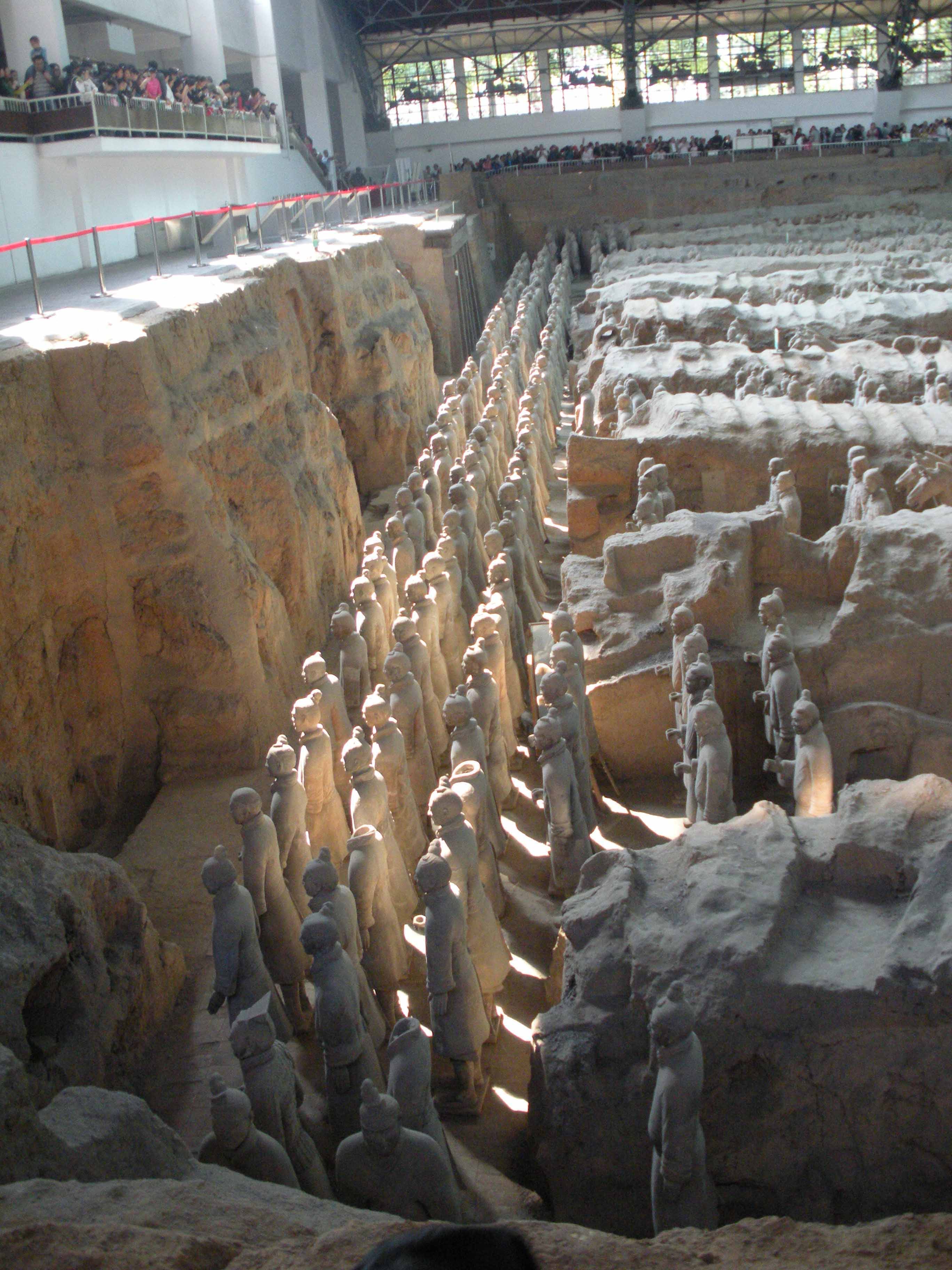
We are taking a quick trip to Xian (in pictures that is). Xian was China’s ancient capital for more than a thousand years before being moved to Beijing.
After landing in Xian in 2008, (our third visit to the city since 1999) we found a great driver. He was honest and knowledgeable. Here’s the cell phone number he had at the time (136-0916-251). If you visit Xian, I recommend you book him for the entire stay. He also introduced us to some experiences we’d never had on previous trips.
The Famous Terra Cotta warriors were created to guard China’s first emperor Qin Shi Huangdi (221-204 B.C.). Qin Shi Huangdi made Xian China’s first capital until Kublai Khan moved the capital to Beijing where he ruled his Khanbalik Empire, from 1264 to 1267.
Xian was known as Chang’an before the Ming Dynasty and is one of the four great ancient capitals of China having held that distinction under several of the most important dynasties in China’s history. In fact, Xian was a cultural center more than a thousand years before Jesus Christ was born.
______________
Lloyd Lofthouse is the award-winning author of The Concubine Saga. When you love a Chinese woman, you marry her family and culture too. This is the love story Sir Robert Hart did not want the world to discover.
Subscribe to “iLook China” Sign up for an E-mail Subscription at the top of this page.
From Laura Rozen, who writes a Blog for Yahoo News called The Envoy, we learn that Xi Jinping is 58 years old and is no stranger to the United States.
Rozen says, “His daughter and only child attends Harvard University (under a pseudonym). He himself famously visited Muscatine, Iowa (his current trip will be a repeat visit) in the 1980s when he was a provincial Chinese official trying to promote U.S.-Chinese agriculture ties.
“The son of a Chinese Communist revolutionary general and war hero who was jailed for a time after a falling-out with Chairman Mao, Xi is described as a workaholic pragmatist with a reputation for clean living and (rare among Chinese party bosses) for his anti-corruption practices.”
On February 15, 2012, a staff reporter for Want China Times.com said, “China’s vice president, Xi Jinping, was interviewed by the Washington Post… he answered six questions but declined to talk about his father, Xi Zhongxun, saying the subject was simply too sensitive, according to the Hong Kong-based Ming Pao… Xi Zhongxun was persecuted by Mao Zedong’s right-hand man, Kang Sheng. He was investigated and put in prison for almost 16 years. After Xi was rehabilitated under Deng Xiaoping, he played an important role in China’s economic reforms.”
In addition, Xi Jinping is married to one of China’s most famous singers, patriotic folk singer Peng Liyuan.
The Daily Beast says, “Xi began pursuing Peng in the ’80s, after his previous marriage ended in divorce. Reportedly, Peng’s parents initially weren’t crazy about the match because of Xi’s label as a ‘princeling’… Undaunted, Xi continued his courtship, eventually winning over both Peng and her family.”
In 2011, his wife, Peng Liyuan was appointed as a goodwill ambassador for the World Health Organization.
Rozen says, “Xi reportedly lived in a cave for almost seven years and did hard labor as a young man after his father’s political troubles, and had to apply eight times before being accepted into the Chinese Communist Party.”
China’s vice president since 2008, Xi is expected to become general secretary of China’s Communist Party this fall, and to formally succeed Hu Jintao as China’s president next year. But the succession plan is not absolutely certain, officials caution.
“In fairness, Xi is not yet the number 1 official in China, …. and there’s still a long runway before take-off ahead of him…’
Chinese Leaders.org says, “an unnamed professor who was a childhood friend of Xi reportedly said Xi was drawn to Buddhism during his early career, and had a ‘seeming belief in supernatural forces’. The professor added that Xi was incorruptible by money, did not drink or take drugs and women felt he was ‘boring’.”
Lee Kuan Yew of Singapore was quoted in Time magazine saying, “I would put him in the Nelson Mandela class of persons. A person with enormous emotional stability who does not allow his personal misfortunes or sufferings to affect his judgment. In other words, he is impressive.”
Lloyd Lofthouse is the award-winning author of The Concubine Saga. When you love a Chinese woman, you marry her family and culture too. This is the love story Sir Robert Hart did not want the world to discover.
Subscribe to “iLook China” Sign up for an E-mail Subscription at the top of this page.
China is a land of many spoken languages and one written language. In fact, Chinese movies often have subtitles flowing across the bottom of the screen in Mandarin for the hundreds of millions of Chinese that do not speak Mandarin but only read it. To understand how complex this mix of languages is, Mandarin by itself has more than 50 dialects and there are 56 different minority languages.
I suggest you see Wikipedia’s list of Chinese dialects and languages for a better understanding of how complex China is and how amazing it is that this nation has been a unified country for more than two millennia.
After Wen Jiaboa’s speech, I read the media translations in English from several sources and had no idea that in his speech he quoted original poetry dating back to one of ancient China’s greatest and earliest recognized poets, Ch’u Yu (343 – 289 BC). Since Wen’s speech, the micro-Blog debate and criticism in China have been intense, which demonstrates that in China, expressing an opinion is not forbidden.
How would Americans react if an American President gave his State of the Union address laced with quotes from Latin or Old English?
In Latin, The Lord’s Prayer starts, “PATER noster, qui es in caelis, sanctificetur nomen tuum.” In Old English, it starts with, “Fæder ure þu þe eart on heofonum…”
In China, the response to Wen Jiabao’s use of an ancient and dead Chinese language mostly focused on the translator, Miss Zhang Lu (in Chinese the last name comes first, which emphasized the importance of the family over the individual and demonstrates a major difference between the West and Asia). Zhang majored in international law and graduated from China’s Institute of Diplomacy. She then became a translator for top ranking Chinese Communist Party officials.
Zhang was praised by many for translating Wen Jiabao’s “I’d not regret dying nine times,” to “For the ideal that I hold dear to my heart, I’d not regret dying a thousand times.”
I printed 14 pages of comments from a Chinese language micro Blog that was part of the national debate, which started with comments by Chinese professors from different universities in China including Fudan University, Tsinghua University and Shanghai’s Foreign Language Institute correcting and offering suggestions for Miss Zhang’s translation.
Sexy Beijing: Lost in Translation
I’m going to focus on one example of one of the ancient Chinese poems Wen Jiabao quoted when he said, “知我罪我,其惟春秋”, which in proper English translates into “History will judge what I have done.”
Miss Zhang’s translation said, “There are people who will appreciate what I have done but there are also people who will criticize me. Ultimately, history will have the final say.”
One professor’s suggested translation said, “What I have done may be appreciated and criticized by the people, yet ultimately history will give me a fair assessment (or judgment).”
In addition, here are several typical comments from the same micro Blog:
Comment A
What’s wrong with Premier Wen acting like he was competing in a poetry contest? He ought to earn credit for doing a good job managing the country, not to impress with his skill of reciting ancient Chinese poetry.
Comment B
It goes to show how difficult it is to be a leader of Chinese today. Wen should not be criticized for incorporating in his speech a couple of lines from ancient poems. Americans didn’t criticize their President W. Bush for saying things that didn’t make sense or made the wrong sense. Instead, they thought him cool and a “man of his-true-self”.
Comment C
For Heaven’s sake Wen represents the face of China. Americans don’t have trouble with Obama’s talent in speaking beautifully. Instead of ridiculing, they appreciated him.
Comment D
Oh, come on, don’t be so naive. Every question at Wen’s last press conference was pre-selected. Premier Wen must have communicated with his translator prior to show-time. He would never risk the young translator’s misunderstanding or misinterpreting his use of ancient poems.
___________________________
In conclusion, the alleged reason Premier Wen Jiabao used passages from ancient Chinese poems may have been to not only demonstrate the beauty of the Chinese language and his knowledge of it, but to infer that China does not need to bend to the rest of the world and do things as a foreign leader might do but as a Chinese leader.
In fact, it is Chinese tradition for scholars and government officials in China to quote ancient poetry and literature in speeches. In addition, the beauty of language is valued highly in China. The use of spoken and written language to many Chinese is not just getting a meaning or emotion across, it is also considered a form of art.
Meanwhile, in the West/America, we read an English translation of his speech, which is a translation of a translation and walk away thinking we know what one of China’s leaders meant, which brings me to a final question.
What happens when there is a mistake in translation during sensitive political negotiations between countries such as China and America?
______________
Lloyd Lofthouse is the award-winning author of The Concubine Saga. When you love a Chinese woman, you marry her family and culture too. This is the love story Sir Robert Hart did not want the world to discover.
Subscribe to “iLook China”!
Sign up for an E-mail Subscription at the top of this page, or click on the “Following” tab in the WordPress toolbar at the top of the screen.


 Posted by Lloyd Lofthouse

 iLook China