The COVID-19 Warning

May 6, 2020

If it is possible to learn from history, the world may be fortunate that the stability of Chinese civilization for several thousand years left behind a well-documented historical record.

In 2017, Scientific American reported, “Records from Ancient China reveal link between Epidemics and Climate Change. By analyzing Chinese records throughout nearly 2,000 years of history, researchers have found that climate-driven disturbances like floods, droughts and locust outbreaks were associated with disease epidemics. …

“The new research underscores the idea that climatic changes may affect human health in a variety of ways. Present-day concerns about climate change and infection often focus on the potential of higher temperatures to facilitate the spread of disease vectors, like mosquitoes.”

Contagion Live reports on The Ripple Effect of Climate Change on Epidemic Risk. “Increases in extreme weather events, as predicted by climate scientists, may also lead to increases in infectious disease outbreaks. Epidemics have previously been seen in the wake of natural disasters, which can lead to displaced and crowded populations, hotbeds for infection transmission. Severe rainfall or flooding is particularly effective at creating environments suitable for the transmission and propagation of infectious diseases such as measles or cholera. Conditions, as currently seen on the devastated island of Puerto Rico, are often more amenable for mosquitoes to breed in flood-affected regions and as a result, may increase disease risk in those areas.”

What did China learn over the centuries?

The Journal of Biosafety and Biosecurity reports, “Since ancient times, China has acquired a rich experience in both the prevention and cure of infectious diseases. As early as in the Warring States period (475 BC – 221 BC), China began to develop theories on epidemic diseases. In the Qin Dynasty (221 BC – 206 BC), an integrated response system, including prevention, diagnosis, and isolation, was established.

“Later, during the Han Dynasty (206BC – 220 AD), people began to pay attention to the control of infection sources. Whereas, vaccination methods were created in the Song Dynasty (960 – 1270 AD, composed by the Northern Song Dynasty and Southern Song Dynasty), they were popularized throughout the Ming (1368 – 1644 AD) and Qing (1644 – 1912) Dynasties.

“However, at that time, China had not established a biosafety prevention system based on modern microbiological studies on infectious diseases, lacking a comprehensive scientific understanding of them. It was in the middle and late Qing Dynasty, with the arrival of missionaries and the return of overseas students, that advanced western science and technology were introduced into China, allowing the implementation of scientific infectious disease prevention and control measures and giving rise to modern biosafety means.”

For modern civilization to survive, the world’s leaders must cooperate, and that includes the United States. However, current President Donald Trump is always looking for someone else to blame. For sure, Donald Trump is not a role model for how to survive a pandemic. That is not how to survive climate change and the epidemics to come. COVID-19 might be just the beginning. Are you ready? 

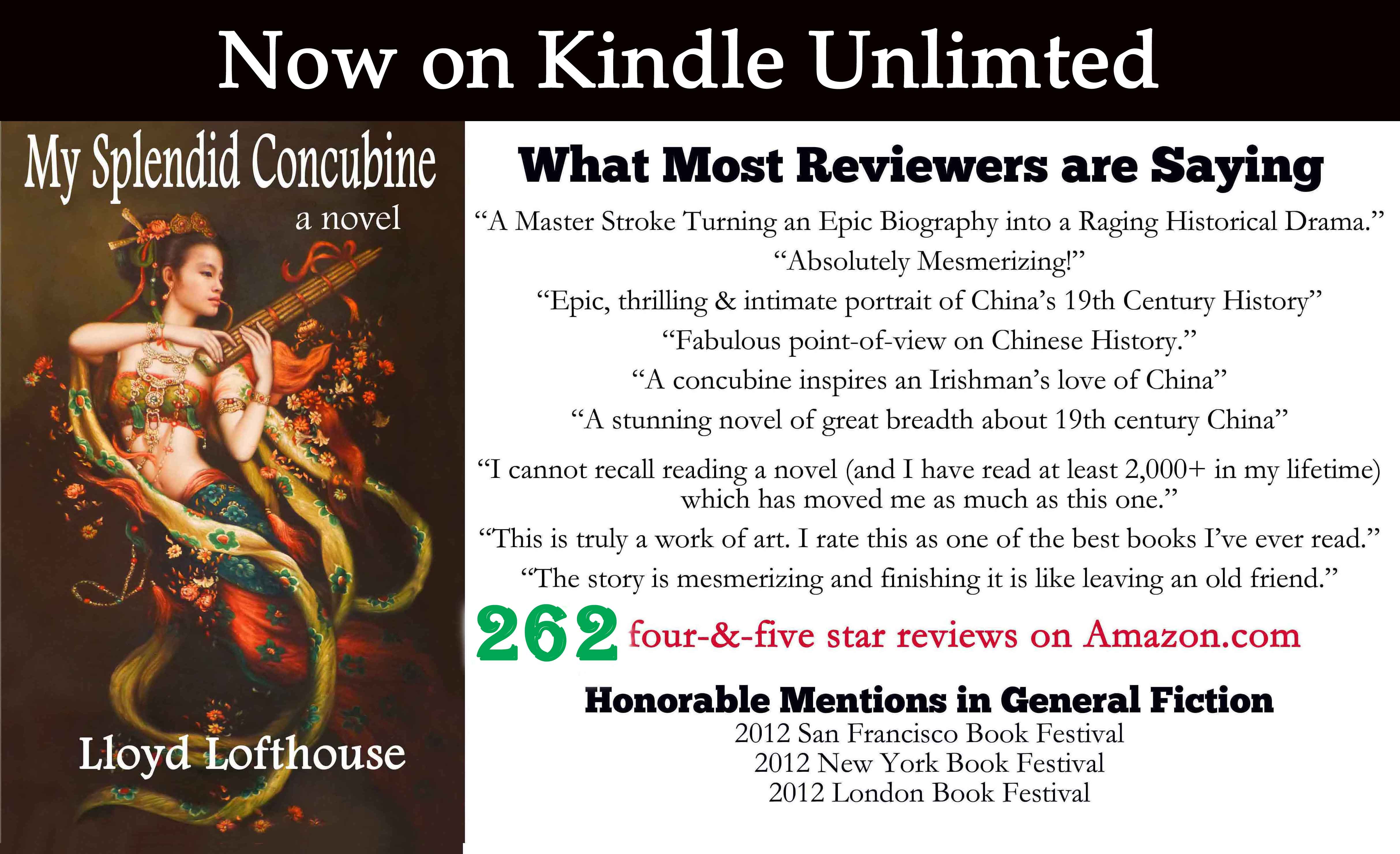
Lloyd Lofthouse is the award-winning author of My Splendid Concubine, Crazy is Normal, Running with the Enemy, and The Redemption of Don Juan Casanova.
Where to Buy

About iLook China


Who was the Real Anna May Wong?

April 22, 2020

Anna May Wong was born an American citizen on January 3, 1905, and died February 3, 1961. She was the first Chinese-American movie star and the first Asian-American actress to gain international fame.

On March 1, 2003, Bill Moyers reported, Anna was American-born, confident in ways her father’s generation could never be, still she lived suspended between two countries, starting with how people saw her.

“Americans regard [us] as a dark, mysterious race,” Anna May once said, “impossible to understand. Why is it that the screen Chinese is always the villain? And so crude a villain — murderous, treacherous, a snake in the grass. I was so tired of the parts I had to play.”

In fact, because if the films she appeared in, she became known as The Woman that Died a Thousand Times.

By the time she was 32, and an established Hollywood star, in August 1937, Japan invaded Shanghai. Anna’s younger sister was living there at the time and managed to escape, but their family couldn’t get out. In 1938, Anna managed to get her family back in the United States. Then she started working with Chinatown communities to get rid of the Chinese Exclusion Act.

Five years later in 1943, this racist legislation that targeted Chinese was repealed.

The Exclusion Act (1882 – 1943) made it virtually impossible for Chinese to have a normal family life inside the United States. The Exclusion law applied to Chinese laborers. It exempted merchants, travelers and students. What this meant to the Chinese who could not become a merchant, and what it meant was not a student or a traveler what it meant was that he could not bring his wife. – Stanford Lyman (Historian)

As a young girl, Anna skipped school to watch silent films at local theaters. By the time she was 9, she had set a goal to become a movie star.  She hung around the studios, including MGM, asking for extra work instead of going to school. Eventually, she landed some rolls. At 17, it’s rumored that she had an affair with an older but married director.

In 1924, at 19, Anna had her first success when she played a Mongol slave in the classic film “The Thief of Bagdad” cast alongside Douglas Fairbanks.

According to Cal Van Vechten’s daughter, Anna May had a brief affair with co-star Vincent Price. – Anna May Wong: From Laundryman’s Daughter to Hollywood Legend, page 164. While acting on stage in Turandot, she also had a brief affair with her costar. – Vincent Price: A Daughter’s Biography, page 77.

The first Chinese film star in Hollywood, the rolls she could play were limited. The Hays Code did not permit the portrayal of interracial relationships on-screen. However, Anna’s rumored lovers, from Vincent Price to Marlene Dietrich, were white, and Douglas Fairbanks called her the “Chink in my amour”. Her most famous movies were denounced as “ghost films” and banned in China. – The Fortunes by Peter Ho Davies.

Lloyd Lofthouse is the award-winning author of My Splendid Concubine, Crazy is Normal, Running with the Enemy, and The Redemption of Don Juan Casanova.

Where to Buy

About iLook China


The Moral Failings of Donald Trump according to Confucius

April 15, 2020

Simon Worrall, writing in National Geographic Magazine said Confucius “was hailed after his death as ‘The Uncrowned King,’ a philosopher whose sound bites of wisdom became China’s handbook on government and its code of personal morality for thousands of years.”

Confucius believed that every person had their place in society, and his philosophy turned Ancient China into a structured society with the longest continuous history of any country in the world–3,500 years of written history. Source: American Historical Association

More than twenty-four hundred years ago, Confucius dedicated his life to the moral training of his culture. He lived during the Warring States period before China was unified. Living with all of that violence and death, he dreamed of a land where people could live happily and harmoniously together.

Does that mean China enjoys dignity without democracy while the United States has democracy without dignity?

Confucius provides the answer In Analects 16.7, “The gentleman has three things to be cautious about: In his youth, when his blood and energy are not yet settled, he must be cautious about sex. In his middle years, when his blood and energy are just strong, he must be cautious about fighting. In his old age, when his blood and energy are already weak, he must be cautious about greed.”

The Conversation says, “Trump seems to embody all three types of recklessness identified by Confucius.

“His behavior towards women has been roundly condemned; his warmongering words regarding North Korea provoked fear and consternation around the world; he unashamedly made his lust for wealth and power into the basis of his media personality.”

Why do these moral failings matter?

“Because democracy needs dignity if it is not to descend into disorder. That doesn’t mean (America’s) leaders have to abide by some impossible standard of personal moral purity; after all, they are only human.”

However, if we judge Donald Trump by Confucian standards, Trump is now America’s most irredeemable leader and is beyond redemption. It doesn’t matter of Trump wins or loses the election in November 2020, he will always be considered hopeless by future historians.

Lloyd Lofthouse is the award-winning author of My Splendid Concubine, Crazy is Normal, Running with the Enemy, and The Redemption of Don Juan Casanova.

Where to Buy

About iLook China


China’s Wild Elephants

April 8, 2020

According to 2017’s Great Elephant Census, there are, “352,271 African savanna elephants in 18 countries, down 30% in seven years.”

The BBC reports, “There are around 40,000-50,000 elephants left in Asia, and like African elephants they are listed as endangered on the IUCN Red List. The number of Asian elephants has declined by at least 50% in the last three generations. … on 1 January 2018, China banned domestic ivory trade – a historic move shutting down the world’s biggest legal ivory market. A number of other countries, including the UK and Thailand, have also begun taking steps to try and ban the sale of ivory.”

However, while other wild elephants population in the world are down, China is the only country where numbers are on the rise, but don’t celebrate yet. There are only 200 – 250 wild elephants in China.


“In the past 20 years, the number of Asian elephants in southwest China’s Yunnan Province has more than doubled when elephant populations all over the world are decreasing and under threat. China’s conservation efforts are seen as an international wildlife and environmental success story.”

Eleaid.com says, “China’s elephants are only found in the extreme south of the Yunnan province, bordering Burma and Laos. Their range includes Xishuangbanna (XSNB) and the Nangunhe Nature Reserves.

“The elephant is a protected species in China and the government has taken steps to conserve areas of elephant habitat including moving people out of the reserves in a bid to minimize human-elephant conflict.

“Chinese officials have reported that the population is growing through both reproduction and immigration of herds from Laos. This is attributable to the lack of a threat from poachers in China and the abundant availability of fodder. …”

The existence of elephants in ancient China appears in both archaeological evidence and in Chinese artwork. Long thought to belong to an extinct subspecies of Asian elephants, … they lived in Central and Southern China before the 14th century BC, more than 3,000 years ago. Elephants ranged as far north as Anyang, Henan in northern China.

Today, tourists may see wild elephants in Gajah Liar Valley. “There are wooden houses built in tall trees that offer a safe place to watch. — China Travel.com

Lloyd Lofthouse is the award-winning author of My Splendid Concubine, Crazy is Normal, Running with the Enemy, and The Redemption of Don Juan Casanova.

Where to Buy

About iLook China


Who Deserves Credit for the First Vaccine?

April 1, 2020

Worst Pandemics in History reports that “25 million died from Bubonic Plague in 541-542 AD, and 75-200 million died from the Black Death in 1346-1353.” … The next huge death toll from a pandemic equal to the first two was Influenza in 1918 killing “20 – 50 million people.”

Because of these earlier pandemics, eventually, the first successful vaccines were created, and as the COVID-19 pandemic continues to spread around the world, a global race is on to create a vaccine to protect us from this one, too.

While Edward Jenner, an English physician, developed the first successful smallpox vaccine in 1796, did you know that he wasn’t the first one to inoculate for a viral disease?

The history of vaccinations started centuries before Jenner was born.

“Several accounts from the 1500s describe smallpox inoculation as practiced in China and India (one is referred to in volume 6 of Joseph Needham’s Science and Civilisation in China). Glynn and Glynn, in The Life and Death of Smallpox, note that in the late 1600s Emperor K’ang Hsi, who had survived smallpox as a child, had his children inoculated. That method involved grinding up smallpox scabs and blowing the matter into nostril. Inoculation may also have been practiced by scratching matter from a smallpox sore into the skin. It is difficult to pinpoint when the practice began, as some sources claim dates as early as 200 BCE.” — History of Vaccines.org

However, Britannica.com tells us “China has one of the world’s oldest medical systems. Acupuncture and Chinese herbal remedies date back at least 2,200 years, although the earliest known written record of Chinese medicine is the Huangdi neijing (The Yellow Emperor’s Inner Classic) from the 3rd century bce.”

“Newly discovered documents reveal that 2,200 years ago, Qin Shi Huangdi, China’s first emperor, put out an executive order to search for a potion that would give him eternal live.” — Live Science.com

Is it possible that the first emperor of China’s search for immorality might have also led to those alleged early inoculation attempts as early as 200 BCE? After all, the same desperate search by Huangdi’s alchemists accidently led to the discovery of gunpowder.

Lloyd Lofthouse is the award-winning author of My Splendid Concubine, Crazy is Normal, Running with the Enemy, and The Redemption of Don Juan Casanova.

Where to Buy

About iLook China