Sun Yat-sen’s Republic in China: Part 3 of 4

April 14, 2016

Hawaii was not a democracy modeled after today’s United States when Sun Yat-sen lived there from age 13 to 17 [1879 – 1883].

In fact, when Sun Yat-sen lived in Hawaii, it was a kingdom ruled by a king and was a Constitutional Monarchy similar to but not the same as Great Britain.

It wouldn’t be until 1887, that the Hawaiian King Kalākaua was forced to sign the 1887 Constitution of the Kingdom of Hawaii—four years after Sun Yat-sen had returned to China—that stripped the king of any authority he had turning him into a figurehead.

In addition, there was a property qualification in 1887’s Hawaiian Constitution for voting rights similar to what the Founding Fathers wrote into the U.S. Constitution in 1776, and resident whites in Hawaii, who owned property, since Asians were not allowed to own property or could not afford to buy it, were the only ones allowed to vote.

Meanwhile, the American Chinese Exclusion Act of 1882 excluded skilled and unskilled Chinese from entering the United States for ten years under penalty of imprisonment and deportation. In the U.S. at this time, many Chinese were relentlessly beaten or murdered just because of their race.

Therefore, when Sun Yat-sen lived in Hawaii as a Chinese teenager, it was not a republic or a democracy and he was a second-class person barred from entering the United States.

The structure of the political system in the United States was also dramatically different from the one America has today.

In 1790, the Constitution explicitly says that only “free white” immigrants could become naturalized citizens.

In 1848, Mexican-Americans were granted U.S. Citizenship but not voting rights.

In 1856, voting rights were expanded to all white men and not just property owners.

In 1868, four years after the end of the American Civil War, former slaves were granted citizenship, however only African-American men were allowed to be citizens and the right to vote was left up to each state.

In 1870, the 15th Amendment was passed saying the right to vote could not be denied by the federal or state governments based on race (this still did not include women), but some states restricted the right to vote based on voting taxes and literacy tests.

In 1876, the US Supreme Court ruled that Native Americans were not citizens and could not vote.

In 1882, the Chinese Exclusion Act barred people of Chinese ancestry from naturalizing to become U.S. citizens.

In 1920, the right to vote was extended to women with the 19th Amendment. – U.S. Voting Rights Timeline

What do you think Sun Yat-sen learned from these facts about the U.S. republic and democracy?

Continued on April 15, 2016 with Part 4 or return to Part 2

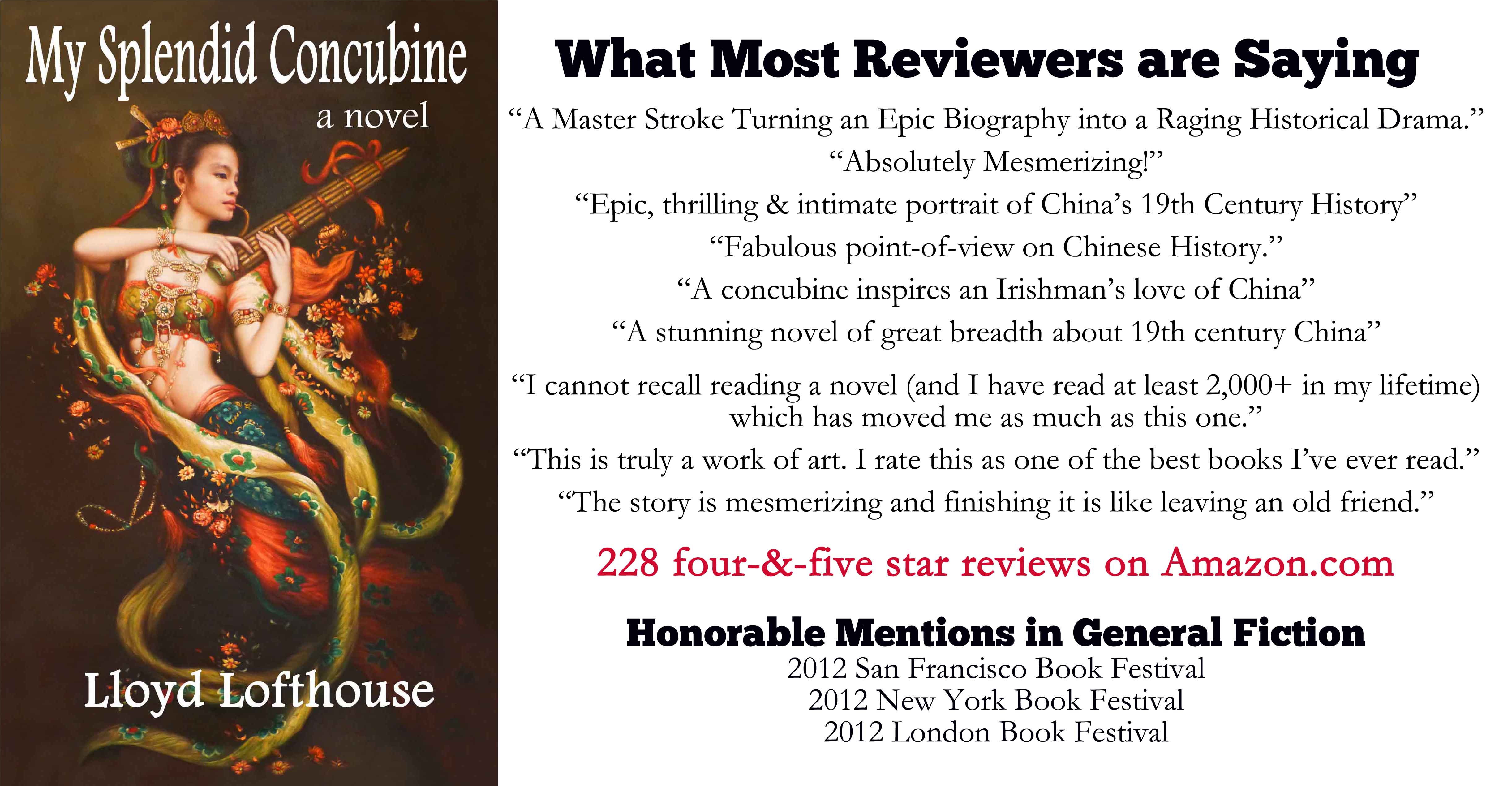
Lloyd Lofthouse is the award-winning author of My Splendid Concubine [3rd edition]. When you love a Chinese woman, you marry her family and culture too. This is the unique love story Sir Robert Hart did not want the world to discover.

IMAGE with Blurbs and Awards to use on Twitter

Where to Buy

Subscribe to “iLook China”!
Sign up for an E-mail Subscription at the top of this page, or click on the “Following” tab in the WordPress toolbar at the top of the screen.

About iLook China

China’s Holistic Historical Timeline


Sun Yat-sen’s Republic in China: Part 2 of 4

April 13, 2016

The answer to the question I asked in Part 1 has nothing to do with the government of the United States as it exists today, but it does have everything to do with the politics of Hawaii when Sun Yat-sen lived there for four years of his young life, the structure of the United States government, and who could vote at that time.

Sun Yat-sen attended a Christian British Bishop’s school in Hawaii for four years. His model on a Chinese republic may have been based on the beliefs of America’s Founding Fathers, who despised democracy as mob rule. Since Sun attended a British school, we may assume safely that he also learned about the British parliamentary system where the prime minister is not elected to office but is the leader of the majority party and there is no term limit. In fact, there was no term limit for the president of the U.S. until 1947, long after Sun’s death.

According to Sun Yat-Sen Hawaii Foundation, he arrived in Hawaii in 1879 at the age of thirteen. He then spent four of his teenage years being educated in Hawaii. China’s first revolutionary society, the Xing Zhong Hui (Revive China Society) was organized in Hawaii in 1894 more than a decade after Sun left.

Sun Yat-sen would later be involved in the overthrow of the Qing Dynasty in 1911 and a failed attempt to establish a republic in China. He never achieved his goals during his lifetime.

Whatever Sun Yat-sen’s vision of a republic might look like had to be formed during the four years he lived in Hawaii as a teenager.  The Sun Yat-sen Timeline shows that he returned to China in 1883.

To learn what Sun Yat-sen may have believed means learning about the political structure of Hawaii and the United States between 1879 and 1883.

Continued on April 14, 2016 in Part 3 or start with Part 1

Lloyd Lofthouse is the award-winning author of My Splendid Concubine [3rd edition]. When you love a Chinese woman, you marry her family and culture too. This is the unique love story Sir Robert Hart did not want the world to discover.

#1 - Joanna Daneman review posted June 19 2014

Where to Buy

Subscribe to “iLook China”!
Sign up for an E-mail Subscription at the top of this page, or click on the “Following” tab in the WordPress toolbar at the top of the screen.

About iLook China

China’s Holistic Historical Timeline


Sun Yat-sen’s Republic in China: Part 1 of 4

April 12, 2016

Dictionary.com defines a republic as “a state in which the supreme power rests in the body of citizens entitled to vote and is exercised by representatives chosen directly or indirectly by them.”

Sun Yat-sen remains unique among 20th-century Chinese leaders for having a high reputation both in mainland China and in Taiwan. In Taiwan, he is seen as the Father of the Republic of China. On the mainland, Sun is seen as a Chinese nationalist and proto-socialist, and is highly regarded as the Forerunner of the Revolution (革命先行者). He is even mentioned by name in the preamble to the Constitution of the People’s Republic of China (PRC).

“Sun Yat-sen was born in 1867 and died in 1925. Sun was a nationalist revolutionary who believed that the only way for China to move forward in the early 1900’s was for the country to become a republic and adopt western ways in industry, agriculture etc. Unless China did this, Sun was convinced that she was doomed to remain backward by western standards.” – historylearningsite.co.uk

There you have it.  Sun Yat-sen wanted a republic in China based on the American model. Has his dream been realized?

The easy answer is yes, but what Sun Yat-sen envisioned as a republic for China may have been exceeded by the Chinese Communist Party.

We will never know exactly what Sun Yat-sen wanted for a republic in China.

However, we can gain a better idea of what his vision may have been by discovering what it was like in Hawaii and America at the time Sun Yat-sen lived in Hawaii before it was a territory of the United States.

First, Hawaii was a Republic [1894 -1898] before it became a territory of the United States [1898 – 1959], and before it became a state in 1959.

In fact, a commission during the administration of President Grover Cleveland (1885–1889 and 1893–1897) concluded that the removal of Queen Lili’uokalani was illegal, and the U.S. government demanded that she be re-instated.

Then in 1993, a joint Apology Resolution regarding the overthrow of Hawaii’s Queen was passed by Congress and signed by President Clinton, apologizing for the overthrow of the Hawaiian Kingdom.

In China today, there are more than 80 million voting members in the Chinese Communist Party (CCP) and China’s president—elected by the 2,987 members of National People’s Congress—is limited to two, 5-year terms. In addition, about 600 million rural Chinese are allowed to vote for elected village leaders and the candidates do not have to be a member of the CCP.

Did you know that the President of the United States is elected by the 538 members of the U.S. Electoral College and not by the popular vote? If you don’t know the answer to that question, watch the following video.

Continued on April 13, 2016 in Part 2

Lloyd Lofthouse is the award-winning author of My Splendid Concubine [3rd edition]. When you love a Chinese woman, you marry her family and culture too. This is the unique love story Sir Robert Hart did not want the world to discover.

A1 on March 13 - 2016 Cover Image with BLurbs to promote novel

Where to Buy

Subscribe to “iLook China”!
Sign up for an E-mail Subscription at the top of this page, or click on the “Following” tab in the WordPress toolbar at the top of the screen.

About iLook China

China’s Holistic Historical Timeline


What happens when any Form of Government becomes destructive and many people suffer?

March 1, 2016

I was recently asked, “What can China learn from the US political model? American government is looking more and more like ‘of the 1% by the 1% and for the 1%’!”

My answer follows: If China learns anything from what is happening in the U.S., it’s to keep a balance between socialism and capitalism and not let socialism dominate capitalism and capitalism dominate socialism.

Capitalism benefits the 1% – everyone cannot be a winner even though many of the wealthy think everyone can make it like they did and they look down on and discriminate against everyone who doesn’t make it. After all, everyone has the right to work harder to make it, right, even on poverty wages with no benefits?

Socialist programs benefits the other 99% where many can end up suffering horribly without a safety net.

I’m not talking about pure socialism where the state—representing the people—own everything: the land and everything built on and under it, the means of production and the retail sector that sells what’s produced. I’m talking about social safety-net programs like affordable and/or free universal health care for every citizen no matter how much they earn, a livable wage, Social Security for when people are old and retire, unemployment insurance for people who have lost their jobs, labor unions that represent the workers, and disability insurance for workers injured on the job and even from accidents outside of work, who can no longer work because of the injury.

The capitalists, the 1%, will moan and groan because of these social programs that protect 99% of the people—the workers that helped make the 1% wealthy and powerful. The 1% will moan and groan because enough is never enough and the social programs that protect the 99% cut into the profits and the growth of their wealth and power. Angry, the 1% will bribe as many leaders in the country as possible to get rid of the socialist programs that protect the 99%. The corruption and lies will be rampant, because money buys power and power corrupts and absolute power corrupts absolutely. Wealth and power is similar to cancer and to contain that disease and protect the 99%, the government must walk a fine line to keep the balance.  The 99% must be stopped from destroying the 1% and the 1% must be stopped from causing the 99% from suffering due to the greed of the 1%.

The 99% can cause tyranny and suffering too because the mob is dangerous and powerful when united against tyranny, and the 1% can quickly become the tyranny behind the suffering caused to the 99%. That is what is happening in the United States today. The 1% is systematically attacking every public sector socialist program that protects the quality of life for the 99%.

The U.S. Declaration of Independence, that is not the law of the United States—the U.S. Constitution and Bill of Rights is the law that guides America—says it best:

“We hold these truths to be self-evident, that all men are created equal, that they are endowed by their Creator with certain unalienable Rights, that among these are Life, Liberty and the pursuit of Happiness.–That to secure these rights, Governments are instituted among Men, deriving their just powers from the consent of the governed, — That whenever any Form of Government becomes destructive of these ends, it is the Right of the People to alter or to abolish it, and to institute new Government, laying its foundation on such principles and organizing its powers in such form, as to them shall seem most likely to effect their Safety and Happiness. Prudence, indeed, will dictate that Governments long established should not be changed for light and transient causes; and accordingly all experience hath shewn, that mankind are more disposed to suffer, while evils are sufferable, than to right themselves by abolishing the forms to which they are accustomed. But when a long train of abuses and usurpations, pursuing invariably the same Object evinces a design to reduce them under absolute Despotism, it is their right, it is their duty, to throw off such Government, and to provide new Guards for their future security.–Such has been the patient sufferance of these Colonies; and such is now the necessity which constrains them to alter their former Systems of Government. The history of the present King of Great Britain is a history of repeated injuries and usurpations, all having in direct object the establishment of an absolute Tyranny over these States. To prove this, let Facts be submitted to a candid world.”

A government’s struggle to keep that balance between capitalism and socialism never ends because the temptations to lean toward capitalism’s 1% are many, and it has been said through the ages that every person has a price and can be bought one way or the other. Government also must resist the cry of the mob, loud and organized factions of the 99%, that demand more from the social safety net. In the end, it is up to knowledgeable, honest voters to help keep that balance in place.

Lloyd Lofthouse is the award-winning author of My Splendid Concubine [3rd edition]. When you love a Chinese woman, you marry her family and culture too. This is the unique love story Sir Robert Hart did not want the world to discover.

#1 - Joanna Daneman review posted June 19 2014

Where to Buy

Subscribe to “iLook China”!
Sign up for an E-mail Subscription at the top of this page, or click on the “Following” tab in the WordPress toolbar at the top of the screen.

About iLook China

China’s Holistic Historical Timeline


What is the risk to Outspoken Nonconformists in China?

February 17, 2016

To find out what might really happen to outspoken nonconformists in China, let’s examine what happened with a few high profile cases in the recent past and ignore any headlines designed to paint China’s leaders as evil.

According to the record, none of China’s dissidents since 1976 have been executed, and only two have been given a life sentence in prison: Wang Bingzhang and Ilham Tohti.

What about a few of the thirty-three who have been arrested and served or are still serving time in a Chinese prison? Oh, 33 is 0.00000243% of China’s population of 1.357+  billion people.

  1. In 1989, Tan Baiqiao was arrested for spreading counterrevolutionary propaganda; inciting counterrevolutionary activities; defection to the enemy, and treason— but due to international pressure, Tan was released and reached the U.S. in 1992.
  2. In 2002, Cai Lujun, a businessman and writer was arrested for “incitement to subversion and eventually sought political asylum in Taiwan in 2007.
  3. In 1995, Wang Dan was sentenced to 11 years in prison but was released on medical parole to the US in 1998 and is currently living in Taiwan.
  4. In 1998, Wang Youcai was sentenced to 11 years in prison for subversion but was released and exiled to the United States in 2004.
  5. In 1979, Wei Jingsheng an electrician was arrested and sentenced to 15 years in prison for passing military secretes.  He was released from prison for medical reasons and deported to the US in 1997.

What about other countries? There are laws in most countries that support what China does with its political dissidents.

For instance, in the United States Code, 18 U.S.C. & 2385, “Advocating overthrow of Government by force or violence”:

“Whoever knowingly or willfully advocates, abets, advises, or teaches the duty, necessity, desirability, or propriety of overthrowing or destroying the government of the United States or the government of any State, Territory, District or Possession thereof, or the government of any political subdivision therein, by force or violence, or by the assassination of any officer of any such government; or

“Whoever, with intent to cause the overthrow or destruction of any such government, prints, publishes, edits, issues, circulates, sells, distributes, or publicly displays any written or printed matter advocating, advising, or teaching the duty, necessity, desirability, or propriety of overthrowing or destroying any government in the United States by force or violence, or attempts to do so; or

“Whoever organizes or helps or attempts to organize any society, group, or assembly of persons who teach, advocate, or encourage the overthrow or destruction of any such government by force or violence; or becomes or is a member of, or affiliates with, any such society, group, or assembly of persons, knowing the purposes thereof—

“Shall be fined under this title or imprisoned not more than twenty years, or both, and shall be ineligible for employment by the United States or any department or agency thereof, for the five years next following his conviction.”

In addition, on May 4, 2012, the New York Times got it right with this headline, For China, a Dissident in Exile Is One Less Headache Back Home.

The NY Times said, “Based on past experience, China is often all too pleased to see its most nettlesome dissidents go into exile, where they almost invariably lose their ability to grab headlines in the West and to command widespread sympathy both in China and abroad.”

In fact, if you read the US law carefully, it sounds like it is also illegal to advocate the overthrow of another country’s government—just read the first paragraph in bold print above.

Moreover, fifty-two countries are led by authoritarian governments ruling over more than a third of humanity, so if you have to live under an authoritarian government, which kind is best?  After all, everyone cannot live in Hong Kong, which is considered the freest economy in the world.  Hong Kong (part of China) is followed by Singapore, Ireland, Australia, New Zealand and Switzerland. The U.S. ranks tenth of more than 150 nations.  China is ranked 138. Sources: The Freest Nations on Earth and Heritage.org

And what country puts more of its citizens in prison—China or the United States? The answer might surprise you. The United States has 698 people locked up for every 100,000 compared to China’s 119 per 100,000. – prisonstudies.org

In addition, according to Foreign Policy magazine, Joshua E. Keating, “found that single-party states—think China and Vietnam—are the most responsive to citizens’ demands, providing a higher quality of governance … the Chinese Communist Party has not lasted through the use of force alone, but also by making popular investments in China’s infrastructure and social services,” which has reduced poverty from more than 80% in 1949 to less than 13% today and increased the average lifespan from 35 years of age in 1949 to more than 75 today.

______________________________

Lloyd Lofthouse is the award-winning author of My Splendid Concubine [3rd edition]. When you love a Chinese woman, you marry her family and culture too. This is the unique love story Sir Robert Hart did not want the world to discover.

IMAGE with Blurbs and Awards to use on Twitter

Where to Buy

Subscribe to “iLook China”!
Sign up for an E-mail Subscription at the top of this page, or click on the “Following” tab in the WordPress toolbar at the top of the screen.

About iLook China

China’s Holistic Historical Timeline