Dictatorship Defined

April 7, 2010

There is so much misleading information on the Internet and from the Western media regarding China that it boggles the mind. For example, China’s President is listed as a dictator but by definition, he cannot be a dictator.

Dictatorship: 1) government by a ruler who has complete power 2) a country that is ruled by one person who has complete power (source: Longman Advanced American Dictionary)

Chinese Constitution: Article 1

Article 1. The People’s Republic of China is a socialist state under the people’s democratic dictatorship led by the working class and based on the alliance of workers and peasants. The socialist system is the basic system of the People’s Republic of China. Sabotage of the socialist system by any organization or individual is prohibited. Source: Chinese Constitution

I asked my wife, “How can China use the term dictatorship in Article 1 if China isn’t ruled by a dictator?”

She replied, “In Chinese, ‘people’s democratic dictatorship‘ means the people have the power. It’s a translation error.”

I then Googled dictatorship and discovered Parade’s Annual list of…the World’s 10 Worst Dictators.

Parade’s definition of a dictator says, “A ‘dictator‘ is a head of state who exercises arbitrary authority over the lives of his citizens and who cannot be removed from power through legal means.” Hu Jintao, China’s president, was number six on Parade’s list, but the claims used to include Hu Jintao are wrong.
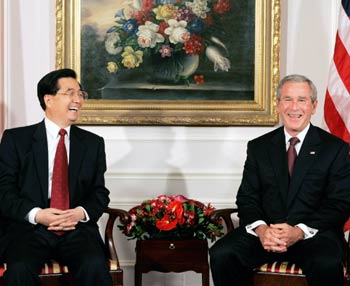
Presidents Hu Jintao and George Bush

For example, Parade claims that at least 400,000 residents of Beijing were forcibly evicted from their houses prior to the 2008 Olympics. That’s not true—the people sent from Beijing before the 2008 Olympics was transient labor and did not have residence cards and could not own property in Beijing. They were not legal residents and many transient laborers in China rent rooms shared with others in a communal environment crowded with bunk beds crammed in every possible space—like a military barracks. I know, because I’ve seen places like this in Shanghai. I also learned that the government paid for the transportation costs.

The reason Beijing sent those people away was because some were from Tibet and Xinjiang and may have been separatists, who might have staged protests to embarrass China—something the Chinese government avoids like the plague. The truth is, those people were sent home to their villages and were allowed to return to work after the Beijing Olympics. For them, it was like a vacation. Most also return to their villages during the Chinese New Year to be with their families because that’s where their homes are.

Since the Chinese Constitution rules China, Hu Jintao does not exercise arbitrary authority over the lives of his citizens. In fact, I doubt if he makes any legal decisions since the Chinese Constitution puts that power in the hands of China’s legal system. Discover more at China Law and Justice System

Parade is also wrong that China’s president cannot be removed from power through legal means.

Article 79 says, “The term of office of the President and Vice-President of the People’s Republic of China is the same as that of the National People’s Congress, and they shall serve no more than two consecutive terms.”

Article 59. The National People’s Congress is composed of deputies elected by the provinces, autonomous regions and municipalities directly under the Central Government, and by the armed forces.

Article 63. The National People’s Congress has the power to recall or remove from office the following persons:

(1) The President and the Vice-President of the People’s Republic of China;

(2) The Premier, Vice-Premiers, State Councillors, Ministers in charge of Ministries or Commissions and the Auditor-General and the Secretary-General of the State Council;

(3) The Chairman of the Central Military Commission and others on the commission;

(4) The President of the Supreme People’s Court; and

(5) The Procurator-General of the Supreme People’s Procuratorate.

Discover Stereotypes and/or The Failure of Multiculturalism in the United States

______________

Lloyd Lofthouse is the award-winning author of The Concubine Saga. When you love a Chinese woman, you marry her family and culture too. This is the love story Sir Robert Hart did not want the world to discover.

To subscribe to “iLook China”, look for the “Subscribe” button at the top of the screen in the menu bar, click on it then follow directions.


The Use of Power

April 4, 2010

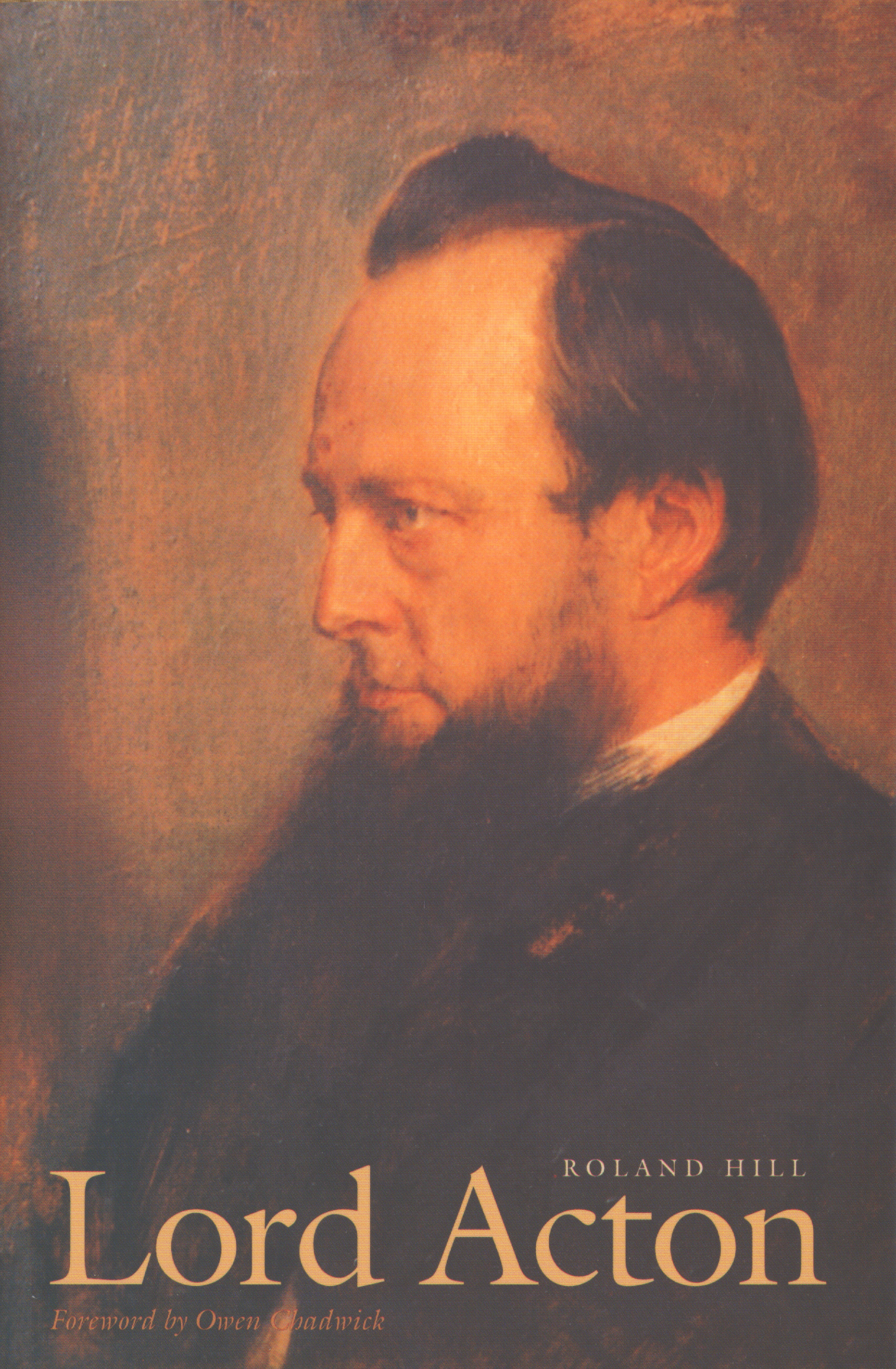
“Power tends to corrupt, and absolute power corrupts absolutely. Great men are almost always bad men.” Lord Acton

There’s a lot of truth to what Lord Acton wrote.

William Pitt, The Earl of Chatham and British Prime Minister from 1766 to 1778 said something similar: “Unlimited power is apt to corrupt the minds of those who possess it.”

The corruption that Lord Acton and William Pitt talk about does not only apply to a nation’s political and business leaders. It influences common citizens, who put pressure on their government to react violently.

As China grows its power, how will that corruption manifest itself?  Will China become like the British Empire or the United States and continue to wage wars around the globe in the national interest? Maybe, or will China re-define what the use of power means?

“China is presenting its ascent not as a power shift, but as a paradigm shift. It claims that its rise will be different from other powers in the past and sets an example for a fundamental revision of the nature of great power politics.” Source: In The New Times

See Power Corrupts http://wp.me/pN4pY-40


One Party Advantage

April 4, 2010

The West’s loudest criticisms of China are a one party system, limited religious freedom and government censorship. Is it possible that these same things are also China’s strengths?

President of China, Hu Jintao

Clean water, air and plentiful, healthy food are precious. China’s one-party system ruled by scientists and engineers excels at solving these challenges. Instead of becoming embroiled in partisanship battles over political and religious differences, as in the United States, China is moving ahead to clean up their environment with no “Tea Bag People” or opposition claiming global warming is not caused by carbon emissions.

China has already become the leader in solar power and wind turbine technology. Now, in the last few years, China has emerged as an early leader in adopting “clean coal” technologies. The next industry China is poised to dominate is high-speed rail with plans to add more at home while considering a line from Beijing to London.

The motivation behind this sudden awareness to the dangers of pollution is because China’s government, with a cultural foundation in Confucianism, must meet the needs of the people or be swept from power. Even if a few complain and suffer, the needs of the many must come first.

Discover Hitting Endless Homeruns


______________

Lloyd Lofthouse is the award-winning author of the concubine saga, My Splendid Concubine & Our Hart. When you love a Chinese woman, you marry her family and culture too.

If you want to subscribe to iLook China, there is a “Subscribe” button at the top of the screen in the menu bar.


Media Demons

April 2, 2010

When I read it, I laughed. To me, it was obvious.

Definition for propaganda: ideas, facts, or allegations spread deliberately to further one’s cause or to damage an opposing cause; also: a public action having such an effect (Merriam Webster.com) Or—manipulation of information to influence public opinion.

In 1948, the CIA established Operation Mockingbird, a program designed to influence the American media to play an important role in the propaganda campaign against the spread of Communism. The CIA recruited journalists, who wrote for The Washington Post, New York Times, Time Magazine, New York Herald Tribune, Newsweek, Miami News, Chattanooga Times, etc.  By 1953, this CIA network had a major influence over 25 newspapers and wire agencies (like the Associated Press and United Press International).

Evidence suggests that Operation Mockingbird (or something like it) exists today. If so, whom would this operation target? After all, Cold War Communism is gone.

The reason I mention Operation Mockingbird in this post is because of something I read in the New York Times today—Journalists’ E-Mails Hacked in China. The first few paragraphs of this piece infer that China’s government is responsible. Later, the piece indirectly mentions there is no way to know who did it. In the last paragraph, we are not sure if Google is partially responsible. As a journalist, why organize the piece this way?

See Google Recycled http://wp.me/pN4pY-2r


The Orphan’s Life

April 2, 2010

More than 90% of babies in Chinese orphanages are girls. Prior to 1949, it was common for parents to murder girl infants. From the 1950s to the end of the 1970s, due to Mao’s leadership and a tough stance for women’s equality, the death rate went down. Then in the 1980s, with the population growing too fast, a desperate government implemented the one-child policy.

After that, many girl babies went missing or were abandoned to state-run orphanages. To end this tragedy, the government eventually allowed rural families to have two children per family—hoping for a boy.

The conditions in these rural, state-run orphanages are often not ideal. Girls, who are not adopted, usually end up being the caregivers for the younger children. Since these orphan caregivers were raised without the love of parents and siblings, they may not be loving themselves creating a cold environment to grow up in.

abandoned at birth

It isn’t as if China’s government has done nothing to stop a practice that has been around for thousands of years. During the 90s, tougher laws were passed but often ignored. Government inspectors were sent to rural areas to enforce these laws, but it isn’t easy controlling a population of 1.3 billion scattered over a mountainous country almost the size of the United States.

I will not criticize the Chinese government for these conditions. I’ve been to China and understand the challenges. What would you do if you had inherited a medieval country in 1949 that was bankrupt due to the Kuomintang looting the banks and treasury as they fled to Taiwan under American protection? Then there is a culture reaching back thousands of years where girls were considered worthless. That is a lot to overcome.

Discover Gendercide in China and India, and also see the conclusion of one orphan’s journey in Saying Goodbye

______________

Lloyd Lofthouse is the award-winning author of The Concubine Saga. When you love a Chinese woman, you marry her family and culture too. This is the love story Sir Robert Hart did not want the world to discover.

To subscribe to “iLook China”, look for the “Subscribe” button at the top of the screen in the menu bar, click on it then follow directions.