Foreign Elements: a guest post by Alec Ash

December 11, 2013

??????????

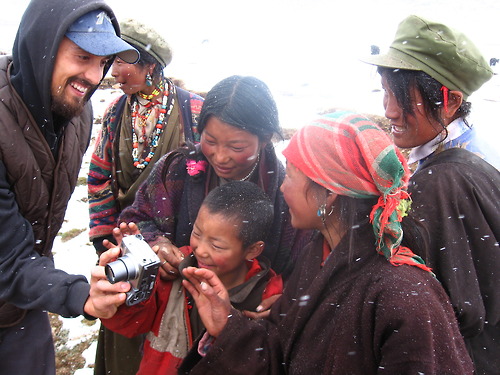
Photo by Eelco Florijn. The picture was taken in Kham, Tibet, at the Dongdola pass.

There have been expats in China since the first Jesuit missionaries started arriving in the 16th century. But what characterizes the hundreds of thousands of Westerners who call China home today? And what are the challenges and identity issues that they face?

Tom Carter, originally from San Francisco, has been living in China for a decade. He did a well received book of photography [China: Portrait of a People] based on trekking 35,000 miles through 33 provinces for two years. More recently he edited a collection of true stories from expat China called Unsavory Elements, which has generated both praise and controversy.

I sat down with him over lunch in Shanghai, and followed up with questions over email, to dig deeper.

Alec Ash [AA]: Why did you feel there was a need for a collection of stories and anecdotes by Westerners living in China? What is it about that experience that interests you?

Tom Carter [TC]: It was a project whose time had come. The past decade has seen an unprecedented number of new books and novels about China, but aside from a handful of mass-market memoirs there was nothing definitive about its expatriate culture. As an editor and avid reader, I had this grand vision of an epic collection of true short stories from a variety of voices that takes the reader on a long, turbulent arc through the entire lifetime of an expat – bursting with ephemera and memories from abroad. That’s how Unsavory Elements was conceived.

Of course, the landscape of China in 2013 is vastly different than 2008 – generally considered the new golden age for laowai (foreigners) – and virtually unrecognizable from 2004, which is when I first arrived. Such rapid changes are the subject of just about every book on China these days. But swapping stories with other backpackers I bumped into on the road while photographing my first book, I noticed that there was something profound about our experiences and adventures – the tales we told might just as well have occurred in the 1960s or even the 1860s. And that’s when it struck me: the more China changes the more it stays the same. So I wanted to switch up the trends of this genre and feature stories that were not only timely but timeless.

AA: But how has the foreigner community in China changed over the past decades? Do you feel there’s anything Westerners in China have in common, among all the diverse reasons that people have to end up here?

TC: Expatriates in China are certainly a motley crew. I’ve lived and traveled extensively across many countries in the world, but none seem to have attracted such a diverse crowd as China, this eclectic mix of businessmen and backpackers, expense-account expats and economic refugees. It really could be the 1800s all over again, like some scene out of James Clavell’s novel Tai-Pan [about the aftermath of the Opium War] except now with neon lights and designer clothes. What we’ve seen this past decade surrounding the Beijing Olympics is history repeating itself. The Western businessmen who have come and gone these past ten years during the rise of China’s economy are the exact same class of capitalists who populated Shanghai and Hong Kong in the 1800s. They’ve come to make their fortunes and then get out – which is what we are witnessing with the recent expat exodus [now that China’s economy shows signs of faltering].

The darker side of China’s history also seems to be repeating itself. The Communist-conducted purges of “foreign devils” and foreign-owned enterprises that occurred in the Cultural Revolution are happening all over again – perhaps not as violently (with the exception of the looting of Japanese businesses during the Diaoyu Islands dispute in 2012) but certainly with as much vitriol. There was last year’s poster depicting a fist smashing down on the characters for “foreigner” and various video footage (possibly staged) of foreigners behaving badly, used to justify their Strike Hard crackdowns [against foreigners in China with black market visas]. The title Unsavory Elements is a playful homage to Communist terminology. To be sure, China has a love-hate relationship with outsiders – our success and our status here rises and falls on the whims of the government. In spite of this, as many foreigners continue to arrive in China as leave (or are expelled). So what do we all have in common? If nothing else, a degree of masochism.

AA: And how, if at all, does living in China long-term change you?

TC: I expect it’s tempered me, much like in metallurgy, from the constant pounding and heating and cooling and reheating of my patience. Suan tian ku la (sour sweet bitter spicy) is an old Chinese adage, and this country definitely serves up its share. But it hasn’t been easy to swallow. Westerners tend to arrive in China a bit hot-headed, and we’ve all had our explosive moments: with the taxi driver who runs his meter fast or takes us the long way, at a train ticket office jostling with queue jumpers, due to endless red tape, or when you are ripped off by your business partners.

Few foreign writers ever admit to having these moments so I encouraged my anthology contributors to be more forthcoming about their darker feelings – seeing red, so to speak. Alan Paul, writing in the book about a stressful family road trip across Sichuan, has a line: “I stood there bitterly looking down into that hole, silently damning New China’s incessant construction.” I can relate to that every time I hear a jackhammer. Even the famously mild-mannered Peter Hessler confesses in his essay to going ballistic with his fists on a thief he catches in his hotel room. I’ve been there as well, taking out all my pent-up frustrations on some poor pickpocket who wasn’t quick enough to escape the reach of this 6’4” foreign devil. I expect that having had my patience tried so often here has forged me into a calmer, more levelheaded person than the clenched-fisted, teeth-gnashing, Thundarr the Barbarian in Beijing I arrived as.

AA: A foreigner also has special status and perks from being in China – for instance, they always stand out, whereas back home they’re just another face in the crowd.

TC: Special status, yes, but not in the way it’s been mythologized. Sure, in the countryside it’s nice to be invited in for tea by villagers who’ve never encountered a Westerner before, but in Shanghai you’re bumped into and cut in front of and run over by cars like any other laobaixing or common person. That oft-eulogized “rock star status” was more of a vague concept that the Chinese used to have about the West – the branded clothing, the rebellious music, the casual sex. But actually there’s nothing special about being gawked at, openly talked about and cheated because it’s assumed that you’re wealthy. And there’s certainly nothing special about the hell-like bureaucracy foreigners are burdened with, or not having access to basic public services like hospitals, schools and even hotels, or the frequent suspicions that the government casts over us.

In fact, in just the past five years following the global recession of 2008 – during which nearly every world economy collapsed except for China’s – our collective esteem in the eyes of the Chinese has plummeted from superstar status to that of some invasive species, a metaphor which the environment journalist Jonathan Watts also makes in the book, comparing non-indigenous plants with foreigners. And there’s a wholesale fumigation of Western corporations [that exploit China’s low labor costs], which the Communist government now considers a threat, like the imperialist military incursions of centuries past. They want and need our business, but they are no longer going to make it easy for us. As a result, the Xi Jinping administration is coming down hard on foreign firms that have historically gotten away with shady practices like price fixing, influence buying and general non-compliance.

AA: Do you think it’s hard to adjust to life back home if you return? With no cheap taxis, eating out, cleaners, massages…

TC: I honestly couldn’t tell you. I’ve only been back to the States once in nearly a decade; China is “home” now. I’m not that laowai who skips out on China when it’s convenient, or because living here is no longer convenient. I’m also not that Westerner who has a driver or only takes taxis – I ride public transportation and my rusty trusty 40-year-old 40-kilogram Flying Pigeon bike. Nor do I hire old ayis [housekeepers] to do my dirty work – my wife and I raise our child ourselves, make our own meals, and clean our home ourselves. I can just hear all the gasps from colonialist-minded “enclave expats” who could never conceive a life in Asia without servants.

I did live in Japan for a year after four straight years in China, and found the orderliness and politeness and emotionlessness of it all quite difficult to adjust to. So I spent the following year wandering around India, which provided me with a much-needed dose of dust and disorder. After that I returned to China and for the following few years lived in my wife’s native farming village in rural Jiangsu province. That to me was like an epiphany, as if I had finally found home. But for my wife – who in her youth had strived to escape the countryside and eventually made her way up to Beijing, where we met – it was coming full circle back to where she started. So now we divide our time between Jiangsu and Shanghai, which I guess gives each of us the best of both worlds.

AA: I’ve had friends who went back home after living in China, but missed the excitement and buzz so much they couldn’t help but come back. Is China a drug?

TC: I should first disclaim that the Ministry of Public Security takes drug dealing in China very seriously, as Dominic Stevenson, who wrote about his two-year incarceration in a Chinese prison for dealing hash, can attest. But I’d venture to say that, like any drug, it depends entirely on the user’s own state of mind. If we’re making metaphors, for old China hands I’d imagine their time here draws parallels with the soaring euphoria and bleak depths of smoking opium, while China for the uninitiated is probably a bit like bath salts: the constantly convulsing nervous system, the paranoia, the god-complex, the rage.

I’d liken my own China experience to a decade-long acid trip. It began with liberating my mind from the restraints of Western society. Then I departed on an odyssey that took me tens of thousands of miles across China, experiencing various metaphysical and spiritual states as my journey progressed, punctuated by periods of intense creativity due to my heightened sensory perceptions. To a background score of warped erhu and guzheng [classical Chinese instruments], and the looped calls of sidewalk vendors echoing into the void, the kaleidoscopic chaos of this culture surged around me like the Yangtze river – in outer space. Now I’m one with China’s cosmic consciousness. I want to reeducate the communists with love. Or maybe I’m not even here. Maybe I really did perish during my Kora around Mount Kailash and none of this ever happened …

AA: Ground control to Major Tom. Your own story in the book is about a visit to a brothel with two lecherous laowai. How representative do you feel that this kind of foreigner in China is, especially those who come to try and pick up Chinese girls?

TC: It’s been fascinating for me to see how much polemic this single story has stirred. I kind of knew I’d be martyring myself when I decided to include my account of a boy’s night out at a brothel in the anthology instead of, say, a story about my marriage in a rural village, or about delivering our firstborn son at a public People’s hospital in the countryside. My publisher, Graham Earnshaw, even tried to warn me about the inevitable ire that would follow and suggested I pull the piece for my own well-being. His forecast was unfortunately accurate. Immediately following a Time Out review that dedicated most of its page space to criticizing my brothel story, certain women’s reading groups called for my arrest and deportation from China because, they said, I “patronized teenaged prostitutes”.              

And yet, the story has received as much praise as it has hate. An equal number of readers seem to find it refreshing that a foreigner is finally writing about experiences many single males in the Orient have had but never dared admit – especially not in print. And considering the Party’s penchant for keeping extensive dossiers on Chinese and foreigners alike, I can understand their reticence. But I can’t help but consider as downright disingenuous the glaring omissions of any situation involving prostitution – an impossible-to-overlook trade found in nearly every neighborhood in every city and town – by certain best-selling Western authors in China. Do they not consider the women of this profession worthy of writing about? Or are they simply lying?

I’m not saying I had some altruistic intention with my story – it was just an absurd situation that my friends and I got ourselves into that also happened to make for ribald writing. But the truth is, I conceptualized the entire anthology around that brothel incident, because I wanted to compile a collection of candid and truthful experiences that left nothing out, including visits to your neighborhood pink-lit hair salon. Only the discerning reader can tell you how representative it is of them, but maybe, nay, hopefully, my story will kick off a new era of honesty by Western writers in China. We’ll see.

This interview was first posted on Tumbler September 25, 2013 and on The Anthill.org September 26, 2013


Seeing China through Multiple Lenses

October 29, 2013

Unsavory Elements edited by Tom Carter, the author of China: Portrait of a People, has twenty-eight short memoirs that offer a balanced view of China from expatriates who have lived and/or traveled there.

But the title almost misleads because not all of the authors come off as unsavory elements—most are there to learn and not to judge. Only a few of the stories in this collection were written by expatiates suffering from some form of sinophobia.

I also value books that teach and I think that many of the stories in Unsavory Elements did that refreshingly well.

For a few examples, first there was Paying Tuition by Matthew Polly who wrote: “One of the first things I had learned during my stay was that the Chinese love to negotiate. They love it so much that even after an agreement is reached, they’ll often reopen negotiations just so they can do it all over again.”

I have visited China many times and—unlike most Westerners—I enjoy negotiating, but I didn’t know about the reopening gambit. Next time, I may want to give that a try and extend the fun.

In Communal Parenting by Aminta Arrington, I learned that the “Chinese have a fundamentally different relationship with their history than we Westerners. History is a subject we study in schools,” and that history is not connected to who we are.

“Not so for the Chinese,” Arrington writes. “History here [in China] is not book knowledge. Rather, their history is carried along with them as they walk along the way, an unseen burden, an invisible shadow; unconscious, and therefore, powerful.”

Kaitlin Solimine in Water, For Li-Ming writes about the five-months she stayed in China as a teenager in a high school, home-stay program, and it was her first time outside of the United States. For those few months, Li-Ming was her Chinese mother.

Here is the gem that Solimine shares with us: “That’s the thing about Chinese mothers: hidden behind their maternal expectations and critical diatribes are women who will fight to the death for you. As soon as I called her Mama, Li-Ming would be my strongest ally for the only months I knew her.”

From Graham Earnshaw in Playing in the Gray we discover: “There were no rules. Or rather, there was only one rule: that nothing is allowed. But the corollary, which reveals the true genius of China’s love of the grey—in contrast to the black and white of the West—is that everything is possible. Nothing is allowed but everything is possible. It’s just a matter of finding the right way to explain what you’re doing.”

Reading Empty from the Outside by Susie Gordon we see that the “New China isn’t shackled with the Judeo-Christian Morals of the West.”

Some in the West may see this lack of Judeo-Christian morals in China as a bad thing but that depends on how deeply entrenched a Westerner is in fundamentalist Christian morality. China—believe it or not—does have a moral foundation that many in the West turn a blind eye to. If you are married to a woman who was born in China and grew up there during Mao’s puritanical repressive twenty-seven years as its leader, you might understand what I mean.

In conclusion, there is Tom Carter’s signature-title piece. In his short Unsavory Elements, Carter says in one passage, “Claude admittedly couldn’t care less about Chinese culture; he was simply, like so many other foreigners in China—myself included—aimless and desperate for an income.”

There is so much more to this book called Unsavory Elements than these few examples. If you are have an open mind that isn’t infected by sinophobia and you want a better understanding of the Chinese, I highly recommend this collection.

_______________

Lloyd Lofthouse is the award-winning author of My Splendid Concubine [3rd edition]. When you love a Chinese woman, you marry her family and culture too. This is the love story Sir Robert Hart did not want the world to discover.

His latest novel is the multiple-award winning Running with the Enemy.

Subscribe to “iLook China”!
Sign up for an E-mail Subscription at the top of this page, or click on the “Following” tab in the WordPress toolbar at the top of the screen.

About iLook China

 China’s Holistic Historical Timeline


From Mao to the Met

March 12, 2013

Arriving early at the local library to attend a lecture called the Wit and Wisdom of Abraham Lincoln, I stopped by the library’s used bookstore first and found a three-dollar DVD of Hao Jiang Tian’s From Mao to the Met. Later that evening, my wife said she had been looking for that DVD, and she invited her sister and father to join us when we watched it.

Funded by the Committee of 100, this one-man show features Metropolitan Opera basso Hao Jiang Tian weaving song and story into a compelling tale of growing up in China under Chairman Mao, based on his autobiography (with co-author Lois B. Morris) “Along the Roaring River: My Wild Ride from Mao to the Met“.

What I enjoyed most about the one-man show was that Tian never condemned Mao, the CCP or China for his bitter-sweet journey.


Instead, this fantastic opera singer says it was fate that led him from Mao to the Met. When you stop to think about it, fate is the river-of-life known later as history—the current that carries all of us through life often without much say in that history.

As a child, Tian hated his piano lessons. Then with the arrival of Mao’s Cultural Revolution, Tian said, “So one happiest day came when I heard an announcement from the loudspeakers: My piano teacher was arrested as a counterrevolutionary. And then I was so happy. And so immediately I ran to the courtyard, screaming and jumping with joy.”

Thirty years later, Tian returned to Beijing and visited his piano teacher, who said, “Well, that was a crazy period, and it was so hard to figure out who was right and who was wrong.”

In his one man show, Tian performs songs of the Cultural Revolution, American standards such as “Some Enchanted Evening”, Irish song “Danny Boy” and operatic arias from his favorite roles; Tian tells the story of the music-and the woman- that changed his life.

NPR says, “For more than 20 years, the basso voice of Hao Jiang Tian has filled major American opera houses. As one of the few Chinese stars in opera, his life story is as remarkable as his work. … Tian is one of the few opera singers to emerge from China.” Source: NPR.org

Discover China’s Invisible Man – Liu Bolin

_______________

Lloyd Lofthouse is the award-winning author of My Splendid Concubine [3rd edition]. When you love a Chinese woman, you marry her family and culture too. This is the love story Sir Robert Hart did not want the world to discover.

Subscribe to “iLook China”!
Sign up for an E-mail Subscription at the top of this page, or click on the “Following” tab in the WordPress toolbar at the top of the screen.

About iLook China


A bit of advice on doing business in China

January 14, 2013

An expatriate living in China sent me a copy of The Australian’s Goodwill Offers a Rich Yield by Greg Rudd.  The commentary was published in that newspaper back in May 2009.

However, what Greg Rudd says is just as important today as it was then regardless of the few negative voices that left comments.

I find it interesting that the negative comments from such as “lao de lao ren” and “RN of Canberra” may be from ignorant individuals that do not realize that the US Founding Fathers despised “democracies” and built a “republic” where only white male property owners (excluding Jews) could vote—about 10% of the 3.9 million people counted in the first U.S. Census of 1790, and 90% were farmers.  That number included almost 700,000 slaves in the land of the free. That means about 320,000 may have been eligible to vote.

“RN of Canberra” even compared China to Hitler’s Nazi Germany, which isn’t even close. There is no comparison. Today’s China is a much safer place to live than Nazi Germany was and there are no signs that China plans to go out and wage war against the rest of the world or set up gas chambers and start killing people as the Nazis did.

Both “lao de lao ren” and “RN of Canberra” express that China should become a democracy. Well, the CCP has about 80 million members and they do vote in addition to the 600 million rural Chinese that vote in elections for village political posts such as mayor. That’s more than 10% of the population.

In fact, the first time the US was officially called a democracy was by President Woodrow Wilson more than a century after the US was founded. Why, after the Civil War, veterans were known as the Grand Army of the Republic (GAR)—not the Grand Army of a Democracy.

Presidents John Adams and Thomas Jefferson both said democracy was no better than mob rule, which explains why the Founding Fathers created the Electoral College to select presidents and why George W Bush lost the popular vote to Al Gore but became president anyway.

Greg Rudd offers some advice about China in his commentary.

He says, “My mother taught me when you walk into someone’s house you shouldn’t be rude. You may not like what you see sometimes, and advice and suggestions can be given in the right spirit and in the right atmosphere, but always remember it is not your house.

“When we are in China’s house we should show respect and when they are in our house they should show respect.”

Greg Rudd is managing director of GPR Asia, based in Beijing. GPR advises on investment and joint ventures.

GPR Asia works with Asian companies who wish to invest/joint venture/merge or acquire companies in Australia and/or with Australian companies that wish to invest/joint venture/ merge or acquire companies within the Asian region.

Discover more about Doing Business in China

______________

Lloyd Lofthouse is the award-winning author of The Concubine Saga. When you love a Chinese woman, you marry her family and culture too. This is the love story Sir Robert Hart did not want the world to discover.

Subscribe to “iLook China”!
Sign up for an E-mail Subscription at the top of this page, or click on the “Following” tab in the WordPress toolbar at the top of the screen.

About iLook China


Indiana Jones, make room for Irene Blum

January 7, 2013

Ballantine Books sent me an advanced, uncorrected proof of Kim Fay’s The Map of Lost Memories. Because I’m not going to check or read the finished book, note that the final novel may have been revised.

After reading the uncorrected proof, I think Kim Fay’s novel is brilliant at times, average at times and sometimes falls flat then revives to be brilliant again repeating the cycle. In fact, Fay’s descriptions were so vivid they transported me to Shanghai, Saigon and Cambodia, and I could smell and see these exotic places—some I have visited and Fay’s descriptions rang true.

The main character in The Map of Lost Memories is Irene Blum, who in 1925 slams into the glass ceiling and is passed over for a job she deserves, the curatorship of the museum where she grew up and then worked. Instead, the job goes to a man who has the proper credentials even though he does not have Irene’s experience or global connections.

This leads Irene to steam across the Pacific to resurrect her career by finding several copper scrolls that record the lost history of Cambodia’s ancient Khmer Empire (802 – 1431 AD).

Irene’s first stop is Shanghai where she is sucked into the power struggle between the nationalists and communists and barely escapes with her life. Her next stop is Saigon and from there she travels to Cambodia with her motley crew, visits Angkor Wat and then is off to discover a lost temple in Cambodia’s rugged northeast near Laos that may be the rival of Angkor Wat.

Along the way, she collects a crew of dysfunctional allies each with his or her own agenda. There is the drug-addicted Simone Merlin, who appears to be a dedicated communist out to save the poor Cambodians from being exploited by the French colonial powers.

Then there is Louis, a world renowned scholar of the Khmer civilization and Angkor Wat, who was a childhood friend and former lover of Simone.

Irene also finds romance with the mysterious Mark Rafferty, who is linked to her mentor Henry Simms, a wealthy and powerful old man dying of cancer and another reason why Irene is racing to find the copper scrolls that will reveal the history of the Khmer empire ruled by Jayavarman VII (1125–1218), the last of the great Angkor kings.

At one time, the Khmer Empire was one of the most, if not the most, powerful empires in Southeast Asia. In fact, recent satellite images have revealed that Angkor Wat, the capital of the Khmer Empire, was the largest pre-industrial urban center in the world at that time.

However, history reveals there will always be empires that rise to flatten other cultures and countries and then fall. For example: the Aztec, Han, Inca, Roman, Spanish, French, British, Greek, Persian, and Egyptian. I doubt that the future will ever see Italy rise to equal the Roman Empire.

The Khmer Empire of Jayavarman VII was no different.

I enjoyed this novel and if you enjoy an Indiana Jones adventure, this book is for you. At the end of the novel, I had a feeling that we may see more of Irene in subsequent novels as the adventure continues.

Discover China’s Three “Journeys to the West”

______________

Lloyd Lofthouse is the award-winning author of The Concubine Saga. When you love a Chinese woman, you marry her family and culture too. This is the love story Sir Robert Hart did not want the world to discover.

Subscribe to “iLook China”!
Sign up for an E-mail Subscription at the top of this page, or click on the “Following” tab in the WordPress toolbar at the top of the screen.

About iLook China