According to the History of Feng Shui, also known as Kanyu, the practice of Feng Shui began in the Western Han dynasty around the third century BC.
Feng Shui is an ancient Chinese belief that the laws of astronomy and geography may be applied aesthetically to improve the positive energy (chi) that surrounds our daily lives.
Feng Shui is also big business today.
In Asia, Feng Shui consultants charge astronomical fees to corporations who retain them to advise on architectural design, building location, interior decorations and grand-opening dates.
No matter how small, no business or shop in Eastern Asia would dare debut without having first consulted extensively with a Feng Shui practitioner.
Even on Amazon, there are literally hundreds of books written by Feng Shui “experts” seeking to capitalize on the resurgence of middle-class trends co-opting Feng Shui.
Ironically, one of the major themes of Feng Shui is in removing clutter, yet the endless piles of Feng Shui books that keep appearing on the literary market seems only to contribute to the clutter.
Detractors, however, have branded Feng Shui everything from an “occult superstition” to “new-age psychobabble.”
After all (they say), how could something as banal as the position of your bed and the color of a candle have any relation to the safety and welfare of a human being?
During the Cultural Revolution, Communist Party chairman Mao Zedong took his revulsion of Feng Shui one-step further during the 1970s by having the teenage Red Guard persecute Chinese citizens who dared follow this “old, evil ideology”.
Regardless of your beliefs, the fact is that it cannot hurt – and might help – your daily happiness and comfort by following at least the most basic principles of Feng Shui at your home and office.
If, perchance, the southeast part of your house were truly the Wealth Sector, as Feng Shui suggests, then why would you not want to keep it spotless and free of clutter?
If jars of coins around the house really do symbolize abundance and can attract wealth, then how hard would it be to fill some up with your old pocket change?
In Part 2, Tom Carter recommends a handy, easy guide to Feng Shui.
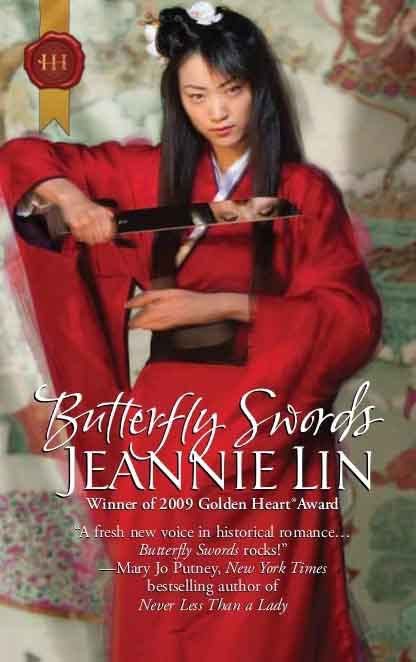
Enter Jeannie Lin, Harlequin’s rising red-star of romance writing. She isn’t the first author on Harlequin’s roster to set her books in China (that honor goes to Jade Lee and her infinite “Tigress” series).
However, Lin’s debut novel, Butterfly Swords, has been attracting a viral buzz louder than a summertime cicada not just for being the first Harlequin novel to NOT feature a man on the cover, but for using an Asian model as the cover girl, another Harlequin first.
The star of Butterfly Swords is a Chinese woman, yes. But to give American readers something that they can relate to, the male love interest of Lin’s novel is not Chinese but a wandering whiteboy from the west.
Ryam is drifting around the Tang (618-906 AD) empire begging for food (this sounds exactly like my own travels across China!) when he spots a disguised female being attacked by a pack of marauding bandits.
The swordsman, who evokes images of bare-chested, fur underwear-wearing Thundarr the Barbarian from the eponymous 80’s cartoon, rescues her, then agrees to escort her home.
Little does Ryam know that young Ai Li is really a princess on the run from an arranged marriage to a dastardly warlord. The two proceed on their journey together across the 7th-century frontier, getting in adventures and slowly but surely falling in love.
Pitting strength, courage and her fabulous butterfly swords against the forces of evil, Ai Li proves herself in the battlefield (“With Ai Li’s swords and determined spirit it was easy to forget that she was innocent”).
However, where the book has significant cultural crossover appeal is in author Jeannie Lin’s ability to keenly capture the multi-dimensional perspectives of both characters throughout their budding interracial relationship.
From Ryam’s course communicative abilities (“Where did you learn how to speak Chinese” Ai Li asks him, laughing. “You sound like you were taught in a brothel”) to his struggles with his inner-white demons as a big, bad bai gui (“It was so much easier to seduce a woman than talk to her”), the reader is introduced not to some empty-headed he-man but a complex male of the species who is genuinely torn between his biological needs and respecting Ai Li’s virtue.
“I don’t understand what she’s talking about half the time,” Ryam grumbles to himself. “Everything is about honor and duty.” Surely even expats living in present-day P.R.C. can relate to this dilemma.
Ai Li, meanwhile, finds herself attracted not only to Ryam’s “musky scent” and “sleek muscles” (Harlequin prerequisites; don’t blame the authoress), but his sincerity (“There was nothing barbaric about him. His manner was direct and honest. It was her own countrymen she needed to be worried about.”).
The protagonist does find herself frustrated with “this swordsman with blue eyes and the storm of emotions that came with him,” but, true to life, Ai Li comes with her own personality flaws as well (“she was being irrational and she knew it”).
Of course, it wouldn’t be a Harlequin without passionate love scenes, something my fiancée missed in the heavily censored Chinese versions.
This Jeannie Lin does in the poetic prose of a Tang Dynasty-era pillow book yet with just enough creatively-provocative language to keep sex-numbed westerners interested (“Ryam slipped his fingers into her silken, heated flesh…her body went liquid and damp in welcome.”). And thankfully without ever once resorting to the word “loin.”
Ryam proves himself to be an ideal lover for nubile Ai Li, “rough enough to make her breath catch, gentle enough to have her opening her knees,” though one can’t help but wonder how these two nomadic warriors can go so long without bathing nor brushing their teeth yet still manage to say things like “her mouth tasted just as sweet as he remembered.”
If only real life were as hygienic as a Harlequin novel.
One of the reasons why Harlequin is able to sell over 100 million units per year (the most profitable publishing company in the industry) is because every book is part of a series.
There are no individual Harlequin titles, which brilliantly leaves the reader yearning for more from the characters they have literally become so intimate with. In this respect, Butterfly Swords concludes with a wide opening that screams sequel, but thankfully lacks the typical Harlequin-happy ending of matrimonial bliss.
One familiar with Chinese culture can’t help but wonder, then, what kind of future Ai Li and Ryam actually have together: in reality, Ai Li would put on weight, cut her hair short and become a shrill nag; her parents and grandparents would all move into their cramped apartment, and a frustrated Ryam, now with beer-belly, would spend more and more time at card games and with karaoke parlor hostesses than at home.
But before the infuriating realties of interracial marriage set in, we hope Jeannie Lin has at least a few more of her trademark sword fights and steamy sensuality in store.
Growing up in a rural, slate-roofed village deep in the countryside of southeast China, the only English books my Chinese fiancée had to read back then were a brittle copy of Tess of the d’Urbervilles and a set of Harlequin novels.
Yes, I’m talking about Harlequin, those pulpy paperbacks found on revolving wire racks at supermarket checkout aisles across North America and the UK. Their enticing cover art – usually, nay, always featuring shirtless, square-jawed men hovering millimeters away from the glistening-red lips of a damsel in distress – and formulaic flirt/fight/fall-in-love storylines mercilessly targeted housewives and secretaries longing for a 200-page escape from the dirty diapers and pot-bellied husbands of their mid-life realities.
As it turns out, it was by reading books like “Stormy Voyage” by Sally Wentworth and Roberta Leigh’s “Two-Timing Man” (bought used for 7 RMB out of a sidewalk vendor’s book cart), amongst other Harlequin classics, that my fiancée managed to teach herself English (which explains her tendency to throw her head back dramatically whenever we kiss).
Curious how Harlequin, the forbidden fruit of literature, could be found anywhere in a Communist republic that has the world’s most strict state-sponsored vetting process for publications, I was surprised to learn that in 1995 (about when my fiancée found her copies) Harlequin received official, red star-stamped permission to place half a million copies of twenty titles in Mandarin and a quarter-million copies of ten English versions on the shelves of Xinhua.
Harlequin’s stated goal: “to bring romance to millions of Chinese Women.”
A China.org article on the increasing popularity of romance books in the P.R.C. concurred with Harlequin’s audacious move: “Chinese women today have new demands for their Prince Charming: first, he must be powerful and distinguished…next, he must unlimited financial resources.”
Wosai! No wonder China has become home to the world’s highest surplus of single men!
Harlequin, which puts out 1,500 new titles annually in over 100 international markets, has yet to think up a romance set in present-day China (Possible storyline: wealthy, second-generation Beijing businessman seduces sexy xiaojie with his shiny black Audie, pleather man-purse and a thick stack of redbacks; he agrees to save her Anhui village from being bulldozed by corrupt cadres if she will become his kept woman.).
Until that day, we will have to entertain ourselves with stories set in China’s olden times starring princesses and concubines.
The embedded ten-minute video of the China Daily interview with Yao Ming is in Mandarin with English subtitles.
For those who don’t know who Yao Ming is, he was born in Shanghai, China in 1980. When he was twenty-two, Yao Ming came to the US.
Today he plays for the Houston Rockets of the National Basketball Association and is currently the tallest player in the NBA at 2.29 meters or 7 feet 6 inches.
Before Yao Ming came to the US, he played for the Shanghai Sharks as a teen then played on their senior team for five years in the Chinese Basketball Association.
Watching the China Daily interview revealed another side to this gentle giant. A brief abridged transcript of the interview is provided.
The People Daily interview took place in July 2010 shortly before a charity game held in Beijing. The reporter conducting the interview is Yu Yilei
Yu Yilei – Your charity game will be held in Beijing. What idea do you want to convey through it?
Yao Ming – The main purpose of the game is to help kids in Sichuan and other remote areas to rebuild their schools. In addition, we want to tell the public that people like us, who live in big cities, have the responsibility and obligation to help others.
It (the charity) was actually Steve Nash’s idea. Nash had a friend who was an entrepreneur in China, and he’d been concerned about China’s education in its remote areas. It was an early time, the beginning of 2007.
I said I needed to think it over, because I didn’t have any experience in terms of charity (In fact, Charity as we know it in America and/or the West was new to the Chinese).
The man who provided the information about education in remote areas of China shocked “us” deeply.
A foreigner knew more about China than I did. It feels… It makes me blush. (He then mentions that charity is just getting started in China and there hasn’t yet been time to develop regulations to supervise and protect it.)
Yu Yilei – How to you insure the regulation of the Yao Foundation?
Yao Ming – I think information transparency is most important. There is a professional management team and accountants. You can also find out very clearly on our website what each donation has been used for.
Note: In 2004, Business Week said, Yao’s four-year contract with the Rockets was worth $18 million, and he earned an estimated $15 million a year in longer-term deals with top-tier brands Pepsi, Reebok, Gatorade, and McDonalds.…Some executives believe Yao has the potential to gross $300 million in his first 10 years in the league. Yao Ming earned 51 million U.S. Dollars (357 million yuan) in 2008 alone.
Yao Ming goes on to talk about his son and how China and America have influenced him.
Lloyd Lofthouse is the award-winning author of the concubine saga, My Splendid Concubine & Our Hart. When you love a Chinese woman, you marry her family and culture too.
If you want to subscribe to iLook China, there is a “Subscribe” button at the top of the screen in the menu bar.
China still has millions of poor people — poor by U.S. standards where many that live in poverty often drive cars and have TVs.
However, contrary to the belief of many gloating China bashers and Sinophobes, the Communist Party did not create this situation and has been working hard since the early 1980s to solve this challenge.
The Guardian.co.uk says, “The report, by authors from the China Institute for Reform and Development and other think tanks, describes the nation’s progress over the past 30 years of reform as a miracle in the history of poverty reduction….“
In fact, in 1949, most of China still lived in an environment similar to Europe’s middle ages.
To escape this poverty, many Chinese still immigrate illegally to the US. The reason so many do this is because there is a myth in China that America is “Gold Mountain”.
Golden Venture, a documentary about the US immigration crises, says, “The first major waves of Chinese immigrants came to the U.S. after hearing of the “Golden Mountain” or “Gum Saan” when California’s Gold Rush began in 1848.”
However, the US is not the mythical Gold Mountain.
Steve Lendmansays, “On September 16, the Census Bureau reported that US poverty rose to 43.6 million in 2009, an increase of 3.8 million in the past year – the largest total since the first 1959 estimates. It shows one in seven Americans are impoverished, the official 14.3% rate the highest since 1994, by the Bureau’s conservative measures.”
Of China, the United Nationssays, “Both national and international indicators show that China has already achieved the goal of halving the number of people in extreme poverty by 2015 set by the UN as one of eight Millennium Development Goals. Remaining poverty is however becoming increasingly difficult to address, as the rural poor are now concentrated in remote regions with difficult natural conditions.”
“China also accounts for nearly all the world’s reduction in poverty. Excluding China, (global) poverty fell only by around 10%.” Source: Global Issues
Lloyd Lofthouse is the award-winning author of the concubine saga, My Splendid Concubine & Our Hart. When you love a Chinese woman, you marry her family and culture too.
If you want to subscribe to iLook China, there is a “Subscribe” button at the top of the screen in the menu bar.
 Guest Post by Tom Carter


 Posted by Lloyd Lofthouse
 iLook China