Dozing Dragon

January 19, 2011

 a guest post by Tom Carter of Bernd Hagemann’s Sleeping Chinese

German businessman Bernd Hagemann arrived in China in 2002 amidst media reports of China’s impending rise to global domination. “News outlets around the world,” he writes, “were warning us about… how fast China is developing, how competitive it is, and what a tense life the Chinese people must live.”

Casual strolls down the streets of China in between boardroom meetings and networking, however, soon revealed to Hagemann a far less threatening side of China. So he took out his point-and-shoot camera and documented what he saw all around him. In just 148 pages, Hagemann’s debut photography book Sleeping Chinese swiftly dispels 9 years of chest-pounding by the PRC propaganda machine.
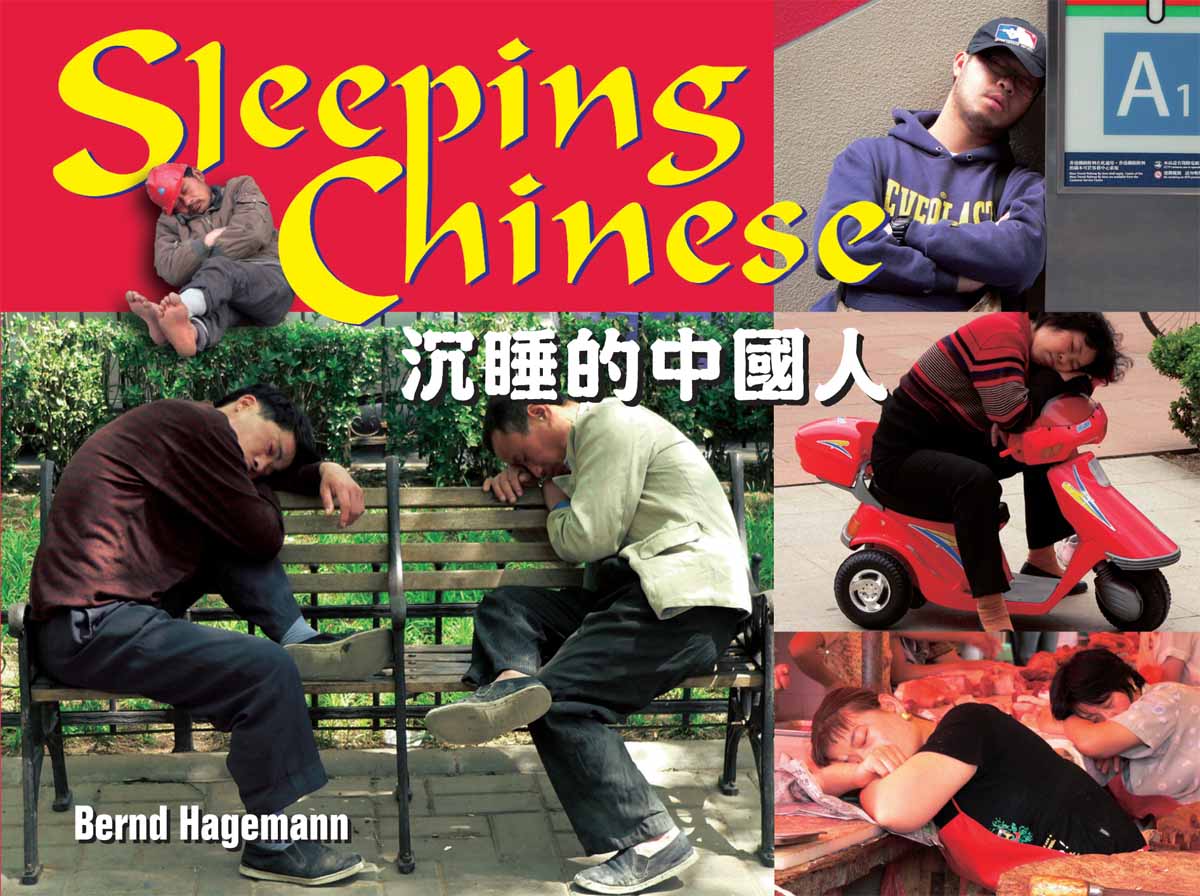
Sleeping Chinese is a fun little novelty item the exact same dimensions as a postcard that will leave you either laughing out loud or scratching your head in perplexity. The pages are divided into 3 parts: Hard Sleepers, Soft Sleepers and Group Sleepers, a clever allusion to China’s train carriage classification system.

Hard Sleepers: “Those who snooze in hard and uncomfortable places can fall asleep anywhere – even on a pile of bricks in a construction site!” Hagemann defines.

Witness, then, the dozens of people who have drifted into deep slumber atop stones, wood, mortar blocks, concrete and even cold slabs of raw meat. The most comical of the chapter being the dozing shoe repair man balancing precariously on a saw horse with an extra 2×4 for a pillow.

Soft Sleepers: “A little more fussy than their hard sleeper comrades,” the chapter intro explains, “fussy” meaning in plastic wash bins, hammocks slung under freight trucks, sleeping lengthwise across a motor scooter and even a laborer using a tape measure to cover his eyes.

Group Sleepers: “A traveling family needs no pillows when they have each other’s knees.” Truly, the photo of the family of five all huddled together like newborn puppies gives greater meaning to ‘jiating,’ China’s family unit.

Some Chinese might take offense to Hagemann’s photographic agenda, but anyone with a sense of humor will see that the book was made out of affection.

“I’d like to express my appreciation of the hard work and effort put in by migrant workers who play a central role in China’s success story but seldom receive the attention they deserve,” writes Hagemann.

Indeed, anyone who has spent quality time in China knows that these laborers, more than anyone else, deserve their rest — anywhere they can get it.

None of the snapshots in Sleeping Chinese were staged. Any foreign tourist in China who bothers to stray from his package tour group or get out of his hotel for a jaunt off the tourist trail will see these exact same sights, and more.

Incidentally, taking and publishing photos of sleeping Chinese people will often land a foreign tourist in hot water if caught by the authorities (the subjects themselves tend not to mind).

People’s Daily newspaper, the official mouthpiece of the Politburo, even attempted to put a socialist spin on Hagemann’s revealing imagery in an article about Sleeping Chinese: “If (we) are tired, (we) lie down anywhere and anytime and sleep. This shows (our) society’s accepting attitude.”

Regarding the western media’s scare tactics of China’s “waking dragon,” this reviewer is reminded by Sleeping Chinese of a particular song from old-school hip-hop artists Public Enemy (who I had occasion to watch perform during their 2007 tour through Beijing): Don’t Believe the Hype!

____________________

Travel photographer Tom Carter is the author of CHINA: Portrait of a People, a 600-page China photography book, available through Amazon.com

If you want to subscribe to iLook China, there is a “Subscribe” button at the top of the screen in the menu bar.


The Concubine’s Journey

January 17, 2011

In 1999, I was introduced to two dead people. One was a white guy from Ireland that died a hundred years ago and the other was Ayaou, a Chinese woman that was a mystery since Robert Hart tried to erase her from his personal history.

I’m fortunate that Hart failed and traces of Ayaou survived.

Since I was a child of seven or eight, I’ve been writing stories. They were short with lots of bad drawings.

Soon after I was honorably discharged from the US Marine Corps in 1968, I took my first writing workshop at a community college. Then Ray Bradbury came to the campus to speak and although I never read his work, what he said inspired me to never stop writing.

Although I did receive a few encouraging rejections through the decades and was represented by two or three reputable agents before Amazon.com and eBooks were born, nothing I wrote was picked up by a traditional publisher.

Believing I wasn’t good enough, I decided to learn more of the writing craft by earning a BA in journalism. An MFA with a focus in twentieth century American literature came much later.

Between earning the two college degrees, I drove about 150 miles one day each week for seven years to attend a workshop out of UCLA’s writing extension program.

The teacher was a chain smoker with an explosive tempter but she was sharp and several of the writers in her workshop went on to publish their work. When she felt one of her students was ready, she went all out and even found an agent for the author. She found one for me, but that’s another story.

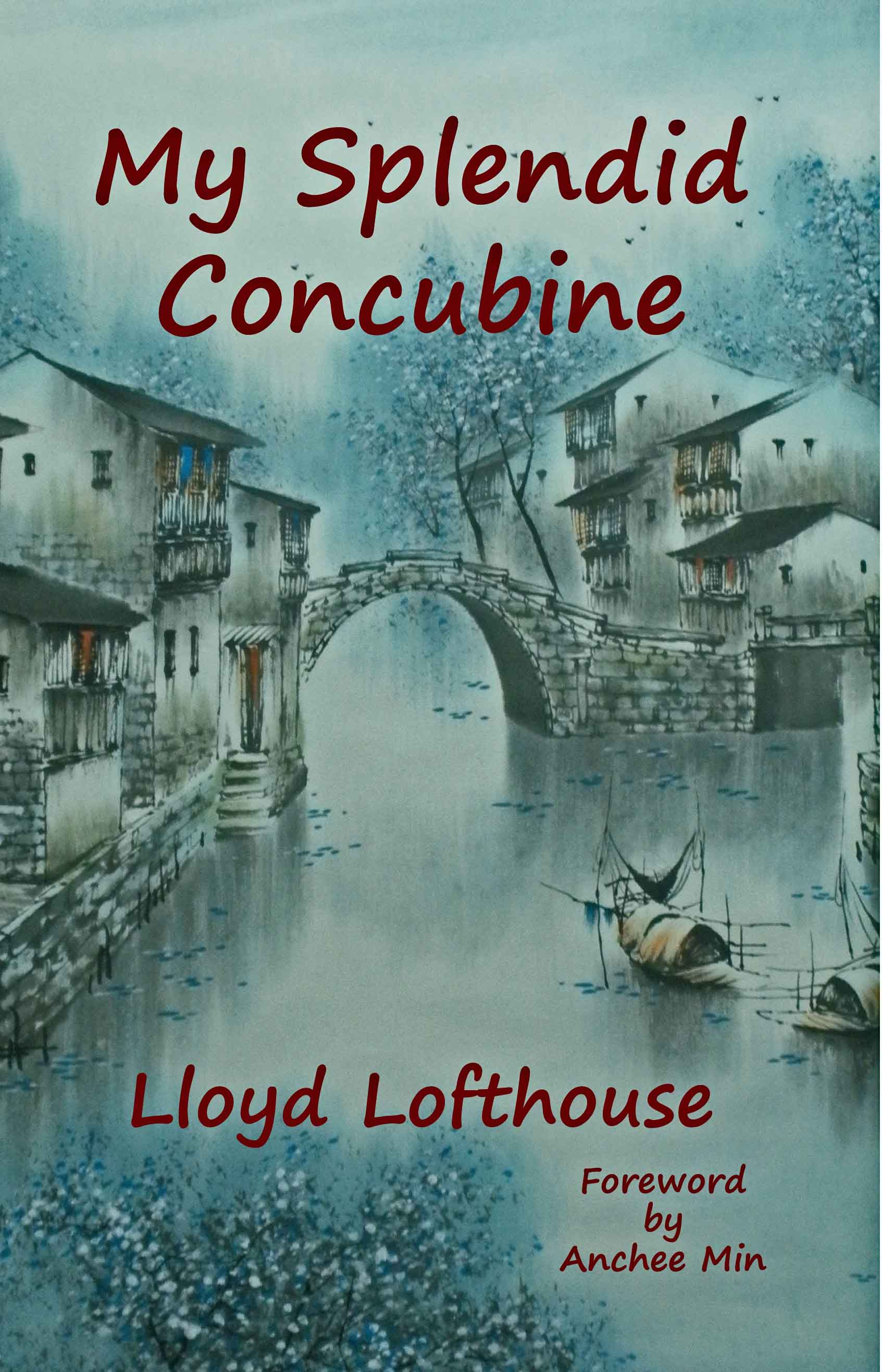
When I published My Splendid Concubine in 2008, I held my breath wondering if anyone would read it and enjoy the lusty, violent story of Robert Hart and Ayaou in the middle of 19th century China immersed in the smoke of the Opium Wars and the oceans of blood of the Taiping Rebellion.

On May 12, 2009, an Amazon reader, an anonymous person in Hong Kong, posted a one-star review of My Splendid Concubine.

The anonymous reader wrote, “As a great fan of Robert Hart’s, I was very eager to get my hands on this book. And what a huge disappointment it proved to be, for many reasons…”

One of those reasons was a “g” missing from one of five “Tang Dynasties” in the novel.

This one-star review was of the first edition. By the time it appeared on Amazon, the second revised edition was out and some of the anonymous reader’s complaints had been corrected.

In three years, My Splendid Concubine earned three honorable mentions in city book festival literary contests then Our Hart earned another four honorable mentions and became a finalist for a national writing award.

About a year ago, the sequel, Our Hart, was submitted to the 18th Annual Writer’s Digest Self-Published Book Awards.

Recently, an envelope arrived from Writer’s Digest.

Jessica Strawser, the editor of Writer’s Digest, wrote that the competition was particularly fierce this year…

Our Hart didn’t win.


This is the book trailer I produced in 2008 of the first edition of
My Splendid Concubine. My wife has been telling me I need a better one and to delete this version.


However, when you enter a book to this Writer’s Digest literary award, a judge writes a commentary of your work and ranks it for plot, grammar, character development, production quality and cover design, which helped dispel the criticism of that one-star review that discovered a missing “g” from one of five “Tang Dynasties” in My Splendid Concubine.

The Writer’s Digest judge, a professional in the publishing industry, awarded grammar a five with five being the highest score.

The judge wrote, “In Our Hart, Elegy for a Concubine, author Lloyd Lofthouse has penned an intriguing story set in an ancient Chinese dynasty. Political intrigue and matters of the heart are both fully explored. The book is meticulously researched and the author’s enthusiasm for his subject is evident.… The author has an ear for natural-sounding dialogue, making Our Hart an engaging read.… That said, readers who enjoy vicariously experiencing other times and cultures will find Our Hart a fascinating journey.”

______________

If you want to subscribe to iLook China, there is a “Subscribe” button at the top of the screen in the menu bar.


Sex, Sex, Sex as Reported by “The China Law Blog”

January 3, 2011

The China Law Blog posted a piece in August 2009 that I became aware of recently titled “A Western Woman in China….Sex, Sex, Sex????!!!!

Dan of The China Law Blog mentions a post at Gina in Shanghai, another Blog. He summarizes Gina’s post with “Chinese view Western women to be like the women in “Sex in the city”.

Then he finishes his brief post with a question “How do you feel about attitudes toward sex in China?”

Actually, I don’t think I have an opinion on that topic.

After all, how others behave or think is not my problem to carry around like a burden, as Gina seems to be doing.


Does this episode of “Sexy Beijing” hosted by Sufei support the “Sex in the City” Stereotype Gina is talking about?

Then I clicked on the link that took me to Gina in Shanghai to read her longer post.

I discovered that Gina is from Palo Alto in the US, which isn’t far from where I live in the East Bay.

Reading her post, I sensed her frustration but also saw her inability to accept others for who they are and what they believe. From what I’ve learned, 85% of an individual’s personality is formed by the environment he or she grew up in and only 15% comes from genetics.

In fact, the multitude of environments in China are very different from the US, where most people grow up as if they live in a jar expecting the rest of the world outside the jar to learn how to act and think like them as if all Americans were the same–isn’t that a reverse stereotype?

In her conclusion, Gina wrote, “There are frustrations with the way we are treated differently, and that the way we look comes associated with really heavy assumptions about our personality, our behavior, our way of life, and even our country…”

When I finished reading Gina’s post, I thought how Americans do the same thing to the Chinese—stereotype them with heavy assumptions about their personalities, their behavior, their way of life and even their country.

Most of those assumptions are supported by American politicians and the Western media and of course maybe individuals such as Gina when she says, “At first, I found these statements funny, but this quickly became something that made me incredibly angry and defensive. As a woman who is quite proud of my independence and my personal choices, I hated being pigeonholed into this ‘morally degenerate’ category. But it seemed like a losing battle…”

That poses a question—is there a double standard when it comes to sex or is it because women and men are different genetically and they grow up in different individual environments?

Shatter your stereotype of China (if you have one) and learn about China’s Sexual Revolution

______________

Lloyd Lofthouse is the award-winning author of the concubine saga, My Splendid Concubine & Our Hart. When you love a Chinese woman, you marry her family and culture too.

If you want to subscribe to iLook China, there is a “Subscribe” button at the top of the screen in the menu bar.


Sexy Beijing’s a Jew Brew

December 29, 2010

If you haven’t heard of it, Sexy Beijing (produced by Goldmines Film and Video Production since 2006) is an Internet TV station run by an in-house production team.

Sexy Beijing says “Our shows have also aired on NBC in Los Angeles, Hunan TV, China Educational TV, and many other stations around China as well as conferences around the world.”

I dare all Westerners that believe the Chinese are depressed and heavily censored to watch Sexy Beijing regularly to learn the truth of China.

Any censorship that exists in the media in China focuses on only a few topics such as the Dalai Lama and Tibetan or Islamic separatists that are considered the same as Islamic terrorists are to the United States.

In this episode of Sexy Beijing, Su Fei tries to please her mother and go for one of her own kind.

Sue Fei, the Jewish host of this segment, says, “Most people are surprised to find out just how multi-cultural Beijing is. And when it comes to a husband search, I could just as easily be bringing home an African or Muslim suitor to meet my Jewish mother as I could a Chinese one.”

Sue Fei then heads for the new Chabad Jewish community center in Beijing to find out what it would be like to become an Orthodox Jew.

Learn about Deep Family Roots

______________

Lloyd Lofthouse is the award-winning author of the concubine saga, My Splendid Concubine & Our Hart. When you love a Chinese woman, you marry her family and culture too.

If you want to subscribe to iLook China, there is a “Subscribe” button at the top of the screen in the menu bar.


China’s Vampires

December 25, 2010

Belief in vampires is not confined to the people of Transylvania, and half humans able to transform themselves into monsters are no strangers to Chinese folklore. Some tales may be traced back to the third century AD.

Since Bram Stoker’s Dracula was published in 1897, this makes a case that vampire folklore may have originated in China and traveled west along the Silk Road almost two thousand years ago.

The Chinese vampire is called a Jiang-shi (also spelled Kaing-shi or Chiang-shih). However, Chinese vampires are different from Dracula or Anne Rice’s vampires.

Chinese folklore says the Jiang-shi is stiffened by rigor mortis and these vampires have to hop to get around.  The Jiang-shi also finds its victims by smelling your breath, so if a hungry Jiang-shi is about, it is best to stop breathing.

In the 1980s, there was a series of vampire movies produced in Hong Kong. The first in the series was Mr. Vampire (you may watch Mr. Vampire here. For parts two through ten, scroll down to the embedded YouTube series at the bottom of this post).

 
Mr. Vampire – Part 1/10
with English subtitles

Ricky Lau directed Mr. Vampire and the producer was Sammo Hung.

Chopper Time says, “Almost all of these movies are pretty watchable, but the best of the bunch was the first one, an expert horror-comedy called Mr. Vampire.

There were a few Taiwanese vampire films, which include The Vampire Shows His Teeth (a series of three films (1984-1986), New Mr. Vampire (1985), Elusive Song of the Vampire (1987) and Spirit versus Zombie (1989).

Today, Vampires stories are becoming popular in mainland China. Tom Carter, an American author and expatriate living in China, says Twilight is a popular pirated novel and some Twilight fans are now writing their own fan-fiction and vampire stores in Chinese on their Blogs.

In fact, a shop called the Vampire opened its doors recently in Beijing to sell vampire, zombie, and werewolf blood along with Satan poison and UFO fuel.

In November 2010, the China Daily reported Blood Shop drawing a thirsty Crowd.

“The shop, which opened September 20, is reportedly the first of its kind in Beijing. The storefront also has a stained-glass window adorned with a miniature vampire model sucking blood from a cup held in his skeletal hand.”

Another excellent Chinese movie is Farewell My Concubine but there are no vampires in this film.

______________

Lloyd Lofthouse is the award-winning author of the concubine saga, My Splendid Concubine & Our Hart. When you love a Chinese woman, you marry her family and culture too.

If you want to subscribe to iLook China, there is a “Subscribe” button at the top of the screen in the menu bar.

______________

Mr. Vampire continued
with English subtitles


Mr. Vampire – Part 2/10


Mr. Vampire – Part 3/10


Mr. Vampire – Part 4/10


Mr. Vampire – Part 5/10


Mr. Vampire – Part 6/10


Mr. Vampire – Part 7/10


Mr. Vampire – Part 8/10


Mr. Vampire – Part 9/10


Mr. Vampire – Part 10/10