Climate Change and Development in Tibet Creates Lifestyle Challenges

July 17, 2018

In 1949, 99 percent of Tibetans were mostly illiterate serfs. Serfs have always been treated as an inferior element in society. As serfs, most Tibetans depended entirely upon the few landowners for survival. In this system of serfdom, peasants could be traded, punished without due process of law, and made to pay tribute to the lord with labor. When China occupied Tibet, all those serfs were freed just like they were throughout China.

Tibet is part of China. Rural Life in China reported, “A typical family of seven described by Business Week in 2000 lived in a four-room house, used 0.64 of an acre for growing rice, used 0.59 an acre for growing other crops and owned four pigs, one horse, and 20 ducks. Their expenditures were $546: $217 for food, $96 for transportation, $72 for fertilizer and pesticides, $48 for medicine, medical services, $36 for local taxes; $7 for road building and improvement; $4 for power station maintenance; $6 for education and culture and $60 for cloth and clothes.”

Did you notice there was no mention of rent or a mortgage payment? My mortgage payment in the United States is almost 38 percent of my income and a friend and his family of three pay more in rent for less space in the same area. But in urban China,, renting or owning a home is not free. Tibet is mostly a rural area of China.

“Since 2006, the Tibetan government has mandated that Tibetan farmers, herders, and nomads use government subsidies to build new homes closer to roads. New concrete homes with traditional Tibetan decorations dot the stark brown countryside. But the base government subsidy for building the new homes is usually $1,500 per household, far short of the total needed. Families have generally had to take out multiple times that amount in interest-free three-year loans from state banks as well as private loans from relatives or friends.” [Source: Edward Wong, New York Times, July 24, 2010]”

Even the lives of Tibetan Nomads that makeup about a quarter of the population is changing. “Tibetan nomads have a lot in common with Mongolian nomads. Tibetan nomad culture is quickly disappearing as more Tibetans each year are being relocated off of the grasslands.”  But that might have more to do with climate change.

Nature.com reports, “A comprehensive environmental assessment of the Plateau of Tibet has found that the region is getting hotter, wetter and more polluted, threatening its fragile ecosystems and those who rely on them.

The plateau and its surrounding mountains cover 5 million square kilometers and hold the largest stock of ice outside the Arctic and Antarctic; the region is thus often referred to as the Third Pole. And like the actual poles, it is increasingly feeling the effects of climate change, but rapid development is putting it doubly at risk and is also changing lifestyle choices.

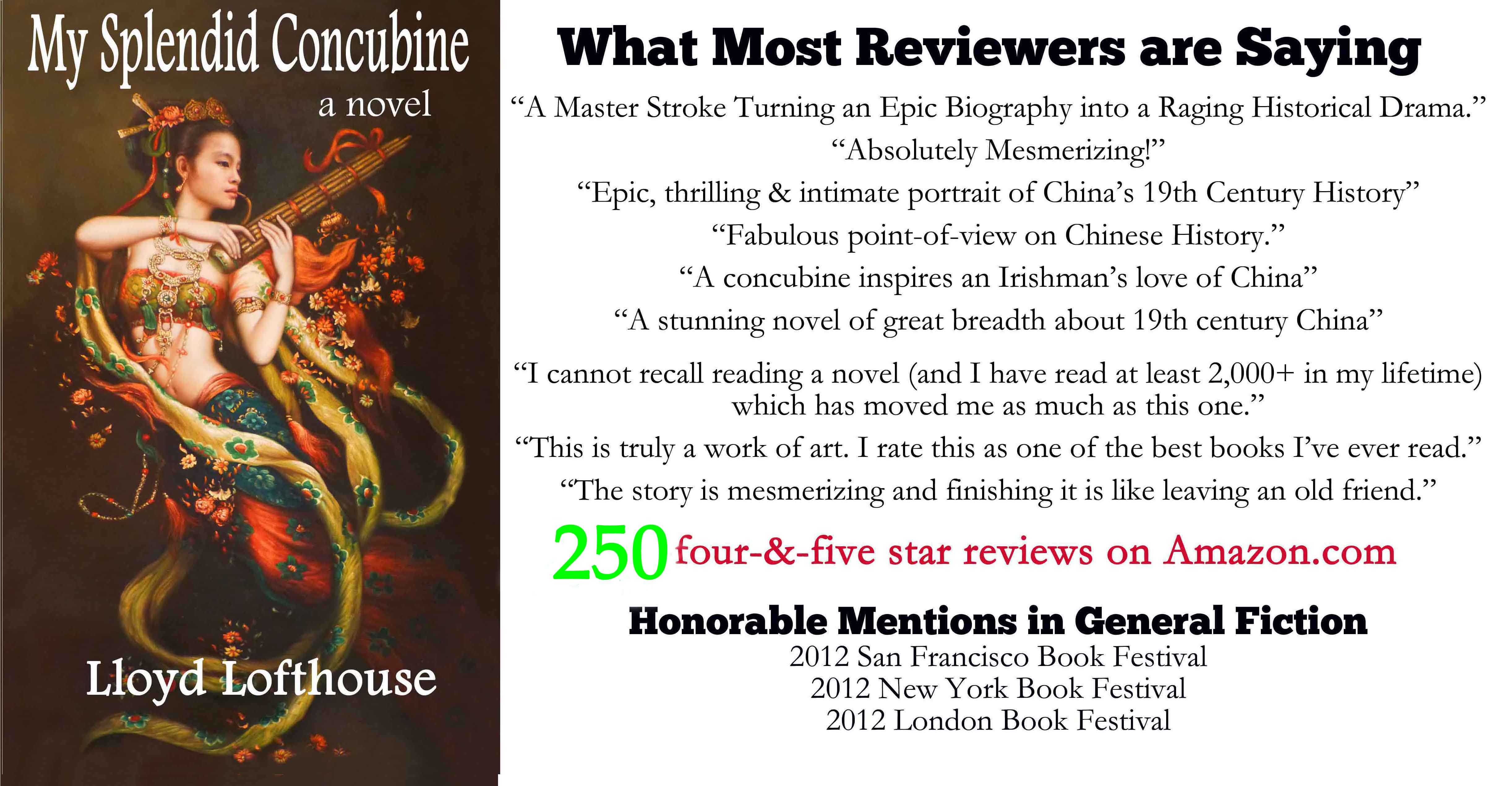
Lloyd Lofthouse is the award-winning author of My Splendid Concubine, Crazy is Normal, Running with the Enemy, and The Redemption of Don Juan Casanova.

Where to Buy

Subscribe to my newsletter to hear about new releases and get a free copy of my award-winning, historical fiction short story “A Night at the Well of Purity”.

About iLook China


The Most Popular Drink in the World originated in China and was stolen by the British

June 12, 2018

Tea is the most popular drink in the world second only to water. Its consumption equals all other manufactured drinks combined including coffee, chocolate, soft drinks, and alcohol, and China is still the leading tea producer in the world.

If you are interested in a real-life collision between the West and China early in the 19th century, I highly recommend reading Sarah Rose’s heavily researched nonfiction book For All the Tea in China: How England Stole the World’s Favorite Drink and Changed History.

In this book, you will discover that the British Empire and its merchants were successful, because they were more ruthless and devious than anyone else on Earth. When China’s last Dynasty collided with the British Empire, the Qing Emperors probably had no idea who they were dealing with.

The British Empire was the largest in history, and it covered more than thirteen-million square miles (20,921,472 square kilometers), which is about a quarter of the Earth’s total land area, and it controlled more than 500 million people, a quarter of the world’s population at the time.

What financed the brutal expansion of this empire?  In the 19th century the British Empire was not only a thief, but the largest drug cartel in human history. After all, it was the British that forced Opium on China and fought two Opium Wars to make that happen. How do you think the British paid for the expansion of their empire?

The real-life main character in Sara Rose’s fascinating, true, fact-based story is Robert Fortune (1812 – 1880) who successfully pulled off one of, if not the largest, act of corporate espionage and theft in history. This nonfiction book is about how the British stole tea plants and the method of producing tea from China and successfully transplanted this industry in India where the British were also growing the opium they were selling to the Chinese.

If you drink Darjeeling Tea from India, you are drinking a product that was stolen from China by Robert Fortune in the early half of the 19th century.

But there is much more to this story than the theft of tea from the country that has the earliest records of tea drinking dating back to the first millennium BCE, because this nonfiction book reads like a spy thriller. If caught, Fortune would have been executed by the Chinese. To pull off the biggest heist of all time, he disguised himself as Chinese and traveled to areas of China that no foreigner had ever visited before, and his only companions were Chinese that he had bribed to work for him.

Lloyd Lofthouse is the award-winning author of My Splendid Concubine, Crazy is Normal, Running with the Enemy, and The Redemption of Don Juan Casanova.

Where to Buy

Subscribe to my newsletter to hear about new releases and get a free copy of my award-winning, historical fiction short story “A Night at the Well of Purity”.

About iLook China


China was the Most Innovative Country in the World for Fifteen Hundred Years: Part 3 of 3

May 10, 2018

Another Chinese inventor during the Song Dynasty created a machine known as the Cosmic Engine, the ancient world’s astronomical computer.

Su Song was the inventor.  The Cosmic Engine was so complicated that for centuries no one (even Westerners) understood how it worked. Today, few westerners know that it existed.

However, records show that the Cosmic Engine was created in 1092 AD.

The Cosmic Engine calculated time—not just hours and minutes but weeks, months and seasons reflecting how the earth moves around the sun. It also calculated how the earth and planets moved through space.

The Cosmic Engine was five stories tall and its working innards were complex.

Today, we know exactly how this device was created since Su Song left detailed blueprints and directions describing how it was built. Song’s Cosmic Engine worked from the eleventh century until enemies of the Song Dynasty destroyed it.

Using Song’s blueprints, the Science and Technology Museum in Beijing built a fully accurate reconstruction. Another reconstruction exists in London.

This ingenious device led to the invention of Western clocks hundreds of years later, and we now know that many of the inventions and discoveries the modern world was built on originated in ancient Imperial China.

The Confucian method of meritocracy was (and still is) the engine that led to the creation of all of the Chinese innovations mentioned in this series of posts and this is only a sample.

The Chinese system of meritocracy then and now makes it impossible that anyone as weak or ignorant as George W. Bush or Donald Trump could ever come close to a position of top leadership.

Return to Part 2 or start with Part 1

Lloyd Lofthouse is the award-winning author of My Splendid Concubine, Crazy is Normal, Running with the Enemy, and The Redemption of Don Juan Casanova.

Where to Buy

Subscribe to my newsletter to hear about new releases and get a free copy of my award-winning, historical fiction short story “A Night at the Well of Purity”.

About iLook China


China was the Most Innovative Country in the World for Fifteen Hundred Years: Part 2 of 3

May 9, 2018

Modern ironworkers of today use the same method that ancient Chinese did, but today there is automation and we use electrical air pumps to feed the fire.

How did the ancient Chinese develop a method to drive enough air into a furnace to heat it to the necessary high temperatures? The Chinese used water to drive the bellows for a blast furnace. With these inventions, the groundwork was laid for other sophisticated machinery used in mass production.

One such invention in ancient China was an odometer designed to measure distance.  This device was known as the rangefinder chariot. A cart that was rolling along with troops measured every five hundred meters by banging a drum automatically.

This device was used to measure the distance to enemy camps and measure how far the troops had marched from a royal city.

What is amazing about this ancient odometer is that the gears match exactly those found in modern motorcycle engines.

There is also evidence of the application of gear engineering in eastern China on a massive industrial scale during the Song Dynasty (960 – 1276 AD).

We now know that the Chinese had huge factories capable of mass production.

Another ancient machine recently discovered is the hydraulic trip hammer and it is believed to have been developed two millennia ago. The texts from that time tell us that the huge machine was used to crush grain but also to pound metal the same way metal is still developed today.

The ancient Chinese then invented a more efficient way to grind grain-using millstones. However, the Chinese took this machine to an advanced level known as a multiple geared gristmill, which was also powered by water.

Nearly a thousand years later, the industrial revolution started in England.

Part 3 continues on May 10, 2018, or return to Part 1

Lloyd Lofthouse is the award-winning author of My Splendid Concubine, Crazy is Normal, Running with the Enemy, and The Redemption of Don Juan Casanova.

Where to Buy

Subscribe to my newsletter to hear about new releases and get a free copy of my award-winning, historical fiction short story “A Night at the Well of Purity”.

About iLook China


China was the Most Innovative Country in the World for Fifteen Hundred Years: Part 1 of 3

May 8, 2018

It is a common assumption (a guess) in the West that Europe and The United States invented the machines that power our modern lifestyles.

However, new discoveries from ancient China are forcing us to rewrite history.

While Europe was mired in the so-called dark ages, ancient China ruled supreme as the world’s technological super power, and we are discovering that many of the inventions that have shaped our modern world had their beginning in ancient China.

There were complex geared machines that allowed production on an industrial scale such as precision seismographs that detected earthquakes, drilling machines that bored for natural gas hundreds of meters beneath the earth, or a super-scale Cosmic Engine that not only told the time but also predicted the passages of the planets and the stars.

Some of these technologies were so complex, they remained a mystery for centuries.

Two thousand year old books show in detail things that are still needed today.

Another discovery from ancient China was drilling for oil. We assumed it was modern engineers that developed oil-drilling techniques. It wasn’t. They improved the techniques but did not invent the method.

History Lines.net reports, “The Chinese have used oil and gas for many centuries. There is no record of when Chinese began using natural gas, but clearly in Szechuan the local people were drilling down hundreds of feet into the earth to get natural gas and brine before the start of the Han Dynasty, before 400 B.C. The Chinese used bamboo pipelines to carry natural gas and mix it with air to yield a usable source of fuel for fires. … By the first century B.C., the technology of well-drilling had advanced, and Chinese engineers were able to dig down over 800 feet …”

During the Song Dynasty, China’s innovations reached their peak. Inventers and engineers were creating machines that wouldn’t be seen in the West for another thousand years.

Part 2 continues on May 9, 2018

Lloyd Lofthouse is the award-winning author of My Splendid Concubine, Crazy is Normal, Running with the Enemy, and The Redemption of Don Juan Casanova.

Where to Buy

Subscribe to my newsletter to hear about new releases and get a free copy of my award-winning, historical fiction short story “A Night at the Well of Purity”.

About iLook China