Seeing China through Multiple Lenses

October 29, 2013

Unsavory Elements edited by Tom Carter, the author of China: Portrait of a People, has twenty-eight short memoirs that offer a balanced view of China from expatriates who have lived and/or traveled there.

But the title almost misleads because not all of the authors come off as unsavory elements—most are there to learn and not to judge. Only a few of the stories in this collection were written by expatiates suffering from some form of sinophobia.

I also value books that teach and I think that many of the stories in Unsavory Elements did that refreshingly well.

For a few examples, first there was Paying Tuition by Matthew Polly who wrote: “One of the first things I had learned during my stay was that the Chinese love to negotiate. They love it so much that even after an agreement is reached, they’ll often reopen negotiations just so they can do it all over again.”

I have visited China many times and—unlike most Westerners—I enjoy negotiating, but I didn’t know about the reopening gambit. Next time, I may want to give that a try and extend the fun.

In Communal Parenting by Aminta Arrington, I learned that the “Chinese have a fundamentally different relationship with their history than we Westerners. History is a subject we study in schools,” and that history is not connected to who we are.

“Not so for the Chinese,” Arrington writes. “History here [in China] is not book knowledge. Rather, their history is carried along with them as they walk along the way, an unseen burden, an invisible shadow; unconscious, and therefore, powerful.”

Kaitlin Solimine in Water, For Li-Ming writes about the five-months she stayed in China as a teenager in a high school, home-stay program, and it was her first time outside of the United States. For those few months, Li-Ming was her Chinese mother.

Here is the gem that Solimine shares with us: “That’s the thing about Chinese mothers: hidden behind their maternal expectations and critical diatribes are women who will fight to the death for you. As soon as I called her Mama, Li-Ming would be my strongest ally for the only months I knew her.”

From Graham Earnshaw in Playing in the Gray we discover: “There were no rules. Or rather, there was only one rule: that nothing is allowed. But the corollary, which reveals the true genius of China’s love of the grey—in contrast to the black and white of the West—is that everything is possible. Nothing is allowed but everything is possible. It’s just a matter of finding the right way to explain what you’re doing.”

Reading Empty from the Outside by Susie Gordon we see that the “New China isn’t shackled with the Judeo-Christian Morals of the West.”

Some in the West may see this lack of Judeo-Christian morals in China as a bad thing but that depends on how deeply entrenched a Westerner is in fundamentalist Christian morality. China—believe it or not—does have a moral foundation that many in the West turn a blind eye to. If you are married to a woman who was born in China and grew up there during Mao’s puritanical repressive twenty-seven years as its leader, you might understand what I mean.

In conclusion, there is Tom Carter’s signature-title piece. In his short Unsavory Elements, Carter says in one passage, “Claude admittedly couldn’t care less about Chinese culture; he was simply, like so many other foreigners in China—myself included—aimless and desperate for an income.”

There is so much more to this book called Unsavory Elements than these few examples. If you are have an open mind that isn’t infected by sinophobia and you want a better understanding of the Chinese, I highly recommend this collection.

_______________

Lloyd Lofthouse is the award-winning author of My Splendid Concubine [3rd edition]. When you love a Chinese woman, you marry her family and culture too. This is the love story Sir Robert Hart did not want the world to discover.

His latest novel is the multiple-award winning Running with the Enemy.

Subscribe to “iLook China”!
Sign up for an E-mail Subscription at the top of this page, or click on the “Following” tab in the WordPress toolbar at the top of the screen.

About iLook China

 China’s Holistic Historical Timeline


Earning Gold from Dead Tibetan Caterpillars

October 9, 2013

Mary Jenkins writes in the May 2010 National Geographic about Tibetan cowboys and Chinese-made motorcycles in his Tea Horse Road piece unwittingly revealing the truth about Tibetan life under Chinese rule.

The Tibetan cowboys, who once used horses, now use motorcycles to tend their flocks. On the way to 17,756-foot Nubgang Pass, Jenkins passes the black yak-hair tents of Tibetan nomads, and sees big Chinese trucks or Land Cruisers parked outside. He wonders how poor Tibetans can afford such luxuries. Aren’t they supposed to be suffering?

I think, “Maybe they are smuggling drugs into China from India”.  As I read on, I learn I’m wrong.

On his way back from the pass, Jenkins discovers these Tibetan cowboys have found wealth in their high grasslands from parasite infected caterpillars called Yartsa Gompo in Tibet and Chong Cao in China.  These dead caterpillars sell to Chinese medicine shops throughout Asia for as much as 80 dollars a gram—more than the price for a gram of gold.

Why?

The Chinese and Tibetans think these dead caterpillars are a cure-all medicine that also acts as an aphrodisiac boosting sexual performance—just what China needs with its population of almost 1.4 billion.

_______________

Lloyd Lofthouse is the award-winning author of My Splendid Concubine [3rd edition]. When you love a Chinese woman, you marry her family and culture too. This is the love story Sir Robert Hart did not want the world to discover.

His latest novel is the multiple-award winning Running with the Enemy.

Subscribe to “iLook China”!
Sign up for an E-mail Subscription at the top of this page, or click on the “Following” tab in the WordPress toolbar at the top of the screen.

About iLook China

China’s Holistic Historical Timeline


The History of Chinese Poetry

October 2, 2013

Traditional Chinese Poetry is very similar to Western poetry.  Lines in Chinese poetry may have a fixed number of syllables and rhyme was required, so ancient Chinese poetry resembles traditional English verse and is not at all like the free verse in today’s Western culture.

Modern Chinese poets have written in free verse, but many still write with a strict form.

In the end, the form is not as important as what the poem says. Western poetry often focuses on love while painting an image of the poet as a lover.

Influenced by Confucius and Taoism, the ancient Chinese poet shows he or she is a friend—not a lover and often paints a picture of a poet’s life as a life of leisure without ambitions beyond writing poetry and having a good time.

According to legend, this Chinese poet killed himself to protest the corruption of the time, and it is said that the Dragon Boat Festival was named to honor his sacrifice.

Battle
By Qu Yuan (332-295 B.C.)

We grasp our battle-spears: we don our breastplates of hide.
The axles of our chariots touch: our short swords meet.
Standards obscure the sun: the foe roll up like clouds.
Arrows fall thick: the warriors press forward.
They menace our ranks: they break our line.
The left-hand trace-horse is dead: the one on the right
is smitten.
The fallen horses block our wheels: they impede the
yoke-horses?”

Translated by Arthur Waley 1919

Note: The translation process from Mandarin to English would insure that the fixed number of syllables and rhyme required  of a traditional Chinese poem in its original language would not survive, but the contextual meaning should.

Discover China’s Holistic Historical Timeline

_______________

Lloyd Lofthouse is the award-winning author of My Splendid Concubine [3rd edition]. When you love a Chinese woman, you marry her family and culture too. This is the love story Sir Robert Hart did not want the world to discover.

His latest novel is the multiple-award winning Running with the Enemy.

Subscribe to “iLook China”!
Sign up for an E-mail Subscription at the top of this page, or click on the “Following” tab in the WordPress toolbar at the top of the screen.

About iLook China

China’s Holistic Historical Timeline


Working in China

October 1, 2013

The China Law Blog compared China’s employment laws to those of the United States. Reading this post was a revelation, because I did not know that Chinese workers had more job protection—if not higher pay—than most U.S. workers, and I was curious how this came about.

I discovered the reason was due to the transition from state controlled to private owned businesses.  Since 1978—when China implemented its open-door policy—the country went from no privately owned small businesses to more than 10 million small to medium-sized private enterprises that represent about 90 percent of all businesses.

In addition, The Diplomat.com reports, “China’s private sector now comprises some 70% or more of China’s economy …”

And before anyone criticizes China for paying low wages to migrant factory workers who moved to the cities from rural China, Bloomberg says, “Rural spending power has been lifted by wages earned by peasants working in cities. “

“Wage levels in China [while low compared to the United States] have increased continually over the last two decades as the economy has developed and the private sector has created new employment opportunities. … In 2012, a total of 25 provinces increased their minimum wage by an average of 20.2 percent.”  Source: China Labour Bulletin

Prior to this transition, state workers didn’t have to worry about a job. Once the transition began, significant numbers of workers started losing jobs. Since China’s constitution says the government’s role is to serve the people, the government changed the laws to make it more difficult to fire a worker offering better job protection.

In fact, the Library of Economics and Liberty says, “China appears to have come through the world economic crises better than many countries. … As Europe and the United States slump, the CPC can speedily launch infrastructure projects or shift millions of migrant workers from one locality to another.”

“China’s employment law system is quite different from the U.S. The main difference is that the U.S. is an employment at will system, which means you can terminate employees at any time for pretty much any reason. China’s system is the opposite. The Chinese system is a contract employment system. … An employee can only be terminated for cause and cause must be clearly proved. … This whole situation makes the employment relationship and the employment documents much more adversarial than is customary in the U.S.” Source: China Law Blog

Discover China’s Holistic Historical Timeline

_______________

Lloyd Lofthouse is the award-winning author of My Splendid Concubine [3rd edition]. When you love a Chinese woman, you marry her family and culture too. This is the love story Sir Robert Hart did not want the world to discover.

His latest novel is the multiple-award winning Running with the Enemy.

Subscribe to “iLook China”!
Sign up for an E-mail Subscription at the top of this page, or click on the “Following” tab in the WordPress toolbar at the top of the screen.

About iLook China

China’s Holistic Historical Timeline


Lin Yutang explains Christianity from a Chinese viewpoint

September 26, 2013

Lin Yutang (1895 – 1976) was a Chinese writer, translator, linguist and inventor. He was one of the most influential writers of his generation. In 1933, he met Pearl S. Buck in Shanghai and she introduced him, and his writings to her American publisher.

For most Chinese the end of life lies not in life after death, for the idea that we live in order to die, as taught by Christianity, is incomprehensible, nor in Nirvana, for that is too metaphysical, not in the satisfaction of accomplishment, for that is too vainglorious, nor yet in progress for progress’ sake, for that is meaningless.

The true end, the Chinese have decided in a singularly clear manner, lies in the enjoyment of a simple life, especially the family life, and in harmonious social relationships.

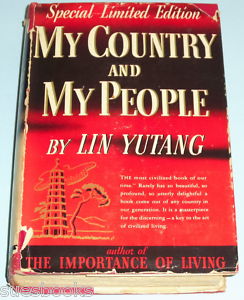
My Country and My People by Lin Yutang

“The Chinese are a nation of individualists. They are family-minded, not social-minded…. It is curious that the word society does not exist as an idea in Chinese thought. In the Confucian social and political philosophy we see a direct transition from family, ‘chia’, to the state, ‘kuo’, as successive stages of human organization.…

lin-yu-tang

Lin Yutang

“The Chinese, therefore, make rather poor Christian converts, and if they are to be converted they should all become Quakers, for that is the only sort of Christianity that the Chinese can understand. Christianity as a way of life can impress the Chinese, but Christian creeds and dogmas will be crushed, not by a superior Confucian logic but by ordinary Confucian common sense. Buddhism itself, when absorbed by the educated Chinese, became nothing but a system of mental hygiene, which is the essence of Sung philosophy.” Source: My Country and My People, Lin Yutang. Halcyon House, New York. 1938. Pgs 94; 101; 103; 172, and 108

Discover China’s Holistic Historical Timeline

_______________

Lloyd Lofthouse is the award-winning author of My Splendid Concubine [3rd edition]. When you love a Chinese woman, you marry her family and culture too. This is the love story Sir Robert Hart did not want the world to discover.

His latest novel is the multiple-award winning Running with the Enemy.

Subscribe to “iLook China”!
Sign up for an E-mail Subscription at the top of this page, or click on the “Following” tab in the WordPress toolbar at the top of the screen.

About iLook China

China’s Holistic Historical Timeline