Three times George Washington acted in a way that would insure the newly born US Republic would survive.
His first act was in 1782, when Colonel Lewis Nicola wrote a letter to Washington suggesting that Washington should set up a constitutional monarchy because of the inefficiency of the Continental Congress.
Washington was offended at such a suggestion and wrote to Nicola telling him to banish such thoughts from his mind. George Washington – Legends and Myths
His second act took place in 1783, when he stepped in and saved the republic by ending the Newburgh Conspiracy, a plot in the military to seize power and create a military dictatorship. Source: Early America
The third act was when Washington stepped down as President (1789 – 1797) and returned to his farm.
When King George III asked his American painter, Benjamin West, what Washington would do after winning independence, West replied, “They say he will return to his farm.”
“If he does that,” King George said, “he will be the greatest man in the world.” Cato Institute
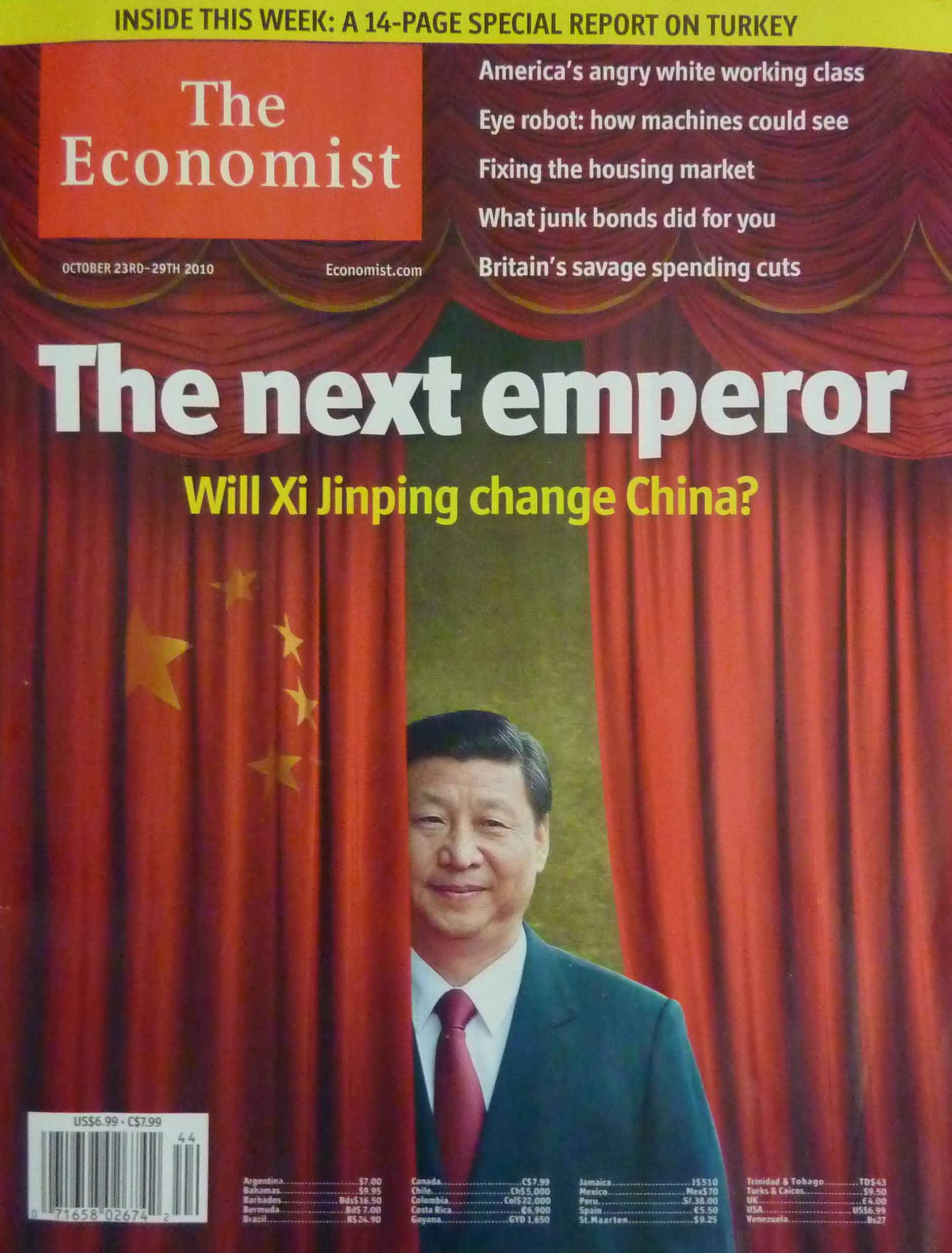
The cover of The Economist for October 23, 2010—in the best tradition of biased and Yellow Journalism—SHOUTED: “The next emperor – Will Xi Jinping change China?”
As I read the feature article on page 13, I laughed when I saw, “Mr. Xi’s appointment was eerily similar to the recent anointment of Kim Jong-un in North Korea.”
The reason I saw humor in this absurd statement was that there is nothing similar. Kim Jong Un inherited his for-life position as Supreme Leader of North Korea. He is the son of Kim Jong-il, and the grandson of Kim Il-sung, the founder of North Korea.
In Part 2 of this series that will appear on December 11, 2014, I will explain the difference between China’s one-party authoritarian Republic, and why it isn’t a dictatorship or a monarchy.
Lloyd Lofthouse is the award-winning author of My Splendid Concubine [3rd edition]. When you love a Chinese woman, you marry her family and culture too. This is the love story Sir Robert Hart did not want the world to discover.
Subscribe to “iLook China”!
Sign up for an E-mail Subscription at the top of this page, or click on the “Following” tab in the WordPress toolbar at the top of the screen.
Turkey is a fowl the Chinese seldom eat. However, eating duck and chicken is common. Duck is even considered a delicacy. In fact, the Unvegan says, “No trip to Beijing is complete without eating some Peking Duck.”
Since I am a vegan, I didn’t eat Peking Duck, but I watched my wife eat it at Quan Ju De (Peking Duck) in Beijing.
The Virtual Tourist says, “It is thought that Beijing roast duck, like the tradition of roast turkey in America and the UK, owes its origin to the roast goose that is still popular in Europe on festive occasions.”
Most Americans do not celebrate the Chinese New Year (the Spring Festival) and most Chinese do not celebrate Thanksgiving. After all, Thanksgiving is an American holiday that Canadians celebrate too but on the second Monday in October.
Thanksgiving in Beijing with Peking Duck
China.org says, “From 2001 to 2005, China imported 486,000 tons of turkey, with all of the whole turkeys and 90 percent of Turkey parts coming from the US…. Currently, 70 to 80 percent of the consumers are Westerners.”
I’m assuming that Westerners eating turkey in China are there working, as tourists or are expatriates living in the Middle Kingdom and can’t do without turkey on Thanksgiving in October or November.
If you are from North America in China during Thanksgiving, you have a choice between Peking Duck, which is easy to find, and turkey.
Go China says, “Just head to your local international grocery store (Jenny Lu’s in Beijing, Cityshop in Shanghai) and stock up on all the fixings: frozen Butterball turkeys, cranberry sauce and pumpkin pie makings. But you better do it fast, there tends to be a run on these items so if you’re shopping on the last Thursday in November, you’ll be out of luck.”
And maybe I should have posted this before Thanksgiving day. :o)
_______________
Lloyd Lofthouse is the award-winning author of My Splendid Concubine [3rd edition]. When you love a Chinese woman, you marry her family and culture too. This is the love story Sir Robert Hart did not want the world to discover.
Subscribe to “iLook China”!
Sign up for an E-mail Subscription at the top of this page, or click on the “Following” tab in the WordPress toolbar at the top of the screen.
I’m sure that most people outside of China don’t think of love poems when they think of China. However, there has to be a reason for more than 1.3 billion people, other than the Great Wall of China, the Pacific Ocean and the biggest mountain range on the planet, the Himalayas, which helped shelter China from some of the violence that rocked the rest of the world for centuries—at least until the Opium Wars.
For poetry lovers, Chinese Love Poetry imparts a sense of the private passion that beats in the Chinese heart. The three arts of poetry, calligraphy and painting, the Triple Excellence, are represented on the pages.
The following painting, lady weeping at parting from husband, 17th century, comes from the Qing Dynasty and the book says it is a color woodblock print on paper.
Chinese poetry is frequently personal and often linked to a particular occasion (page 9).
Deeply in love, but tonight
we seem to be passionless;
I just feel, before our last cup of wine
a smile will not come.
The wax candle has sympathy –
weeps at our separation:
Its tears for us keep rolling down
till day breaks.
by Du Mu (803-852 AD)
As you can see, the Chinese are a passionate people—they just don’t dramatize these passions publicly as many Westerners do—at least until the West invaded China to force—if possible—a different set of values on China’s collective culture.
_______________
Lloyd Lofthouse is the award-winning author of My Splendid Concubine [3rd edition]. When you love a Chinese woman, you marry her family and culture too. This is the love story Sir Robert Hart did not want the world to discover.
Subscribe to “iLook China”!
Sign up for an E-mail Subscription at the top of this page, or click on the “Following” tab in the WordPress toolbar at the top of the screen.
Jingyun Dagu is a form of Chinese opera where stories are often sung in a Beijing dialect accompanied by a drum along with one or two other musical instruments.
The focus is on the singing that depicts stories in short episodes.
Dagu was first popular near the end of the Qing Dynasty (1644-1911).
One super star of Dagu was Luo Yusheng, who was born in 1914, and died at 89 in 2002. Her stage name was Xiao Caiwu. She studied under Su Huanting at the age of nine in order to play Laosheng (old man) roles in Peking Opera. At 14, she gave performances in singing without musical accompaniment in Nanjing, before she formally switched to Jingyun Dagu at the age of 17.
In 1934, Luo Yusheng studied at the Liu School of Jingyun Dagu (storytelling in Beijing dialect while beating a drum, accompanied by two or three persons who play three-stringed instruments).
At one time she was well known by most of China, and her fans called her the Queen of the Golden Voice.
After the PRC was founded in 1949, Dagu singers were regarded as people’s artists or actors, who sang traditional stories and new operas with themes reflecting contemporary life. For instance, patriotic Communist stories like Glorious Journey, Red Flag Over Mount Everest, and Patriotism and Roaring Waves.
The singer/drummer is often accompanied by the Sihu (a four-stringed instrument similar to an Erhu) and Pipa (lute) in addition to three-stringed lutes and wooden clappers. China Culture.org.
_______________
Lloyd Lofthouse is the award-winning author of My Splendid Concubine [3rd edition]. When you love a Chinese woman, you marry her family and culture too. This is the love story Sir Robert Hart did not want the world to discover.
Subscribe to “iLook China”!
Sign up for an E-mail Subscription at the top of this page, or click on the “Following” tab in the WordPress toolbar at the top of the screen.
The closest celebration in China to Halloween in the United States is The Hungry Ghost Festival, which is celebrated the 14th or 15th night of the 7th lunar month in July or August.
The Ghost Festival, also known as The Hungry Ghost Festival, is a traditional Chinese festival and holiday celebrated by Chinese in many countries, in which ghosts and/or spirits of deceased ancestors come from the lower realm and/or hell to visit the living.
Buddhists from China and Taoists claim that the Ghost Festival originated with the canonical scriptures of Buddhism, but many of the visible aspects of the ceremonies originate from Chinese folk religion, and other local folk traditions (see Stephen Teiser’s 1988 book, The Ghost Festival in Medieval China).
In America, most children wear costumes and go door to door collecting free candy. In China, food is offered to dead ancestors, joss paper is burned and scriptures are chanted.
Chinese Culture.net says the Hungry Ghost Festival is “Celebrated mostly in South China, Hong Kong, Taiwan and especially in Singapore and Malaysia… It is believed by many Chinese that during this month, the gates of hell are opened to let out the hungry ghosts who then want food.
By comparison, History.com says, “Halloween’s origins date back to the ancient Celtic festival of Samhain (pronounced sow-in). The Celts, who lived 2,000 years ago in the area that is now Ireland, the United Kingdom and northern France, celebrated their new year on November 1. This day marked the end of summer and the harvest and the beginning of the dark, cold winter, a time of year that was often associated with human death. Celts believed that on the night before the New Year, the boundary between the worlds of the living and the dead became blurred.”
I found it interesting that the dead linked both America’s Halloween and The Chinese Hungry Ghost Festival—at least historically.
As a child, I loved wearing a costume on Halloween and going out “trick-or-treating” at night to return home with a heavy bag (usually a pillowcase) filled with candy.
I still remember how much my stomach hurt and how terrible I felt after gorging myself on all that free candy.
Today, due to the epidemic of diabetes and overweight or obese children in the United States, I do not celebrate Halloween and do not give candy to children. The last time I gave treats to children on Halloween, I handed out small boxes of raisins (sweet dried grapes) instead of candy, and one mother called me cheap.
But Science Daily.com comes to my defense with: “Teenagers who consume a lot of added sugars in soft drinks and foods may have poor cholesterol profiles—which may possibly lead to heart disease in adulthood, according to first-of-its-kind research reported in Circulation: Journal of the American Heart Association.”
In addition, the Centers for Disease Control and Prevention reported, “Teenagers and young adults consume more sugar drinks than other age groups and have been linked to poor diet quality, weight gain, obesity, and, in adults and children, type 2 diabetes.”
Then the Mayo Clinic said, “Type 2 diabetes used to be called adult-onset diabetes. But type 2 diabetes in children is on the rise, fueled largely by the obesity epidemic,” and the American Diabetes Association says, “25.8 million children and adults in the US have diabetes while 79 million have prediabetes.
“Due to excessive sugar consumption, the risk of diabetes may lead to heart disease, stroke, high blood pressure, blindness, kidney disease, nervous system disease, and/or amputation of feet and legs.”
Americans are Addicted to Sugars
To be fair, I can’t leave out the for-profit candy and costume industry in the U.S. that salivates when Halloween arrives. For instance, Forbes reported that consumers spent $1.96 billion on decorations, $360 million on greeting cards, $2.08 billion on candy and $2.6 billion on costumes. Consider that next time you go out shopping for Halloween candy, you’re helping make the rich wealthier at the cost of your child’s health.
In fact, Americans should learn something from the Chinese Hungry Ghost Festival. Do not feed sugary candy to children. Instead, give the sugar to the dead and eat an apple—because there’s a lot of truth to the old saying that if you eat an apple a day, it will help keep the doctor away. And if you doubt that, then I suggest you read this post on Science Daily.
Lloyd Lofthouse is the award-winning author of My Splendid Concubine [3rd edition]. When you love a Chinese woman, you marry her family and culture too. This is the love story Sir Robert Hart did not want the world to discover.
Subscribe to “iLook China”!
Sign up for an E-mail Subscription at the top of this page, or click on the “Following” tab in the WordPress toolbar at the top of the screen.


 Posted by Lloyd Lofthouse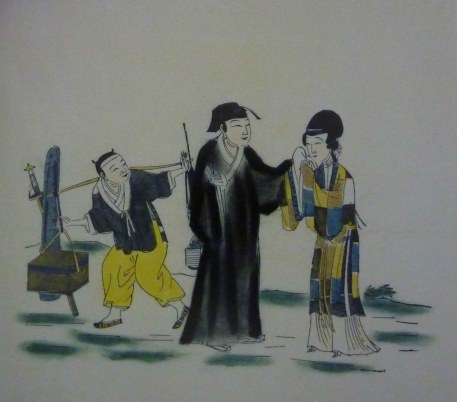
 iLook China