What does it mean to Eat Bitterness and be Asian in the United States?

December 8, 2015

On April 25, 2011, Nadra Kareem Nittle wrote, Are U.S. Universities Discriminating Against Asian Students? The answer to Nittle’s question was and still is YES.

In the US, since the Civil Rights era preferential treatment favored African-Americans and Latinos since Asian-Americans tend to swallow their bitterness instead of protesting violently as the other minorities have done.

For example, the NAACP says it fights for social justice for all Americans. However, facts demonstrate that the NAACP tends to favor legislation that focuses on benefits for African Americans. If this were not true, there would be no need for political organizations to serve Latinos and Asian-Americans.

In fact, Africana Online said, “The National Association for the Advancement of Colored People (NAACP) has been instrumental in improving the legal, educational, and economic lives of African Americans.” There was no mention of the other minorities that suffer from racism in the U.S.

However, Latino Political Clout is growing in the U.S. to challenge the NAACP’s clout. The recent US Census indicated Latinos continue to become a larger ratio of the American population. With growing numbers will come political and social changes to the country.

But we know that the number of votes a minority such as African-Americans, Latinos and Asian-Americans deliver during an election results in political influence, and it’s obvious that blacks are winning when it comes to clout because a higher ratio of blacks vote than whites, Latinos and Asians.

For instance, in 2012, a larger percentage of blacks—66% of eligible black voters—voted than whites (64.1%). In contrast, Latino voters tend to turn out in slightly lower ratios than blacks or whites. Asians, on the other hand, are not voting like they could. According to Pew Research.org, only three in ten Asian American eligible voters cast ballots in midterm elections.

As demonstrated, Asian American political organizations have a long way to go to catch up to African-American and Hispanic or Latino political influence.

Is this because Asian and Chinese Americans are crippled by the influence of their cultures when it comes to increasing political influence in the U.S. since Chinese parents teach their children to eat bitterness?

In China, the tradition to “eat bitter” has been passed down from generation to generation. “Eat bitter” is a literal translation of Chinese "吃苦", which refers to endure hardship including discrimination without complaint or protest.

The 2014 Census 2014 census revealed that minority influence is not equal since there are about 42.1 million African-Americans, 55.5 million Hispanic or Latino Americans and only 17.1 million Asian Americans, who turn out to vote in lower ratios. Numbers count and it helps that Latinos and African-Americans do not eat bitterness like most Asians do.

I think that the Asian cultural aspect of “eating bitterness” has been influenced by Taoism, Buddhism and Confucius while in the West the warlike and often-violent religions of Christianity and Islam did not follow the same path.

______________________________

Lloyd Lofthouse is the award-winning author of My Splendid Concubine [3rd edition]. When you love a Chinese woman, you marry her family and culture too. This is the lusty love story Sir Robert Hart did not want the world to discover.

IMAGE with Blurbs and Awards to use on Twitter

Where to Buy

Subscribe to “iLook China”!
Sign up for an E-mail Subscription at the top of this page, or click on the “Following” tab in the WordPress toolbar at the top of the screen.

About iLook China

China’s Holistic Historical Timeline


The Popular Street Art of Chinese Calligraphy

December 2, 2015

Chinese calligraphy is demonstrated in the videos included with this post. In China, many artists use sidewalks as a canvas and a brush with water to paint the beauty of calligraphy. As the water evaporates, the art vanishes.

In fact, calligraphy is more popular than ever. After the Cultural Revolution (1966 until 1976 when Mao died), many people turned to calligraphy in the hope of finding solace in the calm repetition of its exercises. Then, in 1981, the Chinese government took the lead in setting up a Chinese Calligraphers Association, the first such nationwide body ever to be established in the country.

Both a language and an art, Chinese calligraphy has been traced back more than 4,000 years to the crude form called “Jia Gu Wen” found on turtle shells from the Shang Dynasty.

Calligraphy first bloomed as an art during the Han Dynasty but by the time of the Tang Dynasty, it had declined as an art. > Chinese Calligraphy History

It would be difficult to talk about Chinese art without understanding Chinese calligraphy and its artistic inspiration. A painting has to convey an object, but a well-written character conveys only its beauty through line and structure.

In Shanghai on sidewalks, or Beijing at The Summer Palace, I’ve watched men with long handled brushes, as seen in the first video, using water for ink and concrete for paper. With grace, they exhibit the skills of a Rembrandt breathing life into the characters.

America’s so called street artists should copy the Chinese that practice calligraphy and trade in their cans of spray paint for brushes and water, which would save US taxpayers a lot of money.

Lin Yutang writes in My Country and My People that Western art is more sensual, more passionate, fuller of the artist’s ego, while the Chinese artist and art-lover contemplates a dragonfly, a frog, a grasshopper or a piece of jagged rock—more in harmony with nature.

Owing to the use of writing calligraphy with a brush, which is more subtle and more responsive than the pen, calligraphy as art is equal to Chinese painting.

Through calligraphy, the scholar is trained to appreciate, as regards line, qualities like force, suppleness, reserved strength, exquisite tenderness, swiftness, neatness, massiveness, ruggedness, and restraint or freedom.

Maybe this helps explain why the Chinese are not as warlike as Christian and Islamic cultures.

______________________________

Lloyd Lofthouse is the award-winning author of My Splendid Concubine [3rd edition]. When you love a Chinese woman, you marry her family and culture too. This is the lusty love story Sir Robert Hart did not want the world to discover.

#1 - Joanna Daneman review posted June 19 2014

Where to Buy

Subscribe to “iLook China”!
Sign up for an E-mail Subscription at the top of this page, or click on the “Following” tab in the WordPress toolbar at the top of the screen.

About iLook China

China’s Holistic Historical Timeline


California’s Chinese during the Gold Rush: Part 2 of 2

November 25, 2015

Guest post by John Putnam

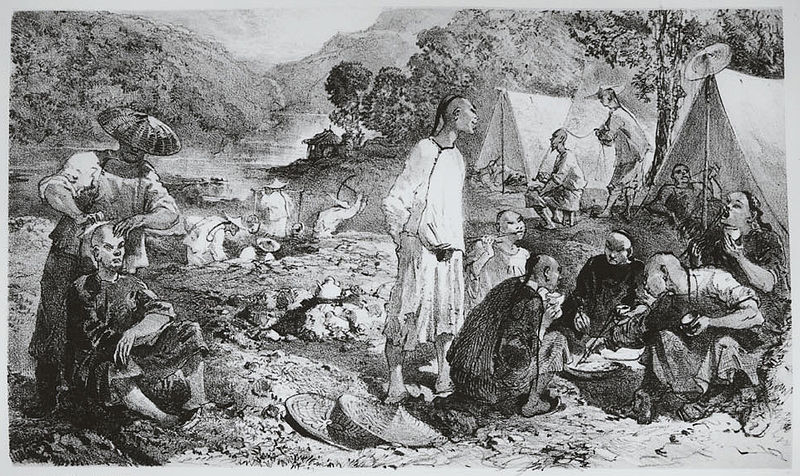
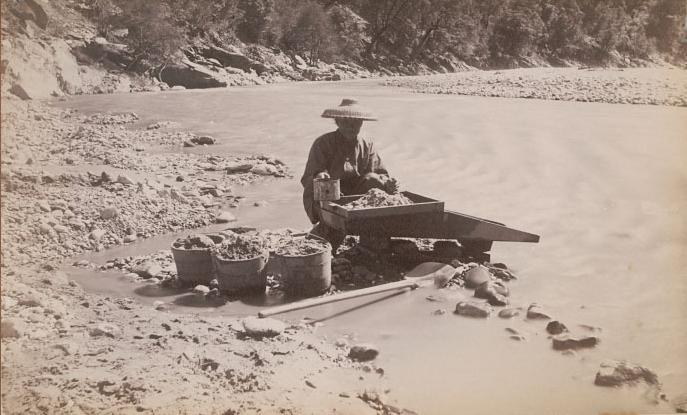
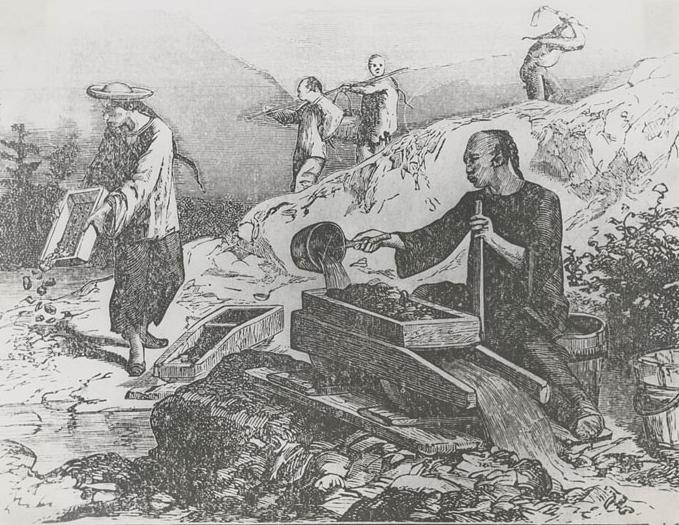
In the mines the Chinese were often forced to work sites that others had abandoned as no longer productive and, by hard work, made these claims pay.

As more men arrived in the gold fields and the amount of surface gold dwindled, tensions increased. Thirty-five Chinese showed up at Camp Salvado in 1849 where men from El Salvador had worked and here they found rich placer deposits.

White miners soon arrived and pushed the Chinese out, but they were taken in at another nearby site called Camp Washington where still more gold was found

Chinese flocked to a place where they were accepted and Tuolumne County’s Chinese Camp survives to this day.

But by 1850, a $20 per month tax on each foreign miner was imposed.

By 1852 Chinese were forced from Mormon Island and Horseshoe Bar along the American River, then from Colombia in the southern mines and Yuba City in the northern.

In 1856 Chinese paid $70,000 for the right to mine in Mokelumne Hill.

By 1868 almost all Chinese had left the mines to work on the transcontinental railroad or in Chinese operated businesses.

Return to or start with  Part 1

____________________

Reprinted by permission.
First published May 23, 2011 in My gold rush tales.
John Rose Putnam is the author of four novels.

The River of Corn

Where to Buy

To subscribe to “iLook China”, look for the “Subscribe” button at the top of the screen in the menu bar, click on it then follow directions.


California’s Chinese during the Gold Rush: Part 1 of 2

November 24, 2015

Guest post by John Putnam

Of all the diverse peoples that poured into California after the discovery of gold, none stood out more than the Chinese. Radically different in dress, language and culture these new men were first welcomed because of their willingness to work hard for low wages at any task presented them.

John McDougall, the 2nd Governor of California, described them as “one of the most worthy of our newly adopted citizens.”

At the start of 1849 only 54 Chinese were in California. By1852 there were nearly 12,000 living here and only seven of them women. Because of turmoil in Canton another 20,000 would arrive that same year.

A community of Chinese Americans quickly grew in San Francisco. They marched in Fourth of July parades and rejoiced at California’s statehood, but celebrated their lunar new year in their traditional way.

In 1852 a Cantonese opera was performed at the American Theater and in 1854 a Chinese language newspaper began publishing.

The Kong Chow Association formed to help the new arrivals adapt to their new home. Then another, the Chew Yick, elected Norman As-sing, an English speaking owner of the Macao and Woosung Restaurant as their leader. Soon there were six associations called tongs that combined to form the Six Companies to better represent Chinese interest.

Continued on November 25, 2015 in Part 2

____________________

Reprinted by permission.
First published May 23, 2011 in My gold rush tales.
John Rose Putnam is the author of four novels.


The River of Corn

Where to Buy

To subscribe to “iLook China”, look for the “Subscribe” button at the top of the screen in the menu bar, click on it then follow directions.


Is Guanxi China’s Cultural System of Grass Roots Business and Justice?

November 17, 2015

In lieu of a Western style legal system for most of China’s history, Guanxi offered an alternative for thousands of years to foster innovation, develop trust and contribute to trade and commerce.

Sir Robert Hart (1835 – 1911), the godfather of China’s modernization and the main character in my historical fiction novel, discovered the importance of Guanxi soon after he left the employ of the British and went to work for the Emperor.  He quickly learned that a “supreme value of loyalty glued together China’s structure of personal relationships.” Source: Entering China’s Service

In addition, Hart wrote in a letter in 1891, “These people (referring to the Chinese) never act too soon, and, so far, I have not known of their losing anything by being late. To glide naturally, easily and seasonably into the safe position sequence as circumstances make, is probably a sounder though less heroic policy for a state than to be forever experimenting—”

To translate, it takes time to develop a relationship/friendship/trust (Guanxi) that all involved might benefit from.


Warning: This is a Promotional Video. However, it offers a perspective on Guanxi worth watching.

However, I did not learn about Guanxi from Robert Hart. I first learned of it from the China Law Blog, which quoted the Silicon Hutong Blog.

Then I did more research and watched a few videos on the subject. I learned that Guanxi is one of those complexities of Chinese culture that does not translate easily.

There are several elements and layers to Guanxi. First, Guanxi is based on a Confucian hierarchy of familial relationships, long-term friendships, classmates, and schoolmates and to those no stranger – Chinese or foreign – will ever have access.

Guanxi developed over millennia because China did not have a stable and effective legal system similar to the one that developed in western countries.

In fact, the legal system in China today is relatively new and made its appearance after the 1982 Chinese Constitution became the basis of the law.

Since 1982, there have been several amendments to the Constitution as China adapts its evolving legal system, which was modeled after the German legal system.

In time, this Western influenced legal system may replace Guanxi since business law modeled on Western law with Chinese characteristic has developed faster than civil law.

There are a several opinions about Guanxi. I learned that Guanxi is similar to a gate that opens to a network of human beings, but it isn’t that simple.

Maintaining Guanxi is different than how relationships are maintained in other cultures. The embedded videos with this post offer a more detailed explanation.

The China Law Blog copied the post from the Silicon Hutong Blog. The post on the China Law Blog had more than twenty comments and it was a lively discussion worth reading if you are interested in discovering more.

______________________________

Lloyd Lofthouse is the award-winning author of My Splendid Concubine [3rd edition]. When you love a Chinese woman, you marry her family and culture too. This is the lusty love story Sir Robert Hart did not want the world to discover.

IMAGE with Blurbs and Awards to use on Twitter

Where to Buy

Subscribe to “iLook China”!
Sign up for an E-mail Subscription at the top of this page, or click on the “Following” tab in the WordPress toolbar at the top of the screen.

About iLook China

China’s Holistic Historical Timeline