Quality Wine from China

February 16, 2016

The World Bank reports, “In 1981, private sector employment accounted for 2.3 million workers, while state-owned enterprises (SOEs) had 80 million workers. Twenty years later, the private sector accounted for 74.7 million workers, surpassing, for the first time, the 74.6 million workers in SOEs.”

In addition, Bloomberg.com said, “Many of the world’s richest self-made women are Chinese,” and Psychology Today.com tells us, “Women own more than 40% of private businesses in China.”

Meet one of those women. Judy Leissner was 24 when she became the CEO and President of 168-acre Grace Vineyard in Shanxi province, south of Beijing after she quit her job at Goldman Sachs.

The first grape-vine plantings were in 1997 and the first vintage in 2001. Judy started the winery because her father liked to drink. Today, Judy produces a quality wine—about 700,000 bottles annually.

Most people do not know that quality wine is produced in China. In fact, Judy has competition because, according to the International Organisation of Vine and Wine, China now has the second-largest vineyard area worldwide after Spain, pushing France into third position.

Judy says there is an opportunity in China to make a lot of money in a short period of time, because the country is developing and growing.

The difference between the wine market in China and the rest of the world is that most drinkers in China must drink because they have to. It’s part of the culture of doing business and developing guanxi.

Grape Wall of China.com visited Grace Vineyard in September 2011, and Jim Boyce says he visited Grace CEO Judy Leisser, and he reported, “About a week ago, she sent an email that the wines Grace bottled under screw cap earlier this year are doing fine and, if all goes well with final trials, the winery will switch closures this year for its entry level and premium level wines. Grace’s Premium Chardonnay ranks among the better Chinese wines and is found in top hotels and restaurants in Beijing and Shanghai.”

______________________________

Lloyd Lofthouse is the award-winning author of My Splendid Concubine [3rd edition]. When you love a Chinese woman, you marry her family and culture too. This is the unique love story Sir Robert Hart did not want the world to discover.

#1 - Joanna Daneman review posted June 19 2014

Where to Buy

Subscribe to “iLook China”!
Sign up for an E-mail Subscription at the top of this page, or click on the “Following” tab in the WordPress toolbar at the top of the screen.

About iLook China

China’s Holistic Historical Timeline


What would you be willing to do to Enhance your Beauty?

February 10, 2016

According to historical accounts, foot binding appeared in China during the Sung Dynasty (960-1276 AD).

The process of foot binding often started between the ages of four and seven. Feet were soaked in a blood and herb mixture. Toes were broken. Then the arch was broken. There was extreme pain since no pain relief was used. It is estimated that in a thousand years about two billion women went through the process.

Manchu women did not bind their feet, and the Manchu leaders of the Qing Dynasty (1644 to 1911 AD) attempted, but with little success, to stop foot binding among the mostly Han (the majority in China) women who continued the practice.

In 1928, the Nationalist government announced plans to do away with foot binding. This attempt to end foot binding met with mixed success. In rural areas, large feet were still considered unattractive and unacceptable and the practice of foot binding continued.

While working in China for National Geographic Magazine on a three part Marco Polo series, Michael Yamashita, a veteran photographer, went in search of women who had bound feet. He found them living in remote urban villages. Yamashita’s book Marco Polo: A Photographer’s Journey was published April 5, 2011.

Even in 19th century San Francisco, there were Chinese girls and women with bound feet. Source: Virtual Museum of the City of San Francisco

In most of China, like all countries, social and sexual customs resist rapid change. For millions of women, the practice would continue until 1949 when the Chinese Communist Party came to power under Mao. That is when the popularity of foot binding to enhance a woman’s beauty—according to the men who wanted women to suffer for what they thought was beauty—ended.

______________________________

Lloyd Lofthouse is the award-winning author of My Splendid Concubine [3rd edition]. When you love a Chinese woman, you marry her family and culture too. This is the unique love story Sir Robert Hart did not want the world to discover.

#1 - Joanna Daneman review posted June 19 2014

Where to Buy

Subscribe to “iLook China”!
Sign up for an E-mail Subscription at the top of this page, or click on the “Following” tab in the WordPress toolbar at the top of the screen.

About iLook China

China’s Holistic Historical Timeline


China’s Ancient Capital: Part 3 of 5

January 28, 2016

From the Qin Dynasty (221 – 206 BC) to the Tang Dynasty (618 – 907 AD), 62 emperors ruled China from Qin Xianyang and Han Chang’an. The China Daily reported that there are about 500 burial mounds where the remains of emperors and aristocrats rest.

The largest tombs mark the resting place of Emperors Qin Shi Huangdi (259 – 210 BC), Tang Gaozong (628 – 683 AD), and his wife Empress Tang Wu Zetian (624 – 705 AD).

Map of China showing location of Chang'an

When I mentioned Neville Gishford’s documentary, China’s Most Honourable City, in Part 2, Chang’an was the capital of the Tang Dynasty with a population of over a million — six times the size of ancient Rome.

The Daming Palace, where the Tang Emperors ruled China, was 800 years older and nearly five times larger than Beijing’s Forbidden City, and this huge palace was built in one year.

However, it wasn’t the Daming Palace that made Chang’an powerful. Long before Manhattan, Hong Kong, Paris and Dubai, Chang’an was where the world came to shop.

Over a thousand years ago, the wealth of the West poured into China and arrived at Chang’an over the Silk Road.

But wealth wasn’t the only thing China gained. Major religions also arrived in China at this time.

Islam was barely a century old when Silk Road traders brought this religion to Chang’an. In another post, A Road to the Hajj from China, I wrote, “The ancient city of Xi’an in Shaanxi province is home to about 60,000 ethnic Chinese Muslims.”

Chang’an and Xi’an have a Muslim history going back thirteen hundred years when Islam was first introduced to China in 650 AD.

In fact, the oldest mosque in China was built in 685-762 AD in Chang’an during the reign of Emperor Xuanzong of the Tang Dynasty.

Continued on January 29, 2016 in Part 4 or Return to Part 2

______________________________

Lloyd Lofthouse is the award-winning author of My Splendid Concubine [3rd edition]. When you love a Chinese woman, you marry her family and culture too. This is the unique love story Sir Robert Hart did not want the world to discover.

#1 - Joanna Daneman review posted June 19 2014

Where to Buy

Subscribe to “iLook China”!
Sign up for an E-mail Subscription at the top of this page, or click on the “Following” tab in the WordPress toolbar at the top of the screen.

About iLook China

China’s Holistic Historical Timeline


China’s Ancient Capital: Part 2 of 5

January 27, 2016

In Part One, I mentioned the subway system under construction in modern Xi’an.  That was in September 2008.

For an update, Travel China Guide.com says, “The Xi’an subway system is scheduled to have 6 lines, with a total length of 251.8 kilometers… While the first phase of subway Line 2 has been in use since Sep 16, 2011, the other five lines are designed to be finished in 2018 in sequence.”

When the second phase is completed, the full length of Line 2 will be 26.64 kilometers (about 16.5 miles).

The population of Xi’an has also increased since Neville Gishford hosted The Discovery Channel’s documentary of China’s Most Honourable City. Today, there are more than 8 million people living there.

Gishford’s documentary started with Archaeologist Charles Higham (born 1939), a world famous authority on ancient Asian cities. Higham is a British archaeologist most noted for his work in Southeast Asia. Among his noted contributions to archaeology are his work (including several documentaries) about the Angkor civilization in Cambodia, and his current work in Northeast Thailand. He is a Research Professor at the University of Otago in Dunedin, New Zealand.

Higham said, “A delegation of jugglers from Roman Emperor Marcus Aurelius (161-180 AD, who is regarded as one of the greatest emperors in Roman history) traveled and performed in the Han Court of Chang’an.”

More than two thousand years ago, the walls of Chang’an were made of rammed (compressed) earth and much of the city from kiln fired clay bricks, which was a revolutionary building material at the time that changed the history of architecture.

The builders of Han Chang’an used this new technology in revolutionary ways. For instance, building an underground sewer system connected to the moat that surrounded the city.

Continued on January 28, 2016 in Part 3 or Start with Part 1

______________________________

Lloyd Lofthouse is the award-winning author of My Splendid Concubine [3rd edition]. When you love a Chinese woman, you marry her family and culture too. This is the unique love story Sir Robert Hart did not want the world to discover.

IMAGE with Blurbs and Awards to use on Twitter

Where to Buy

Subscribe to “iLook China”!
Sign up for an E-mail Subscription at the top of this page, or click on the “Following” tab in the WordPress toolbar at the top of the screen.

About iLook China

China’s Holistic Historical Timeline


China’s Ancient Capital: Part 1 of 5

January 26, 2016

China’s Ancient Capital: Part 1 of 5

Most people outside of China only know of Beijing—first known as Peking—as the capital of China. However, another city was China’s capital for more than a thousand years, and more than 4,000 historical sites and tombs have been excavated there.

That city was Chang’an and it served as the capital of China from the Han to the Tang Dynasty spanning more than eleven hundred years. It was also the cultural center of the Silk Road.

In 2008, the last time we visited Xi’an (near the original site of Chang-an), subway construction was running behind schedule due to a law that does not allow the destruction of historical sites such as the tombs of emperors.  There are so many of these tombs below ground that the subway tunnels must be diverted to avoid them causing construction delays.


This is the first part of a documentary about Xian produced by the Discovery Channel. I watched the five-part series on You Tube in 2011 but only found Part 1 to share with this series of Blog post.

To learn about Chang’an and Xi’an’s also teaches us a lot about China’s civilization.

In the Discovery Channel’s documentary, Neville Gishford said, “It (Han Chang’an) was more powerful than Rome. If any Roman army had actually gone there, they would have been absolutely annihilated.”

The city of Han Chang’an was larger than Constantinople and richer than Egypt’s Alexandria.

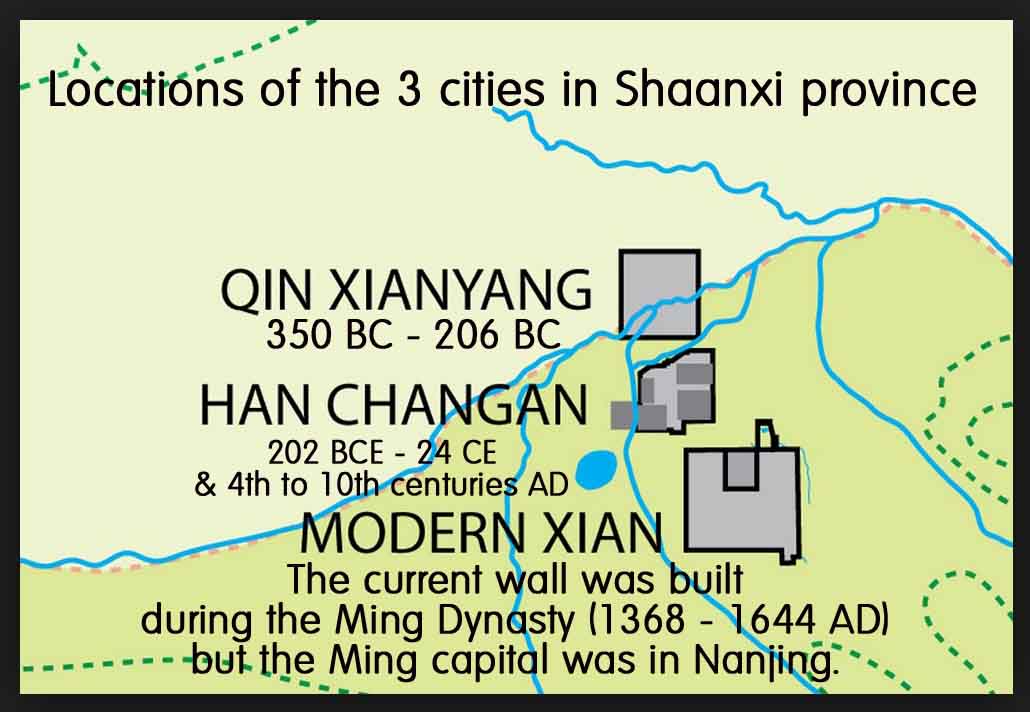
The three cities of Xian

Today, another city called Xi’an, near the original location of Chang’an, is home to millions of people and thousands of men made of clay, the Terra Cotta Warriors guarding China’s first emperor.

In addition, the current massive city wall for Xi’an is more than six hundred years old and longer than 12 kilometers. Cracks are appearing and an engineering team keeps close watch and makes repairs

Soon after the Qin Dynasty capital of Xianyang was destroyed, the Han Dynasty built the second city Chang’an, which is close to the modern city of Xi’an, and the old eroding walls of Chang’an are still visible.

Covering 36 square kilometers, Han Chang’an (202 BCE – 24 CE and again in the 4th to 10th centuries AD) was more than one and a half times the size of Rome.

Continued January 27, 2016 in Part 2

______________________________

Lloyd Lofthouse is the award-winning author of My Splendid Concubine [3rd edition]. When you love a Chinese woman, you marry her family and culture too. This is the unique love story Sir Robert Hart did not want the world to discover.

#1 - Joanna Daneman review posted June 19 2014

Where to Buy

Subscribe to “iLook China”!
Sign up for an E-mail Subscription at the top of this page, or click on the “Following” tab in the WordPress toolbar at the top of the screen.

About iLook China

China’s Holistic Historical Timeline