What Came First, the Blog or the Book?

April 29, 2020

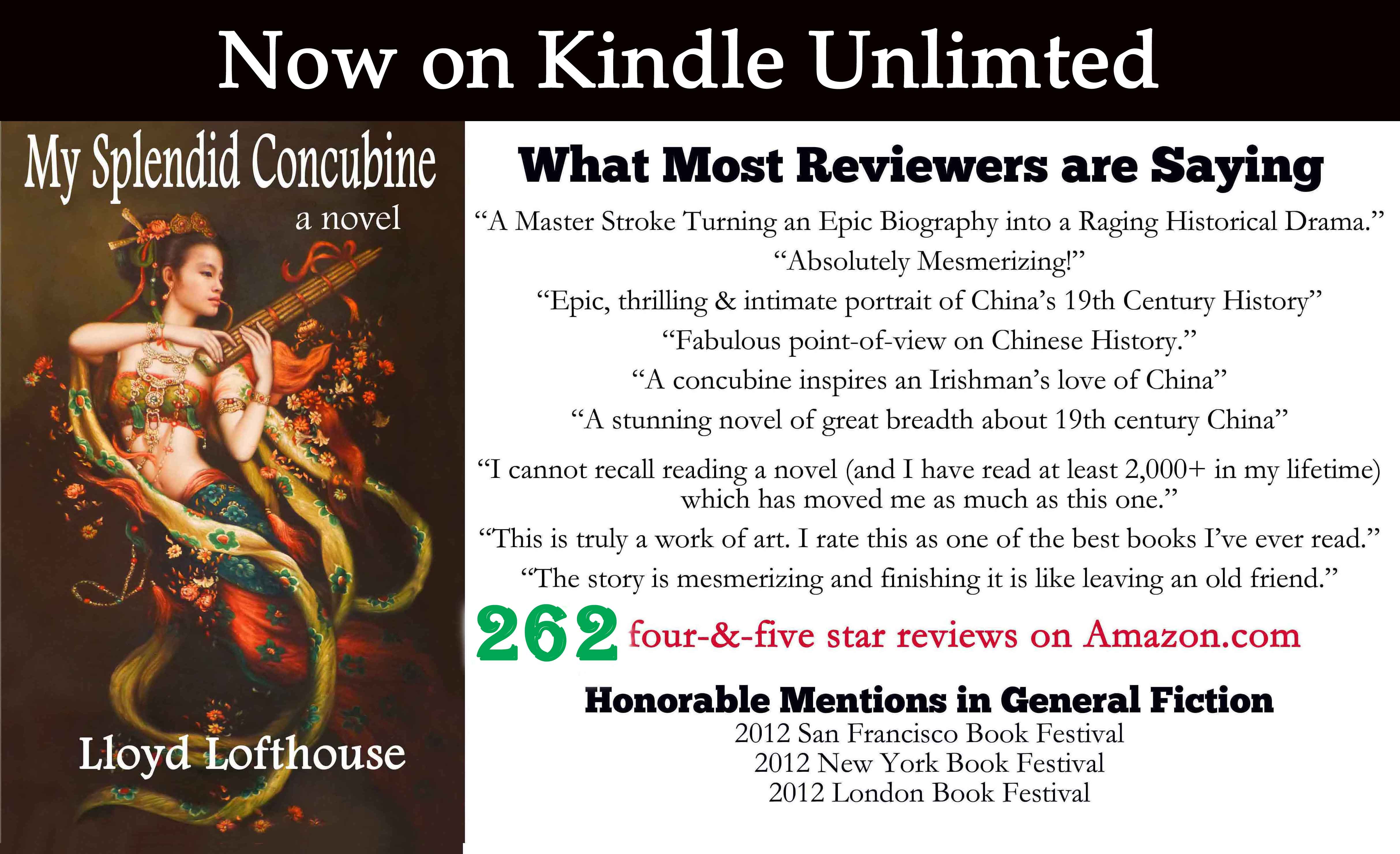
The reason I launched iLookChina in January 2010, was to build a social media platform to attract readers for “My Splendid Concubine”, my first published novel, and it worked. The 1st edition of the book was released in December 2007 and two years later the novel had sold 562 copies. By New Years of 2010, another 2,375 copies had been sold thanks to the blog. Fast forward a decade to February 2020, and Concubine has reached 64,399 readers (more if their copies were loaned to friends and family), and that is not counting the near quarter-million page reads through Kindle Unlimited.

This journey did not start in 2007. It started December 1999, when Anchee and I visited China together for the first time on our honeymoon. By then, I had already I started the nine years of research, writing, editing and revisions that led to the novel.

By the end of 2007, I thought I knew a lot about China. I could not have been more wrong. The truth was I didn’t know much at all as I was soon to discover.

That brings me to 2009, when I was a member of the California Writers Club (the 2nd oldest writers club in the United States), and I took an all-day workshop through the South Bay Branch of the club where we learned what we had to do to attract interested readers for our books.

Without word-of-mouth, readers are not going to find our books. We had to find the readers first.

In that workshop, we were told not to write about being writers as many authors do, but to write about something our book was a small part of. For me, that meant China. The instructor said if we wanted to be found on the first page of a Google search we had to publish 1,000 posts in the first year. I went home and did everything I had learned in that workshop and started posting three times a day until I hit the one thousand mark. Good thing I was a retired teacher by then, because that turned out to be more than a full-time job. After reaching 1,000 posts, I slowed down to one new post a day for the next few years before I ended up where I am now, once a week.

The first post was American Hypocrisy published on January 28, 2010. The first paragraph says, “Why am I writing about China? Simple—many Americans do not respect the differences between cultures. They say they do, but I don’t believe them. During the 2008-2009 school year, our daughter returned home one day to tell us that her history teacher talked about China and said the people had to be very depressed to live under a totalitarian government like the Communists.”

While China has an authoritarian one-party government, it isn’t a totalitarian state like North Korea, not even close, and I never met any Chinese depressed by their government during my trips to China. In fact, Shanghai turned out to be the Paris of Asia, a colorful, thriving city filled with life.

The day I launched the blog, I had been married to Anchee Min for a decade and had visited China nine times with my family to learn more about the country, its culture, and people, and even that wasn’t enough.

Long before the end of 2010, I ran out of stuff to write about by the time I reached the hundredth post. Most of what I knew about China was what I had learned while writing that historical fiction novel set in the middle of the 19th century. It was based on a true story and the main character was an Irishman named Robert Hart who was 19 when he arrived in China in 1854. Beginning as a student interpreter in the consular service, Hart arrived in China at the age of 19 and stayed for 54 years, except for two short leaves in 1866 and 1874. Hart has been credited as the most important and most influential Westerner in Qing dynasty China.

I had to learn more about China, or the blog was going to die a slow death. I started studying China’s history going back thousands of years. I wrote about the Great Wall, the Grand Canal, the first emperor, the different dynasties, the best emperors, the worst emperors, the inventions that came out of China, Chinese medicine, Daoism Confucianism, Buddhism, and the food, et al.

I also learned about China’s 1911 revolution, and Dr. Sun Yat-sen, known today as the Father of the Nation, both in Taiwan and Mainland China. Sun had been sent by his family to go to school in Hawaii as a boy where he learned about the U.S. Constitution. He returned to China as a young man and joined the revolution to replace the Qing Dynasty with a republic modeled on the United States but adapted to fit Chinese culture.  After several failures, Sun successfully recruited the Chinese Communist Party (CCP), the Nationalist Party, and other smaller parties to work together and form a multi-party republic.

Then Dr. Sun Yat-sen died unexpectedly in 1925 before the job was done, and the alliance he had built fell apart starting China’s long and brutal Civil War (1927 – 1949). The CCP did not start that Civil War. Chiang Kai-shek did that when he formed an alliance with the criminal triad gangs in Shanghai to destroy the newly forming labor unions and the young Chinese Communist Party that was organizing the unions. Without warning, Chiang Kai-shek’s troops, with help from Shanghai’s ruthless criminal triads, hunted down and executed, without trials, every member of the Communist Party they could find and the leaders of the labor unions along with the workers that had joined the unions.

To keep publishing posts and attracting readers interested in learning more about the real China, I had to keep learning, but I couldn’t do that by turning to the misleading, biased propaganda that often gets published and broadcast about China in the U.S. media. I had to find material published before 1911 and from other academic sources like from Australia, and the media from other countries like the BBC, France 24, and Al Jazeera English, headquartered in Doha, Qatar.

Since iLookChina’s launch, there have been more than 2,434 posts (most of them researched and written by me), 4,966 comments, and 802,366 hits (visitors). Sometimes I have paid a price when a China hating American accuses me of being an evil Communist and a traitor to the United States, because I strive to reveal the real China and not the fabricated one we often read about in the U.S. Media.

Lloyd Lofthouse is the award-winning author of My Splendid Concubine, Crazy is Normal, Running with the Enemy, and The Redemption of Don Juan Casanova.
Where to Buy

About iLook China


Who was the Real Anna May Wong?

April 22, 2020

Anna May Wong was born an American citizen on January 3, 1905, and died February 3, 1961. She was the first Chinese-American movie star and the first Asian-American actress to gain international fame.

On March 1, 2003, Bill Moyers reported, Anna was American-born, confident in ways her father’s generation could never be, still she lived suspended between two countries, starting with how people saw her.

“Americans regard [us] as a dark, mysterious race,” Anna May once said, “impossible to understand. Why is it that the screen Chinese is always the villain? And so crude a villain — murderous, treacherous, a snake in the grass. I was so tired of the parts I had to play.”

In fact, because if the films she appeared in, she became known as The Woman that Died a Thousand Times.

By the time she was 32, and an established Hollywood star, in August 1937, Japan invaded Shanghai. Anna’s younger sister was living there at the time and managed to escape, but their family couldn’t get out. In 1938, Anna managed to get her family back in the United States. Then she started working with Chinatown communities to get rid of the Chinese Exclusion Act.

Five years later in 1943, this racist legislation that targeted Chinese was repealed.

The Exclusion Act (1882 – 1943) made it virtually impossible for Chinese to have a normal family life inside the United States. The Exclusion law applied to Chinese laborers. It exempted merchants, travelers and students. What this meant to the Chinese who could not become a merchant, and what it meant was not a student or a traveler what it meant was that he could not bring his wife. – Stanford Lyman (Historian)

As a young girl, Anna skipped school to watch silent films at local theaters. By the time she was 9, she had set a goal to become a movie star.  She hung around the studios, including MGM, asking for extra work instead of going to school. Eventually, she landed some rolls. At 17, it’s rumored that she had an affair with an older but married director.

In 1924, at 19, Anna had her first success when she played a Mongol slave in the classic film “The Thief of Bagdad” cast alongside Douglas Fairbanks.

According to Cal Van Vechten’s daughter, Anna May had a brief affair with co-star Vincent Price. – Anna May Wong: From Laundryman’s Daughter to Hollywood Legend, page 164. While acting on stage in Turandot, she also had a brief affair with her costar. – Vincent Price: A Daughter’s Biography, page 77.

The first Chinese film star in Hollywood, the rolls she could play were limited. The Hays Code did not permit the portrayal of interracial relationships on-screen. However, Anna’s rumored lovers, from Vincent Price to Marlene Dietrich, were white, and Douglas Fairbanks called her the “Chink in my amour”. Her most famous movies were denounced as “ghost films” and banned in China. – The Fortunes by Peter Ho Davies.

Lloyd Lofthouse is the award-winning author of My Splendid Concubine, Crazy is Normal, Running with the Enemy, and The Redemption of Don Juan Casanova.

Where to Buy

About iLook China


China’s Wild Elephants

April 8, 2020

According to 2017’s Great Elephant Census, there are, “352,271 African savanna elephants in 18 countries, down 30% in seven years.”

The BBC reports, “There are around 40,000-50,000 elephants left in Asia, and like African elephants they are listed as endangered on the IUCN Red List. The number of Asian elephants has declined by at least 50% in the last three generations. … on 1 January 2018, China banned domestic ivory trade – a historic move shutting down the world’s biggest legal ivory market. A number of other countries, including the UK and Thailand, have also begun taking steps to try and ban the sale of ivory.”

However, while other wild elephants population in the world are down, China is the only country where numbers are on the rise, but don’t celebrate yet. There are only 200 – 250 wild elephants in China.


“In the past 20 years, the number of Asian elephants in southwest China’s Yunnan Province has more than doubled when elephant populations all over the world are decreasing and under threat. China’s conservation efforts are seen as an international wildlife and environmental success story.”

Eleaid.com says, “China’s elephants are only found in the extreme south of the Yunnan province, bordering Burma and Laos. Their range includes Xishuangbanna (XSNB) and the Nangunhe Nature Reserves.

“The elephant is a protected species in China and the government has taken steps to conserve areas of elephant habitat including moving people out of the reserves in a bid to minimize human-elephant conflict.

“Chinese officials have reported that the population is growing through both reproduction and immigration of herds from Laos. This is attributable to the lack of a threat from poachers in China and the abundant availability of fodder. …”

The existence of elephants in ancient China appears in both archaeological evidence and in Chinese artwork. Long thought to belong to an extinct subspecies of Asian elephants, … they lived in Central and Southern China before the 14th century BC, more than 3,000 years ago. Elephants ranged as far north as Anyang, Henan in northern China.

Today, tourists may see wild elephants in Gajah Liar Valley. “There are wooden houses built in tall trees that offer a safe place to watch. — China Travel.com

Lloyd Lofthouse is the award-winning author of My Splendid Concubine, Crazy is Normal, Running with the Enemy, and The Redemption of Don Juan Casanova.

Where to Buy

About iLook China


Surviving a Pandemic: China vs the United States

March 25, 2020

China is a collective culture and the United States is individualistic. FutureLearn.com says, “Individualism stresses individual goals and the rights of the individual person. Collectivism focuses on group goals, what is best for the collective group, and personal relationships.”

While it is true that China got off to a bad start when local officials in the city of Wuhan attempted to silence and punish Dr. Li Wenliang for sending out a warning about the COVID-19 virus, it didn’t take long before China’s central government acted aggressively to contain the spread of the epidemic.

On December 27, Wuhan health officials learned that a new coronavirus was making people sick. Four days later, China informed the World Health Organization’s office in China.

Then on January 7, China’s President Xi Jinping became involved. Eleven days later Beijing sends epidemiologists to Wuhan to determine what is happening.

On January 21st, the CDC in the United States confirmed the first COVID-19 case. Two days later, China, locked down Wuhan and three other nearby cities, days before Dr. Li Wenliang died on February 7 from COVID-19. The lockdown was not voluntary. It was mandatory.

By March 19, China Daily reported, “The lockdown of Wuhan, the city hardest-hit by the novel coronavirus in China, could gradually be lifted if no new cases are reported for two consecutive weeks, which may happen in April, a top public health expert said.

“However, strict disease control and prevention measures will still be needed to prevent a possible rebound of the outbreak, said Li Lanjuan, a member of the Chinese Academy of Engineering and a senior adviser to the nation’s top health authority.”

Meanwhile, in the United States on January 22, President Donald Trump, a hard-core individualist, because almost every word out of his mouth or from his Twitter account is about how great he is or an attack on someone else or another country, said, “We have it totally under control.”

That was the same day it was confirmed that the first American had COVID-19.

February 2, Trump said, “We pretty much shut it down coming in from China. It’s going to be fine.”

The number of confirmed victims in the U.S. had climbed to 8.

February 24, Trump said, “The Coronavirus is very much under control in the USA … Stock Market starting to look very good to me!”

But the number of confirmed infected individuals was increased by 27, and CNBC reported, “Stocks plunge for a second day as the DOW lost more than 800 points on Tuesday.”

February 25, Trump said, “CDC and my administration are doing a GREAT job of handling Coronavirus.”

Eighteen more victims of COVID-19 were confirmed in the United States.

February 26: Trump said, “The 15 cases within a couple of days is going to be down to close to zero.” He also said, “We’re going very substantially down, not up.”

Six more cases were reported by February 27.

On March 4 (Source: The White House), Trump said. “If we have thousands of people that get better just by, you know, sitting around and even going to work – some of them go to work, but they get better.” Trump made this comment during an interview on Fox News. At the time, the CDC was urging employers to have workers stay home. Later that day, Trump defended himself, “I never said people that are feeling sick should go to work.” Source: CBS News

By the end of March 4, another 51 confirmed cases had been added to the list.

Meanwhile, many of Donald Trump supporters, individuals that seem to think like him, refused to self-quarantine. “Trump supporters have been warned incessantly not to trust mainstream journalistic coverage of the issue.” Source: The Atlantic.com 

Between March 4 and March 18, another 7,078 confirmed cases had been added to the list. — Statista.com

“Though President Trump said March 7 that ‘anyone who wants a test can get a test,’ the United States’ limited testing capacity means that in practice, only a fraction of people who have symptoms are being tested.” – LiveScience.com

To see the list of Trump’s lies from January 22 to March 13, click on Snopes.com.


I started my self-quarantine on March 13th and have gone out once to buy supplies. I was gone for about an hour on March 19. While out, I saw two shoppers (of dozens) wearing masks and they were a young Asian American couple. Later, while at Trader Joes, I saw one cashier (Caucasian) with a face mask, but it was hanging around her neck and wasn’t covering her mouth or nose.

Time.com reported, “Why Wearing a Face mask is Encouraged in Asia, but Shunned in the U.S.”

What do you think – Do collectivist cultures like China have an advantage over an individualist country like the United States when it comes to dealing with a pandemic like COVID-19?

Lloyd Lofthouse is the award-winning author of My Splendid Concubine, Crazy is Normal, Running with the Enemy, and The Redemption of Don Juan Casanova.

Where to Buy

About iLook China


The Classical Gardens of Suzhou

March 18, 2020

UNESCO.org says, “Classical Chinese garden design, which seeks to recreate natural landscapes in miniature, is nowhere better illustrated than in the nine gardens in the historic city of Suzhou. They are generally acknowledged to be masterpieces of the genre. Dating from the 11th-19th century, the gardens reflect the profound metaphysical importance of natural beauty in Chinese culture in their meticulous design.”

The city of Suzhou has more than 2,500 years of history and was once part of the empire of Wu. The empire occupied the area in eastern China around Nanjing. Wu was one of the three major states that competed for supremacy over China after the Han Dynasty fell. The Three Kingdoms period of China took place between 220 – 280 AD.

Suzhou is located in the southern portion of Jiangsu province about fifty miles from Shanghai along the old Grand Canal. By the 14th century, Suzhou was established as the leading silk producer in China. Suzhou is also known for Kun Opera with roots in folk songs from the mid-14th century.

The Japanese art of bonsai originated in the Chinese practice of penjing (盆景). Penjing is known as the ancient Chinese art of depicting artistically formed trees, other plants, and landscapes in miniature.

Suzhou’s famous gardens were destroyed three times. The first time was during the Taiping Rebellion (1850 – 1864). Then the Japanese invaded China during World War II, and the gardens were destroyed a second time. During Mao’s Cultural Revolution, many of the gardens were destroyed a third time.

It wasn’t until 1981, several years after Mao’s death, when Deng Xiaoping ruled the Communist Party, that the gardens were rebuilt.

Lloyd Lofthouse is the award-winning author of My Splendid Concubine, Crazy is Normal, Running with the Enemy, and The Redemption of Don Juan Casanova.

Where to Buy

About iLook China