The Religious Cult that Contributed to China’s Decline

May 22, 2018

It could be argued that religion has only played a ‘major’ role in Chinese Culture and Politics one time.

Even today, more than 800-million Chinese say they do not belong to any organized religion and the largest religion in China is Buddhism representing 18.2-percent of the total population, and less than 0.05-percent of China’s population are Christians, 0.015 are Muslims, and about five hundred are Jews.

Then there was the White Lotus Society that brought down the Mongols.

Persecution of the White Lotus Society started during the Mongol led Yuan Dynasty (1271 – 1368). Due to this persecution, the White Lotus Society changed from one of peace and tranquility and organized protests against the Mongol rulers, the first non-Han to rule China.

When the Mongols defeated the Song Dynasty, they broke the almost 1500-year progression of dynasties ruled by the ethnic Han Chinese … the fifteen hundred years when China was the most innovative country in the world.

The Han Chinese are bound together with a common genetic stock and a shared history inhabiting an ancient ancestral territory spanning more than four thousand years, deeply rooted with many different cultural traditions and customs. Even though the Mongol Kublai Khan practiced Confucianism, that did not make him think like the Han Chinese.

Since Yuan Imperial authorities distrusted the White Lotus Society, the Mongol led Dynasty banned them, and the White Lotus that were mostly Han Chinese went underground.  The White Lotus also started to predict that a messianic Christ like figure would come and save them from persecution.

The White Lotus led revolution started in 1352 around Guangzhou. A Buddhist monk, Zhu Yuanzhang, joined the rebellion. Soon, he became the leader by forbidding his soldiers to pillage, in observance of White Lotus religious beliefs.

By 1355, the rebellion had spread through much of China. In 1356, Zhu Yuanzhang captured Nanjing and made it his capital. Then Confucian scholars issued pronouncements supporting Zhu’s claim of the Mandate of Heaven, the first step toward establishing a new dynasty.

Zhu Yuanzhang liberated China from the Mongols and became the founding Emperor of the Ming Dynasty (1368 – 1643), but this Chinese Han led Dynasty would break from the methods used by all the previous dynasties led by Han Chinese.

中

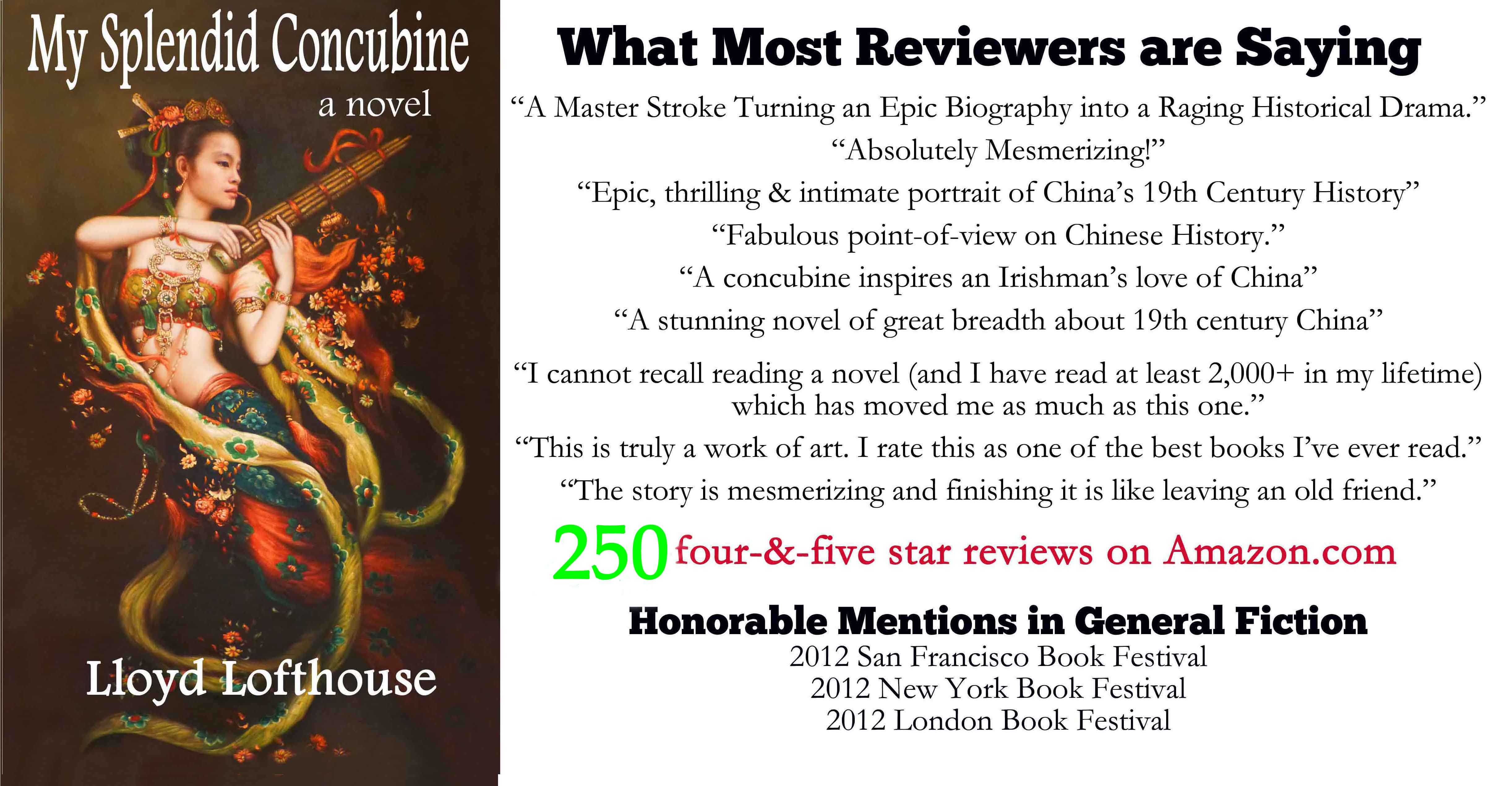
Lloyd Lofthouse is the award-winning author of My Splendid Concubine, Crazy is Normal, Running with the Enemy, and The Redemption of Don Juan Casanova.
Where to Buy

Subscribe to my newsletter to hear about new releases and get a free copy of my award-winning, historical fiction short story “A Night at the Well of Purity”.

About iLook China


How far are you willing to go to enhance your beauty?

May 2, 2018

In ancient China, the process of foot binding usually started between the ages of four and seven.  Feet were soaked in a blood and herb mixture. Toes were broken. Then the arch was broken. There was extreme pain since no drugs were used. It is estimated that in about a thousand year period about two billion Chinese women went through the process.

But China wasn’t always like this. According to historical accounts, foot binding appeared in China during the Song Dynasty (960 – 1276 AD). That means Chinese women before the Song Dynasty did not have their feet broken to keep them small. In fact, during the Tang Dynasty (618 – 907 AD), women gained more freedom that wouldn’t return until after the Civil War that the Chinese Communist Party won in 1949.

The Manchu leaders of the Qing Dynasty (1644 to 1911) attempted to stop foot binding, and Manchu women did not bind their feet, but many Han women continued the practice. More than 90-percent of China’s population is Han.

In 1928, the Nationalist government also attempted to end foot binding but with mixed success. In rural areas, large feet were still considered unattractive and unacceptable and the practice continued. Smithsonian Magazine says, “Despite the pain, millions of Chinese women stood firm in their devotion to the tradition.”

The Virtual Museum of the City of San Francisco reports, “Even in 19th century San Francisco, there were Chinese girls and women with bound feet.”

For millions of Chinese women, the practice of foot binding continued until 1949 when the Chinese Communist Party came into power and enacted laws that made women equal to men for the first time in China’s history.

And if you think the practice of foot binding in China was horrible, the BBC reports, “There are still plenty of fashion victims in the 21st Century. ‘Although we haven’t got corsets or crinolines anymore, there are now people having their ribs removed to get a smaller waist.’”

中

Lloyd Lofthouse is the award-winning author of My Splendid Concubine, Crazy is Normal, Running with the Enemy, and The Redemption of Don Juan Casanova.

Where to Buy

Subscribe to my newsletter to hear about new releases and get a free copy of my award-winning, historical fiction short story “A Night at the Well of Purity”.

About iLook China


The ‘Golden Age’ of the Song Dynasty: part 4 of 4

April 27, 2018

In 1973, under the sands of a beach in the city of Quanzhou City in Fujian Province, a well-preserved boat built during the Song Dynasty was discovered.

It was the oldest, fully intact wooden boat unearthed in the world with a load capacity of 200 tons. It was not the largest boat constructed during that time. The largest had a load capacity of more than 1,000 tons.

Experts say the construction of these ships with hermetic compartments made safe navigation possible and these methods that were developed a millennia ago in China are still used today in modern ship construction.

During the Song Dynasty, the trading port of Quanzhou was considered one of the two largest in the world. Egypt’s Alexandria was the second one. As an important seaport for trade at one end of the Maritime Silk Road, Quanzhou had close ties with Korea and Japan in the east and as far as northeast Africa in the west.

There were two major kinds of trade goods, silk, and porcelain. Some scholars say porcelain should be considered the fifth great Chinese invention.

Return to Part 3, or start with Part 1

中

Lloyd Lofthouse is the award-winning author of My Splendid Concubine, Crazy is Normal, Running with the Enemy, and The Redemption of Don Juan Casanova.

Where to Buy

Subscribe to my newsletter to hear about new releases and get a free copy of my award-winning, historical fiction short story “A Night at the Well of Purity”.

About iLook China


The ‘Golden Age’ of the Song Dynasty: part 2 of 4

April 25, 2018

The Song Dynasty was responsible for innovations and prosperity that doubled the population from 50-million at the end of the Tang Dynasty to 100-million.

Here are a few examples of what happened. A new type of canal lock was invented in 1373 AD, four hundred years before someone in Europe invented a similar lock. This enabled China to finish building the Grand Canal, the longest canal in the world that is still in use.

The focus on astronomical observations helped improve agriculture and the Song Dynasty’s grain yield was ten to twenty times that of Europe at the time. In addition, methods to fertilize land that was not suitable for growing crops was also developed leading to two or three annual harvests that helped support the large population. For a comparison, the 3rd edition of Introduction to Medieval Europe reports, “Bold estimates for the whole of continental Europe (including Russia and the Balkans) place the number of inhabitants in the year 1000 at 30 and 40 million.”

Although China’s four greatest inventions came long before the Song Dynasty, it wasn’t until then that papermaking, the large-scale application of printing, the compass, and gunpowder made their mark about four hundred years before the German inventor Johannes Gutenberg invented his printing press in 1440 AD.

It was also during this dynasty that the compass was improved for navigation making it less likely for ships to get lost at sea and allowed ships to travel farther from China.

To preserve these innovations, Shen Kuo published his Dream Pool Essays in 1088 AD (still in print today), a huge encyclopedic book that covered a wide range of subjects, including literature, art, military strategy, mathematics, astronomy, meteorology, geology, geography, metallurgy, engineering, hydraulics, architecture, zoology, botany, agronomy, medicine, anthropology, archeology, etc.

Continued in Part 3 on April 26, 2018, or return to Part 1

中

Lloyd Lofthouse is the award-winning author of My Splendid Concubine, Crazy is Normal, Running with the Enemy, and The Redemption of Don Juan Casanova.

Where to Buy

Subscribe to my newsletter to hear about new releases and get a free copy of my award-winning, historical fiction short story “A Night at the Well of Purity”.

About iLook China


The ‘Golden Age’ of the Song Dynasty: part 1 of 4

April 24, 2018

Fifty-three years after the Tang Dynasty collapsed (618 – 907AD), the Song Dynasty (960-1279 AD) was born and established its first capital in Kaifeng City, Henan Province.

The Song Dynasty survived for 319 years — thirty years longer than the Tang Dynasty.

Reference.com says, “While the Tang and Song dynasties shared much in common, there were a couple of major differences in the way they ruled over the populous territory of China. During both periods China experiences political, cultural and social blossoming. Some common traits include the development of trade, the flourishing of painting and poetry and the improvement of bureaucracy. Even though both Tang and Song were Chinese dynasties, they did not rule over the same territory. The Song power was centered on the southeastern part of the country, whereas the Tang power extended over much of modern China, as well as Manchuria, Tibet, and Mongolia.”

In addition, during the Song Dynasty, astronomy was one of the areas where advances were made. In July 1054, an unknown nova appeared in the sky. The sudden appearance of this nova alarmed the bureau of astronomy. A year later, the star vanished. The nova was important because Chinese astronomers discovered the Crab Nebula near Taurus and careful records were kept that still benefits science today.

In fact, the world’s largest and earliest star chart was carved on a stele in Suzhou, Jiangsu.

Continued with Part 2 on April 25, 2018

中

Lloyd Lofthouse is the award-winning author of My Splendid Concubine, Crazy is Normal, Running with the Enemy, and The Redemption of Don Juan Casanova.

Where to Buy

Subscribe to my newsletter to hear about new releases and get a free copy of my award-winning, historical fiction short story “A Night at the Well of Purity”.

About iLook China