Belching about China

June 20, 2010

I sometimes read opinions about China from individuals who should stay quiet.  Leo Hindery wrote one for The Huffington Post, which  is an example of an American castigating China from a Western cultural point-of-view.

These biased voices bother me and probably bother many Chinese too. Of course, Hindery has a right to voice his opinions, but most Chinese don’t understand that the American government has no control (at least we like to think so) of what appears in the American media.
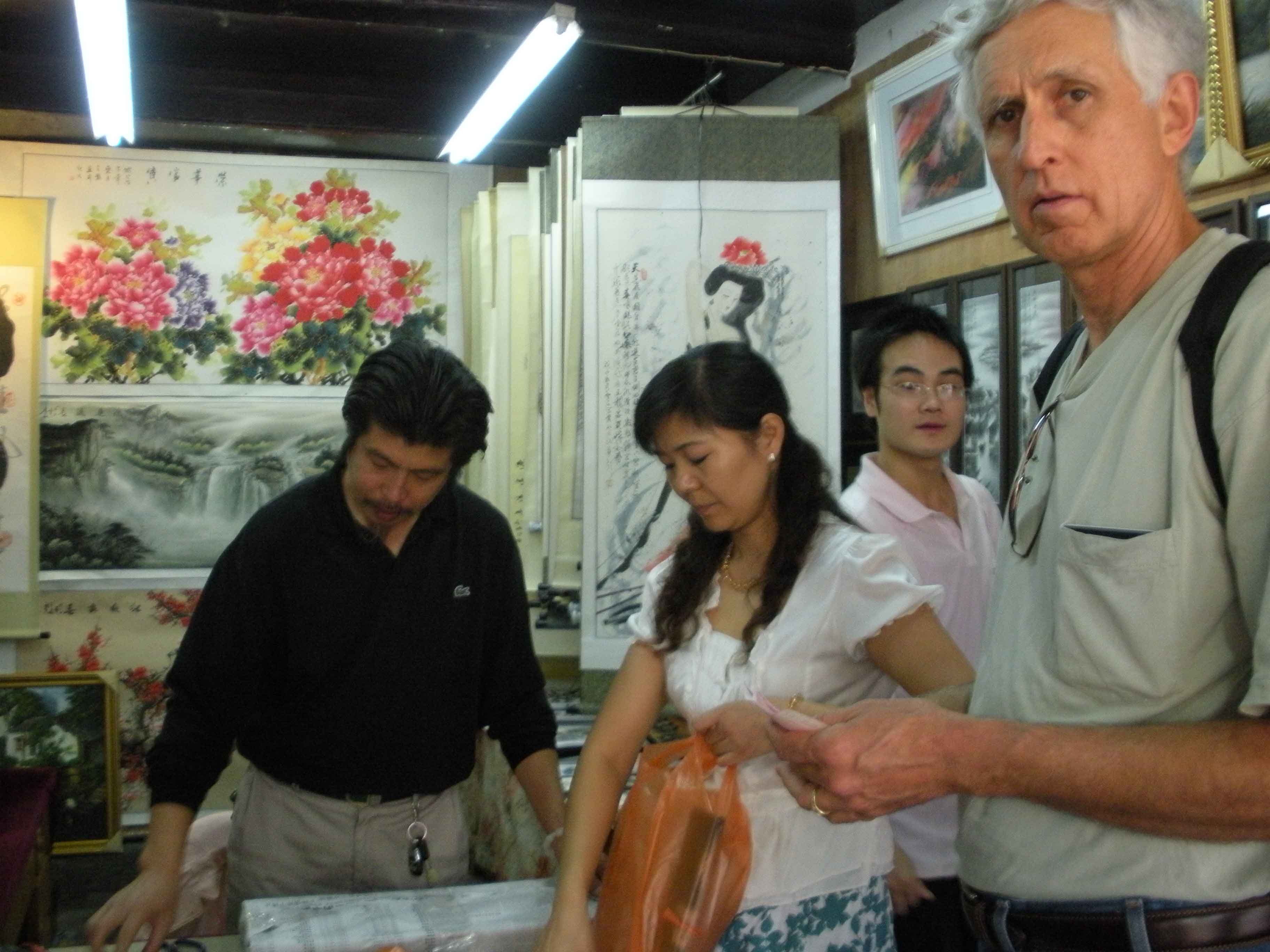
Xu Xiao-dong, in Zhouzhuang, China, an artist in his shop earning a living without help from the American labor movement.

Since the media in China is the official voice of the government, many in China see the Western media the same way. Hindery says he is eager to see the “American labor movement smartly and creatively provide all the help to China’s workers that it can responsibly offer” to help Chinese workers earn more money along with better benefits. Considering what the American labor movement did for the US auto industry, that is a bad idea.

Due to Western meddling in China  during the 19th century, there were two Opium Wars  forcing British, French and American opium into the country along with Christian missionaries, which led to the Taiping Rebellion started by a Christian convert ending in 20 to 100 million killed. Then there was the Boxer Rebellion, a peasant uprising caused by meddling Christian missionaries, greedy Western businessmen and pompous politicians.

In fact, due to the West forcing China to open its doors, more than two-thousand years of Imperial rule ended leading to four decades of chaos and anarchy between 1913 and 1950 where millions more were killed.

My opinion is to let the Chinese fix China and leave the American labor movement out of it.

See China’s Labor Laws

______________

Lloyd Lofthouse is the award-winning author of the concubine saga, My Splendid Concubine & Our Hart. When you love a Chinese woman, you marry her family and culture too. 

If you want to subscribe to iLook China, there is a “Subscribe” button at the top of the screen in the menu bar.


See, Hear, Touch No Truth—Just Lies, Please

June 18, 2010

The “Wall Street Journal” published China: Not Intentionally Pursing Trade Surplus With US, and I agree. The American thirst for high wages with benefits and cheap products created this mess.  After all, when you balance global exports and imports for China, they are close to even. China has a small trade surplus with the world—nothing compared with the “HUGE” trade surplus with the US, where far too many people use plastic to live beyond their means. 

However, most Americans don’t know that. Politicians who tell American voters the truth lose elections and the media seldom shows the whole picture—only the American slice. It seems that most Americans are not interested in the truth.

Qin Gang, a Chinese foreign ministry spokesperson, mentioned the problem was with low US savings rates and high levels of borrowing and unemployment.  He should have mentioned Wall Street risk taking too, which caused the current world economic crises and most of the job losses. Even China lost about 20 million jobs thanks to greed in the US.

People who accuse China of taking jobs from US workers don’t take into account that there are about 12 million illegal aliens in the US working low pay jobs most Americans refuse to do. Even Mexico and Canada, because of NATFA, have taken more jobs than China has.

Gang said, “We hope politician in the U.S. will think seriously about how to resolve the structural problems in their own economy, rather than invariably blaming others.”

Right again. Americans and US politicians spend too much time finding scapegoats while disagreeing on how to fix the problems in America. The US Federal deficit is in the trillions, and the average credit card debt per household is $15,519.  Source: CreditCard.com

The personal savings rate in the US as a percent of personal income is about 3%, while in China that rate is more than 30% and the Chinese government saves too—its cultural.  What’s more embarrassing for grumbling Americans is the fact that the Chinese work longer hours for much lower pay and still manage to save.

See Chinese Work Ethic

________________________

Lloyd Lofthouse is the author of the award winning My Splendid Concubine and writes The Soulful Veteran and Crazy Normal.

Sign up for an RSS Feed for iLook China


Working Conditions in China

June 17, 2010

The Editors in Room for Debate express varied opinions about “What Do China’s Workers Want?”

Worker strikes at Honda plants and suicides at a PRC Foxconn facility, a Taiwan owned company, have made splashes in the global media lately. I read what the five editors had to say and sided with Leslie T. Chang, author of Factory Girls. Her experience speaks for itself and lends weight to her opinion. Chang spent three years following the successes, hardships and heartbreaks of two teenage girls, Min and Chunming, migrants working the assembly lines in Dongguan, one of the new factory cities that have sprung up all over China.

Chang says, “It is important not to interpret the recent spate of worker suicides as protests against factory conditions. In my experience, the greatest pressure on workers comes from interpersonal and emotional concerns rather than conditions inside the factory, which workers tend to take for granted.” 

I recommend clicking on the link for “Room for Debate” and reading what Chang and the others editors say. I agree with Chang’s assessment because of the importance of family in a culture heavily influenced by Confucianism.

See Middle Kingdom Wages Rising

________________________

Lloyd Lofthouse is the author of the award winning My Splendid Concubine and writes The Soulful Veteran and Crazy Normal.

Sign up for an RSS Feed for iLook China


Hollywood Takes the “Karate Kid” to China

June 17, 2010

I walked to the local movie theater (June, 2010) to see the new The Karate Kid staring Jaden Smith, which was filmed in China—mostly in Beijing.  It was also the biggest modern movie co-produced between an American Studio and China. The themes from the old movie were there, but I enjoyed this movie more because it delivered something the old movie didn’t—a glimpse at Chinese culture.

The Jackie Chan character lives in a Hutong.  If you want to learn more, I suggest The Last Days of Old Beijing by Michael Meyer. The Great Wall is about an hour from Beijing. I’ve been there too, but I’ve never seen it without people.

The trip to the top of Wudang Mountain, well known for its deep-rooted tradition of wushu (martial arts), took me to a place I’ve never been. Watching Jackie Chang and Jaden Smith climb that long, narrow stairway reminded me of mountains I’ve climbed that took my breath away in gasps with heart pounding.

China may not have elections where eligible citizens , stupid and smart, gets to vote as in America, but James Lassiter, a “Karate Kid” producer, says that in China The people run the country, so if people didn’t want you shooting in their neighborhood, there’s no authority that can tell them they have to. That’s why it’s called the People’s Republic of China.” Source for quote:  KansasCity.com

Balzac and the Little Chinese Seamstress offers another look at China.

_______________

Lloyd Lofthouse is the award-winning author of My Splendid Concubine [3rd edition]. When you love a Chinese woman, you marry her family and culture too. This is the love story Sir Robert Hart did not want the world to discover.

His latest novel is the multiple-award winning Running with the Enemy.

Subscribe to “iLook China”!
Sign up for an E-mail Subscription at the top of this page, or click on the “Following” tab in the WordPress toolbar at the top of the screen.

About iLook China

China’s Holistic Historical Timeline


No Talking About White Elephants

June 12, 2010

Most Chinese do not like anarchy and chaos. They also do not like talking about the “white elephant” in the room. After suffering for more than a century starting with the Opium Wars in 1839, life in China improved after Deng Xiaoping opened a global market economy in China.

Deng Xiaoping Billboard in China

With that in mind, it should not surprise that when Google was complaining about being hacked by China’s government and refusing to censor their search engine in China, many Chinese turned to Baidu, which operates China’s most popular Internet search engine.

Chinese officials defended the government’s censorship and denied being involved in the cyber-attacks against Google. In fact, most Chinese don’t care what happened to Google.

On February 10, 2010, Simple Thoughts reported that Baidu’s 4th quarter earnings jumped 48%.  Then on June 4, Investor’s Daily Edge reported that Baidu’s stock price was up over 200% in the last year.

It would seem that Google became the “white elephant” in the room—a big mistake in China.

_____________________

Lloyd Lofthouse is the author of the award winning novels My Splendid Concubine and Our Hart. He also Blogs at The Soulful Veteran and Crazy Normal.

Sign up for an RSS Feed for iLook China