China Following Tradition — Part 3/4

November 6, 2010

In Part 2, I explained why China was not a monarchy or a dictatorship. In this post and the last one in this series, I will show why China is becoming a republic as Dr. Sun Yat-sen wanted by combining Western thought with Chinese tradition.

After Mao died, The Communist Party worked for several years to draft the 1982 Constitution, which included term limits of two five-year terms.

If you have read the Chinese Constitution carefully, it is obvious that America’s Constitution was used as a model.

However, these two documents are not the same as many Western critics and Chinese activists claim regarding freedom of the press, speech and religion.

If the Party leadership is not happy with China’s president, he can be removed after one five-year term. There is even an article of impeachment in the Constitution.

China’s first president was Li Xiannian (1983 to 1988). He served one, five-year term. Then he stepped down.

From 1988 to 1993, Yang Shangkun would be China’s president for one five-year term. Deng Xiaoping (born 1904 – died 1997) was the Chairman of the Communist Party from 1983 to 1993, which was ten years—what China’s 1982 Constitution calls for.

Due to how the Tiananmen Square incident in 1989 was handled, Yang had to step down at the end of his first, five-year term. The only other way to remove him would have been through impeachment.

In 1993, Jiang Zemin became President and Chairman of the Communist Party.

Then in 2003, Hu Jintao became President and Chairman of the Party. His term ends in 2012.

China has now had four presidents serve out their terms according to China’s 1982 Constitution.

Return to China Following Tradition — Part 2

______________

Lloyd Lofthouse is the award-winning author of the concubine saga, My Splendid Concubine & Our Hart. When you love a Chinese woman, you marry her family and culture too. 

If you want to subscribe to iLook China, there is a “Subscribe” button at the top of the screen in the menu bar.


China Following Tradition — Part 2/4

November 6, 2010

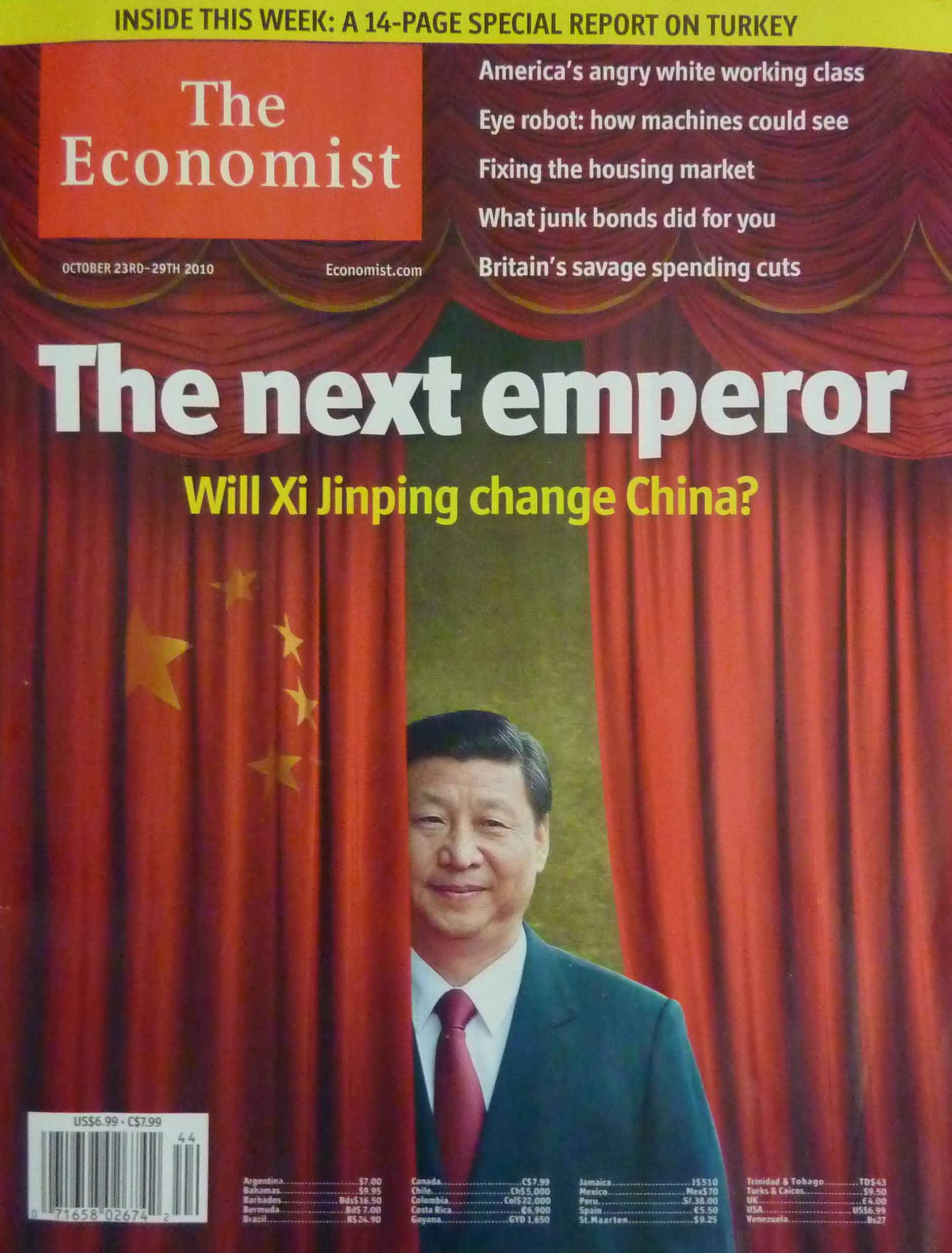
The Economist implied in the feature for the October 23 issue of the magazine, that China is a monarchy.

However, China is not a monarchy as the Kim Dynasty in North Korea has become or a dictatorship as many in the West believe.

In North Korea, what started as a Socialist Dictatorship modeled on Maoism has become a Socialist Maoist Monarchy.

China, on the other hand, started as a Socialist Dictatorship under Mao (1949 to 1976) and is becoming a fledgling republic with Western critics looking for cockroaches and slugs under rocks.

In fact, Dr. Sun Yat-sen, the father of China’s Republic, wrote that he wanted to model China’s government after America but by combining Western thought with Chinese tradition.

He did not say he wanted China to be a clone of America’s Republic.

America was still a Republic prior to World War II. The US wouldn’t become a full-fledged democracy until the 1960s.

Unfortunately, Dr. Sun died in 1925 before he could finish what he started.

It wouldn’t be until after Mao died in 1976, that the leaders of the Communist Party under Deng Xiaoping would start the long journey to implement Sun’s dream of a Republic against great pressure from Western democracies to copy them.

In Part three, I will talk about what happened after Mao died and explain what “Chinese tradition” means.

Return to China Following Tradition — Part 1

______________

Lloyd Lofthouse is the award-winning author of the concubine saga, My Splendid Concubine & Our Hart. When you love a Chinese woman, you marry her family and culture too.

If you want to subscribe to iLook China, there is a “Subscribe” button at the top of the screen in the menu bar.


China Following Tradition — Part 1/4

November 5, 2010

Three times George Washington acted in a way that would insure the newly born US Republic would survive.

His first act was in 1782, when Colonel Lewis Nicola wrote a letter to Washington suggesting that Washington should set up a constitutional monarchy because of the inefficiency of the Continental Congress.

Washington was offended at such a suggestion and wrote to Nicola telling him to banish such thoughts from his mind. Source: George Washington – Legends and Myths

His second act took place in 1783, when he stepped in and saved the republic by ending the Newburgh Conspiracy, a plot in the military to seize power and create a military dictatorship. Source: Early America

The third act was when Washington stepped down as President (1789 – 1797) and returned to his farm.

When King George III asked his American painter, Benjamin West, what Washington would do after wining independence, West replied, “They say he will return to his farm.”

“If he does that,” King George said, “he will be the greatest man in the world.” source: Cato Institute

A few days ago while at Costco, I paid for a copy of The Economist for October 23, 2010.  The cover ( in the tradition of Yellow Journalism ) promised great topics to write about.

The headline on the cover read, “The next emperor – Will Xi Jinping change China?”

As I read the feature article on page 13, I laughed when I saw, “Mr. Xi’s appointment was eerily similar to the recent anointment of Kim Jong-un in North Korea.”

The reason I saw humor in this absurd statement was that there is nothing similar. Kim Jong Un inherited his for-life position as Supreme Leader of North Korea. He is the son of Kim Jong-il, and the grandson of Kim Il-sung, the founder of North Korea.

In Part Two, I will explain the difference between China’s Republic, a dictatorship and a monarchy.

______________

Lloyd Lofthouse is the award-winning author of the concubine saga, My Splendid Concubine & Our Hart. When you love a Chinese woman, you marry her family and culture too.

If you want to subscribe to iLook China, there is a “Subscribe” button at the top of the screen in the menu bar.


The Emperor is Dead

November 5, 2010

In a Republic, everyone “does not” have the right to vote and that’s the way it was in the United States until 1965 when President Lyndon B. Johnson signed into law the Voting Rights Act and created a democracy.

In 1776, when the US was a Republic, only white men with property had the right to vote, and the electorate consisted of perhaps only 10 to 20 percent of the population.

In fact, “”This made the country (America) far more stable than places that did not have this tradition and later went through dozens of constitutions and revolutions. In short, when it came to government and voting, Americans had a model to build on.” Source: History – Voting in Early America

Since America took almost two centuries to become the chaotic democracy it is today where almost everyone may vote but many don’t, why should China be rushed.

In China, members of the Communist Party make up the electorate, which is about 5% of the population. If the Communist Youth League were added, it would be closer to 10 percent. Regardless of how this electorate makes decisions, they do have a voice.

However, the consensus (rather than a majority vote) of that electorate still decides the direction China is moving.

China’s Central Committee has about 300 members (connected by a hot line) and nominally appoints the current 25 Politburo members, who select the Standing Committee of 5 to 9 men who select the President and Prime Minister.

Before 1911, only one man had a vote and that was the emperor. China has no emperor today. Today, China’s leaders may only serve two, five-year terms and there are also age limits, which the US doesn’t have. In fact, China’s next leader will not be the son of an emperor.

At its birth, the United States was not a democratic nation—far from it. The very word “democracy” had pejorative overtones, summoning up images of disorder, government by the unfit, even mob rule — considering the run up to the 2010 election, which sounds about right.

The explanation for the pressure from the “so-called” free world that China throw away the more stable Republic that has led to a steady, controlled modernization, improved health care and lifestyles and stumble quickly into a chaotic democracy is that misery loves company.

In 1950, the average life expectancy in China was 32.  Today life expectancy at birth is 73 (78 in the US). The infant mortality rate in 1950 was about 200 for 1,000 live births. Today that number is 20 (6 in the US).

If you want to see what happens to a country that became a Democracy before it was ready, study India carefully.

In India, the infant mortality rate is 51 for 1,000 live births. Life expectancy at birth is 66.

So far, since 1982 (which marks the end of Mao’s era and the birth of China’s new Constitution), China has avoided many of India’s mistakes, and India has been a democracy since 1947.

The learn more about India, see Comparing India and China’s Economic Engines, India Falling Short and The India, China battle to eliminate poverty and illiteracy.

______________

Lloyd Lofthouse is the award-winning author of the concubine saga, My Splendid Concubine & Our Hart. When you love a Chinese woman, you marry her family and culture too. 

If you want to subscribe to iLook China, there is a “Subscribe” button at the top of the screen in the menu bar.


The Have or Have Nots at the G-20 in South Korea

October 28, 2010

The world appears to be divided between nations that have spent too much and those that save.

In China, people that hold onto money are called “Iron Roosters”. In the US, we call people who save stingy or skin flints or other insulting terms. The average saving rate among Chinese is about 40%, while the average family in the US carries several thousand dollars in credit card debt.

According to the Wall Street Journal, the US is among the ‘Have Nots’. In G-20 Deal to Curb China is Weakened, Evan Ramstad and Bob Davis said that “China, Japan and Germany all have surpluses; the U.S. has a deficit.”

However, the US is not alone. “Australia, Canada, Britain and France, all of which have current-account deficits, lined up with the US” to pressure China to let the value of the yuan rise.

The US and other Western nations that have overspent need to export more products to other countries and import less.  For this to happen, the US dollar must be worth less than the Chinese yuan to pressure U.S. consumers to stop buying products made in China when prices for those products become higher than what is manufactured in America.

This means that countries with money in the bank want to rely less on exports for growth and more on homegrown demand instead of buying more products from the debt-ridden nations.

Germany’s current account surplus is about 6%, Japan’s 3% and China is at 4.7%. The U.S. is running a 3.2% deficit, which should be no surprise.

It appears that China won this round and will not loosen controls on the value of the yuan yet.  The US went into the G-20 summit in South Korea wanting to punish China for US consumer appetites to buy cheap foreign made goods.

Instead, little was accomplished.

It’s all about the national interest of each nation, and China and America have opposing interests.

If America wins, China loses.

In fact, whoever, wins this global currency war will be the stronger for it. The question is, Will the Iron Rooster win or the Buy Now Pay Later nation?

See Democracy’s Economic Roller Coaster

______________

Lloyd Lofthouse is the award-winning author of the concubine saga, My Splendid Concubine & Our Hart. When you love a Chinese woman, you marry her family and culture too. 

If you want to subscribe to iLook China, there is a “Subscribe” button at the top of the screen in the menu bar.